| Record Information |
|---|
| Version | 5.0 |
|---|
| Status | Detected and Quantified |
|---|
| Creation Date | 2005-11-16 15:48:42 UTC |
|---|
| Update Date | 2023-05-30 20:55:58 UTC |
|---|
| HMDB ID | HMDB0000267 |
|---|
| Secondary Accession Numbers | - HMDB0000805
- HMDB00267
- HMDB0060262
- HMDB00805
- HMDB60262
|
|---|
| Metabolite Identification |
|---|
| Common Name | Pyroglutamic acid |
|---|
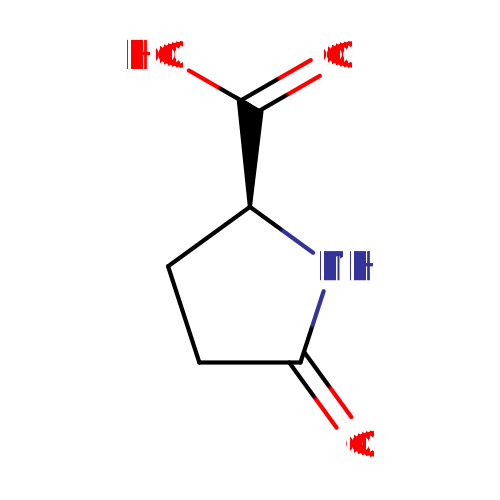
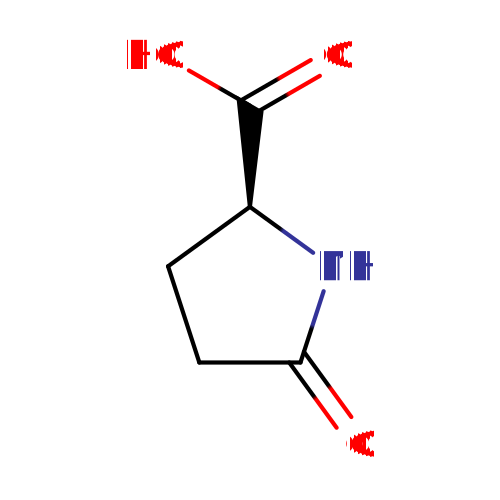
| Description | Pyroglutamic acid (5-oxoproline) is a cyclized derivative of L-glutamic acid. It is an uncommon amino acid derivative in which the free amino group of glutamic acid cyclizes to form a lactam. It is formed nonenzymatically from glutamate, glutamine, and gamma-glutamylated peptides, but it can also be produced by the action of gamma-glutamylcyclotransferase on an L-amino acid. Elevated blood levels may be associated with problems of glutamine or glutathione metabolism. This compound is found in substantial amounts in brain tissue and other tissues in bound form, especially skin. It is also present in plant tissues. It is sold, over the counter, as a "smart drug" for improving blood circulation in the brain. Pyroglutamate in the urine is a biomarker for the consumption of cheese. When present in sufficiently high levels, pyroglutamic acid can act as an acidogen and a metabotoxin. An acidogen is an acidic compound that induces acidosis, which has multiple adverse effects on many organ systems. A metabotoxin is an endogenously produced metabolite that causes adverse health effects at chronically high levels. Chronically high levels of pyroglutamic acid are associated with at least five inborn errors of metabolism including 5-oxoprolinuria, 5-oxoprolinase deficiency, glutathione synthetase deficiency, hawkinsinuria, and propionic acidemia. Pyroglutamic acid is an organic acid. Abnormally high levels of organic acids in the blood (organic acidemia), urine (organic aciduria), the brain, and other tissues lead to general metabolic acidosis. Acidosis typically occurs when arterial pH falls below 7.35. In infants with acidosis, the initial symptoms include poor feeding, vomiting, loss of appetite, weak muscle tone (hypotonia), and lack of energy (lethargy). These can progress to heart, liver, and kidney abnormalities, seizures, coma, and possibly death. These are also the characteristic symptoms of the untreated IEMs mentioned above. Many affected children with organic acidemias experience intellectual disability or delayed development. In adults, acidosis or acidemia is characterized by headaches, confusion, feeling tired, tremors, sleepiness, and seizures. It has been shown that pyroglutamic acid releases GABA from the cerebral cortex and displays anti-anxiety effects in a simple approach-avoidance conflict situation in the rat. In clinical pharmacology experiments, pyroglutamic acid significantly shortens the plasma half-life of ethanol during acute intoxication. |
|---|
| Structure | InChI=1S/C5H7NO3/c7-4-2-1-3(6-4)5(8)9/h3H,1-2H2,(H,6,7)(H,8,9)/t3-/m0/s1 |
|---|
| Synonyms | | Value | Source |
|---|
| (-)-2-Pyrrolidone-5-carboxylic acid | ChEBI | | (S)-(-)-2-Pyrrolidone-5-carboxylic acid | ChEBI | | (S)-Pyroglutamic acid | ChEBI | | 5-Pyrrolidone-2-carboxylic acid | ChEBI | | L-5-Pyrrolidone-2-carboxylic acid | ChEBI | | L-Pyroglutamic acid | ChEBI | | Pidolic acid | ChEBI | | Pyroglutamate | ChEBI | | 5-oxo-L-Proline | Kegg | | (-)-2-Pyrrolidone-5-carboxylate | Generator | | (S)-(-)-2-Pyrrolidone-5-carboxylate | Generator | | (S)-Pyroglutamate | Generator | | 5-Pyrrolidone-2-carboxylate | Generator | | L-5-Pyrrolidone-2-carboxylate | Generator | | L-Pyroglutamate | Generator | | Pidolate | Generator | | (-)-Pyroglutamate | HMDB | | (-)-Pyroglutamic acid | HMDB | | (5S)-2-Oxopyrrolidine-5-carboxylate | HMDB | | (5S)-2-Oxopyrrolidine-5-carboxylic acid | HMDB | | (S)-(-)-g-Butyrolactam-g-carboxylate | HMDB | | (S)-(-)-g-Butyrolactam-g-carboxylic acid | HMDB | | (S)-(-)-gamma-Butyrolactam-gamma-carboxylate | HMDB | | (S)-(-)-gamma-Butyrolactam-gamma-carboxylic acid | HMDB | | (S)-2-Pyrrolidone-5-carboxylate | HMDB | | (S)-2-Pyrrolidone-5-carboxylic acid | HMDB | | (S)-5-oxo-2-Pyrrolidinecarboxylate | HMDB | | (S)-5-oxo-2-Pyrrolidinecarboxylic acid | HMDB | | 2-L-Pyrrolidone-5-carboxylate | HMDB | | 2-L-Pyrrolidone-5-carboxylic acid | HMDB | | 2-Oxopyrrolidine-5(S)-carboxylate | HMDB | | 2-Oxopyrrolidine-5(S)-carboxylic acid | HMDB | | 2-Pyrrolidinone-5-carboxylate | HMDB | | 2-Pyrrolidinone-5-carboxylic acid | HMDB | | 5-Carboxy-2-pyrrolidinone | HMDB | | 5-L-Oxoproline | HMDB | | 5-Oxoproline | HMDB | | 5-Pyrrolidinone-2-carboxylate | HMDB | | 5-Pyrrolidinone-2-carboxylic acid | HMDB | | Ajidew a 100 | HMDB | | Glutimate | HMDB | | Glutimic acid | HMDB | | Glutiminate | HMDB | | Glutiminic acid | HMDB | | L-2-Pyrrolidone-5-carboxylate | HMDB | | L-2-Pyrrolidone-5-carboxylic acid | HMDB | | L-5-Carboxy-2-pyrrolidinone | HMDB | | L-5-oxo-2-Pyrrolidinecarboxylate | HMDB | | L-5-oxo-2-Pyrrolidinecarboxylic acid | HMDB | | L-5-Oxoproline | HMDB | | L-Glutamic acid g-lactam | HMDB | | L-Glutimate | HMDB | | L-Glutimic acid | HMDB | | L-Glutiminate | HMDB | | L-Glutiminic acid | HMDB | | L-Pyrrolidinonecarboxylate | HMDB | | L-Pyrrolidinonecarboxylic acid | HMDB | | L-Pyrrolidonecarboxylate | HMDB | | L-Pyrrolidonecarboxylic acid | HMDB | | Oxoproline | HMDB | | Oxopyrrolidinecarboxylate | HMDB | | Oxopyrrolidinecarboxylic acid | HMDB | | Pidolidone | HMDB | | Pyrrolidinonecarboxylate | HMDB | | Pyrrolidinonecarboxylic acid | HMDB | | Pyrrolidone-5-carboxylate | HMDB | | Pyrrolidone-5-carboxylic acid | HMDB | | Pyrrolidonecarboxylic acid | HMDB | | 5-Ketoproline | HMDB | | Pidolate, magnesium | HMDB | | 5-Oxopyrrolidine-2-carboxylic acid | HMDB | | Magnesium pidolate | HMDB | | 2-Pyrrolidone-5-carboxylic acid | HMDB | | 5-Oxoprolinate | HMDB | | PCA | HMDB |
|
|---|
| Chemical Formula | C5H7NO3 |
|---|
| Average Molecular Weight | 129.114 |
|---|
| Monoisotopic Molecular Weight | 129.042593095 |
|---|
| IUPAC Name | (2S)-5-oxopyrrolidine-2-carboxylic acid |
|---|
| Traditional Name | pyroglutamic acid |
|---|
| CAS Registry Number | 98-79-3 |
|---|
| SMILES | OC(=O)[C@@H]1CCC(=O)N1 |
|---|
| InChI Identifier | InChI=1S/C5H7NO3/c7-4-2-1-3(6-4)5(8)9/h3H,1-2H2,(H,6,7)(H,8,9)/t3-/m0/s1 |
|---|
| InChI Key | ODHCTXKNWHHXJC-VKHMYHEASA-N |
|---|
| Chemical Taxonomy |
|---|
| Description | Belongs to the class of organic compounds known as alpha amino acids and derivatives. These are amino acids in which the amino group is attached to the carbon atom immediately adjacent to the carboxylate group (alpha carbon), or a derivative thereof. |
|---|
| Kingdom | Organic compounds |
|---|
| Super Class | Organic acids and derivatives |
|---|
| Class | Carboxylic acids and derivatives |
|---|
| Sub Class | Amino acids, peptides, and analogues |
|---|
| Direct Parent | Alpha amino acids and derivatives |
|---|
| Alternative Parents | |
|---|
| Substituents | - Alpha-amino acid or derivatives
- Pyrroline carboxylic acid
- Pyrroline carboxylic acid or derivatives
- Pyrroline
- Cyclic carboximidic acid
- Lactim
- Carboxylic acid
- Monocarboxylic acid or derivatives
- Propargyl-type 1,3-dipolar organic compound
- Organic 1,3-dipolar compound
- Azacycle
- Organoheterocyclic compound
- Organopnictogen compound
- Organic oxygen compound
- Organooxygen compound
- Organic oxide
- Hydrocarbon derivative
- Carbonyl group
- Organic nitrogen compound
- Organonitrogen compound
- Aliphatic heteromonocyclic compound
|
|---|
| Molecular Framework | Aliphatic heteromonocyclic compounds |
|---|
| External Descriptors | |
|---|
| Ontology |
|---|
| Physiological effect | |
|---|
| Disposition | |
|---|
| Process | |
|---|
| Role | |
|---|
| Physical Properties |
|---|
| State | Solid |
|---|
| Experimental Molecular Properties | | Property | Value | Reference |
|---|
| Melting Point | Not Available | Not Available | | Boiling Point | Not Available | Not Available | | Water Solubility | 476 mg/mL at 13 °C | Not Available | | LogP | Not Available | Not Available |
|
|---|
| Experimental Chromatographic Properties | Experimental Collision Cross Sections |
|---|
| Predicted Molecular Properties | |
|---|
| Predicted Chromatographic Properties | Predicted Collision Cross SectionsPredicted Retention Times Underivatized| Chromatographic Method | Retention Time | Reference |
|---|
| Measured using a Waters Acquity ultraperformance liquid chromatography (UPLC) ethylene-bridged hybrid (BEH) C18 column (100 mm × 2.1 mm; 1.7 μmparticle diameter). Predicted by Afia on May 17, 2022. Predicted by Afia on May 17, 2022. | 1.51 minutes | 32390414 | | Predicted by Siyang on May 30, 2022 | 8.9864 minutes | 33406817 | | Predicted by Siyang using ReTip algorithm on June 8, 2022 | 6.77 minutes | 32390414 | | AjsUoB = Accucore 150 Amide HILIC with 10mM Ammonium Formate, 0.1% Formic Acid | 229.5 seconds | 40023050 | | Fem_Long = Waters ACQUITY UPLC HSS T3 C18 with Water:MeOH and 0.1% Formic Acid | 913.1 seconds | 40023050 | | Fem_Lipids = Ascentis Express C18 with (60:40 water:ACN):(90:10 IPA:ACN) and 10mM NH4COOH + 0.1% Formic Acid | 315.4 seconds | 40023050 | | Life_Old = Waters ACQUITY UPLC BEH C18 with Water:(20:80 acetone:ACN) and 0.1% Formic Acid | 74.0 seconds | 40023050 | | Life_New = RP Waters ACQUITY UPLC HSS T3 C18 with Water:(30:70 MeOH:ACN) and 0.1% Formic Acid | 192.0 seconds | 40023050 | | RIKEN = Waters ACQUITY UPLC BEH C18 with Water:ACN and 0.1% Formic Acid | 59.9 seconds | 40023050 | | Eawag_XBridgeC18 = XBridge C18 3.5u 2.1x50 mm with Water:MeOH and 0.1% Formic Acid | 246.5 seconds | 40023050 | | BfG_NTS_RP1 =Agilent Zorbax Eclipse Plus C18 (2.1 mm x 150 mm, 3.5 um) with Water:ACN and 0.1% Formic Acid | 269.3 seconds | 40023050 | | HILIC_BDD_2 = Merck SeQuant ZIC-HILIC with ACN(0.1% formic acid):water(16 mM ammonium formate) | 462.4 seconds | 40023050 | | UniToyama_Atlantis = RP Waters Atlantis T3 (2.1 x 150 mm, 5 um) with ACN:Water and 0.1% Formic Acid | 588.5 seconds | 40023050 | | BDD_C18 = Hypersil Gold 1.9µm C18 with Water:ACN and 0.1% Formic Acid | 111.5 seconds | 40023050 | | UFZ_Phenomenex = Kinetex Core-Shell C18 2.6 um, 3.0 x 100 mm, Phenomenex with Water:MeOH and 0.1% Formic Acid | 801.0 seconds | 40023050 | | SNU_RIKEN_POS = Waters ACQUITY UPLC BEH C18 with Water:ACN and 0.1% Formic Acid | 202.7 seconds | 40023050 | | RPMMFDA = Waters ACQUITY UPLC BEH C18 with Water:ACN and 0.1% Formic Acid | 195.6 seconds | 40023050 | | MTBLS87 = Merck SeQuant ZIC-pHILIC column with ACN:Water and :ammonium carbonate | 623.1 seconds | 40023050 | | KI_GIAR_zic_HILIC_pH2_7 = Merck SeQuant ZIC-HILIC with ACN:Water and 0.1% FA | 271.0 seconds | 40023050 | | Meister zic-pHILIC pH9.3 = Merck SeQuant ZIC-pHILIC column with ACN:Water 5mM NH4Ac pH9.3 and 5mM ammonium acetate in water | 277.0 seconds | 40023050 |
Predicted Kovats Retention IndicesUnderivatizedDerivatized| Derivative Name / Structure | SMILES | Kovats RI Value | Column Type | Reference |
|---|
| Pyroglutamic acid,1TMS,isomer #1 | C[Si](C)(C)OC(=O)[C@@H]1CCC(=O)N1 | 1478.9 | Semi standard non polar | 33892256 | | Pyroglutamic acid,1TMS,isomer #2 | C[Si](C)(C)N1C(=O)CC[C@H]1C(=O)O | 1484.5 | Semi standard non polar | 33892256 | | Pyroglutamic acid,2TMS,isomer #1 | C[Si](C)(C)OC(=O)[C@@H]1CCC(=O)N1[Si](C)(C)C | 1494.7 | Semi standard non polar | 33892256 | | Pyroglutamic acid,2TMS,isomer #1 | C[Si](C)(C)OC(=O)[C@@H]1CCC(=O)N1[Si](C)(C)C | 1478.9 | Standard non polar | 33892256 | | Pyroglutamic acid,2TMS,isomer #1 | C[Si](C)(C)OC(=O)[C@@H]1CCC(=O)N1[Si](C)(C)C | 1803.4 | Standard polar | 33892256 | | Pyroglutamic acid,1TBDMS,isomer #1 | CC(C)(C)[Si](C)(C)OC(=O)[C@@H]1CCC(=O)N1 | 1718.7 | Semi standard non polar | 33892256 | | Pyroglutamic acid,1TBDMS,isomer #2 | CC(C)(C)[Si](C)(C)N1C(=O)CC[C@H]1C(=O)O | 1717.9 | Semi standard non polar | 33892256 | | Pyroglutamic acid,2TBDMS,isomer #1 | CC(C)(C)[Si](C)(C)OC(=O)[C@@H]1CCC(=O)N1[Si](C)(C)C(C)(C)C | 1928.0 | Semi standard non polar | 33892256 | | Pyroglutamic acid,2TBDMS,isomer #1 | CC(C)(C)[Si](C)(C)OC(=O)[C@@H]1CCC(=O)N1[Si](C)(C)C(C)(C)C | 1945.3 | Standard non polar | 33892256 | | Pyroglutamic acid,2TBDMS,isomer #1 | CC(C)(C)[Si](C)(C)OC(=O)[C@@H]1CCC(=O)N1[Si](C)(C)C(C)(C)C | 1985.5 | Standard polar | 33892256 |
|
|---|
| Disease References | | Glutathione synthetase deficiency |
|---|
- Li X, Ding Y, Liu Y, Ma Y, Song J, Wang Q, Yang Y: Five Chinese patients with 5-oxoprolinuria due to glutathione synthetase and 5-oxoprolinase deficiencies. Brain Dev. 2015 Nov;37(10):952-9. doi: 10.1016/j.braindev.2015.03.005. Epub 2015 Apr 4. [PubMed:25851806 ]
- G.Frauendienst-Egger, Friedrich K. Trefz (2017). MetaGene: Metabolic & Genetic Information Center (MIC: http://www.metagene.de). METAGENE consortium.
| | Schizophrenia |
|---|
- Yang J, Chen T, Sun L, Zhao Z, Qi X, Zhou K, Cao Y, Wang X, Qiu Y, Su M, Zhao A, Wang P, Yang P, Wu J, Feng G, He L, Jia W, Wan C: Potential metabolite markers of schizophrenia. Mol Psychiatry. 2013 Jan;18(1):67-78. doi: 10.1038/mp.2011.131. Epub 2011 Oct 25. [PubMed:22024767 ]
| | Irritable bowel syndrome |
|---|
- Ponnusamy K, Choi JN, Kim J, Lee SY, Lee CH: Microbial community and metabolomic comparison of irritable bowel syndrome faeces. J Med Microbiol. 2011 Jun;60(Pt 6):817-27. doi: 10.1099/jmm.0.028126-0. Epub 2011 Feb 17. [PubMed:21330412 ]
| | Colorectal cancer |
|---|
- Brown DG, Rao S, Weir TL, O'Malia J, Bazan M, Brown RJ, Ryan EP: Metabolomics and metabolic pathway networks from human colorectal cancers, adjacent mucosa, and stool. Cancer Metab. 2016 Jun 6;4:11. doi: 10.1186/s40170-016-0151-y. eCollection 2016. [PubMed:27275383 ]
- Sinha R, Ahn J, Sampson JN, Shi J, Yu G, Xiong X, Hayes RB, Goedert JJ: Fecal Microbiota, Fecal Metabolome, and Colorectal Cancer Interrelations. PLoS One. 2016 Mar 25;11(3):e0152126. doi: 10.1371/journal.pone.0152126. eCollection 2016. [PubMed:27015276 ]
- Goedert JJ, Sampson JN, Moore SC, Xiao Q, Xiong X, Hayes RB, Ahn J, Shi J, Sinha R: Fecal metabolomics: assay performance and association with colorectal cancer. Carcinogenesis. 2014 Sep;35(9):2089-96. doi: 10.1093/carcin/bgu131. Epub 2014 Jul 18. [PubMed:25037050 ]
| | Ulcerative colitis |
|---|
- Azario I, Pievani A, Del Priore F, Antolini L, Santi L, Corsi A, Cardinale L, Sawamoto K, Kubaski F, Gentner B, Bernardo ME, Valsecchi MG, Riminucci M, Tomatsu S, Aiuti A, Biondi A, Serafini M: Neonatal umbilical cord blood transplantation halts skeletal disease progression in the murine model of MPS-I. Sci Rep. 2017 Aug 25;7(1):9473. doi: 10.1038/s41598-017-09958-9. [PubMed:28842642 ]
| | Supragingival Calculus |
|---|
- Liebsch C, Pitchika V, Pink C, Samietz S, Kastenmuller G, Artati A, Suhre K, Adamski J, Nauck M, Volzke H, Friedrich N, Kocher T, Holtfreter B, Pietzner M: The Saliva Metabolome in Association to Oral Health Status. J Dent Res. 2019 Jun;98(6):642-651. doi: 10.1177/0022034519842853. Epub 2019 Apr 26. [PubMed:31026179 ]
| | 5-oxoprolinase deficiency |
|---|
- Calpena E, Deshpande AA, Yap S, Kumar A, Manning NJ, Bachhawat AK, Espinos C: New insights into the genetics of 5-oxoprolinase deficiency and further evidence that it is a benign biochemical condition. Eur J Pediatr. 2015 Mar;174(3):407-11. doi: 10.1007/s00431-014-2397-0. Epub 2014 Aug 17. [PubMed:25129617 ]
- Mayatepek E: 5-Oxoprolinuria in patients with and without defects in the gamma-glutamyl cycle. Eur J Pediatr. 1999 Mar;158(3):221-5. [PubMed:10094443 ]
- G.Frauendienst-Egger, Friedrich K. Trefz (2017). MetaGene: Metabolic & Genetic Information Center (MIC: http://www.metagene.de). METAGENE consortium.
| | Autosomal dominant polycystic kidney disease |
|---|
- Gronwald W, Klein MS, Zeltner R, Schulze BD, Reinhold SW, Deutschmann M, Immervoll AK, Boger CA, Banas B, Eckardt KU, Oefner PJ: Detection of autosomal dominant polycystic kidney disease by NMR spectroscopic fingerprinting of urine. Kidney Int. 2011 Jun;79(11):1244-53. doi: 10.1038/ki.2011.30. Epub 2011 Mar 9. [PubMed:21389975 ]
| | Eosinophilic esophagitis |
|---|
- Slae, M., Huynh, H., Wishart, D.S. (2014). Analysis of 30 normal pediatric urine samples via NMR spectroscopy (unpublished work). NA.
|
|
|---|
| General References | - Sreekumar A, Poisson LM, Rajendiran TM, Khan AP, Cao Q, Yu J, Laxman B, Mehra R, Lonigro RJ, Li Y, Nyati MK, Ahsan A, Kalyana-Sundaram S, Han B, Cao X, Byun J, Omenn GS, Ghosh D, Pennathur S, Alexander DC, Berger A, Shuster JR, Wei JT, Varambally S, Beecher C, Chinnaiyan AM: Metabolomic profiles delineate potential role for sarcosine in prostate cancer progression. Nature. 2009 Feb 12;457(7231):910-4. doi: 10.1038/nature07762. [PubMed:19212411 ]
- Guneral F, Bachmann C: Age-related reference values for urinary organic acids in a healthy Turkish pediatric population. Clin Chem. 1994 Jun;40(6):862-6. [PubMed:8087979 ]
- Hoffmann GF, Meier-Augenstein W, Stockler S, Surtees R, Rating D, Nyhan WL: Physiology and pathophysiology of organic acids in cerebrospinal fluid. J Inherit Metab Dis. 1993;16(4):648-69. [PubMed:8412012 ]
- Jellum E, Stokke O, Eldjarn L: Combined use of gas chromatography, mass spectrometry, and computer in diagnosis and studies of metabolic disorders. Clin Chem. 1972 Aug;18(8):800-9. [PubMed:4557757 ]
- Wevers RA, Engelke U, Heerschap A: High-resolution 1H-NMR spectroscopy of blood plasma for metabolic studies. Clin Chem. 1994 Jul;40(7 Pt 1):1245-50. [PubMed:8013094 ]
- Manning NJ, Davies NP, Olpin SE, Carpenter KH, Smith MF, Pollitt RJ, Duncan SL, Larsson A, Carlsson B: Prenatal diagnosis of glutathione synthase deficiency. Prenat Diagn. 1994 Jun;14(6):475-8. [PubMed:7937585 ]
- Caspers PJ, Lucassen GW, Carter EA, Bruining HA, Puppels GJ: In vivo confocal Raman microspectroscopy of the skin: noninvasive determination of molecular concentration profiles. J Invest Dermatol. 2001 Mar;116(3):434-42. [PubMed:11231318 ]
- Hussain Z, Lannigan R, Stoakes L: A new approach for presumptive identification of clinically important streptococci. Zentralbl Bakteriol Mikrobiol Hyg A. 1984 Oct;258(1):74-9. [PubMed:6441390 ]
- Creer MH, Lau BW, Jones JD, Chan KM: Pyroglutamic acidemia in an adult patient. Clin Chem. 1989 Apr;35(4):684-6. [PubMed:2702756 ]
- Hammond JW, Potter M, Truscott R, Wilcken B: gamma-Glutamylglutamine identified in plasma and cerebrospinal fluid from hyperammonaemic patients. Clin Chim Acta. 1990 Dec 24;194(2-3):173-83. [PubMed:2093471 ]
- Uhlhaas S, Lange H: Striatal deficiency of L-pyroglutamic acid in Huntington's disease is accompanied by increased plasma levels. Brain Res. 1988 Aug 2;457(1):196-9. [PubMed:2971422 ]
- Croal BL, Glen AC, Kelly CJ, Logan RW: Transient 5-oxoprolinuria (pyroglutamic aciduria) with systemic acidosis in an adult receiving antibiotic therapy. Clin Chem. 1998 Feb;44(2):336-40. [PubMed:9474033 ]
- Winslow JW, Shih A, Bourell JH, Weiss G, Reed B, Stults JT, Goldsmith LT: Human seminal relaxin is a product of the same gene as human luteal relaxin. Endocrinology. 1992 May;130(5):2660-8. [PubMed:1572287 ]
- Erasmus E, Mienie LJ, de Vries WN, de Wet WJ, Carlsson B, Larsson A: Prenatal analysis in two suspected cases of glutathione synthetase deficiency. J Inherit Metab Dis. 1993;16(5):837-43. [PubMed:8295398 ]
- Palekar AG, Tate SS, Sullivan JF, Meister A: Accumulation of 50oxo-L-proline and 5-oxo-D-proline in the blood plasma in end stage renal disease. Biochem Med. 1975 Nov;14(3):339-45. [PubMed:1225334 ]
- Monsigny M, Rondanino C, Duverger E, Fajac I, Roche AC: Glyco-dependent nuclear import of glycoproteins, glycoplexes and glycosylated plasmids. Biochim Biophys Acta. 2004 Jul 6;1673(1-2):94-103. [PubMed:15238252 ]
- Thiele I, Swainston N, Fleming RM, Hoppe A, Sahoo S, Aurich MK, Haraldsdottir H, Mo ML, Rolfsson O, Stobbe MD, Thorleifsson SG, Agren R, Bolling C, Bordel S, Chavali AK, Dobson P, Dunn WB, Endler L, Hala D, Hucka M, Hull D, Jameson D, Jamshidi N, Jonsson JJ, Juty N, Keating S, Nookaew I, Le Novere N, Malys N, Mazein A, Papin JA, Price ND, Selkov E Sr, Sigurdsson MI, Simeonidis E, Sonnenschein N, Smallbone K, Sorokin A, van Beek JH, Weichart D, Goryanin I, Nielsen J, Westerhoff HV, Kell DB, Mendes P, Palsson BO: A community-driven global reconstruction of human metabolism. Nat Biotechnol. 2013 May;31(5):419-25. doi: 10.1038/nbt.2488. Epub 2013 Mar 3. [PubMed:23455439 ]
- Elshenawy S, Pinney SE, Stuart T, Doulias PT, Zura G, Parry S, Elovitz MA, Bennett MJ, Bansal A, Strauss JF 3rd, Ischiropoulos H, Simmons RA: The Metabolomic Signature of the Placenta in Spontaneous Preterm Birth. Int J Mol Sci. 2020 Feb 4;21(3). pii: ijms21031043. doi: 10.3390/ijms21031043. [PubMed:32033212 ]
|
|---|