You are using an unsupported browser. Please upgrade your browser to a newer version to get the best experience on Human Metabolome Database.
| Record Information |
|---|
| Version | 5.0 |
|---|
| Status | Detected and Quantified |
|---|
| Creation Date | 2005-11-16 15:48:42 UTC |
|---|
| Update Date | 2023-05-30 20:55:50 UTC |
|---|
| HMDB ID | HMDB0000022 |
|---|
| Secondary Accession Numbers | - HMDB00022
- HMDB0006022
- HMDB06022
|
|---|
| Metabolite Identification |
|---|
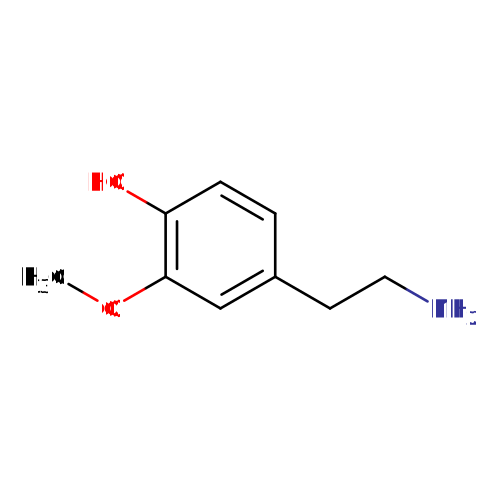
| Common Name | 3-Methoxytyramine |
|---|
| Description | 3-methoxytyramine, also known as 4-(2-amino-Ethyl)-2-methoxy-phenol or 3-O-Methyldopamine, is classified as a member of the Methoxyphenols. Methoxyphenols are compounds containing a methoxy group attached to the benzene ring of a phenol moiety. 3-methoxytyramine is considered to be slightly soluble (in water) and acidic. 3-methoxytyramine can be found primarily in human brain and most tissues tissues; and in blood, cerebrospinal fluid (csf) or urine. Within a cell, 3-methoxytyramine is primarily located in the cytoplasm |
|---|
| Structure | InChI=1S/C9H13NO2/c1-12-9-6-7(4-5-10)2-3-8(9)11/h2-3,6,11H,4-5,10H2,1H3 |
|---|
| Synonyms | | Value | Source |
|---|
| 3-Methoxy-4-hydroxyphenylethyl amine | HMDB | | 3-O-Methyldopamine | HMDB | | 4-(2-Amino-ethyl)-2-methoxy-phenol | HMDB | | 4-(2-Aminoethyl)-2-methoxy-phenol | HMDB | | 4-(2-Aminoethyl)-2-methoxyphenol | HMDB | | 5-(2-Aminoethyl)guaiacol | HMDB | | Methoxytyramine | HMDB | | 3-Methoxytyramine hydrochloride | HMDB |
|
|---|
| Chemical Formula | C9H13NO2 |
|---|
| Average Molecular Weight | 167.205 |
|---|
| Monoisotopic Molecular Weight | 167.094628665 |
|---|
| IUPAC Name | 4-(2-aminoethyl)-2-methoxyphenol |
|---|
| Traditional Name | methoxytyramine |
|---|
| CAS Registry Number | 554-52-9 |
|---|
| SMILES | COC1=C(O)C=CC(CCN)=C1 |
|---|
| InChI Identifier | InChI=1S/C9H13NO2/c1-12-9-6-7(4-5-10)2-3-8(9)11/h2-3,6,11H,4-5,10H2,1H3 |
|---|
| InChI Key | DIVQKHQLANKJQO-UHFFFAOYSA-N |
|---|
| Chemical Taxonomy |
|---|
| Description | Belongs to the class of organic compounds known as methoxyphenols. Methoxyphenols are compounds containing a methoxy group attached to the benzene ring of a phenol moiety. |
|---|
| Kingdom | Organic compounds |
|---|
| Super Class | Benzenoids |
|---|
| Class | Phenols |
|---|
| Sub Class | Methoxyphenols |
|---|
| Direct Parent | Methoxyphenols |
|---|
| Alternative Parents | |
|---|
| Substituents | - Methoxyphenol
- Phenethylamine
- Anisole
- Phenoxy compound
- Phenol ether
- Methoxybenzene
- 2-arylethylamine
- Aralkylamine
- Alkyl aryl ether
- 1-hydroxy-2-unsubstituted benzenoid
- Monocyclic benzene moiety
- Ether
- Primary amine
- Amine
- Organooxygen compound
- Organonitrogen compound
- Primary aliphatic amine
- Organic nitrogen compound
- Hydrocarbon derivative
- Organopnictogen compound
- Organic oxygen compound
- Aromatic homomonocyclic compound
|
|---|
| Molecular Framework | Aromatic homomonocyclic compounds |
|---|
| External Descriptors | |
|---|
| Ontology |
|---|
| Physiological effect | Not Available |
|---|
| Disposition | |
|---|
| Process | |
|---|
| Role | |
|---|
| Physical Properties |
|---|
| State | Solid |
|---|
| Experimental Molecular Properties | | Property | Value | Reference |
|---|
| Melting Point | Not Available | Not Available | | Boiling Point | Not Available | Not Available | | Water Solubility | Not Available | Not Available | | LogP | -0.08 | SANGSTER (1994) |
|
|---|
| Experimental Chromatographic Properties | Experimental Collision Cross Sections |
|---|
| Predicted Molecular Properties | |
|---|
| Predicted Chromatographic Properties | Predicted Collision Cross SectionsPredicted Kovats Retention IndicesUnderivatizedDerivatized| Derivative Name / Structure | SMILES | Kovats RI Value | Column Type | Reference |
|---|
| 3-Methoxytyramine,1TMS,isomer #1 | COC1=CC(CCN)=CC=C1O[Si](C)(C)C | 1618.6 | Semi standard non polar | 33892256 | | 3-Methoxytyramine,1TMS,isomer #2 | COC1=CC(CCN[Si](C)(C)C)=CC=C1O | 1721.4 | Semi standard non polar | 33892256 | | 3-Methoxytyramine,2TMS,isomer #1 | COC1=CC(CCN[Si](C)(C)C)=CC=C1O[Si](C)(C)C | 1770.7 | Semi standard non polar | 33892256 | | 3-Methoxytyramine,2TMS,isomer #1 | COC1=CC(CCN[Si](C)(C)C)=CC=C1O[Si](C)(C)C | 1846.2 | Standard non polar | 33892256 | | 3-Methoxytyramine,2TMS,isomer #1 | COC1=CC(CCN[Si](C)(C)C)=CC=C1O[Si](C)(C)C | 2000.9 | Standard polar | 33892256 | | 3-Methoxytyramine,2TMS,isomer #2 | COC1=CC(CCN([Si](C)(C)C)[Si](C)(C)C)=CC=C1O | 1938.6 | Semi standard non polar | 33892256 | | 3-Methoxytyramine,2TMS,isomer #2 | COC1=CC(CCN([Si](C)(C)C)[Si](C)(C)C)=CC=C1O | 2026.4 | Standard non polar | 33892256 | | 3-Methoxytyramine,2TMS,isomer #2 | COC1=CC(CCN([Si](C)(C)C)[Si](C)(C)C)=CC=C1O | 2278.3 | Standard polar | 33892256 | | 3-Methoxytyramine,3TMS,isomer #1 | COC1=CC(CCN([Si](C)(C)C)[Si](C)(C)C)=CC=C1O[Si](C)(C)C | 1998.6 | Semi standard non polar | 33892256 | | 3-Methoxytyramine,3TMS,isomer #1 | COC1=CC(CCN([Si](C)(C)C)[Si](C)(C)C)=CC=C1O[Si](C)(C)C | 2003.7 | Standard non polar | 33892256 | | 3-Methoxytyramine,3TMS,isomer #1 | COC1=CC(CCN([Si](C)(C)C)[Si](C)(C)C)=CC=C1O[Si](C)(C)C | 1980.9 | Standard polar | 33892256 | | 3-Methoxytyramine,1TBDMS,isomer #1 | COC1=CC(CCN)=CC=C1O[Si](C)(C)C(C)(C)C | 1883.4 | Semi standard non polar | 33892256 | | 3-Methoxytyramine,1TBDMS,isomer #2 | COC1=CC(CCN[Si](C)(C)C(C)(C)C)=CC=C1O | 1992.1 | Semi standard non polar | 33892256 | | 3-Methoxytyramine,2TBDMS,isomer #1 | COC1=CC(CCN[Si](C)(C)C(C)(C)C)=CC=C1O[Si](C)(C)C(C)(C)C | 2258.4 | Semi standard non polar | 33892256 | | 3-Methoxytyramine,2TBDMS,isomer #1 | COC1=CC(CCN[Si](C)(C)C(C)(C)C)=CC=C1O[Si](C)(C)C(C)(C)C | 2294.7 | Standard non polar | 33892256 | | 3-Methoxytyramine,2TBDMS,isomer #1 | COC1=CC(CCN[Si](C)(C)C(C)(C)C)=CC=C1O[Si](C)(C)C(C)(C)C | 2258.3 | Standard polar | 33892256 | | 3-Methoxytyramine,2TBDMS,isomer #2 | COC1=CC(CCN([Si](C)(C)C(C)(C)C)[Si](C)(C)C(C)(C)C)=CC=C1O | 2372.1 | Semi standard non polar | 33892256 | | 3-Methoxytyramine,2TBDMS,isomer #2 | COC1=CC(CCN([Si](C)(C)C(C)(C)C)[Si](C)(C)C(C)(C)C)=CC=C1O | 2431.0 | Standard non polar | 33892256 | | 3-Methoxytyramine,2TBDMS,isomer #2 | COC1=CC(CCN([Si](C)(C)C(C)(C)C)[Si](C)(C)C(C)(C)C)=CC=C1O | 2398.2 | Standard polar | 33892256 | | 3-Methoxytyramine,3TBDMS,isomer #1 | COC1=CC(CCN([Si](C)(C)C(C)(C)C)[Si](C)(C)C(C)(C)C)=CC=C1O[Si](C)(C)C(C)(C)C | 2677.9 | Semi standard non polar | 33892256 | | 3-Methoxytyramine,3TBDMS,isomer #1 | COC1=CC(CCN([Si](C)(C)C(C)(C)C)[Si](C)(C)C(C)(C)C)=CC=C1O[Si](C)(C)C(C)(C)C | 2600.1 | Standard non polar | 33892256 | | 3-Methoxytyramine,3TBDMS,isomer #1 | COC1=CC(CCN([Si](C)(C)C(C)(C)C)[Si](C)(C)C(C)(C)C)=CC=C1O[Si](C)(C)C(C)(C)C | 2327.6 | Standard polar | 33892256 |
|
|---|
| Spectra |
|---|
| GC-MS Spectra| Spectrum Type | Description | Splash Key | Deposition Date | Source | View |
|---|
| Experimental GC-MS | GC-MS Spectrum - 3-Methoxytyramine GC-MS (3 TMS) | splash10-00dr-2900000000-57b1653ec21d5aed99ae | 2014-06-16 | HMDB team, MONA, MassBank | View Spectrum | | Experimental GC-MS | GC-MS Spectrum - 3-Methoxytyramine GC-MS (Non-derivatized) | splash10-00dr-2900000000-57b1653ec21d5aed99ae | 2017-09-12 | HMDB team, MONA, MassBank | View Spectrum | | Predicted GC-MS | Predicted GC-MS Spectrum - 3-Methoxytyramine GC-MS (Non-derivatized) - 70eV, Positive | splash10-001i-6900000000-d04baf61f1b9c22278b3 | 2017-09-01 | Wishart Lab | View Spectrum | | Predicted GC-MS | Predicted GC-MS Spectrum - 3-Methoxytyramine GC-MS (1 TMS) - 70eV, Positive | splash10-00e9-9550000000-cf6955d311ff0f030176 | 2017-10-06 | Wishart Lab | View Spectrum | | Predicted GC-MS | Predicted GC-MS Spectrum - 3-Methoxytyramine GC-MS (Non-derivatized) - 70eV, Positive | Not Available | 2021-10-12 | Wishart Lab | View Spectrum | | Predicted GC-MS | Predicted GC-MS Spectrum - 3-Methoxytyramine GC-MS (TMS_1_2) - 70eV, Positive | Not Available | 2021-11-05 | Wishart Lab | View Spectrum | | Predicted GC-MS | Predicted GC-MS Spectrum - 3-Methoxytyramine GC-MS (TBDMS_1_1) - 70eV, Positive | Not Available | 2021-11-05 | Wishart Lab | View Spectrum | | Predicted GC-MS | Predicted GC-MS Spectrum - 3-Methoxytyramine GC-MS (TBDMS_1_2) - 70eV, Positive | Not Available | 2021-11-05 | Wishart Lab | View Spectrum |
MS/MS Spectra| Spectrum Type | Description | Splash Key | Deposition Date | Source | View |
|---|
| Experimental LC-MS/MS | LC-MS/MS Spectrum - 3-Methoxytyramine Quattro_QQQ 10V, Positive-QTOF (Annotated) | splash10-0udi-0900000000-4e9a34f44fa20fd4d805 | 2012-07-24 | HMDB team, MONA | View Spectrum | | Experimental LC-MS/MS | LC-MS/MS Spectrum - 3-Methoxytyramine Quattro_QQQ 25V, Positive-QTOF (Annotated) | splash10-0006-9200000000-78e8a8758da00cc24c66 | 2012-07-24 | HMDB team, MONA | View Spectrum | | Experimental LC-MS/MS | LC-MS/MS Spectrum - 3-Methoxytyramine Quattro_QQQ 40V, Positive-QTOF (Annotated) | splash10-014l-9000000000-146285917801bb44d792 | 2012-07-24 | HMDB team, MONA | View Spectrum | | Experimental LC-MS/MS | LC-MS/MS Spectrum - 3-Methoxytyramine , negative-QTOF | splash10-00di-0900000000-74c2d306bf6eb6a07be2 | 2017-09-14 | HMDB team, MONA | View Spectrum | | Experimental LC-MS/MS | LC-MS/MS Spectrum - 3-Methoxytyramine , positive-QTOF | splash10-0udi-0900000000-d1ca0694bd5e8bd36f69 | 2017-09-14 | HMDB team, MONA | View Spectrum | | Experimental LC-MS/MS | LC-MS/MS Spectrum - 3-Methoxytyramine 35V, Positive-QTOF | splash10-0udi-0900000000-eeed4de3e7f5f72519af | 2021-09-20 | HMDB team, MONA | View Spectrum | | Experimental LC-MS/MS | LC-MS/MS Spectrum - 3-Methoxytyramine 10V, Positive-QTOF | splash10-0udi-1900000000-c2bf7cc0e159aec8bc9c | 2021-09-20 | HMDB team, MONA | View Spectrum | | Experimental LC-MS/MS | LC-MS/MS Spectrum - 3-Methoxytyramine 35V, Positive-QTOF | splash10-0udi-0900000000-48bfff9436f67210714a | 2021-09-20 | HMDB team, MONA | View Spectrum | | Experimental LC-MS/MS | LC-MS/MS Spectrum - 3-Methoxytyramine 6V, Positive-QTOF | splash10-0udi-1900000000-f6ed6533d3bfc4041eda | 2021-09-20 | HMDB team, MONA | View Spectrum | | Experimental LC-MS/MS | LC-MS/MS Spectrum - 3-Methoxytyramine 20V, Positive-QTOF | splash10-0006-9700000000-e166795428a247265de9 | 2021-09-20 | HMDB team, MONA | View Spectrum | | Experimental LC-MS/MS | LC-MS/MS Spectrum - 3-Methoxytyramine 40V, Positive-QTOF | splash10-014l-9000000000-6f72ae33fa2456098759 | 2021-09-20 | HMDB team, MONA | View Spectrum | | Experimental LC-MS/MS | LC-MS/MS Spectrum - 3-Methoxytyramine 40V, Positive-QTOF | splash10-014l-9000000000-35e2f48ababcd5fd3868 | 2021-09-20 | HMDB team, MONA | View Spectrum | | Experimental LC-MS/MS | LC-MS/MS Spectrum - 3-Methoxytyramine 10V, Positive-QTOF | splash10-0udi-1900000000-fd53e2a3964d0617e0da | 2021-09-20 | HMDB team, MONA | View Spectrum | | Experimental LC-MS/MS | LC-MS/MS Spectrum - 3-Methoxytyramine 20V, Positive-QTOF | splash10-00kf-9700000000-fdcc846a0eca87296609 | 2021-09-20 | HMDB team, MONA | View Spectrum | | Predicted LC-MS/MS | Predicted LC-MS/MS Spectrum - 3-Methoxytyramine 10V, Positive-QTOF | splash10-0gb9-0900000000-cb0f2ccb662476519dde | 2017-09-01 | Wishart Lab | View Spectrum | | Predicted LC-MS/MS | Predicted LC-MS/MS Spectrum - 3-Methoxytyramine 20V, Positive-QTOF | splash10-0uxr-0900000000-ef5b01d09a8667741704 | 2017-09-01 | Wishart Lab | View Spectrum | | Predicted LC-MS/MS | Predicted LC-MS/MS Spectrum - 3-Methoxytyramine 40V, Positive-QTOF | splash10-0uy1-9600000000-4ac4df62e408ef8fd47c | 2017-09-01 | Wishart Lab | View Spectrum | | Predicted LC-MS/MS | Predicted LC-MS/MS Spectrum - 3-Methoxytyramine 10V, Negative-QTOF | splash10-014i-0900000000-2f9cbc34c2bce5dc77ad | 2017-09-01 | Wishart Lab | View Spectrum | | Predicted LC-MS/MS | Predicted LC-MS/MS Spectrum - 3-Methoxytyramine 20V, Negative-QTOF | splash10-014i-0900000000-55720e7caeb2db7b0bc1 | 2017-09-01 | Wishart Lab | View Spectrum | | Predicted LC-MS/MS | Predicted LC-MS/MS Spectrum - 3-Methoxytyramine 40V, Negative-QTOF | splash10-006x-6900000000-6902b729d46692ea6897 | 2017-09-01 | Wishart Lab | View Spectrum | | Predicted LC-MS/MS | Predicted LC-MS/MS Spectrum - 3-Methoxytyramine 10V, Positive-QTOF | splash10-0gi0-0900000000-64fba7f95df6be1d30dd | 2021-09-22 | Wishart Lab | View Spectrum | | Predicted LC-MS/MS | Predicted LC-MS/MS Spectrum - 3-Methoxytyramine 20V, Positive-QTOF | splash10-014i-0900000000-d564daf5d8113bc09867 | 2021-09-22 | Wishart Lab | View Spectrum | | Predicted LC-MS/MS | Predicted LC-MS/MS Spectrum - 3-Methoxytyramine 40V, Positive-QTOF | splash10-0690-9600000000-5ce880a874434cb99139 | 2021-09-22 | Wishart Lab | View Spectrum | | Predicted LC-MS/MS | Predicted LC-MS/MS Spectrum - 3-Methoxytyramine 10V, Negative-QTOF | splash10-014i-0900000000-104aad9eca02be4778f8 | 2021-09-22 | Wishart Lab | View Spectrum | | Predicted LC-MS/MS | Predicted LC-MS/MS Spectrum - 3-Methoxytyramine 20V, Negative-QTOF | splash10-02t9-0900000000-5fb5b2b3ed01da825735 | 2021-09-22 | Wishart Lab | View Spectrum |
NMR Spectra| Spectrum Type | Description | Deposition Date | Source | View |
|---|
| Experimental 1D NMR | 1H NMR Spectrum (1D, 500 MHz, H2O, experimental) | 2012-12-04 | Wishart Lab | View Spectrum | | Predicted 1D NMR | 13C NMR Spectrum (1D, 100 MHz, D2O, predicted) | 2021-09-16 | Wishart Lab | View Spectrum | | Predicted 1D NMR | 1H NMR Spectrum (1D, 100 MHz, D2O, predicted) | 2021-09-16 | Wishart Lab | View Spectrum | | Predicted 1D NMR | 13C NMR Spectrum (1D, 200 MHz, D2O, predicted) | 2021-09-16 | Wishart Lab | View Spectrum | | Predicted 1D NMR | 1H NMR Spectrum (1D, 200 MHz, D2O, predicted) | 2021-09-16 | Wishart Lab | View Spectrum | | Predicted 1D NMR | 13C NMR Spectrum (1D, 300 MHz, D2O, predicted) | 2021-09-16 | Wishart Lab | View Spectrum | | Predicted 1D NMR | 1H NMR Spectrum (1D, 300 MHz, D2O, predicted) | 2021-09-16 | Wishart Lab | View Spectrum | | Predicted 1D NMR | 13C NMR Spectrum (1D, 400 MHz, D2O, predicted) | 2021-09-16 | Wishart Lab | View Spectrum | | Predicted 1D NMR | 1H NMR Spectrum (1D, 400 MHz, D2O, predicted) | 2021-09-16 | Wishart Lab | View Spectrum | | Predicted 1D NMR | 13C NMR Spectrum (1D, 500 MHz, D2O, predicted) | 2021-09-16 | Wishart Lab | View Spectrum | | Predicted 1D NMR | 1H NMR Spectrum (1D, 500 MHz, D2O, predicted) | 2021-09-16 | Wishart Lab | View Spectrum | | Predicted 1D NMR | 13C NMR Spectrum (1D, 600 MHz, D2O, predicted) | 2021-09-16 | Wishart Lab | View Spectrum | | Predicted 1D NMR | 1H NMR Spectrum (1D, 600 MHz, D2O, predicted) | 2021-09-16 | Wishart Lab | View Spectrum | | Predicted 1D NMR | 13C NMR Spectrum (1D, 700 MHz, D2O, predicted) | 2021-09-16 | Wishart Lab | View Spectrum | | Predicted 1D NMR | 1H NMR Spectrum (1D, 700 MHz, D2O, predicted) | 2021-09-16 | Wishart Lab | View Spectrum | | Predicted 1D NMR | 13C NMR Spectrum (1D, 800 MHz, D2O, predicted) | 2021-09-16 | Wishart Lab | View Spectrum | | Predicted 1D NMR | 1H NMR Spectrum (1D, 800 MHz, D2O, predicted) | 2021-09-16 | Wishart Lab | View Spectrum | | Predicted 1D NMR | 13C NMR Spectrum (1D, 900 MHz, D2O, predicted) | 2021-09-16 | Wishart Lab | View Spectrum | | Predicted 1D NMR | 1H NMR Spectrum (1D, 900 MHz, D2O, predicted) | 2021-09-16 | Wishart Lab | View Spectrum | | Predicted 1D NMR | 13C NMR Spectrum (1D, 1000 MHz, D2O, predicted) | 2021-09-16 | Wishart Lab | View Spectrum | | Predicted 1D NMR | 1H NMR Spectrum (1D, 1000 MHz, D2O, predicted) | 2021-09-16 | Wishart Lab | View Spectrum | | Experimental 2D NMR | [1H, 13C]-HSQC NMR Spectrum (2D, 600 MHz, H2O, experimental) | 2012-12-04 | Wishart Lab | View Spectrum |
IR Spectra| Spectrum Type | Description | Deposition Date | Source | View |
|---|
| Predicted IR Spectrum | IR Ion Spectrum (Predicted IRIS Spectrum, Adduct: [M-H]-) | 2023-02-03 | FELIX lab | View Spectrum | | Predicted IR Spectrum | IR Ion Spectrum (Predicted IRIS Spectrum, Adduct: [M+H]+) | 2023-02-03 | FELIX lab | View Spectrum | | Predicted IR Spectrum | IR Ion Spectrum (Predicted IRIS Spectrum, Adduct: [M+Na]+) | 2023-02-03 | FELIX lab | View Spectrum |
|
|---|
| Biological Properties |
|---|
| Cellular Locations | |
|---|
| Biospecimen Locations | - Blood
- Cerebrospinal Fluid (CSF)
- Urine
|
|---|
| Tissue Locations | |
|---|
| Pathways | |
|---|
| Normal Concentrations |
|---|
| |
| Blood | Detected but not Quantified | Not Quantified | Adult (>18 years old) | Both | Normal | | details | | Blood | Detected and Quantified | 0.0025 (0.0016-0.0029) uM | Adult (>18 years old) | Both | Normal | | details | | Cerebrospinal Fluid (CSF) | Detected and Quantified | 0.00377 uM | Not Specified | Not Specified | Normal | | details | | Cerebrospinal Fluid (CSF) | Detected and Quantified | 0.0014 +/- 0.0002 uM | Adult (>18 years old) | Not Specified | Normal | | details | | Urine | Detected and Quantified | 0.31-0.55 umol/mmol creatinine | Adult (>18 years old) | Female | Normal | | details | | Urine | Detected and Quantified | 0.6 umol/mmol creatinine | Adult (>18 years old) | Both | Normal | | details | | Urine | Detected and Quantified | 0.014 (0.0052-0.028) umol/mmol creatinine | Children (1-13 years old) | Both | Normal | - Geigy Scientific ...
- West Cadwell, N.J...
- Basel, Switzerlan...
| details | | Urine | Detected and Quantified | 0.09 (0.07-0.14) umol/mmol creatinine | Newborn (0-30 days old) | Both | Normal | | details | | Urine | Detected and Quantified | 0.29-0.54 umol/mmol creatinine | Adult (>18 years old) | Male | Normal | | details | | Urine | Detected and Quantified | 0.0370-0.118 umol/mmol creatinine | Adult (>18 years old) | Male | Normal | | details | | Urine | Detected and Quantified | 0.0130-0.0290 umol/mmol creatinine | Adult (>18 years old) | Male | Normal | | details | | Urine | Detected but not Quantified | Not Quantified | Adult (>18 years old) | Both | Normal | | details |
|
|---|
| Abnormal Concentrations |
|---|
| |
| Cerebrospinal Fluid (CSF) | Detected and Quantified | 0.0005 +/- 0.0003 uM | Adult (>18 years old) | Not Specified | Parkinson's Disease | | details | | Urine | Detected and Quantified | 0.217-0.318 umol/mmol creatinine | Adult (>18 years old) | Male | Brunner Syndrome | | details | | Urine | Detected and Quantified | 0.0140-0.0340 umol/mmol creatinine | Adult (>18 years old) | Male | Brunner Syndrome | | details |
|
|---|
| Associated Disorders and Diseases |
|---|
| Disease References | | Parkinson's disease |
|---|
- Loeffler DA, LeWitt PA, DeMaggio AJ, Juneau PL, Milbury PE, Matson WR: Markers of dopamine depletion and compensatory response in striatum and cerebrospinal fluid. J Neural Transm Park Dis Dement Sect. 1995;9(1):45-53. [PubMed:7605589 ]
| | Brunner Syndrome |
|---|
- Brunner HG, Nelen MR, van Zandvoort P, Abeling NG, van Gennip AH, Wolters EC, Kuiper MA, Ropers HH, van Oost BA: X-linked borderline mental retardation with prominent behavioral disturbance: phenotype, genetic localization, and evidence for disturbed monoamine metabolism. Am J Hum Genet. 1993 Jun;52(6):1032-9. [PubMed:8503438 ]
|
|
|---|
| Associated OMIM IDs | |
|---|
| External Links |
|---|
| DrugBank ID | Not Available |
|---|
| Phenol Explorer Compound ID | Not Available |
|---|
| FooDB ID | FDB021876 |
|---|
| KNApSAcK ID | C00042132 |
|---|
| Chemspider ID | 1606 |
|---|
| KEGG Compound ID | C05587 |
|---|
| BioCyc ID | Not Available |
|---|
| BiGG ID | 46076 |
|---|
| Wikipedia Link | 3-Methoxytyramine |
|---|
| METLIN ID | 5094 |
|---|
| PubChem Compound | 1669 |
|---|
| PDB ID | Not Available |
|---|
| ChEBI ID | 742324 |
|---|
| Food Biomarker Ontology | Not Available |
|---|
| VMH ID | 3MOXTYR |
|---|
| MarkerDB ID | MDB00000011 |
|---|
| Good Scents ID | Not Available |
|---|
| References |
|---|
| Synthesis Reference | Kametani, Tetsuji; Takano, Seiichi; Karibe, Etsuo. Syntheses of heterocyclic compounds. LXXXVII. Simplified synthesis of 3-methoxy-4-hydroxy- and 3-methoxy-4-tosyloxyphenethylamine. Yakugaku Zasshi (1963), 83(11), 1035-9. |
|---|
| Material Safety Data Sheet (MSDS) | Download (PDF) |
|---|
| General References | - Leysen JE, Wynants J, Eens A, Janssen PA: Ketanserin reduces a particular monoamine pool in peripheral tissues. Mol Pharmacol. 1989 Mar;35(3):375-80. [PubMed:2927387 ]
- Faraj BA, Lawson DH, Nixon DW, Murray DR, Camp VM, Ali FM, Black M, Stacciarini W, Tarcan Y: Melanoma detection by enzyme-radioimmunoassay of L-dopa, dopamine, and 3-O-methyldopamine in urine. Clin Chem. 1981 Jan;27(1):108-12. [PubMed:7004664 ]
- Muskiet FA, Thomasson CG, Gerding AM, Fremouw-Ottevangers DC, Nagel GT, Wolthers BG: Determination of catecholamines and their 3-O-methylated metabolites in urine by mass fragmentography with use of deuterated internal standards. Clin Chem. 1979 Mar;25(3):453-60. [PubMed:262188 ]
- Sparks DL, Hunsaker JC 3rd, Slevin JT: Postmortem accumulation of 3-methoxytyramine in the brain. N Engl J Med. 1984 Aug 23;311(8):540. [PubMed:6749220 ]
- Peterson ZD, Collins DC, Bowerbank CR, Lee ML, Graves SW: Determination of catecholamines and metanephrines in urine by capillary electrophoresis-electrospray ionization-time-of-flight mass spectrometry. J Chromatogr B Analyt Technol Biomed Life Sci. 2002 Sep 5;776(2):221-9. [PubMed:12138004 ]
- Beck O, Faull KF: Extractive acylation and mass spectrometric assay of 3-methoxytyramine, normetanephrine, and metanephrine in cerebrospinal fluid. Anal Biochem. 1985 Sep;149(2):492-500. [PubMed:4073504 ]
- Goldstein DS, Eisenhofer G, Kopin IJ: Sources and significance of plasma levels of catechols and their metabolites in humans. J Pharmacol Exp Ther. 2003 Jun;305(3):800-11. Epub 2003 Mar 20. [PubMed:12649306 ]
- Oeltmann T, Carson R, Shannon JR, Ketch T, Robertson D: Assessment of O-methylated catecholamine levels in plasma and urine for diagnosis of autonomic disorders. Auton Neurosci. 2004 Nov 30;116(1-2):1-10. [PubMed:15556832 ]
- Yui K, Ikemoto S, Goto K: Factors for susceptibility to episode recurrence in spontaneous recurrence of methamphetamine psychosis. Ann N Y Acad Sci. 2002 Jun;965:292-304. [PubMed:12105105 ]
- Uchikura K, Horikawa R, Tanimura T, Kabasawa Y: Determination of catecholamines by radioenzymatic assay using ion-pair liquid chromatography. J Chromatogr. 1981 Apr 10;223(1):41-50. [PubMed:7251775 ]
- Carlsson A, Lindqvist M, Kehr W: Postmortal accumulation of 3-methoxytyramine in brain. Naunyn Schmiedebergs Arch Pharmacol. 1974;284(4):365-72. [PubMed:4281061 ]
- Shoup RE, Kissinger PT: Determination of urinary normetanephrine, metanephrine, and 3-methoxytyramine by liquid chromatography, with amperometric detection. Clin Chem. 1977 Jul;23(7):1268-74. [PubMed:872373 ]
- Wester P, Puu G, Reiz S, Winblad B, Wester PO: Increased monoamine metabolite concentrations and cholinesterase activities in cerebrospinal fluid of patients with acute stroke. Acta Neurol Scand. 1987 Dec;76(6):473-9. [PubMed:3434205 ]
- Yui K, Goto K, Ikemoto S: The role of noradrenergic and dopaminergic hyperactivity in the development of spontaneous recurrence of methamphetamine psychosis and susceptibility to episode recurrence. Ann N Y Acad Sci. 2004 Oct;1025:296-306. [PubMed:15542730 ]
- Rajput AH, Fenton ME, Di Paolo T, Sitte H, Pifl C, Hornykiewicz O: Human brain dopamine metabolism in levodopa-induced dyskinesia and wearing-off. Parkinsonism Relat Disord. 2004 Jun;10(4):221-6. [PubMed:15120096 ]
|
|---|