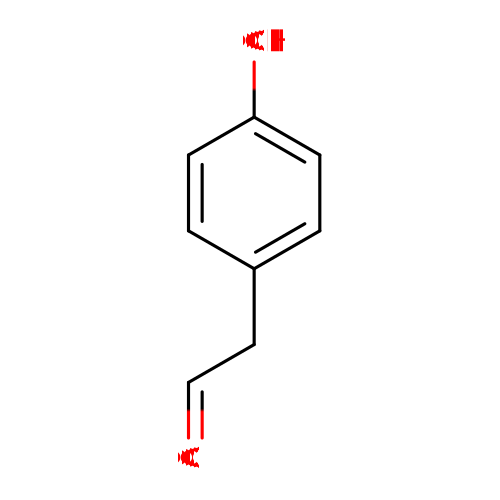
| Record Information |
|---|
| Version | 5.0 |
|---|
| Status | Expected but not Quantified |
|---|
| Creation Date | 2006-08-13 04:32:33 UTC |
|---|
| Update Date | 2023-02-21 17:16:48 UTC |
|---|
| HMDB ID | HMDB0003767 |
|---|
| Secondary Accession Numbers | |
|---|
| Metabolite Identification |
|---|
| Common Name | 4-Hydroxyphenylacetaldehyde |
|---|
| Description | 4-Hydroxyphenylacetaldehyde, also known as POH-PH-CH2CHO, belongs to the class of organic compounds known as phenylacetaldehydes. Phenylacetaldehydes are compounds containing a phenylacetaldehyde moiety, which consists of a phenyl group substituted at the second position by an acetalydehyde. 4-Hydroxyphenylacetaldehyde exists in all living species, ranging from bacteria to plants to humans. 4-Hydroxyphenylacetaldehyde has been detected, but not quantified in, several different foods, such as plains prickly pears (Opuntia macrorhiza), dills (Anethum graveolens), half-highbush blueberries (Vaccinium angustifolium X Vaccinium corymbosum), cloves (Syzygium aromaticum), and wild carrots (Daucus carota). This could make 4-hydroxyphenylacetaldehyde a potential biomarker for the consumption of these foods. 4-Hydroxyphenylacetaldehyde is a primary metabolite. Primary metabolites are metabolically or physiologically essential metabolites. They are directly involved in an organism’s growth, development or reproduction. Based on a literature review a significant number of articles have been published on 4-Hydroxyphenylacetaldehyde. |
|---|
| Structure | InChI=1S/C8H8O2/c9-6-5-7-1-3-8(10)4-2-7/h1-4,6,10H,5H2 |
|---|
| Synonyms | | Value | Source |
|---|
| 2-(4-Hydroxyphenyl)acetaldehyde | ChEBI | | p-Hydroxyphenylacetaldehyde | ChEBI | | POH-PH-CH2CHO | ChEBI | | (4-Hydroxyphenyl)acetaldehyde | HMDB | | (p-Hydroxyphenyl)acetaldehyde | HMDB | | 4-Hydroxybenzeneacetaldehyde | HMDB | | 4-Hydroxyphenylacetadehyde | HMDB | | 4-Hydroxyphenylacetaldehyde | HMDB |
|
|---|
| Chemical Formula | C8H8O2 |
|---|
| Average Molecular Weight | 136.1479 |
|---|
| Monoisotopic Molecular Weight | 136.0524295 |
|---|
| IUPAC Name | 2-(4-hydroxyphenyl)acetaldehyde |
|---|
| Traditional Name | p-hydroxyphenylacetaldehyde |
|---|
| CAS Registry Number | 7339-87-9 |
|---|
| SMILES | OC1=CC=C(CC=O)C=C1 |
|---|
| InChI Identifier | InChI=1S/C8H8O2/c9-6-5-7-1-3-8(10)4-2-7/h1-4,6,10H,5H2 |
|---|
| InChI Key | IPRPPFIAVHPVJH-UHFFFAOYSA-N |
|---|
| Chemical Taxonomy |
|---|
| Description | Belongs to the class of organic compounds known as phenylacetaldehydes. Phenylacetaldehydes are compounds containing a phenylacetaldehyde moiety, which consists of a phenyl group substituted at the second position by an acetalydehyde. |
|---|
| Kingdom | Organic compounds |
|---|
| Super Class | Benzenoids |
|---|
| Class | Benzene and substituted derivatives |
|---|
| Sub Class | Phenylacetaldehydes |
|---|
| Direct Parent | Phenylacetaldehydes |
|---|
| Alternative Parents | |
|---|
| Substituents | - Phenylacetaldehyde
- 1-hydroxy-2-unsubstituted benzenoid
- Phenol
- Alpha-hydrogen aldehyde
- Organic oxygen compound
- Organic oxide
- Hydrocarbon derivative
- Organooxygen compound
- Carbonyl group
- Aldehyde
- Aromatic homomonocyclic compound
|
|---|
| Molecular Framework | Aromatic homomonocyclic compounds |
|---|
| External Descriptors | |
|---|
| Ontology |
|---|
| Physiological effect | Not Available |
|---|
| Disposition | |
|---|
| Process | |
|---|
| Role | Not Available |
|---|
| Physical Properties |
|---|
| State | Solid |
|---|
| Experimental Molecular Properties | | Property | Value | Reference |
|---|
| Melting Point | Not Available | Not Available | | Boiling Point | Not Available | Not Available | | Water Solubility | Not Available | Not Available | | LogP | 1.379 | Not Available |
|
|---|
| Experimental Chromatographic Properties | Not Available |
|---|
| Predicted Molecular Properties | |
|---|
| Predicted Chromatographic Properties | Predicted Collision Cross SectionsPredicted Retention Times Underivatized| Chromatographic Method | Retention Time | Reference |
|---|
| Measured using a Waters Acquity ultraperformance liquid chromatography (UPLC) ethylene-bridged hybrid (BEH) C18 column (100 mm × 2.1 mm; 1.7 μmparticle diameter). Predicted by Afia on May 17, 2022. Predicted by Afia on May 17, 2022. | 3.18 minutes | 32390414 | | Predicted by Siyang on May 30, 2022 | 11.1641 minutes | 33406817 | | Predicted by Siyang using ReTip algorithm on June 8, 2022 | 3.81 minutes | 32390414 | | AjsUoB = Accucore 150 Amide HILIC with 10mM Ammonium Formate, 0.1% Formic Acid | 34.5 seconds | 40023050 | | Fem_Long = Waters ACQUITY UPLC HSS T3 C18 with Water:MeOH and 0.1% Formic Acid | 1342.6 seconds | 40023050 | | Fem_Lipids = Ascentis Express C18 with (60:40 water:ACN):(90:10 IPA:ACN) and 10mM NH4COOH + 0.1% Formic Acid | 371.1 seconds | 40023050 | | Life_Old = Waters ACQUITY UPLC BEH C18 with Water:(20:80 acetone:ACN) and 0.1% Formic Acid | 148.1 seconds | 40023050 | | Life_New = RP Waters ACQUITY UPLC HSS T3 C18 with Water:(30:70 MeOH:ACN) and 0.1% Formic Acid | 234.3 seconds | 40023050 | | RIKEN = Waters ACQUITY UPLC BEH C18 with Water:ACN and 0.1% Formic Acid | 200.1 seconds | 40023050 | | Eawag_XBridgeC18 = XBridge C18 3.5u 2.1x50 mm with Water:MeOH and 0.1% Formic Acid | 515.7 seconds | 40023050 | | BfG_NTS_RP1 =Agilent Zorbax Eclipse Plus C18 (2.1 mm x 150 mm, 3.5 um) with Water:ACN and 0.1% Formic Acid | 495.1 seconds | 40023050 | | HILIC_BDD_2 = Merck SeQuant ZIC-HILIC with ACN(0.1% formic acid):water(16 mM ammonium formate) | 191.4 seconds | 40023050 | | UniToyama_Atlantis = RP Waters Atlantis T3 (2.1 x 150 mm, 5 um) with ACN:Water and 0.1% Formic Acid | 962.6 seconds | 40023050 | | BDD_C18 = Hypersil Gold 1.9µm C18 with Water:ACN and 0.1% Formic Acid | 378.2 seconds | 40023050 | | UFZ_Phenomenex = Kinetex Core-Shell C18 2.6 um, 3.0 x 100 mm, Phenomenex with Water:MeOH and 0.1% Formic Acid | 1110.6 seconds | 40023050 | | SNU_RIKEN_POS = Waters ACQUITY UPLC BEH C18 with Water:ACN and 0.1% Formic Acid | 312.3 seconds | 40023050 | | RPMMFDA = Waters ACQUITY UPLC BEH C18 with Water:ACN and 0.1% Formic Acid | 310.7 seconds | 40023050 | | MTBLS87 = Merck SeQuant ZIC-pHILIC column with ACN:Water and :ammonium carbonate | 542.6 seconds | 40023050 | | KI_GIAR_zic_HILIC_pH2_7 = Merck SeQuant ZIC-HILIC with ACN:Water and 0.1% FA | 278.9 seconds | 40023050 | | Meister zic-pHILIC pH9.3 = Merck SeQuant ZIC-pHILIC column with ACN:Water 5mM NH4Ac pH9.3 and 5mM ammonium acetate in water | 110.9 seconds | 40023050 |
Predicted Kovats Retention IndicesUnderivatizedDerivatized| Derivative Name / Structure | SMILES | Kovats RI Value | Column Type | Reference |
|---|
| 4-Hydroxyphenylacetaldehyde,1TMS,isomer #1 | C[Si](C)(C)OC1=CC=C(CC=O)C=C1 | 1463.0 | Semi standard non polar | 33892256 | | 4-Hydroxyphenylacetaldehyde,1TMS,isomer #2 | C[Si](C)(C)OC=CC1=CC=C(O)C=C1 | 1627.6 | Semi standard non polar | 33892256 | | 4-Hydroxyphenylacetaldehyde,2TMS,isomer #1 | C[Si](C)(C)OC=CC1=CC=C(O[Si](C)(C)C)C=C1 | 1716.7 | Semi standard non polar | 33892256 | | 4-Hydroxyphenylacetaldehyde,2TMS,isomer #1 | C[Si](C)(C)OC=CC1=CC=C(O[Si](C)(C)C)C=C1 | 1680.8 | Standard non polar | 33892256 | | 4-Hydroxyphenylacetaldehyde,2TMS,isomer #1 | C[Si](C)(C)OC=CC1=CC=C(O[Si](C)(C)C)C=C1 | 1796.1 | Standard polar | 33892256 | | 4-Hydroxyphenylacetaldehyde,1TBDMS,isomer #1 | CC(C)(C)[Si](C)(C)OC1=CC=C(CC=O)C=C1 | 1709.7 | Semi standard non polar | 33892256 | | 4-Hydroxyphenylacetaldehyde,1TBDMS,isomer #2 | CC(C)(C)[Si](C)(C)OC=CC1=CC=C(O)C=C1 | 1895.8 | Semi standard non polar | 33892256 | | 4-Hydroxyphenylacetaldehyde,2TBDMS,isomer #1 | CC(C)(C)[Si](C)(C)OC=CC1=CC=C(O[Si](C)(C)C(C)(C)C)C=C1 | 2195.8 | Semi standard non polar | 33892256 | | 4-Hydroxyphenylacetaldehyde,2TBDMS,isomer #1 | CC(C)(C)[Si](C)(C)OC=CC1=CC=C(O[Si](C)(C)C(C)(C)C)C=C1 | 2122.1 | Standard non polar | 33892256 | | 4-Hydroxyphenylacetaldehyde,2TBDMS,isomer #1 | CC(C)(C)[Si](C)(C)OC=CC1=CC=C(O[Si](C)(C)C(C)(C)C)C=C1 | 2053.7 | Standard polar | 33892256 |
|
|---|
| GC-MS Spectra| Spectrum Type | Description | Splash Key | Deposition Date | Source | View |
|---|
| Predicted GC-MS | Predicted GC-MS Spectrum - 4-Hydroxyphenylacetaldehyde GC-MS (Non-derivatized) - 70eV, Positive | splash10-0a4r-5900000000-dee6bd2327885b9b9c35 | 2016-09-22 | Wishart Lab | View Spectrum | | Predicted GC-MS | Predicted GC-MS Spectrum - 4-Hydroxyphenylacetaldehyde GC-MS (1 TMS) - 70eV, Positive | splash10-05g0-5900000000-052b7c5a508b36e0512f | 2017-10-06 | Wishart Lab | View Spectrum | | Predicted GC-MS | Predicted GC-MS Spectrum - 4-Hydroxyphenylacetaldehyde GC-MS (Non-derivatized) - 70eV, Positive | Not Available | 2021-10-12 | Wishart Lab | View Spectrum |
MS/MS Spectra| Spectrum Type | Description | Splash Key | Deposition Date | Source | View |
|---|
| Predicted LC-MS/MS | Predicted LC-MS/MS Spectrum - 4-Hydroxyphenylacetaldehyde 10V, Positive-QTOF | splash10-000i-0900000000-c592acce12d2ba134040 | 2015-04-24 | Wishart Lab | View Spectrum | | Predicted LC-MS/MS | Predicted LC-MS/MS Spectrum - 4-Hydroxyphenylacetaldehyde 20V, Positive-QTOF | splash10-00kr-2900000000-90058ffcbfd58f5dff5b | 2015-04-24 | Wishart Lab | View Spectrum | | Predicted LC-MS/MS | Predicted LC-MS/MS Spectrum - 4-Hydroxyphenylacetaldehyde 40V, Positive-QTOF | splash10-0690-9500000000-a8abea2510950f337295 | 2015-04-24 | Wishart Lab | View Spectrum | | Predicted LC-MS/MS | Predicted LC-MS/MS Spectrum - 4-Hydroxyphenylacetaldehyde 10V, Negative-QTOF | splash10-000i-0900000000-3f4ed034f10b0d6a25b4 | 2015-04-25 | Wishart Lab | View Spectrum | | Predicted LC-MS/MS | Predicted LC-MS/MS Spectrum - 4-Hydroxyphenylacetaldehyde 20V, Negative-QTOF | splash10-000i-1900000000-99115e80b538ba6b2306 | 2015-04-25 | Wishart Lab | View Spectrum | | Predicted LC-MS/MS | Predicted LC-MS/MS Spectrum - 4-Hydroxyphenylacetaldehyde 40V, Negative-QTOF | splash10-0006-9300000000-6c9913d203a267c92186 | 2015-04-25 | Wishart Lab | View Spectrum | | Predicted LC-MS/MS | Predicted LC-MS/MS Spectrum - 4-Hydroxyphenylacetaldehyde 10V, Positive-QTOF | splash10-052r-4900000000-e2bf91e8ab2ae47d9096 | 2021-09-24 | Wishart Lab | View Spectrum | | Predicted LC-MS/MS | Predicted LC-MS/MS Spectrum - 4-Hydroxyphenylacetaldehyde 20V, Positive-QTOF | splash10-0a4l-9600000000-ff10a0510f947f476688 | 2021-09-24 | Wishart Lab | View Spectrum | | Predicted LC-MS/MS | Predicted LC-MS/MS Spectrum - 4-Hydroxyphenylacetaldehyde 40V, Positive-QTOF | splash10-004l-9100000000-b447fa4b15009b677f8f | 2021-09-24 | Wishart Lab | View Spectrum | | Predicted LC-MS/MS | Predicted LC-MS/MS Spectrum - 4-Hydroxyphenylacetaldehyde 10V, Negative-QTOF | splash10-000i-2900000000-59dcda3398a30862c88d | 2021-09-24 | Wishart Lab | View Spectrum | | Predicted LC-MS/MS | Predicted LC-MS/MS Spectrum - 4-Hydroxyphenylacetaldehyde 20V, Negative-QTOF | splash10-0a4i-1900000000-7a7b9a9d95399c23529b | 2021-09-24 | Wishart Lab | View Spectrum | | Predicted LC-MS/MS | Predicted LC-MS/MS Spectrum - 4-Hydroxyphenylacetaldehyde 40V, Negative-QTOF | splash10-0006-9100000000-b2c6c4e6f393a7458822 | 2021-09-24 | Wishart Lab | View Spectrum |
NMR Spectra| Spectrum Type | Description | Deposition Date | Source | View |
|---|
| Predicted 1D NMR | 1H NMR Spectrum (1D, 100 MHz, D2O, predicted) | 2021-09-24 | Wishart Lab | View Spectrum | | Predicted 1D NMR | 13C NMR Spectrum (1D, 100 MHz, D2O, predicted) | 2021-09-24 | Wishart Lab | View Spectrum | | Predicted 1D NMR | 1H NMR Spectrum (1D, 1000 MHz, D2O, predicted) | 2021-09-24 | Wishart Lab | View Spectrum | | Predicted 1D NMR | 13C NMR Spectrum (1D, 1000 MHz, D2O, predicted) | 2021-09-24 | Wishart Lab | View Spectrum | | Predicted 1D NMR | 1H NMR Spectrum (1D, 200 MHz, D2O, predicted) | 2021-09-24 | Wishart Lab | View Spectrum | | Predicted 1D NMR | 13C NMR Spectrum (1D, 200 MHz, D2O, predicted) | 2021-09-24 | Wishart Lab | View Spectrum | | Predicted 1D NMR | 1H NMR Spectrum (1D, 300 MHz, D2O, predicted) | 2021-09-24 | Wishart Lab | View Spectrum | | Predicted 1D NMR | 13C NMR Spectrum (1D, 300 MHz, D2O, predicted) | 2021-09-24 | Wishart Lab | View Spectrum | | Predicted 1D NMR | 1H NMR Spectrum (1D, 400 MHz, D2O, predicted) | 2021-09-24 | Wishart Lab | View Spectrum | | Predicted 1D NMR | 13C NMR Spectrum (1D, 400 MHz, D2O, predicted) | 2021-09-24 | Wishart Lab | View Spectrum | | Predicted 1D NMR | 1H NMR Spectrum (1D, 500 MHz, D2O, predicted) | 2021-09-24 | Wishart Lab | View Spectrum | | Predicted 1D NMR | 13C NMR Spectrum (1D, 500 MHz, D2O, predicted) | 2021-09-24 | Wishart Lab | View Spectrum | | Predicted 1D NMR | 1H NMR Spectrum (1D, 600 MHz, D2O, predicted) | 2021-09-24 | Wishart Lab | View Spectrum | | Predicted 1D NMR | 13C NMR Spectrum (1D, 600 MHz, D2O, predicted) | 2021-09-24 | Wishart Lab | View Spectrum | | Predicted 1D NMR | 1H NMR Spectrum (1D, 700 MHz, D2O, predicted) | 2021-09-24 | Wishart Lab | View Spectrum | | Predicted 1D NMR | 13C NMR Spectrum (1D, 700 MHz, D2O, predicted) | 2021-09-24 | Wishart Lab | View Spectrum | | Predicted 1D NMR | 1H NMR Spectrum (1D, 800 MHz, D2O, predicted) | 2021-09-24 | Wishart Lab | View Spectrum | | Predicted 1D NMR | 13C NMR Spectrum (1D, 800 MHz, D2O, predicted) | 2021-09-24 | Wishart Lab | View Spectrum | | Predicted 1D NMR | 1H NMR Spectrum (1D, 900 MHz, D2O, predicted) | 2021-09-24 | Wishart Lab | View Spectrum | | Predicted 1D NMR | 13C NMR Spectrum (1D, 900 MHz, D2O, predicted) | 2021-09-24 | Wishart Lab | View Spectrum |
IR Spectra| Spectrum Type | Description | Deposition Date | Source | View |
|---|
| Predicted IR Spectrum | IR Ion Spectrum (Predicted IRIS Spectrum, Adduct: [M-H]-) | 2023-02-03 | FELIX lab | View Spectrum | | Predicted IR Spectrum | IR Ion Spectrum (Predicted IRIS Spectrum, Adduct: [M+H]+) | 2023-02-03 | FELIX lab | View Spectrum | | Predicted IR Spectrum | IR Ion Spectrum (Predicted IRIS Spectrum, Adduct: [M+Na]+) | 2023-02-03 | FELIX lab | View Spectrum |
|
|---|