| Record Information |
|---|
| Version | 5.0 |
|---|
| Status | Expected but not Quantified |
|---|
| Creation Date | 2012-09-06 15:16:52 UTC |
|---|
| Update Date | 2022-03-07 02:51:59 UTC |
|---|
| HMDB ID | HMDB0015443 |
|---|
| Secondary Accession Numbers | |
|---|
| Metabolite Identification |
|---|
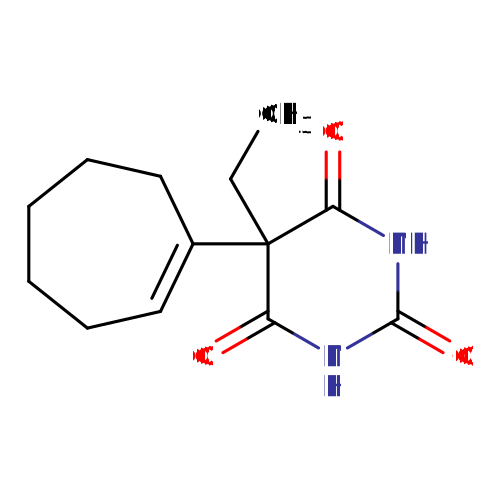
| Common Name | Heptabarbital |
|---|
| Description | Heptabarbital is only found in individuals that have used or taken this drug. It is an intermediate or short term barbiturate used mainly for sedation and hypnosis.Heptabarbital (like all barbiturates) works by binding to the GABAA receptor at either the alpha or the beta sub unit. These are binding sites that are distinct from GABA itself and also distinct from the benzodiazepine binding site. Like benzodiazepines, barbiturates potentiate the effect of GABA at this receptor. This GABAA receptor binding decreases input resistance, depresses burst and tonic firing, especially in ventrobasal and intralaminar neurons, while at the same time increasing burst duration and mean conductance at individual chloride channels; this increases both the amplitude and decay time of inhibitory postsynaptic currents. In addition to this GABA-ergic effect, barbiturates also block the AMPA receptor, a subtype of glutamate receptor. Glutamate is the principal excitatory neurotransmitter in the mammalian CNS. Heptabarbital also appears to bind neuronal nicotinic acetylcholine receptors. |
|---|
| Structure | CCC1(C(=O)NC(=O)NC1=O)C1=CCCCCC1 InChI=1S/C13H18N2O3/c1-2-13(9-7-5-3-4-6-8-9)10(16)14-12(18)15-11(13)17/h7H,2-6,8H2,1H3,(H2,14,15,16,17,18) |
|---|
| Synonyms | | Value | Source |
|---|
| Heptabarb | HMDB | | Heptabarbitone | HMDB | | Heptabarbum | HMDB | | Heptadorm | HMDB | | Heptamal | HMDB | | Heptamalum | HMDB | | Heptbarbital | HMDB | | Medapan | HMDB | | Medomine | HMDB | | Heptabarbital, monosodium salt | HMDB | | Medomin | HMDB |
|
|---|
| Chemical Formula | C13H18N2O3 |
|---|
| Average Molecular Weight | 250.2936 |
|---|
| Monoisotopic Molecular Weight | 250.131742452 |
|---|
| IUPAC Name | 5-(cyclohept-1-en-1-yl)-5-ethyl-1,3-diazinane-2,4,6-trione |
|---|
| Traditional Name | heptabarbital |
|---|
| CAS Registry Number | 509-86-4 |
|---|
| SMILES | CCC1(C(=O)NC(=O)NC1=O)C1=CCCCCC1 |
|---|
| InChI Identifier | InChI=1S/C13H18N2O3/c1-2-13(9-7-5-3-4-6-8-9)10(16)14-12(18)15-11(13)17/h7H,2-6,8H2,1H3,(H2,14,15,16,17,18) |
|---|
| InChI Key | PAZQYDJGLKSCSI-UHFFFAOYSA-N |
|---|
| Chemical Taxonomy |
|---|
| Description | Belongs to the class of organic compounds known as barbituric acid derivatives. Barbituric acid derivatives are compounds containing a perhydropyrimidine ring substituted at C-2, -4 and -6 by oxo groups. |
|---|
| Kingdom | Organic compounds |
|---|
| Super Class | Organoheterocyclic compounds |
|---|
| Class | Diazines |
|---|
| Sub Class | Pyrimidines and pyrimidine derivatives |
|---|
| Direct Parent | Barbituric acid derivatives |
|---|
| Alternative Parents | |
|---|
| Substituents | - Barbiturate
- N-acyl urea
- Ureide
- 1,3-diazinane
- Dicarboximide
- Urea
- Carbonic acid derivative
- Carboxylic acid derivative
- Azacycle
- Organic nitrogen compound
- Organonitrogen compound
- Organooxygen compound
- Hydrocarbon derivative
- Organic oxide
- Organopnictogen compound
- Organic oxygen compound
- Carbonyl group
- Aliphatic heteromonocyclic compound
|
|---|
| Molecular Framework | Aliphatic heteromonocyclic compounds |
|---|
| External Descriptors | |
|---|
| Ontology |
|---|
| Physiological effect | Not Available |
|---|
| Disposition | |
|---|
| Process | Not Available |
|---|
| Role | Not Available |
|---|
| Physical Properties |
|---|
| State | Solid |
|---|
| Experimental Molecular Properties | | Property | Value | Reference |
|---|
| Melting Point | 174 °C | Not Available | | Boiling Point | Not Available | Not Available | | Water Solubility | 0.32 g/L | Not Available | | LogP | 2.03 | HANSCH,C ET AL. (1995) |
|
|---|
| Experimental Chromatographic Properties | Not Available |
|---|
| Predicted Molecular Properties | |
|---|
| Predicted Chromatographic Properties | Predicted Collision Cross SectionsPredicted Retention Times Underivatized| Chromatographic Method | Retention Time | Reference |
|---|
| Measured using a Waters Acquity ultraperformance liquid chromatography (UPLC) ethylene-bridged hybrid (BEH) C18 column (100 mm × 2.1 mm; 1.7 μmparticle diameter). Predicted by Afia on May 17, 2022. Predicted by Afia on May 17, 2022. | 5.84 minutes | 32390414 | | Predicted by Siyang on May 30, 2022 | 17.6766 minutes | 33406817 | | Predicted by Siyang using ReTip algorithm on June 8, 2022 | 1.92 minutes | 32390414 | | Fem_Long = Waters ACQUITY UPLC HSS T3 C18 with Water:MeOH and 0.1% Formic Acid | 2777.0 seconds | 40023050 | | Fem_Lipids = Ascentis Express C18 with (60:40 water:ACN):(90:10 IPA:ACN) and 10mM NH4COOH + 0.1% Formic Acid | 532.9 seconds | 40023050 | | Life_Old = Waters ACQUITY UPLC BEH C18 with Water:(20:80 acetone:ACN) and 0.1% Formic Acid | 199.8 seconds | 40023050 | | Life_New = RP Waters ACQUITY UPLC HSS T3 C18 with Water:(30:70 MeOH:ACN) and 0.1% Formic Acid | 323.3 seconds | 40023050 | | RIKEN = Waters ACQUITY UPLC BEH C18 with Water:ACN and 0.1% Formic Acid | 421.2 seconds | 40023050 | | Eawag_XBridgeC18 = XBridge C18 3.5u 2.1x50 mm with Water:MeOH and 0.1% Formic Acid | 657.6 seconds | 40023050 | | BfG_NTS_RP1 =Agilent Zorbax Eclipse Plus C18 (2.1 mm x 150 mm, 3.5 um) with Water:ACN and 0.1% Formic Acid | 867.8 seconds | 40023050 | | HILIC_BDD_2 = Merck SeQuant ZIC-HILIC with ACN(0.1% formic acid):water(16 mM ammonium formate) | 131.7 seconds | 40023050 | | UniToyama_Atlantis = RP Waters Atlantis T3 (2.1 x 150 mm, 5 um) with ACN:Water and 0.1% Formic Acid | 1556.7 seconds | 40023050 | | BDD_C18 = Hypersil Gold 1.9µm C18 with Water:ACN and 0.1% Formic Acid | 505.9 seconds | 40023050 | | UFZ_Phenomenex = Kinetex Core-Shell C18 2.6 um, 3.0 x 100 mm, Phenomenex with Water:MeOH and 0.1% Formic Acid | 1617.0 seconds | 40023050 | | SNU_RIKEN_POS = Waters ACQUITY UPLC BEH C18 with Water:ACN and 0.1% Formic Acid | 521.9 seconds | 40023050 | | RPMMFDA = Waters ACQUITY UPLC BEH C18 with Water:ACN and 0.1% Formic Acid | 420.4 seconds | 40023050 | | MTBLS87 = Merck SeQuant ZIC-pHILIC column with ACN:Water and :ammonium carbonate | 495.6 seconds | 40023050 | | KI_GIAR_zic_HILIC_pH2_7 = Merck SeQuant ZIC-HILIC with ACN:Water and 0.1% FA | 464.9 seconds | 40023050 | | Meister zic-pHILIC pH9.3 = Merck SeQuant ZIC-pHILIC column with ACN:Water 5mM NH4Ac pH9.3 and 5mM ammonium acetate in water | 30.6 seconds | 40023050 |
Predicted Kovats Retention IndicesUnderivatizedDerivatized| Derivative Name / Structure | SMILES | Kovats RI Value | Column Type | Reference |
|---|
| Heptabarbital,1TMS,isomer #1 | CCC1(C2=CCCCCC2)C(=O)NC(=O)N([Si](C)(C)C)C1=O | 2135.6 | Semi standard non polar | 33892256 | | Heptabarbital,1TMS,isomer #1 | CCC1(C2=CCCCCC2)C(=O)NC(=O)N([Si](C)(C)C)C1=O | 2213.1 | Standard non polar | 33892256 | | Heptabarbital,1TMS,isomer #1 | CCC1(C2=CCCCCC2)C(=O)NC(=O)N([Si](C)(C)C)C1=O | 3180.9 | Standard polar | 33892256 | | Heptabarbital,2TMS,isomer #1 | CCC1(C2=CCCCCC2)C(=O)N([Si](C)(C)C)C(=O)N([Si](C)(C)C)C1=O | 2065.5 | Semi standard non polar | 33892256 | | Heptabarbital,2TMS,isomer #1 | CCC1(C2=CCCCCC2)C(=O)N([Si](C)(C)C)C(=O)N([Si](C)(C)C)C1=O | 2240.6 | Standard non polar | 33892256 | | Heptabarbital,2TMS,isomer #1 | CCC1(C2=CCCCCC2)C(=O)N([Si](C)(C)C)C(=O)N([Si](C)(C)C)C1=O | 2854.4 | Standard polar | 33892256 | | Heptabarbital,1TBDMS,isomer #1 | CCC1(C2=CCCCCC2)C(=O)NC(=O)N([Si](C)(C)C(C)(C)C)C1=O | 2340.1 | Semi standard non polar | 33892256 | | Heptabarbital,1TBDMS,isomer #1 | CCC1(C2=CCCCCC2)C(=O)NC(=O)N([Si](C)(C)C(C)(C)C)C1=O | 2441.0 | Standard non polar | 33892256 | | Heptabarbital,1TBDMS,isomer #1 | CCC1(C2=CCCCCC2)C(=O)NC(=O)N([Si](C)(C)C(C)(C)C)C1=O | 3285.0 | Standard polar | 33892256 | | Heptabarbital,2TBDMS,isomer #1 | CCC1(C2=CCCCCC2)C(=O)N([Si](C)(C)C(C)(C)C)C(=O)N([Si](C)(C)C(C)(C)C)C1=O | 2479.4 | Semi standard non polar | 33892256 | | Heptabarbital,2TBDMS,isomer #1 | CCC1(C2=CCCCCC2)C(=O)N([Si](C)(C)C(C)(C)C)C(=O)N([Si](C)(C)C(C)(C)C)C1=O | 2696.7 | Standard non polar | 33892256 | | Heptabarbital,2TBDMS,isomer #1 | CCC1(C2=CCCCCC2)C(=O)N([Si](C)(C)C(C)(C)C)C(=O)N([Si](C)(C)C(C)(C)C)C1=O | 2981.5 | Standard polar | 33892256 |
|
|---|