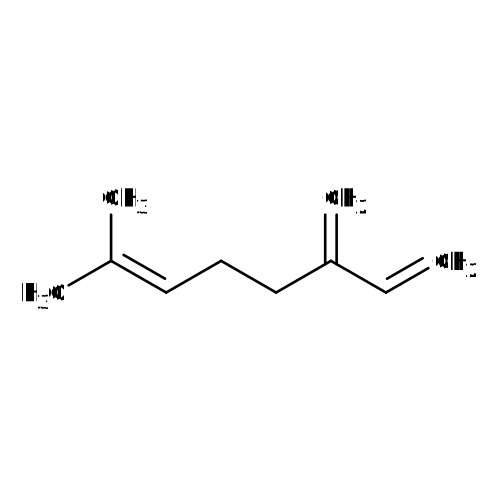
| Record Information |
|---|
| Version | 5.0 |
|---|
| Status | Detected but not Quantified |
|---|
| Creation Date | 2012-09-11 23:27:07 UTC |
|---|
| Update Date | 2022-03-07 02:55:39 UTC |
|---|
| HMDB ID | HMDB0038169 |
|---|
| Secondary Accession Numbers | |
|---|
| Metabolite Identification |
|---|
| Common Name | beta-Myrcene |
|---|
| Description | 7-Methyl-3-methylene-1,6-octadiene, also known as beta-Myrcene or myrcene is an acyclic monoterpene. Monoterpenoids are terpenes that contain 10 carbon atoms and are comprised of two isoprene units. The biosynthesis of monoterpenes is known to occur mainly through the methyl-erythritol-phosphate (MEP) pathway in the plastids. beta-Myrcene is a significant component of the essential oil of several plants, including allspice, bay, cannabis, hops, houttuynia, lemon grass, mango, myrcia, verbena, west indian bay tree, and cardamom. It is also the main component of wild thyme, the leaves of which contain up to 40% by weight of myrcene. Industrially, it is produced mainly semi-synthetically from myrcia, from which it gets its name. Myrcene has been detected as a volatile component in cannabis plant samples (PMID:26657499 ) and its essential oils (PMID:6991645 ). beta-Myrcene is the most abundant monoterpene in Cannabis and it has analgesic, anti-inflammatory, antibiotic, and antimutagenic activities. beta-Myrcene is a flavouring agent and it is used in the perfumery industry. It has a pleasant odor but is rarely used directly. It is a key intermediate in the production of several fragrances such as menthol, citral, citronellol, citronellal, geraniol, nerol, and linalool. |
|---|
| Structure | InChI=1S/C10H16/c1-5-10(4)8-6-7-9(2)3/h5,7H,1,4,6,8H2,2-3H3 |
|---|
| Synonyms | | Value | Source |
|---|
| 7-Methyl-3-methylene-1,6-octadiene | ChEBI | | 7-Methyl-3-methyleneocta-1,6-diene | ChEBI | | Myrcene | ChEBI | | b-Myrcene | Generator | | Β-myrcene | Generator | | 2-Methyl-6-methylene-1,7-octadiene | MeSH | | 2-Methyl-6-methylene-2,7-octadiene | HMDB | | 3-Methylene-7-methyl-1, 6-octadiene | HMDB | | 3-Methylene-7-methyl-1,6-octadiene | HMDB | | 7-Methyl-3-methylene-1,6-octadiene (beta -myrcene) | HMDB | | 7-Methyl-3-methylene-1,6-octadiene (myrcene) | HMDB | | 7-Methyl-3-methylene-octa-1,6-diene | HMDB | | 7-Methyl-3-methyleneoctadiene-(1,6) | HMDB | | 7-Methyl-3-methylideneocta-1,6-diene | HMDB | | b-Geraniolene | HMDB | | beta-Mircene | HMDB | | beta-Myrcene | HMDB, KEGG | | FEMA 2762 | HMDB | | beta-Geraniolene | HMDB | | β-Geraniolene | HMDB |
|
|---|
| Chemical Formula | C10H16 |
|---|
| Average Molecular Weight | 136.238 |
|---|
| Monoisotopic Molecular Weight | 136.125200515 |
|---|
| IUPAC Name | 7-methyl-3-methylideneocta-1,6-diene |
|---|
| Traditional Name | α-myrcene |
|---|
| CAS Registry Number | 123-35-3 |
|---|
| SMILES | CC(C)=CCCC(=C)C=C |
|---|
| InChI Identifier | InChI=1S/C10H16/c1-5-10(4)8-6-7-9(2)3/h5,7H,1,4,6,8H2,2-3H3 |
|---|
| InChI Key | UAHWPYUMFXYFJY-UHFFFAOYSA-N |
|---|
| Chemical Taxonomy |
|---|
| Description | Belongs to the class of organic compounds known as acyclic monoterpenoids. These are monoterpenes that do not contain a cycle. |
|---|
| Kingdom | Organic compounds |
|---|
| Super Class | Lipids and lipid-like molecules |
|---|
| Class | Prenol lipids |
|---|
| Sub Class | Monoterpenoids |
|---|
| Direct Parent | Acyclic monoterpenoids |
|---|
| Alternative Parents | |
|---|
| Substituents | - Acyclic monoterpenoid
- Branched unsaturated hydrocarbon
- Alkatriene
- Unsaturated aliphatic hydrocarbon
- Unsaturated hydrocarbon
- Olefin
- Acyclic olefin
- Hydrocarbon
- Aliphatic acyclic compound
|
|---|
| Molecular Framework | Aliphatic acyclic compounds |
|---|
| External Descriptors | |
|---|
| Ontology |
|---|
| Not Available | Not Available |
|---|
| Physical Properties |
|---|
| State | Liquid |
|---|
| Experimental Molecular Properties | | Property | Value | Reference |
|---|
| Melting Point | < -10 °C | Not Available | | Boiling Point | 166.00 to 167.00 °C. @ 760.00 mm Hg | The Good Scents Company Information System | | Water Solubility | 0.0056 mg/mL at 25 °C | Not Available | | LogP | 4.17 | Not Available |
|
|---|
| Experimental Chromatographic Properties | Not Available |
|---|
| Predicted Molecular Properties | |
|---|
| Predicted Chromatographic Properties | Predicted Collision Cross SectionsPredicted Retention Times Underivatized| Chromatographic Method | Retention Time | Reference |
|---|
| Measured using a Waters Acquity ultraperformance liquid chromatography (UPLC) ethylene-bridged hybrid (BEH) C18 column (100 mm × 2.1 mm; 1.7 μmparticle diameter). Predicted by Afia on May 17, 2022. Predicted by Afia on May 17, 2022. | 6.79 minutes | 32390414 | | Predicted by Siyang on May 30, 2022 | 18.3122 minutes | 33406817 | | Predicted by Siyang using ReTip algorithm on June 8, 2022 | 2.93 minutes | 32390414 | | AjsUoB = Accucore 150 Amide HILIC with 10mM Ammonium Formate, 0.1% Formic Acid | 36.6 seconds | 40023050 | | Fem_Long = Waters ACQUITY UPLC HSS T3 C18 with Water:MeOH and 0.1% Formic Acid | 2386.4 seconds | 40023050 | | Fem_Lipids = Ascentis Express C18 with (60:40 water:ACN):(90:10 IPA:ACN) and 10mM NH4COOH + 0.1% Formic Acid | 661.4 seconds | 40023050 | | Life_Old = Waters ACQUITY UPLC BEH C18 with Water:(20:80 acetone:ACN) and 0.1% Formic Acid | 254.1 seconds | 40023050 | | Life_New = RP Waters ACQUITY UPLC HSS T3 C18 with Water:(30:70 MeOH:ACN) and 0.1% Formic Acid | 455.0 seconds | 40023050 | | RIKEN = Waters ACQUITY UPLC BEH C18 with Water:ACN and 0.1% Formic Acid | 250.6 seconds | 40023050 | | Eawag_XBridgeC18 = XBridge C18 3.5u 2.1x50 mm with Water:MeOH and 0.1% Formic Acid | 650.5 seconds | 40023050 | | BfG_NTS_RP1 =Agilent Zorbax Eclipse Plus C18 (2.1 mm x 150 mm, 3.5 um) with Water:ACN and 0.1% Formic Acid | 782.4 seconds | 40023050 | | HILIC_BDD_2 = Merck SeQuant ZIC-HILIC with ACN(0.1% formic acid):water(16 mM ammonium formate) | 159.4 seconds | 40023050 | | UniToyama_Atlantis = RP Waters Atlantis T3 (2.1 x 150 mm, 5 um) with ACN:Water and 0.1% Formic Acid | 1544.4 seconds | 40023050 | | BDD_C18 = Hypersil Gold 1.9µm C18 with Water:ACN and 0.1% Formic Acid | 565.6 seconds | 40023050 | | UFZ_Phenomenex = Kinetex Core-Shell C18 2.6 um, 3.0 x 100 mm, Phenomenex with Water:MeOH and 0.1% Formic Acid | 1383.0 seconds | 40023050 | | SNU_RIKEN_POS = Waters ACQUITY UPLC BEH C18 with Water:ACN and 0.1% Formic Acid | 557.8 seconds | 40023050 | | RPMMFDA = Waters ACQUITY UPLC BEH C18 with Water:ACN and 0.1% Formic Acid | 465.7 seconds | 40023050 | | MTBLS87 = Merck SeQuant ZIC-pHILIC column with ACN:Water and :ammonium carbonate | 507.5 seconds | 40023050 | | KI_GIAR_zic_HILIC_pH2_7 = Merck SeQuant ZIC-HILIC with ACN:Water and 0.1% FA | 584.0 seconds | 40023050 | | Meister zic-pHILIC pH9.3 = Merck SeQuant ZIC-pHILIC column with ACN:Water 5mM NH4Ac pH9.3 and 5mM ammonium acetate in water | 15.5 seconds | 40023050 |
Predicted Kovats Retention IndicesUnderivatized |
|---|
| Disease References | | Nonalcoholic fatty liver disease |
|---|
- Raman M, Ahmed I, Gillevet PM, Probert CS, Ratcliffe NM, Smith S, Greenwood R, Sikaroodi M, Lam V, Crotty P, Bailey J, Myers RP, Rioux KP: Fecal microbiome and volatile organic compound metabolome in obese humans with nonalcoholic fatty liver disease. Clin Gastroenterol Hepatol. 2013 Jul;11(7):868-75.e1-3. doi: 10.1016/j.cgh.2013.02.015. Epub 2013 Feb 27. [PubMed:23454028 ]
|
|
|---|
| General References | - Luddeke F, Harder J: Enantiospecific (S)-(+)-linalool formation from beta-myrcene by linalool dehydratase-isomerase. Z Naturforsch C. 2011 Jul-Aug;66(7-8):409-12. [PubMed:21950166 ]
- Simons K, Toomre D: Lipid rafts and signal transduction. Nat Rev Mol Cell Biol. 2000 Oct;1(1):31-9. [PubMed:11413487 ]
- Watson AD: Thematic review series: systems biology approaches to metabolic and cardiovascular disorders. Lipidomics: a global approach to lipid analysis in biological systems. J Lipid Res. 2006 Oct;47(10):2101-11. Epub 2006 Aug 10. [PubMed:16902246 ]
- Sethi JK, Vidal-Puig AJ: Thematic review series: adipocyte biology. Adipose tissue function and plasticity orchestrate nutritional adaptation. J Lipid Res. 2007 Jun;48(6):1253-62. Epub 2007 Mar 20. [PubMed:17374880 ]
- Lingwood D, Simons K: Lipid rafts as a membrane-organizing principle. Science. 2010 Jan 1;327(5961):46-50. doi: 10.1126/science.1174621. [PubMed:20044567 ]
- (). Yannai, Shmuel. (2004) Dictionary of food compounds with CD-ROM: Additives, flavors, and ingredients. Boca Raton: Chapman & Hall/CRC.. .
- Gunstone, Frank D., John L. Harwood, and Albert J. Dijkstra (2007). The lipid handbook with CD-ROM. CRC Press.
|
|---|