| Record Information |
|---|
| Version | 5.0 |
|---|
| Status | Detected and Quantified |
|---|
| Creation Date | 2005-11-16 15:48:42 UTC |
|---|
| Update Date | 2023-05-30 20:55:59 UTC |
|---|
| HMDB ID | HMDB0000622 |
|---|
| Secondary Accession Numbers | |
|---|
| Metabolite Identification |
|---|
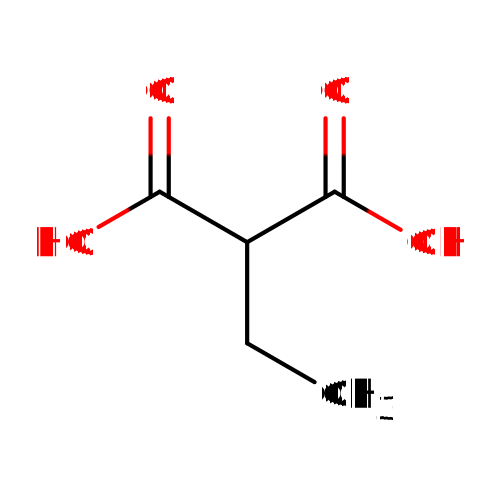
| Common Name | Ethylmalonic acid |
|---|
| Description | Ethylmalonic acid, also known as alpha-carboxybutyric acid or ethylmalonate, is a member of the class of compounds known as branched fatty acids. Branched fatty acids are fatty acids containing one or more branched chains. Ethylmalonic acid is soluble (in water) and a moderately acidic compound (based on its pKa). Ethylmalonic acid can be synthesized from malonic acid, and can be synthesized into (S)-ethylmalonyl-CoA and (R)-ethylmalonyl-CoA. Ethylmalonic acid can be found in blood, cerebrospinal fluid (CSF), and urine, as well as in human fibroblasts, prostate, and skeletal muscle tissues. Moreover, ethylmalonic acid is found to be associated with anorexia nervosa and malonyl-CoA decarboxylase deficiency. Ethylmalonic acid is a non-carcinogenic (not listed by IARC) potentially toxic compound. Chronically high levels of ethylmalonic acid are associated with at least two inborn errors of metabolism, including short-chain acyl-CoA dehydrogenase deficiency (SCAD deficiency) and ethylmalonic encephalopathy. Ethylmalonic acid is identified in the urine of patients with short-chain acyl-CoA dehydrogenase deficiency, which is a fatty acid metabolism disorder. When present at sufficiently high levels, ethylmalonic acid can act as an acidogen and a metabotoxin. An acidogen is an acidic compound that induces acidosis, which has multiple adverse effects on many organ systems. A metabotoxin is an endogenously produced metabolite that causes adverse health effects at chronically high levels. Ethylmalonic acid is an organic acid. Abnormally high levels of organic acids in the blood (organic acidemia), urine (organic aciduria), the brain, and other tissues lead to general metabolic acidosis. Acidosis typically occurs when arterial pH falls below 7.35. In infants with acidosis, the initial symptoms include poor feeding, vomiting, loss of appetite, weak muscle tone (hypotonia), and lack of energy (lethargy). These can progress to heart abnormalities, kidney abnormalities, liver damage, seizures, coma, and possibly death. These are also the characteristic symptoms of the untreated IEMs mentioned above. Many affected children with organic acidemias experience intellectual disability or delayed development. In adults, acidosis or acidemia is characterized by headaches, confusion, feeling tired, tremors, sleepiness, and seizures. |
|---|
| Structure | InChI=1S/C5H8O4/c1-2-3(4(6)7)5(8)9/h3H,2H2,1H3,(H,6,7)(H,8,9) |
|---|
| Synonyms | | Value | Source |
|---|
| 1,1-Propanedicarboxylic acid | ChEBI | | 2-Ethylmalonic acid | ChEBI | | alpha-Carboxybutyric acid | ChEBI | | 1,1-Propanedicarboxylate | Generator | | 2-Ethylmalonate | Generator | | a-Carboxybutyrate | Generator | | a-Carboxybutyric acid | Generator | | alpha-Carboxybutyrate | Generator | | Α-carboxybutyrate | Generator | | Α-carboxybutyric acid | Generator | | Ethylmalonate | Generator | | Ethyl-malonic acid | HMDB | | 2-Ethylpropanedioic acid | HMDB | | Ethylmalonic acid | HMDB |
|
|---|
| Chemical Formula | C5H8O4 |
|---|
| Average Molecular Weight | 132.1146 |
|---|
| Monoisotopic Molecular Weight | 132.042258744 |
|---|
| IUPAC Name | 2-ethylpropanedioic acid |
|---|
| Traditional Name | ethylmalonic acid |
|---|
| CAS Registry Number | 601-75-2 |
|---|
| SMILES | CCC(C(O)=O)C(O)=O |
|---|
| InChI Identifier | InChI=1S/C5H8O4/c1-2-3(4(6)7)5(8)9/h3H,2H2,1H3,(H,6,7)(H,8,9) |
|---|
| InChI Key | UKFXDFUAPNAMPJ-UHFFFAOYSA-N |
|---|
| Chemical Taxonomy |
|---|
| Description | Belongs to the class of organic compounds known as branched fatty acids. These are fatty acids containing a branched chain. |
|---|
| Kingdom | Organic compounds |
|---|
| Super Class | Lipids and lipid-like molecules |
|---|
| Class | Fatty Acyls |
|---|
| Sub Class | Fatty acids and conjugates |
|---|
| Direct Parent | Branched fatty acids |
|---|
| Alternative Parents | |
|---|
| Substituents | - Branched fatty acid
- 1,3-dicarbonyl compound
- Dicarboxylic acid or derivatives
- Carboxylic acid
- Carboxylic acid derivative
- Organic oxygen compound
- Organic oxide
- Hydrocarbon derivative
- Organooxygen compound
- Carbonyl group
- Aliphatic acyclic compound
|
|---|
| Molecular Framework | Aliphatic acyclic compounds |
|---|
| External Descriptors | |
|---|
| Ontology |
|---|
| Physiological effect | |
|---|
| Disposition | |
|---|
| Process | |
|---|
| Role | |
|---|
| Physical Properties |
|---|
| State | Solid |
|---|
| Experimental Molecular Properties | | Property | Value | Reference |
|---|
| Melting Point | 112 - 114 °C | Not Available | | Boiling Point | Not Available | Not Available | | Water Solubility | 712 mg/mL | Not Available | | LogP | Not Available | Not Available |
|
|---|
| Experimental Chromatographic Properties | Not Available |
|---|
| Predicted Molecular Properties | |
|---|
| Predicted Chromatographic Properties | Predicted Collision Cross SectionsPredicted Kovats Retention IndicesUnderivatizedDerivatized |
|---|
| Spectra |
|---|
| GC-MS Spectra| Spectrum Type | Description | Splash Key | Deposition Date | Source | View |
|---|
| Experimental GC-MS | GC-MS Spectrum - Ethylmalonic acid GC-EI-TOF (Pegasus III TOF-MS system, Leco; GC 6890, Agilent Technologies) (Non-derivatized) | splash10-0002-0910000000-ff684346010454e439ec | 2014-06-16 | HMDB team, MONA, MassBank | View Spectrum | | Experimental GC-MS | GC-MS Spectrum - Ethylmalonic acid EI-B (Non-derivatized) | splash10-0gvx-9100000000-9713da0bdd2cd0b28eba | 2017-09-12 | HMDB team, MONA, MassBank | View Spectrum | | Experimental GC-MS | GC-MS Spectrum - Ethylmalonic acid EI-B (Non-derivatized) | splash10-0002-0920000000-c6908d036ed13e7ba519 | 2017-09-12 | HMDB team, MONA, MassBank | View Spectrum | | Experimental GC-MS | GC-MS Spectrum - Ethylmalonic acid GC-EI-TOF (Non-derivatized) | splash10-0002-0910000000-ff684346010454e439ec | 2017-09-12 | HMDB team, MONA, MassBank | View Spectrum | | Predicted GC-MS | Predicted GC-MS Spectrum - Ethylmalonic acid GC-MS (Non-derivatized) - 70eV, Positive | splash10-004u-9400000000-c51992693b05221f3a8a | 2017-09-01 | Wishart Lab | View Spectrum | | Predicted GC-MS | Predicted GC-MS Spectrum - Ethylmalonic acid GC-MS (2 TMS) - 70eV, Positive | splash10-00dr-9220000000-10ce85512076eaa6afde | 2017-10-06 | Wishart Lab | View Spectrum | | Predicted GC-MS | Predicted GC-MS Spectrum - Ethylmalonic acid GC-MS (Non-derivatized) - 70eV, Positive | Not Available | 2021-10-12 | Wishart Lab | View Spectrum | | Predicted GC-MS | Predicted GC-MS Spectrum - Ethylmalonic acid GC-MS (TMS_1_1) - 70eV, Positive | Not Available | 2021-11-05 | Wishart Lab | View Spectrum | | Predicted GC-MS | Predicted GC-MS Spectrum - Ethylmalonic acid GC-MS (TBDMS_1_1) - 70eV, Positive | Not Available | 2021-11-05 | Wishart Lab | View Spectrum | | Predicted GC-MS | Predicted GC-MS Spectrum - Ethylmalonic acid GC-MS (TBDMS_2_1) - 70eV, Positive | Not Available | 2021-11-05 | Wishart Lab | View Spectrum | | MS | Mass Spectrum (Electron Ionization) | splash10-0udr-9300000000-e531a154ddaf695ebe5b | 2014-09-20 | Not Available | View Spectrum |
MS/MS Spectra| Spectrum Type | Description | Splash Key | Deposition Date | Source | View |
|---|
| Experimental LC-MS/MS | LC-MS/MS Spectrum - Ethylmalonic acid Quattro_QQQ 10V, Negative-QTOF (Annotated) | splash10-000l-9000000000-ed08eca90f357944aee9 | 2012-07-24 | HMDB team, MONA | View Spectrum | | Experimental LC-MS/MS | LC-MS/MS Spectrum - Ethylmalonic acid Quattro_QQQ 25V, Negative-QTOF (Annotated) | splash10-0006-9000000000-b6e83c7aef56876fa1b3 | 2012-07-24 | HMDB team, MONA | View Spectrum | | Experimental LC-MS/MS | LC-MS/MS Spectrum - Ethylmalonic acid Quattro_QQQ 40V, Negative-QTOF (Annotated) | splash10-0006-9000000000-409423c1bfecc553b24e | 2012-07-24 | HMDB team, MONA | View Spectrum | | Experimental LC-MS/MS | LC-MS/MS Spectrum - Ethylmalonic acid , negative-QTOF | splash10-000i-9000000000-d15979561ae10b3c94df | 2017-09-14 | HMDB team, MONA | View Spectrum | | Experimental LC-MS/MS | LC-MS/MS Spectrum - Ethylmalonic acid 10V, Negative-QTOF | splash10-000i-9000000000-6cd825b16df28e77024a | 2021-09-20 | HMDB team, MONA | View Spectrum | | Experimental LC-MS/MS | LC-MS/MS Spectrum - Ethylmalonic acid 20V, Negative-QTOF | splash10-00kr-9000000000-32cc5c19f1f63ea75c17 | 2021-09-20 | HMDB team, MONA | View Spectrum | | Experimental LC-MS/MS | LC-MS/MS Spectrum - Ethylmalonic acid 40V, Negative-QTOF | splash10-0gb9-9000000000-c8fadac6a17104d7abf6 | 2021-09-20 | HMDB team, MONA | View Spectrum | | Experimental LC-MS/MS | LC-MS/MS Spectrum - Ethylmalonic acid 35V, Negative-QTOF | splash10-000i-9000000000-e7765d86ee8d74f0f9d6 | 2021-09-20 | HMDB team, MONA | View Spectrum | | Experimental LC-MS/MS | LC-MS/MS Spectrum - Ethylmalonic acid 35V, Negative-QTOF | splash10-000i-9000000000-4086dd4566bac56688a9 | 2021-09-20 | HMDB team, MONA | View Spectrum | | Predicted LC-MS/MS | Predicted LC-MS/MS Spectrum - Ethylmalonic acid 10V, Positive-QTOF | splash10-00lr-3900000000-7ad5e5da82f0646b39db | 2017-09-01 | Wishart Lab | View Spectrum | | Predicted LC-MS/MS | Predicted LC-MS/MS Spectrum - Ethylmalonic acid 20V, Positive-QTOF | splash10-014i-9600000000-00a7e2649b402719b2fa | 2017-09-01 | Wishart Lab | View Spectrum | | Predicted LC-MS/MS | Predicted LC-MS/MS Spectrum - Ethylmalonic acid 40V, Positive-QTOF | splash10-00kf-9000000000-6cd3362f5cdb53773ce8 | 2017-09-01 | Wishart Lab | View Spectrum | | Predicted LC-MS/MS | Predicted LC-MS/MS Spectrum - Ethylmalonic acid 10V, Negative-QTOF | splash10-0019-9400000000-257e80506d0172d05d98 | 2017-09-01 | Wishart Lab | View Spectrum | | Predicted LC-MS/MS | Predicted LC-MS/MS Spectrum - Ethylmalonic acid 20V, Negative-QTOF | splash10-000l-9000000000-e79d02ff9ead3516adaa | 2017-09-01 | Wishart Lab | View Spectrum | | Predicted LC-MS/MS | Predicted LC-MS/MS Spectrum - Ethylmalonic acid 40V, Negative-QTOF | splash10-0006-9000000000-c55403c45b1243b9628e | 2017-09-01 | Wishart Lab | View Spectrum | | Predicted LC-MS/MS | Predicted LC-MS/MS Spectrum - Ethylmalonic acid 10V, Positive-QTOF | splash10-00ku-9100000000-bf24e61d0219e165c8de | 2021-09-22 | Wishart Lab | View Spectrum | | Predicted LC-MS/MS | Predicted LC-MS/MS Spectrum - Ethylmalonic acid 20V, Positive-QTOF | splash10-014i-9000000000-f4c23282a114d4982d2d | 2021-09-22 | Wishart Lab | View Spectrum | | Predicted LC-MS/MS | Predicted LC-MS/MS Spectrum - Ethylmalonic acid 40V, Positive-QTOF | splash10-0006-9000000000-5a0f73206eec5978645d | 2021-09-22 | Wishart Lab | View Spectrum | | Predicted LC-MS/MS | Predicted LC-MS/MS Spectrum - Ethylmalonic acid 10V, Negative-QTOF | splash10-000i-9300000000-fec5eeeb4f241984f787 | 2021-09-22 | Wishart Lab | View Spectrum | | Predicted LC-MS/MS | Predicted LC-MS/MS Spectrum - Ethylmalonic acid 20V, Negative-QTOF | splash10-014r-9000000000-08c6ded2366ed022deab | 2021-09-22 | Wishart Lab | View Spectrum | | Predicted LC-MS/MS | Predicted LC-MS/MS Spectrum - Ethylmalonic acid 40V, Negative-QTOF | splash10-014i-9000000000-76b92022e3a050e0fb1e | 2021-09-22 | Wishart Lab | View Spectrum |
NMR Spectra| Spectrum Type | Description | Deposition Date | Source | View |
|---|
| Experimental 1D NMR | 1H NMR Spectrum (1D, 600 MHz, H2O, experimental) | 2012-12-04 | Wishart Lab | View Spectrum | | Experimental 2D NMR | [1H, 13C]-HSQC NMR Spectrum (2D, 600 MHz, H2O, experimental) | 2012-12-05 | Wishart Lab | View Spectrum |
IR Spectra| Spectrum Type | Description | Deposition Date | Source | View |
|---|
| Predicted IR Spectrum | IR Ion Spectrum (Predicted IRIS Spectrum, Adduct: [M-H]-) | 2023-02-03 | FELIX lab | View Spectrum | | Predicted IR Spectrum | IR Ion Spectrum (Predicted IRIS Spectrum, Adduct: [M+H]+) | 2023-02-03 | FELIX lab | View Spectrum | | Predicted IR Spectrum | IR Ion Spectrum (Predicted IRIS Spectrum, Adduct: [M+Na]+) | 2023-02-03 | FELIX lab | View Spectrum |
|
|---|
| Biological Properties |
|---|
| Cellular Locations | |
|---|
| Biospecimen Locations | - Blood
- Cerebrospinal Fluid (CSF)
- Feces
- Urine
|
|---|
| Tissue Locations | - Fibroblasts
- Placenta
- Prostate
- Skeletal Muscle
|
|---|
| Pathways | |
|---|
| Normal Concentrations |
|---|
| |
| Blood | Expected but not Quantified | Not Quantified | Not Available | Not Available | Normal | | details | | Cerebrospinal Fluid (CSF) | Detected and Quantified | 0.84 (0.15-0.69) uM | Children (1-13 years old) | Both | Normal | | details | | Feces | Detected but not Quantified | Not Quantified | Adult (>18 years old) | Both | Normal | | details | | Feces | Detected but not Quantified | Not Quantified | Adult (>18 years old) | Both | Normal | | details | | Urine | Detected and Quantified | 20-40 umol/mmol creatinine | Newborn (0-30 days old) | Both | Normal | | details | | Urine | Detected and Quantified | 1.16-2.99 umol/mmol creatinine | Adult (>18 years old) | Both | Normal | | details | | Urine | Detected and Quantified | 1.3 +/- 2.8 umol/mmol creatinine | Adolescent (13-18 years old) | Female | Normal | | details | | Urine | Detected and Quantified | 2.053 +/- 1.16 umol/mmol creatinine | Adult (>18 years old) | Both | Not Available | | details | | Urine | Detected and Quantified | 5.5 (0.1-18.6) umol/mmol creatinine | Newborn (0-30 days old) | Both | Normal | | details | | Urine | Detected and Quantified | 3.3 (0.1-11.0) umol/mmol creatinine | Infant (0-1 year old) | Both | Normal | | details | | Urine | Detected and Quantified | 4.8 (0.1-17.9) umol/mmol creatinine | Children (1-13 years old) | Both | Normal | | details | | Urine | Detected and Quantified | 2.9 (0.8-5.3) umol/mmol creatinine | Children (1-13 years old) | Both | Normal | | details | | Urine | Detected and Quantified | 2.2 (0.2-6.6) umol/mmol creatinine | Adolescent (13-18 years old) | Both | Normal | | details | | Urine | Detected but not Quantified | Not Quantified | Adult (>18 years old) | Both | Normal | | details | | Urine | Detected and Quantified | 3.64 +/- 0.80 umol/mmol creatinine | Children (1-13 years old) | Both | Normal | | details | | Urine | Detected and Quantified | 0.14 +/- 0.27 umol/mmol creatinine | Infant (0-1 year old) | Both | Normal | | details | | Urine | Detected and Quantified | 1.9-3.1 umol/mmol creatinine | Adult (>18 years old) | Female | Normal | | details | | Urine | Detected but not Quantified | Not Quantified | Adult (>18 years old) | Both | Normal | | details | | Urine | Detected and Quantified | 2.0 (0.5-3.95) umol/mmol creatinine | Adult (>18 years old) | Both | Normal | | details | | Urine | Detected and Quantified | 20.0 (0.0-40.0) umol/mmol creatinine | Children (1-13 years old) | Both | Normal | | details | | Urine | Detected and Quantified | 1.6-3.8 umol/mmol creatinine | Infant (0-1 year old) | Female | Normal | | details | | Urine | Detected and Quantified | 2-7.0 umol/mmol creatinine | Infant (0-1 year old) | Male | Normal | | details | | Urine | Detected and Quantified | 2-7.1 umol/mmol creatinine | Infant (0-1 year old) | Male | Normal | | details | | Urine | Detected and Quantified | 2.5-6.3 umol/mmol creatinine | Infant (0-1 year old) | Female | Normal | | details | | Urine | Detected and Quantified | 2.5 (0.4-4.2) umol/mmol creatinine | Adult (>18 years old) | Both | Normal | | details | | Urine | Detected and Quantified | <11.08 umol/mmol creatinine | Children (1 - 18 years old) | Both | Normal | | details | | Urine | Detected and Quantified | <10 umol/mmol creatinine | Children (1-13 years old) | Both | Normal | | details | | Urine | Detected and Quantified | <20.0 umol/mmol creatinine | Children (1-13 years old) | Male | Normal | | details | | Urine | Detected and Quantified | <3.392 umol/mmol creatinine | Infant (0-1 year old) | Both | Normal | | details | | Urine | Detected and Quantified | 1-5 umol/mmol creatinine | Children (1 - 13 years old) | Both | Normal | | details | | Urine | Detected and Quantified | 8.1 +/- 5.6 (0.5-20.2) umol/mmol creatinine | Infant (0-1 year old) | Both | Normal | | details | | Urine | Detected and Quantified | 3.0 (1.2-5.8) umol/mmol creatinine | Adult (>18 years old) | Both | Normal | | details | | Urine | Detected and Quantified | 1.5-2.6 umol/mmol creatinine | Adult (>18 years old) | Male | Normal | | details | | Urine | Detected and Quantified | 6.946 +/- 4.98 umol/mmol creatinine | Children (1 - 13 years old) | Not Specified | Normal | | details | | Urine | Detected and Quantified | 0.012 +/- 0.00 umol/mmol creatinine | Newborn (0-30 days old) | Both | Normal | | details | | Urine | Detected and Quantified | 4.14 (3.10-5.81) umol/mmol creatinine | Newborn (0-30 days old) | Both | Normal | | details | | Urine | Detected and Quantified | 197.916 +/- 168.118 umol/mmol creatinine | Children (1 - 13 years old) | Not Specified | Normal | | details | | Urine | Detected and Quantified | 2.4 (0.9-4.0) umol/mmol creatinine | Adult (>18 years old) | Both | Normal | | details | | Urine | Detected and Quantified | <3.392 umol/mmol creatinine | Newborn (0-30 days old) | Female | Normal | | details |
|
|---|
| Abnormal Concentrations |
|---|
| |
| Urine | Detected and Quantified | 2.567-10.269 umol/mmol creatinine | Newborn (0-30 days old) | Both | Isobutyryl-CoA Dehydrogenase Deficiency | | details | | Urine | Detected and Quantified | 9.413-16.260 umol/mmol creatinine | Infant (0-1 year old) | Male | Isobutyryl-CoA Dehydrogenase Deficiency | | details | | Urine | Detected and Quantified | 34.231-1012.319 umol/mmol creatinine | Newborn (0-30 days old) | Not Specified | Short Chain Acyl-Coa Dehydrogenase Deficiency | | details | | Urine | Detected and Quantified | 7.1 +/- 4.4 umol/mmol creatinine | Adult (>18 years old) | Female | Anorexia nervosa | | details | | Urine | Detected and Quantified | 49.2 umol/mmol creatinine | Children (1-13 years old) | Male | Ethylmalonic encephalopathy | | details | | Urine | Detected and Quantified | 182.0266-1152.0814 umol/mmol creatinine | Infant (0-1 year old) | Female | Short chain acyl-CoA dehydrogenase deficiency (SCAD) | | details | | Urine | Detected and Quantified | 2-39 umol/mmol creatinine | Children (1 - 13 years old) | Both | Medium Chain Acyl-CoA Dehydrogenase Deficiency | | details | | Urine | Detected and Quantified | 6-53 umol/mmol creatinine | Children (1-13 years old) | Male | Malonyl-CoA decarboxylase deficiency | | details | | Urine | Detected and Quantified | 8-3900 umol/mmol creatinine | Infant (0-1 year old) | Both | Short chain acyl-CoA Dehydrogenase deficiency (SCAD) | | details | | Urine | Detected but not Quantified | Not Quantified | Adult (>18 years old) | Both | Bladder cancer | | details | | Urine | Detected and Quantified | 7.649 +/- 5.821 umol/mmol creatinine | Children (1 - 13 years old) | Not Specified | Eosinophilic esophagitis | | details | | Urine | Detected and Quantified | 38 umol/mmol creatinine | Children (1-13 years old) | Male | 3-Hydroxy-3-Methylglutaryl-CoA Synthase Deficiency | | details | | Urine | Detected and Quantified | 243.043 +/- 176.552 umol/mmol creatinine | Children (1 - 13 years old) | Not Specified | Eosinophilic esophagitis | | details | | Urine | Detected and Quantified | 218.665 +/- 89.032 umol/mmol creatinine | Children (1 - 13 years old) | Not Specified | Gastroesophageal reflux disease | | details | | Urine | Detected and Quantified | 665.00 (180.00-1150.00) umol/mmol creatinine | Children (1-13 years old) | Both | Malonyl-CoA decarboxylase deficiency | | details | | Urine | Detected and Quantified | 11.76 +/- 4.21 umol/mmol creatinine | Children (1-13 years old) | Both | Malnutrition (type kwashiorkor and marasmus) | | details | | Urine | Detected and Quantified | 182.0266-1152.0814 umol/mmol creatinine | Newborn (0-30 days old) | Female | Short Chain Acyl-Coa Dehydrogenase Deficiency | | details |
|
|---|
| Associated Disorders and Diseases |
|---|
| Disease References | | Anorexia nervosa |
|---|
- Capo-chichi CD, Gueant JL, Lefebvre E, Bennani N, Lorentz E, Vidailhet C, Vidailhet M: Riboflavin and riboflavin-derived cofactors in adolescent girls with anorexia nervosa. Am J Clin Nutr. 1999 Apr;69(4):672-8. [PubMed:10197568 ]
| | Malonyl-Coa decarboxylase deficiency |
|---|
- Yano S, Sweetman L, Thorburn DR, Mofidi S, Williams JC: A new case of malonyl coenzyme A decarboxylase deficiency presenting with cardiomyopathy. Eur J Pediatr. 1997 May;156(5):382-3. [PubMed:9177981 ]
- G.Frauendienst-Egger, Friedrich K. Trefz (2017). MetaGene: Metabolic & Genetic Information Center (MIC: http://www.metagene.de). METAGENE consortium.
| | Eosinophilic esophagitis |
|---|
- Slae, M., Huynh, H., Wishart, D.S. (2014). Analysis of 30 normal pediatric urine samples via NMR spectroscopy (unpublished work). NA.
| | Ethylmalonic encephalopathy |
|---|
- Di Rocco M, Caruso U, Briem E, Rossi A, Allegri AE, Buzzi D, Tiranti V: A case of ethylmalonic encephalopathy with atypical clinical and biochemical presentation. Mol Genet Metab. 2006 Dec;89(4):395-7. Epub 2006 Jul 7. [PubMed:16828325 ]
| | Short Chain Acyl-Coa Dehydrogenase Deficiency |
|---|
- Amendt BA, Greene C, Sweetman L, Cloherty J, Shih V, Moon A, Teel L, Rhead WJ: Short-chain acyl-coenzyme A dehydrogenase deficiency. Clinical and biochemical studies in two patients. J Clin Invest. 1987 May;79(5):1303-9. [PubMed:3571488 ]
- Bhala A, Willi SM, Rinaldo P, Bennett MJ, Schmidt-Sommerfeld E, Hale DE: Clinical and biochemical characterization of short-chain acyl-coenzyme A dehydrogenase deficiency. J Pediatr. 1995 Jun;126(6):910-5. [PubMed:7776094 ]
- Oglesbee D, He M, Majumder N, Vockley J, Ahmad A, Angle B, Burton B, Charrow J, Ensenauer R, Ficicioglu CH, Keppen LD, Marsden D, Tortorelli S, Hahn SH, Matern D: Development of a newborn screening follow-up algorithm for the diagnosis of isobutyryl-CoA dehydrogenase deficiency. Genet Med. 2007 Feb;9(2):108-16. doi: 10.1097GIM.0b013e31802f78d6. [PubMed:17304052 ]
| | Medium Chain Acyl-CoA Dehydrogenase Deficiency |
|---|
- Gregersen N, Kolvraa S, Rasmussen K, Mortensen PB, Divry P, David M, Hobolth N: General (medium-chain) acyl-CoA dehydrogenase deficiency (non-ketotic dicarboxylic aciduria): quantitative urinary excretion pattern of 23 biologically significant organic acids in three cases. Clin Chim Acta. 1983 Aug 15;132(2):181-91. [PubMed:6616873 ]
| | 3-Hydroxy-3-Methylglutaryl-CoA Synthase Deficiency |
|---|
- Thompson GN, Hsu BY, Pitt JJ, Treacy E, Stanley CA: Fasting hypoketotic coma in a child with deficiency of mitochondrial 3-hydroxy-3-methylglutaryl-CoA synthase. N Engl J Med. 1997 Oct 23;337(17):1203-7. doi: 10.1056/NEJM199710233371704. [PubMed:9337379 ]
| | Isobutyryl-CoA Dehydrogenase Deficiency |
|---|
- Oglesbee D, He M, Majumder N, Vockley J, Ahmad A, Angle B, Burton B, Charrow J, Ensenauer R, Ficicioglu CH, Keppen LD, Marsden D, Tortorelli S, Hahn SH, Matern D: Development of a newborn screening follow-up algorithm for the diagnosis of isobutyryl-CoA dehydrogenase deficiency. Genet Med. 2007 Feb;9(2):108-16. doi: 10.1097GIM.0b013e31802f78d6. [PubMed:17304052 ]
|
|
|---|
| Associated OMIM IDs | - 606788 (Anorexia nervosa)
- 248360 (Malonyl-Coa decarboxylase deficiency)
- 610247 (Eosinophilic esophagitis)
- 602473 (Ethylmalonic encephalopathy)
- 201450 (Medium Chain Acyl-CoA Dehydrogenase Deficiency)
- 605911 (3-Hydroxy-3-Methylglutaryl-CoA Synthase Deficiency)
- 611283 (Isobutyryl-CoA Dehydrogenase Deficiency)
|
|---|
| External Links |
|---|
| DrugBank ID | Not Available |
|---|
| Phenol Explorer Compound ID | Not Available |
|---|
| FooDB ID | FDB022147 |
|---|
| KNApSAcK ID | C00052274 |
|---|
| Chemspider ID | 11263 |
|---|
| KEGG Compound ID | Not Available |
|---|
| BioCyc ID | Not Available |
|---|
| BiGG ID | Not Available |
|---|
| Wikipedia Link | Not Available |
|---|
| METLIN ID | 4180 |
|---|
| PubChem Compound | 11756 |
|---|
| PDB ID | Not Available |
|---|
| ChEBI ID | 741548 |
|---|
| Food Biomarker Ontology | Not Available |
|---|
| VMH ID | ETHMALAC |
|---|
| MarkerDB ID | MDB00000204 |
|---|
| Good Scents ID | rw1246381 |
|---|
| References |
|---|
| Synthesis Reference | Zakharova, T. V.; Ternovaya, T. V.; Pirkes, S. B.; Kostromina, N. A. Study of complexing in the neodymium-ethylmalonic acid system by a spectrographic method. Zhurnal Neorganicheskoi Khimii (1979), 24(7), 1827-31. |
|---|
| Material Safety Data Sheet (MSDS) | Download (PDF) |
|---|
| General References | - Sreekumar A, Poisson LM, Rajendiran TM, Khan AP, Cao Q, Yu J, Laxman B, Mehra R, Lonigro RJ, Li Y, Nyati MK, Ahsan A, Kalyana-Sundaram S, Han B, Cao X, Byun J, Omenn GS, Ghosh D, Pennathur S, Alexander DC, Berger A, Shuster JR, Wei JT, Varambally S, Beecher C, Chinnaiyan AM: Metabolomic profiles delineate potential role for sarcosine in prostate cancer progression. Nature. 2009 Feb 12;457(7231):910-4. doi: 10.1038/nature07762. [PubMed:19212411 ]
- Guneral F, Bachmann C: Age-related reference values for urinary organic acids in a healthy Turkish pediatric population. Clin Chem. 1994 Jun;40(6):862-6. [PubMed:8087979 ]
- Tiranti V, D'Adamo P, Briem E, Ferrari G, Mineri R, Lamantea E, Mandel H, Balestri P, Garcia-Silva MT, Vollmer B, Rinaldo P, Hahn SH, Leonard J, Rahman S, Dionisi-Vici C, Garavaglia B, Gasparini P, Zeviani M: Ethylmalonic encephalopathy is caused by mutations in ETHE1, a gene encoding a mitochondrial matrix protein. Am J Hum Genet. 2004 Feb;74(2):239-52. Epub 2004 Jan 19. [PubMed:14732903 ]
- McGowan KA, Nyhan WL, Barshop BA, Naviaux RK, Yu A, Haas RH, Townsend JJ: The role of methionine in ethylmalonic encephalopathy with petechiae. Arch Neurol. 2004 Apr;61(4):570-4. [PubMed:15096407 ]
- Birkebaek NH, Simonsen H, Gregersen N: Hypoglycaemia and elevated urine ethylmalonic acid in a child homozygous for the short-chain acyl-CoA dehydrogenase 625G > A gene variation. Acta Paediatr. 2002;91(4):480-2. [PubMed:12061367 ]
- Tanaka K, Ramsdell HS, Baretz BH, Keefe MB, Kean EA, Johnson B: Identification of ethylmalonic acid in urine of two patients with the vomitting sickness of Jamaica. Clin Chim Acta. 1976 May 17;69(1):105-12. [PubMed:1269146 ]
- Bhala A, Willi SM, Rinaldo P, Bennett MJ, Schmidt-Sommerfeld E, Hale DE: Clinical and biochemical characterization of short-chain acyl-coenzyme A dehydrogenase deficiency. J Pediatr. 1995 Jun;126(6):910-5. [PubMed:7776094 ]
- Bok LA, Vreken P, Wijburg FA, Wanders RJ, Gregersen N, Corydon MJ, Waterham HR, Duran M: Short-chain Acyl-CoA dehydrogenase deficiency: studies in a large family adding to the complexity of the disorder. Pediatrics. 2003 Nov;112(5):1152-5. [PubMed:14595061 ]
- Barschak AG, Ferreira Gda C, Andre KR, Schuck PF, Viegas CM, Tonin A, Dutra Filho CS, Wyse AT, Wannmacher CM, Vargas CR, Wajner M: Inhibition of the electron transport chain and creatine kinase activity by ethylmalonic acid in human skeletal muscle. Metab Brain Dis. 2006 Mar;21(1):11-9. Epub 2006 Apr 28. [PubMed:16773466 ]
- Elshenawy S, Pinney SE, Stuart T, Doulias PT, Zura G, Parry S, Elovitz MA, Bennett MJ, Bansal A, Strauss JF 3rd, Ischiropoulos H, Simmons RA: The Metabolomic Signature of the Placenta in Spontaneous Preterm Birth. Int J Mol Sci. 2020 Feb 4;21(3). pii: ijms21031043. doi: 10.3390/ijms21031043. [PubMed:32033212 ]
|
|---|