| Record Information |
|---|
| Version | 5.0 |
|---|
| Status | Detected but not Quantified |
|---|
| Creation Date | 2005-11-16 15:48:42 UTC |
|---|
| Update Date | 2023-02-21 17:15:11 UTC |
|---|
| HMDB ID | HMDB0000802 |
|---|
| Secondary Accession Numbers | |
|---|
| Metabolite Identification |
|---|
| Common Name | Pterin |
|---|
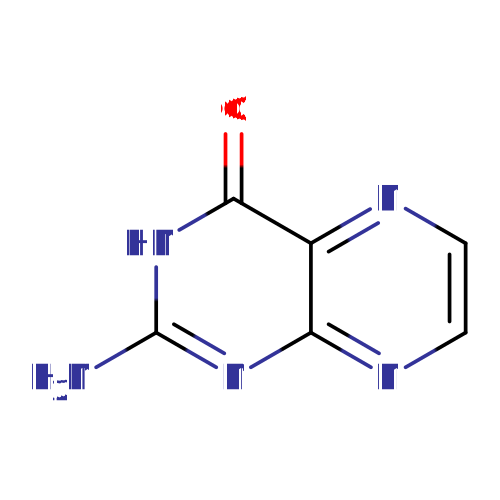
| Description | Pterin, also known as 4-oxopterin or pteridoxamine, belongs to the class of organic compounds known as pterins and derivatives. These are polycyclic aromatic compounds containing a pterin moiety, which consist of a pteridine ring bearing a ketone and an amine group to form 2-aminopteridin-4(3H)-one. Pterin exists in all living organisms, ranging from bacteria to humans. In humans, pterin is involved in the caffeine metabolism pathway. Pterin is found, on average, in the highest concentration within soy beans (Glycine max). Pterin has also been detected, but not quantified in, a few different foods, such as anatidaes (Anatidae), chickens (Gallus gallus), and domestic pigs (Sus scrofa domestica). This could make pterin a potential biomarker for the consumption of these foods. Pterin is a primary metabolite. Primary metabolites are metabolically or physiologically essential metabolites. They are directly involved in an organism’s growth, development or reproduction. Based on a literature review a significant number of articles have been published on Pterin. |
|---|
| Structure | InChI=1S/C6H5N5O/c7-6-10-4-3(5(12)11-6)8-1-2-9-4/h1-2H,(H3,7,9,10,11,12) |
|---|
| Synonyms | | Value | Source |
|---|
| 2-Amino-4-hydroxypteridine | ChEBI | | 2-Amino-4-oxopteridine | Kegg | | 2-Amino-1H-pteridin-4-one | HMDB | | 2-Amino-3H-pteridin-4-one | HMDB | | 2-Amino-4(1H)-pteridinone | HMDB | | 2-Amino-4(3H)-pteridinone | HMDB | | 2-Amino-4-pteridinol | HMDB | | 2-Amino-4-pteridone | HMDB | | 2-Amino-quinonoid dihydropterin | HMDB | | 2-Aminopteridin-4-one | HMDB | | 4-oxo-2-Aminopteridine | HMDB | | 4-Oxopterin | HMDB | | Pteridoxamine | HMDB | | Pterine | HMDB | | 2-Amino-4-hydroxyaminopteridine | HMDB | | AHAPT | HMDB |
|
|---|
| Chemical Formula | C6H5N5O |
|---|
| Average Molecular Weight | 163.1368 |
|---|
| Monoisotopic Molecular Weight | 163.049409807 |
|---|
| IUPAC Name | 2-amino-3,4-dihydropteridin-4-one |
|---|
| Traditional Name | 2-amino-4-oxopteridine |
|---|
| CAS Registry Number | 2236-60-4 |
|---|
| SMILES | NC1=NC2=NC=CN=C2C(=O)N1 |
|---|
| InChI Identifier | InChI=1S/C6H5N5O/c7-6-10-4-3(5(12)11-6)8-1-2-9-4/h1-2H,(H3,7,9,10,11,12) |
|---|
| InChI Key | HNXQXTQTPAJEJL-UHFFFAOYSA-N |
|---|
| Chemical Taxonomy |
|---|
| Description | Belongs to the class of organic compounds known as pterins and derivatives. These are polycyclic aromatic compounds containing a pterin moiety, which consist of a pteridine ring bearing a ketone and an amine group to form 2-aminopteridin-4(3H)-one. |
|---|
| Kingdom | Organic compounds |
|---|
| Super Class | Organoheterocyclic compounds |
|---|
| Class | Pteridines and derivatives |
|---|
| Sub Class | Pterins and derivatives |
|---|
| Direct Parent | Pterins and derivatives |
|---|
| Alternative Parents | |
|---|
| Substituents | - Pterin
- Aminopyrimidine
- Pyrimidone
- Pyrazine
- Pyrimidine
- Heteroaromatic compound
- Vinylogous amide
- Azacycle
- Amine
- Hydrocarbon derivative
- Organic oxide
- Organopnictogen compound
- Organic oxygen compound
- Primary amine
- Organooxygen compound
- Organonitrogen compound
- Organic nitrogen compound
- Aromatic heteropolycyclic compound
|
|---|
| Molecular Framework | Aromatic heteropolycyclic compounds |
|---|
| External Descriptors | |
|---|
| Ontology |
|---|
| Physiological effect | Not Available |
|---|
| Disposition | |
|---|
| Process | Not Available |
|---|
| Role | Not Available |
|---|
| Physical Properties |
|---|
| State | Solid |
|---|
| Experimental Molecular Properties | | Property | Value | Reference |
|---|
| Melting Point | Not Available | Not Available | | Boiling Point | Not Available | Not Available | | Water Solubility | 0.18 mg/mL | Not Available | | LogP | Not Available | Not Available |
|
|---|
| Experimental Chromatographic Properties | Experimental Collision Cross Sections |
|---|
| Predicted Molecular Properties | |
|---|
| Predicted Chromatographic Properties | Predicted Collision Cross SectionsPredicted Retention Times Underivatized| Chromatographic Method | Retention Time | Reference |
|---|
| Measured using a Waters Acquity ultraperformance liquid chromatography (UPLC) ethylene-bridged hybrid (BEH) C18 column (100 mm × 2.1 mm; 1.7 μmparticle diameter). Predicted by Afia on May 17, 2022. Predicted by Afia on May 17, 2022. | 1.59 minutes | 32390414 | | Predicted by Siyang on May 30, 2022 | 9.2115 minutes | 33406817 | | Predicted by Siyang using ReTip algorithm on June 8, 2022 | 3.61 minutes | 32390414 | | AjsUoB = Accucore 150 Amide HILIC with 10mM Ammonium Formate, 0.1% Formic Acid | 58.3 seconds | 40023050 | | Fem_Long = Waters ACQUITY UPLC HSS T3 C18 with Water:MeOH and 0.1% Formic Acid | 756.8 seconds | 40023050 | | Fem_Lipids = Ascentis Express C18 with (60:40 water:ACN):(90:10 IPA:ACN) and 10mM NH4COOH + 0.1% Formic Acid | 325.8 seconds | 40023050 | | Life_Old = Waters ACQUITY UPLC BEH C18 with Water:(20:80 acetone:ACN) and 0.1% Formic Acid | 82.0 seconds | 40023050 | | Life_New = RP Waters ACQUITY UPLC HSS T3 C18 with Water:(30:70 MeOH:ACN) and 0.1% Formic Acid | 208.4 seconds | 40023050 | | RIKEN = Waters ACQUITY UPLC BEH C18 with Water:ACN and 0.1% Formic Acid | 61.1 seconds | 40023050 | | Eawag_XBridgeC18 = XBridge C18 3.5u 2.1x50 mm with Water:MeOH and 0.1% Formic Acid | 288.3 seconds | 40023050 | | BfG_NTS_RP1 =Agilent Zorbax Eclipse Plus C18 (2.1 mm x 150 mm, 3.5 um) with Water:ACN and 0.1% Formic Acid | 340.5 seconds | 40023050 | | HILIC_BDD_2 = Merck SeQuant ZIC-HILIC with ACN(0.1% formic acid):water(16 mM ammonium formate) | 243.1 seconds | 40023050 | | UniToyama_Atlantis = RP Waters Atlantis T3 (2.1 x 150 mm, 5 um) with ACN:Water and 0.1% Formic Acid | 630.4 seconds | 40023050 | | BDD_C18 = Hypersil Gold 1.9µm C18 with Water:ACN and 0.1% Formic Acid | 49.2 seconds | 40023050 | | UFZ_Phenomenex = Kinetex Core-Shell C18 2.6 um, 3.0 x 100 mm, Phenomenex with Water:MeOH and 0.1% Formic Acid | 760.6 seconds | 40023050 | | SNU_RIKEN_POS = Waters ACQUITY UPLC BEH C18 with Water:ACN and 0.1% Formic Acid | 202.0 seconds | 40023050 | | RPMMFDA = Waters ACQUITY UPLC BEH C18 with Water:ACN and 0.1% Formic Acid | 216.9 seconds | 40023050 | | MTBLS87 = Merck SeQuant ZIC-pHILIC column with ACN:Water and :ammonium carbonate | 539.4 seconds | 40023050 | | KI_GIAR_zic_HILIC_pH2_7 = Merck SeQuant ZIC-HILIC with ACN:Water and 0.1% FA | 237.2 seconds | 40023050 | | Meister zic-pHILIC pH9.3 = Merck SeQuant ZIC-pHILIC column with ACN:Water 5mM NH4Ac pH9.3 and 5mM ammonium acetate in water | 182.1 seconds | 40023050 |
Predicted Kovats Retention IndicesUnderivatizedDerivatized| Derivative Name / Structure | SMILES | Kovats RI Value | Column Type | Reference |
|---|
| Pterin,1TMS,isomer #1 | C[Si](C)(C)NC1=NC2=NC=CN=C2C(=O)[NH]1 | 2061.7 | Semi standard non polar | 33892256 | | Pterin,1TMS,isomer #1 | C[Si](C)(C)NC1=NC2=NC=CN=C2C(=O)[NH]1 | 2104.0 | Standard non polar | 33892256 | | Pterin,1TMS,isomer #1 | C[Si](C)(C)NC1=NC2=NC=CN=C2C(=O)[NH]1 | 3211.3 | Standard polar | 33892256 | | Pterin,1TMS,isomer #2 | C[Si](C)(C)N1C(N)=NC2=NC=CN=C2C1=O | 1977.5 | Semi standard non polar | 33892256 | | Pterin,1TMS,isomer #2 | C[Si](C)(C)N1C(N)=NC2=NC=CN=C2C1=O | 2010.8 | Standard non polar | 33892256 | | Pterin,1TMS,isomer #2 | C[Si](C)(C)N1C(N)=NC2=NC=CN=C2C1=O | 3225.0 | Standard polar | 33892256 | | Pterin,2TMS,isomer #1 | C[Si](C)(C)N(C1=NC2=NC=CN=C2C(=O)[NH]1)[Si](C)(C)C | 1885.1 | Semi standard non polar | 33892256 | | Pterin,2TMS,isomer #1 | C[Si](C)(C)N(C1=NC2=NC=CN=C2C(=O)[NH]1)[Si](C)(C)C | 2069.8 | Standard non polar | 33892256 | | Pterin,2TMS,isomer #1 | C[Si](C)(C)N(C1=NC2=NC=CN=C2C(=O)[NH]1)[Si](C)(C)C | 3005.6 | Standard polar | 33892256 | | Pterin,2TMS,isomer #2 | C[Si](C)(C)NC1=NC2=NC=CN=C2C(=O)N1[Si](C)(C)C | 1956.5 | Semi standard non polar | 33892256 | | Pterin,2TMS,isomer #2 | C[Si](C)(C)NC1=NC2=NC=CN=C2C(=O)N1[Si](C)(C)C | 2086.3 | Standard non polar | 33892256 | | Pterin,2TMS,isomer #2 | C[Si](C)(C)NC1=NC2=NC=CN=C2C(=O)N1[Si](C)(C)C | 2970.4 | Standard polar | 33892256 | | Pterin,3TMS,isomer #1 | C[Si](C)(C)N(C1=NC2=NC=CN=C2C(=O)N1[Si](C)(C)C)[Si](C)(C)C | 1979.1 | Semi standard non polar | 33892256 | | Pterin,3TMS,isomer #1 | C[Si](C)(C)N(C1=NC2=NC=CN=C2C(=O)N1[Si](C)(C)C)[Si](C)(C)C | 2127.7 | Standard non polar | 33892256 | | Pterin,3TMS,isomer #1 | C[Si](C)(C)N(C1=NC2=NC=CN=C2C(=O)N1[Si](C)(C)C)[Si](C)(C)C | 2721.5 | Standard polar | 33892256 | | Pterin,1TBDMS,isomer #1 | CC(C)(C)[Si](C)(C)NC1=NC2=NC=CN=C2C(=O)[NH]1 | 2257.9 | Semi standard non polar | 33892256 | | Pterin,1TBDMS,isomer #1 | CC(C)(C)[Si](C)(C)NC1=NC2=NC=CN=C2C(=O)[NH]1 | 2222.2 | Standard non polar | 33892256 | | Pterin,1TBDMS,isomer #1 | CC(C)(C)[Si](C)(C)NC1=NC2=NC=CN=C2C(=O)[NH]1 | 3285.9 | Standard polar | 33892256 | | Pterin,1TBDMS,isomer #2 | CC(C)(C)[Si](C)(C)N1C(N)=NC2=NC=CN=C2C1=O | 2193.7 | Semi standard non polar | 33892256 | | Pterin,1TBDMS,isomer #2 | CC(C)(C)[Si](C)(C)N1C(N)=NC2=NC=CN=C2C1=O | 2190.9 | Standard non polar | 33892256 | | Pterin,1TBDMS,isomer #2 | CC(C)(C)[Si](C)(C)N1C(N)=NC2=NC=CN=C2C1=O | 3238.7 | Standard polar | 33892256 | | Pterin,2TBDMS,isomer #1 | CC(C)(C)[Si](C)(C)N(C1=NC2=NC=CN=C2C(=O)[NH]1)[Si](C)(C)C(C)(C)C | 2303.9 | Semi standard non polar | 33892256 | | Pterin,2TBDMS,isomer #1 | CC(C)(C)[Si](C)(C)N(C1=NC2=NC=CN=C2C(=O)[NH]1)[Si](C)(C)C(C)(C)C | 2431.7 | Standard non polar | 33892256 | | Pterin,2TBDMS,isomer #1 | CC(C)(C)[Si](C)(C)N(C1=NC2=NC=CN=C2C(=O)[NH]1)[Si](C)(C)C(C)(C)C | 3038.9 | Standard polar | 33892256 | | Pterin,2TBDMS,isomer #2 | CC(C)(C)[Si](C)(C)NC1=NC2=NC=CN=C2C(=O)N1[Si](C)(C)C(C)(C)C | 2329.6 | Semi standard non polar | 33892256 | | Pterin,2TBDMS,isomer #2 | CC(C)(C)[Si](C)(C)NC1=NC2=NC=CN=C2C(=O)N1[Si](C)(C)C(C)(C)C | 2428.0 | Standard non polar | 33892256 | | Pterin,2TBDMS,isomer #2 | CC(C)(C)[Si](C)(C)NC1=NC2=NC=CN=C2C(=O)N1[Si](C)(C)C(C)(C)C | 3028.5 | Standard polar | 33892256 | | Pterin,3TBDMS,isomer #1 | CC(C)(C)[Si](C)(C)N(C1=NC2=NC=CN=C2C(=O)N1[Si](C)(C)C(C)(C)C)[Si](C)(C)C(C)(C)C | 2517.6 | Semi standard non polar | 33892256 | | Pterin,3TBDMS,isomer #1 | CC(C)(C)[Si](C)(C)N(C1=NC2=NC=CN=C2C(=O)N1[Si](C)(C)C(C)(C)C)[Si](C)(C)C(C)(C)C | 2736.4 | Standard non polar | 33892256 | | Pterin,3TBDMS,isomer #1 | CC(C)(C)[Si](C)(C)N(C1=NC2=NC=CN=C2C(=O)N1[Si](C)(C)C(C)(C)C)[Si](C)(C)C(C)(C)C | 2893.1 | Standard polar | 33892256 |
|
|---|
| Disease References | | Colorectal cancer |
|---|
- Goedert JJ, Sampson JN, Moore SC, Xiao Q, Xiong X, Hayes RB, Ahn J, Shi J, Sinha R: Fecal metabolomics: assay performance and association with colorectal cancer. Carcinogenesis. 2014 Sep;35(9):2089-96. doi: 10.1093/carcin/bgu131. Epub 2014 Jul 18. [PubMed:25037050 ]
- Sinha R, Ahn J, Sampson JN, Shi J, Yu G, Xiong X, Hayes RB, Goedert JJ: Fecal Microbiota, Fecal Metabolome, and Colorectal Cancer Interrelations. PLoS One. 2016 Mar 25;11(3):e0152126. doi: 10.1371/journal.pone.0152126. eCollection 2016. [PubMed:27015276 ]
|
|
|---|
| General References | - Bonafe L, Thony B, Penzien JM, Czarnecki B, Blau N: Mutations in the sepiapterin reductase gene cause a novel tetrahydrobiopterin-dependent monoamine-neurotransmitter deficiency without hyperphenylalaninemia. Am J Hum Genet. 2001 Aug;69(2):269-77. Epub 2001 Jul 6. [PubMed:11443547 ]
- Dhondt JL, Cotton RG, Danks DM: Liver enzyme activities in hyperphenylalaninaemia due to a defective synthesis of tetrahydrobiopterin. J Inherit Metab Dis. 1985;8(2):47-8. [PubMed:3939528 ]
- Kaufman S, Kapatos G, Rizzo WB, Schulman JD, Tamarkin L, Van Loon GR: Tetrahydropterin therapy for hyperphenylalaninemia caused by defective synthesis of tetrahydrobiopterin. Ann Neurol. 1983 Sep;14(3):308-15. [PubMed:6139056 ]
- Katoh S, Sueoka T, Matsuura S, Sugimoto T: Biopterin and neopterin in human saliva. Life Sci. 1989;45(26):2561-8. [PubMed:2615555 ]
- Dhondt JL, Tilmont P, Ringel J, Farriaux JP: Pterins analysis in amniotic fluid for the prenatal diagnosis of GTP cyclohydrolase deficiency. J Inherit Metab Dis. 1990;13(6):879-82. [PubMed:2079836 ]
- Bonafe L, Thony B, Leimbacher W, Kierat L, Blau N: Diagnosis of dopa-responsive dystonia and other tetrahydrobiopterin disorders by the study of biopterin metabolism in fibroblasts. Clin Chem. 2001 Mar;47(3):477-85. [PubMed:11238300 ]
- Krumdieck CL, Fukushima K, Fukushima T, Shiota T, Butterworth CE Jr: A long-term study of the excretion of folate and pterins in a human subject after ingestion of 14C folic acid, with observations on the effect of diphenylhydantoin administration. Am J Clin Nutr. 1978 Jan;31(1):88-93. [PubMed:413430 ]
- Han F, Huynh BH, Shi H, Lin B, Ma Y: Pteridine analysis in urine by capillary electrophoresis using laser-induced fluorescence detection. Anal Chem. 1999 Apr 1;71(7):1265-9. [PubMed:10204031 ]
- Yamamoto T, Moriwaki Y, Takahashi S, Tsutsumi Z, Yamakita J, Nasako Y, Hiroishi K, Higashino K: Determination of human plasma xanthine oxidase activity by high-performance liquid chromatography. J Chromatogr B Biomed Appl. 1996 Jun 7;681(2):395-400. [PubMed:8811453 ]
- Beckman JS, Parks DA, Pearson JD, Marshall PA, Freeman BA: A sensitive fluorometric assay for measuring xanthine dehydrogenase and oxidase in tissues. Free Radic Biol Med. 1989;6(6):607-15. [PubMed:2753392 ]
- Gordon JH, Perry KO: Pre- and postsynaptic neurochemical alterations following estrogen-induced striatal dopamine hypo- and hypersensitivity. Brain Res Bull. 1983 Apr;10(4):425-8. [PubMed:6134572 ]
- Stupperich E: Recent advances in elucidation of biological corrinoid functions. FEMS Microbiol Rev. 1993 Nov;12(4):349-65. [PubMed:8268006 ]
- Niederwieser A, Blau N, Wang M, Joller P, Atares M, Cardesa-Garcia J: GTP cyclohydrolase I deficiency, a new enzyme defect causing hyperphenylalaninemia with neopterin, biopterin, dopamine, and serotonin deficiencies and muscular hypotonia. Eur J Pediatr. 1984 Feb;141(4):208-14. [PubMed:6734669 ]
- Blau N, Kierat L, Matasovic A, Leimbacher W, Heizmann CW, Guardamagna O, Ponzone A: Antenatal diagnosis of tetrahydrobiopterin deficiency by quantification of pterins in amniotic fluid and enzyme activity in fetal and extrafetal tissue. Clin Chim Acta. 1994 May;226(2):159-69. [PubMed:7923811 ]
- Rokos H, Beazley WD, Schallreuter KU: Oxidative stress in vitiligo: photo-oxidation of pterins produces H(2)O(2) and pterin-6-carboxylic acid. Biochem Biophys Res Commun. 2002 Apr 12;292(4):805-11. [PubMed:11944885 ]
|
|---|