| Record Information |
|---|
| Version | 5.0 |
|---|
| Status | Detected and Quantified |
|---|
| Creation Date | 2005-11-16 15:48:42 UTC |
|---|
| Update Date | 2023-05-30 20:55:58 UTC |
|---|
| HMDB ID | HMDB0000812 |
|---|
| Secondary Accession Numbers | |
|---|
| Metabolite Identification |
|---|
| Common Name | N-Acetyl-L-aspartic acid |
|---|
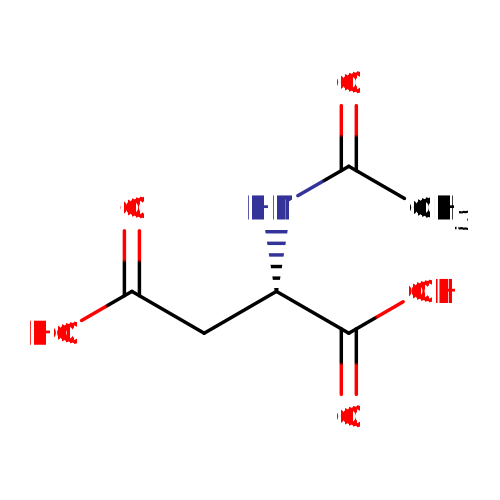
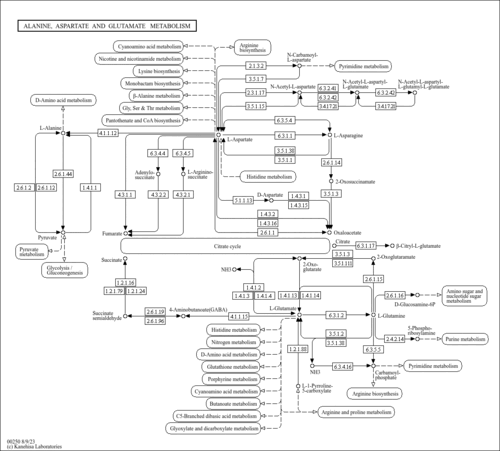
| Description | N-Acetyl-L-Aspartic acid (NAA) or N-Acetylaspartic acid, belongs to the class of organic compounds known as N-acyl-alpha amino acids. N-acyl-alpha amino acids are compounds containing an alpha amino acid which bears an acyl group at its terminal nitrogen atom. N-alpha-Acetyl-L-aspartic acid can also be classified as an alpha amino acid or a derivatized alpha amino acid. Technically, N-Acetyl-L-aspartic acid is a biologically available N-terminal capped form of the proteinogenic alpha amino acid L-aspartic acid. N-acetyl amino acids can be produced either via direct synthesis of specific N-acetyltransferases or via the proteolytic degradation of N-acetylated proteins by specific hydrolases. N-terminal acetylation of proteins is a widespread and highly conserved process in eukaryotes that is involved in protection and stability of proteins (PMID: 16465618 ). About 85% of all human proteins and 68% of all yeast proteins are acetylated at their N-terminus (PMID: 21750686 ). Several proteins from prokaryotes and archaea are also modified by N-terminal acetylation. The majority of eukaryotic N-terminal-acetylation reactions occur through N-acetyltransferase enzymes or NAT’s (PMID: 30054468 ). These enzymes consist of three main oligomeric complexes NatA, NatB, and NatC, which are composed of at least a unique catalytic subunit and one unique ribosomal anchor. The substrate specificities of different NAT enzymes are mainly determined by the identities of the first two N-terminal residues of the target protein. The human NatA complex co-translationally acetylates N-termini that bear a small amino acid (A, S, T, C, and occasionally V and G) (PMID: 30054468 ). NatA also exists in a monomeric state and can post-translationally acetylate acidic N-termini residues (D-, E-). NatB and NatC acetylate N-terminal methionine with further specificity determined by the identity of the second amino acid. N-acetylated amino acids, such as N-acetylaspartate can be released by an N-acylpeptide hydrolase from peptides generated by proteolytic degradation (PMID: 16465618 ). In addition to the NAT enzymes and protein-based acetylation, N-acetylation of free aspartic acid can also occur. In particular, N-Acetyl-L-aspartic acid can be synthesized in neurons from the amino acid aspartate and acetyl coenzyme A (acetyl CoA). Specifically, the enzyme known as aspartate N-acetyltransferase (EC 2.3.1.17) catalyzes the transfer of the acetyl group of acetyl CoA to the amino group of aspartate. N-Acetyl-L-aspartic acid is the second most concentrated molecule in the brain after the amino acid glutamate. The various functions served by N-acetylaspartic acid are still under investigation, but the primary proposed functions include (1) acting as a neuronal osmolyte that is involved in fluid balance in the brain, (2) serving as a source of acetate for lipid and myelin synthesis in oligodendrocytes (the glial cells that myelinate neuronal axons), (3) serving as a precursor for the synthesis of the important dipeptide neurotransmitter N-acetylaspartylglutamate (NAAG), and (4) playing a potential role in energy production from the amino acid glutamate in neuronal mitochondria. High neurotransmitter (i.e. N-acetylaspartic acid) levels can lead to abnormal neural signaling, delayed or arrested intellectual development, and difficulties with general motor skills. When present in sufficiently high levels, N-acetylaspartic acid can be a neurotoxin, an acidogen, and a metabotoxin. A neurotoxin is a compound that disrupts or attacks neural tissue. An acidogen is an acidic compound that induces acidosis, which has multiple adverse effects on many organ systems. A metabotoxin is an endogenously produced metabolite that causes adverse health effects at chronically high levels. Chronically high levels of N-acetylaspartic acid are associated with Canavan disease. Because N-acetylaspartic acid functions as an organic acid and high levels of organic acids can lead to a condition known as acidosis. Abnormally high levels of organic acids in the blood (organic acidemia), urine (organic aciduria), the brain, and other tissues lead to general metabolic acidosis. Acidosis typically occurs when arterial pH falls below 7.35. Infants with acidosis have symptoms that include poor feeding, vomiting, loss of appetite, weak muscle tone (hypotonia), and lack of energy (lethargy). These can progress to heart abnormalities, seizures, coma, and possibly death. Many affected children with organic acidemias experience intellectual disability or delayed development. In adults, acidosis or acidemia is characterized by headaches, confusion, feeling tired, tremors, sleepiness, and flapping tremors. Many N-acetylamino acids, including N-acetylaspartic acid, are classified as uremic toxins if present in high abundance in the serum or plasma (PMID: 26317986 ; PMID: 20613759 ). Uremic toxins are a diverse group of endogenously produced molecules that, if not properly cleared or eliminated by the kidneys, can cause kidney damage, cardiovascular disease and neurological deficits (PMID: 18287557 ). |
|---|
| Structure | CC(=O)N[C@@H](CC(O)=O)C(O)=O InChI=1S/C6H9NO5/c1-3(8)7-4(6(11)12)2-5(9)10/h4H,2H2,1H3,(H,7,8)(H,9,10)(H,11,12)/t4-/m0/s1 |
|---|
| Synonyms | | Value | Source |
|---|
| (S)-2-(Acetylamino)butanedioic acid | ChEBI | | (S)-2-(Acetylamino)succinic acid | ChEBI | | Acetyl-L-aspartic acid | ChEBI | | Acetylaspartic acid | ChEBI | | L-N-Acetylaspartic acid | ChEBI | | N-Acetylaspartic acid | ChEBI | | NAA | ChEBI | | (S)-2-(Acetylamino)butanedioate | Generator | | (S)-2-(Acetylamino)succinate | Generator | | Acetyl-L-aspartate | Generator | | Acetylaspartate | Generator | | L-N-Acetylaspartate | Generator | | N-Acetylaspartate | Generator | | N-Acetyl-L-aspartate | Generator | | (2S)-2-Acetamidobutanedioate | HMDB | | (2S)-2-Acetamidobutanedioic acid | HMDB | | N-Acetyl-S-aspartate | HMDB | | N-Acetyl-S-aspartic acid | HMDB | | N-Acetyl aspartate | HMDB | | N-Acetylaspartate, monopotassium salt | HMDB | | Acetyl aspartic acid | HMDB |
|
|---|
| Chemical Formula | C6H9NO5 |
|---|
| Average Molecular Weight | 175.1394 |
|---|
| Monoisotopic Molecular Weight | 175.048072403 |
|---|
| IUPAC Name | (2S)-2-acetamidobutanedioic acid |
|---|
| Traditional Name | acetyl-L-aspartic acid |
|---|
| CAS Registry Number | 997-55-7 |
|---|
| SMILES | CC(=O)N[C@@H](CC(O)=O)C(O)=O |
|---|
| InChI Identifier | InChI=1S/C6H9NO5/c1-3(8)7-4(6(11)12)2-5(9)10/h4H,2H2,1H3,(H,7,8)(H,9,10)(H,11,12)/t4-/m0/s1 |
|---|
| InChI Key | OTCCIMWXFLJLIA-BYPYZUCNSA-N |
|---|
| Chemical Taxonomy |
|---|
| Description | Belongs to the class of organic compounds known as aspartic acid and derivatives. Aspartic acid and derivatives are compounds containing an aspartic acid or a derivative thereof resulting from reaction of aspartic acid at the amino group or the carboxy group, or from the replacement of any hydrogen of glycine by a heteroatom. |
|---|
| Kingdom | Organic compounds |
|---|
| Super Class | Organic acids and derivatives |
|---|
| Class | Carboxylic acids and derivatives |
|---|
| Sub Class | Amino acids, peptides, and analogues |
|---|
| Direct Parent | Aspartic acid and derivatives |
|---|
| Alternative Parents | |
|---|
| Substituents | - Aspartic acid or derivatives
- N-acyl-alpha-amino acid
- N-acyl-alpha amino acid or derivatives
- N-acyl-l-alpha-amino acid
- Dicarboxylic acid or derivatives
- Fatty acid
- Acetamide
- Carboxamide group
- Secondary carboxylic acid amide
- Carboxylic acid
- Carbonyl group
- Organooxygen compound
- Organonitrogen compound
- Organopnictogen compound
- Organic oxygen compound
- Organic nitrogen compound
- Organic oxide
- Hydrocarbon derivative
- Aliphatic acyclic compound
|
|---|
| Molecular Framework | Aliphatic acyclic compounds |
|---|
| External Descriptors | |
|---|
| Ontology |
|---|
| Physiological effect | |
|---|
| Disposition | |
|---|
| Process | |
|---|
| Role | |
|---|
| Physical Properties |
|---|
| State | Solid |
|---|
| Experimental Molecular Properties | | Property | Value | Reference |
|---|
| Melting Point | 137 - 140 °C | Not Available | | Boiling Point | Not Available | Not Available | | Water Solubility | 675 mg/mL | Not Available | | LogP | Not Available | Not Available |
|
|---|
| Experimental Chromatographic Properties | Experimental Collision Cross Sections |
|---|
| Predicted Molecular Properties | |
|---|
| Predicted Chromatographic Properties | Predicted Collision Cross SectionsPredicted Kovats Retention IndicesUnderivatizedDerivatized| Derivative Name / Structure | SMILES | Kovats RI Value | Column Type | Reference |
|---|
| N-Acetyl-L-aspartic acid,1TMS,isomer #1 | CC(=O)N[C@@H](CC(=O)O[Si](C)(C)C)C(=O)O | 1567.1 | Semi standard non polar | 33892256 | | N-Acetyl-L-aspartic acid,1TMS,isomer #2 | CC(=O)N[C@@H](CC(=O)O)C(=O)O[Si](C)(C)C | 1525.7 | Semi standard non polar | 33892256 | | N-Acetyl-L-aspartic acid,1TMS,isomer #3 | CC(=O)N([C@@H](CC(=O)O)C(=O)O)[Si](C)(C)C | 1623.5 | Semi standard non polar | 33892256 | | N-Acetyl-L-aspartic acid,2TMS,isomer #1 | CC(=O)N[C@@H](CC(=O)O[Si](C)(C)C)C(=O)O[Si](C)(C)C | 1667.9 | Semi standard non polar | 33892256 | | N-Acetyl-L-aspartic acid,2TMS,isomer #2 | CC(=O)N([C@@H](CC(=O)O[Si](C)(C)C)C(=O)O)[Si](C)(C)C | 1654.7 | Semi standard non polar | 33892256 | | N-Acetyl-L-aspartic acid,2TMS,isomer #3 | CC(=O)N([C@@H](CC(=O)O)C(=O)O[Si](C)(C)C)[Si](C)(C)C | 1646.7 | Semi standard non polar | 33892256 | | N-Acetyl-L-aspartic acid,3TMS,isomer #1 | CC(=O)N([C@@H](CC(=O)O[Si](C)(C)C)C(=O)O[Si](C)(C)C)[Si](C)(C)C | 1691.7 | Semi standard non polar | 33892256 | | N-Acetyl-L-aspartic acid,3TMS,isomer #1 | CC(=O)N([C@@H](CC(=O)O[Si](C)(C)C)C(=O)O[Si](C)(C)C)[Si](C)(C)C | 1718.2 | Standard non polar | 33892256 | | N-Acetyl-L-aspartic acid,3TMS,isomer #1 | CC(=O)N([C@@H](CC(=O)O[Si](C)(C)C)C(=O)O[Si](C)(C)C)[Si](C)(C)C | 1890.3 | Standard polar | 33892256 | | N-Acetyl-L-aspartic acid,1TBDMS,isomer #1 | CC(=O)N[C@@H](CC(=O)O[Si](C)(C)C(C)(C)C)C(=O)O | 1824.7 | Semi standard non polar | 33892256 | | N-Acetyl-L-aspartic acid,1TBDMS,isomer #2 | CC(=O)N[C@@H](CC(=O)O)C(=O)O[Si](C)(C)C(C)(C)C | 1781.0 | Semi standard non polar | 33892256 | | N-Acetyl-L-aspartic acid,1TBDMS,isomer #3 | CC(=O)N([C@@H](CC(=O)O)C(=O)O)[Si](C)(C)C(C)(C)C | 1849.9 | Semi standard non polar | 33892256 | | N-Acetyl-L-aspartic acid,2TBDMS,isomer #1 | CC(=O)N[C@@H](CC(=O)O[Si](C)(C)C(C)(C)C)C(=O)O[Si](C)(C)C(C)(C)C | 2095.1 | Semi standard non polar | 33892256 | | N-Acetyl-L-aspartic acid,2TBDMS,isomer #2 | CC(=O)N([C@@H](CC(=O)O[Si](C)(C)C(C)(C)C)C(=O)O)[Si](C)(C)C(C)(C)C | 2126.8 | Semi standard non polar | 33892256 | | N-Acetyl-L-aspartic acid,2TBDMS,isomer #3 | CC(=O)N([C@@H](CC(=O)O)C(=O)O[Si](C)(C)C(C)(C)C)[Si](C)(C)C(C)(C)C | 2093.7 | Semi standard non polar | 33892256 | | N-Acetyl-L-aspartic acid,3TBDMS,isomer #1 | CC(=O)N([C@@H](CC(=O)O[Si](C)(C)C(C)(C)C)C(=O)O[Si](C)(C)C(C)(C)C)[Si](C)(C)C(C)(C)C | 2350.4 | Semi standard non polar | 33892256 | | N-Acetyl-L-aspartic acid,3TBDMS,isomer #1 | CC(=O)N([C@@H](CC(=O)O[Si](C)(C)C(C)(C)C)C(=O)O[Si](C)(C)C(C)(C)C)[Si](C)(C)C(C)(C)C | 2343.0 | Standard non polar | 33892256 | | N-Acetyl-L-aspartic acid,3TBDMS,isomer #1 | CC(=O)N([C@@H](CC(=O)O[Si](C)(C)C(C)(C)C)C(=O)O[Si](C)(C)C(C)(C)C)[Si](C)(C)C(C)(C)C | 2312.6 | Standard polar | 33892256 |
|
|---|
| Spectra |
|---|
| GC-MS Spectra| Spectrum Type | Description | Splash Key | Deposition Date | Source | View |
|---|
| Experimental GC-MS | GC-MS Spectrum - N-Acetyl-L-aspartic acid GC-EI-TOF (Pegasus III TOF-MS system, Leco; GC 6890, Agilent Technologies) (Non-derivatized) | splash10-0cdi-0910000000-80f173aa655a9e8604b5 | 2014-06-16 | HMDB team, MONA, MassBank | View Spectrum | | Experimental GC-MS | GC-MS Spectrum - N-Acetyl-L-aspartic acid GC-EI-TOF (Pegasus III TOF-MS system, Leco; GC 6890, Agilent Technologies) (Non-derivatized) | splash10-008a-0930000000-63ecd768773360e39272 | 2014-06-16 | HMDB team, MONA, MassBank | View Spectrum | | Experimental GC-MS | GC-MS Spectrum - N-Acetyl-L-aspartic acid GC-MS (3 TMS) | splash10-001i-0950000000-beff64b09b14e79c535c | 2014-06-16 | HMDB team, MONA, MassBank | View Spectrum | | Experimental GC-MS | GC-MS Spectrum - N-Acetyl-L-aspartic acid GC-EI-TOF (Non-derivatized) | splash10-0cdi-0910000000-80f173aa655a9e8604b5 | 2017-09-12 | HMDB team, MONA, MassBank | View Spectrum | | Experimental GC-MS | GC-MS Spectrum - N-Acetyl-L-aspartic acid GC-EI-TOF (Non-derivatized) | splash10-008a-0930000000-63ecd768773360e39272 | 2017-09-12 | HMDB team, MONA, MassBank | View Spectrum | | Experimental GC-MS | GC-MS Spectrum - N-Acetyl-L-aspartic acid GC-MS (Non-derivatized) | splash10-001i-0950000000-beff64b09b14e79c535c | 2017-09-12 | HMDB team, MONA, MassBank | View Spectrum | | Experimental GC-MS | GC-MS Spectrum - N-Acetyl-L-aspartic acid GC-EI-TOF (Non-derivatized) | splash10-0pvj-0910000000-8952da198dfa2ecb7e21 | 2017-09-12 | HMDB team, MONA, MassBank | View Spectrum | | Experimental GC-MS | GC-MS Spectrum - N-Acetyl-L-aspartic acid GC-EI-TOF (Non-derivatized) | splash10-01x1-0930000000-ac192f128bc253b6c299 | 2017-09-12 | HMDB team, MONA, MassBank | View Spectrum | | Predicted GC-MS | Predicted GC-MS Spectrum - N-Acetyl-L-aspartic acid GC-MS (Non-derivatized) - 70eV, Positive | splash10-000x-9400000000-e45e6641c1b4fdac03e7 | 2017-09-01 | Wishart Lab | View Spectrum | | Predicted GC-MS | Predicted GC-MS Spectrum - N-Acetyl-L-aspartic acid GC-MS (2 TMS) - 70eV, Positive | splash10-00dl-9541000000-1ca7edd5f216e4355383 | 2017-10-06 | Wishart Lab | View Spectrum | | Predicted GC-MS | Predicted GC-MS Spectrum - N-Acetyl-L-aspartic acid GC-MS (Non-derivatized) - 70eV, Positive | Not Available | 2021-10-12 | Wishart Lab | View Spectrum | | Predicted GC-MS | Predicted GC-MS Spectrum - N-Acetyl-L-aspartic acid GC-MS (Non-derivatized) - 70eV, Positive | Not Available | 2021-10-12 | Wishart Lab | View Spectrum | | Predicted GC-MS | Predicted GC-MS Spectrum - N-Acetyl-L-aspartic acid GC-MS (TMS_1_1) - 70eV, Positive | Not Available | 2021-11-06 | Wishart Lab | View Spectrum | | Predicted GC-MS | Predicted GC-MS Spectrum - N-Acetyl-L-aspartic acid GC-MS (TMS_1_2) - 70eV, Positive | Not Available | 2021-11-06 | Wishart Lab | View Spectrum | | Predicted GC-MS | Predicted GC-MS Spectrum - N-Acetyl-L-aspartic acid GC-MS (TMS_1_3) - 70eV, Positive | Not Available | 2021-11-06 | Wishart Lab | View Spectrum | | Predicted GC-MS | Predicted GC-MS Spectrum - N-Acetyl-L-aspartic acid GC-MS (TMS_2_2) - 70eV, Positive | Not Available | 2021-11-06 | Wishart Lab | View Spectrum | | Predicted GC-MS | Predicted GC-MS Spectrum - N-Acetyl-L-aspartic acid GC-MS (TMS_2_3) - 70eV, Positive | Not Available | 2021-11-06 | Wishart Lab | View Spectrum | | Predicted GC-MS | Predicted GC-MS Spectrum - N-Acetyl-L-aspartic acid GC-MS (TBDMS_1_1) - 70eV, Positive | Not Available | 2021-11-06 | Wishart Lab | View Spectrum | | Predicted GC-MS | Predicted GC-MS Spectrum - N-Acetyl-L-aspartic acid GC-MS (TBDMS_1_2) - 70eV, Positive | Not Available | 2021-11-06 | Wishart Lab | View Spectrum | | Predicted GC-MS | Predicted GC-MS Spectrum - N-Acetyl-L-aspartic acid GC-MS (TBDMS_1_3) - 70eV, Positive | Not Available | 2021-11-06 | Wishart Lab | View Spectrum | | Predicted GC-MS | Predicted GC-MS Spectrum - N-Acetyl-L-aspartic acid GC-MS (TBDMS_2_1) - 70eV, Positive | Not Available | 2021-11-06 | Wishart Lab | View Spectrum | | Predicted GC-MS | Predicted GC-MS Spectrum - N-Acetyl-L-aspartic acid GC-MS (TBDMS_2_2) - 70eV, Positive | Not Available | 2021-11-06 | Wishart Lab | View Spectrum | | Predicted GC-MS | Predicted GC-MS Spectrum - N-Acetyl-L-aspartic acid GC-MS (TBDMS_2_3) - 70eV, Positive | Not Available | 2021-11-06 | Wishart Lab | View Spectrum |
MS/MS Spectra| Spectrum Type | Description | Splash Key | Deposition Date | Source | View |
|---|
| Experimental LC-MS/MS | LC-MS/MS Spectrum - N-Acetyl-L-aspartic acid Quattro_QQQ 10V, Positive-QTOF (Annotated) | splash10-001i-2900000000-73b8786c25f0b59927c6 | 2012-07-24 | HMDB team, MONA | View Spectrum | | Experimental LC-MS/MS | LC-MS/MS Spectrum - N-Acetyl-L-aspartic acid Quattro_QQQ 25V, Positive-QTOF (Annotated) | splash10-00dr-9000000000-f7f7d5d562cbcf3f69fa | 2012-07-24 | HMDB team, MONA | View Spectrum | | Experimental LC-MS/MS | LC-MS/MS Spectrum - N-Acetyl-L-aspartic acid Quattro_QQQ 40V, Positive-QTOF (Annotated) | splash10-006x-9000000000-01988ea29217a99519e1 | 2012-07-24 | HMDB team, MONA | View Spectrum | | Experimental LC-MS/MS | LC-MS/MS Spectrum - N-Acetyl-L-aspartic acid LC-ESI-QQ (API3000, Applied Biosystems) 10V, Negative-QTOF | splash10-00di-0900000000-e8fc0d2735d5a8ce1818 | 2012-08-31 | HMDB team, MONA | View Spectrum | | Experimental LC-MS/MS | LC-MS/MS Spectrum - N-Acetyl-L-aspartic acid LC-ESI-QQ (API3000, Applied Biosystems) 20V, Negative-QTOF | splash10-000i-9800000000-10648516e9c8e71f36ec | 2012-08-31 | HMDB team, MONA | View Spectrum | | Experimental LC-MS/MS | LC-MS/MS Spectrum - N-Acetyl-L-aspartic acid LC-ESI-QQ (API3000, Applied Biosystems) 30V, Negative-QTOF | splash10-000i-9000000000-5a1edaf86830da3de4a6 | 2012-08-31 | HMDB team, MONA | View Spectrum | | Experimental LC-MS/MS | LC-MS/MS Spectrum - N-Acetyl-L-aspartic acid LC-ESI-QQ (API3000, Applied Biosystems) 40V, Negative-QTOF | splash10-0a4r-9000000000-be6d8862f50bbbceda29 | 2012-08-31 | HMDB team, MONA | View Spectrum | | Experimental LC-MS/MS | LC-MS/MS Spectrum - N-Acetyl-L-aspartic acid LC-ESI-QQ (API3000, Applied Biosystems) 50V, Negative-QTOF | splash10-0a4l-9000000000-d8e588abce3e75dbb9e6 | 2012-08-31 | HMDB team, MONA | View Spectrum | | Experimental LC-MS/MS | LC-MS/MS Spectrum - N-Acetyl-L-aspartic acid LC-ESI-QQ , negative-QTOF | splash10-00di-0900000000-e8fc0d2735d5a8ce1818 | 2017-09-14 | HMDB team, MONA | View Spectrum | | Experimental LC-MS/MS | LC-MS/MS Spectrum - N-Acetyl-L-aspartic acid LC-ESI-QQ , negative-QTOF | splash10-000i-9800000000-10648516e9c8e71f36ec | 2017-09-14 | HMDB team, MONA | View Spectrum | | Experimental LC-MS/MS | LC-MS/MS Spectrum - N-Acetyl-L-aspartic acid LC-ESI-QQ , negative-QTOF | splash10-000i-9000000000-7d599142d42610746077 | 2017-09-14 | HMDB team, MONA | View Spectrum | | Experimental LC-MS/MS | LC-MS/MS Spectrum - N-Acetyl-L-aspartic acid LC-ESI-QQ , negative-QTOF | splash10-0a4r-9000000000-be6d8862f50bbbceda29 | 2017-09-14 | HMDB team, MONA | View Spectrum | | Experimental LC-MS/MS | LC-MS/MS Spectrum - N-Acetyl-L-aspartic acid LC-ESI-QQ , negative-QTOF | splash10-0a4l-9000000000-d8e588abce3e75dbb9e6 | 2017-09-14 | HMDB team, MONA | View Spectrum | | Experimental LC-MS/MS | LC-MS/MS Spectrum - N-Acetyl-L-aspartic acid , negative-QTOF | splash10-000i-9600000000-f176de6becb0016bc74d | 2017-09-14 | HMDB team, MONA | View Spectrum | | Experimental LC-MS/MS | LC-MS/MS Spectrum - N-Acetyl-L-aspartic acid , positive-QTOF | splash10-00or-1900000000-26dc8573491416b97a27 | 2017-09-14 | HMDB team, MONA | View Spectrum | | Experimental LC-MS/MS | LC-MS/MS Spectrum - N-Acetyl-L-aspartic acid 35V, Negative-QTOF | splash10-000i-9600000000-0cb75d9cdfce88068fbe | 2021-09-20 | HMDB team, MONA | View Spectrum | | Experimental LC-MS/MS | LC-MS/MS Spectrum - N-Acetyl-L-aspartic acid 10V, Negative-QTOF | splash10-052r-9400000000-327e451ed714e29b3e49 | 2021-09-20 | HMDB team, MONA | View Spectrum | | Experimental LC-MS/MS | LC-MS/MS Spectrum - N-Acetyl-L-aspartic acid 35V, Negative-QTOF | splash10-004i-0900000000-7f8ca1d0dd5f77ffad96 | 2021-09-20 | HMDB team, MONA | View Spectrum | | Experimental LC-MS/MS | LC-MS/MS Spectrum - N-Acetyl-L-aspartic acid 30V, Negative-QTOF | splash10-0a4r-9000000000-a67943ff273546b3c435 | 2021-09-20 | HMDB team, MONA | View Spectrum | | Predicted LC-MS/MS | Predicted LC-MS/MS Spectrum - N-Acetyl-L-aspartic acid 10V, Positive-QTOF | splash10-0a4i-0900000000-7208631bdea4f3ac52f6 | 2017-09-01 | Wishart Lab | View Spectrum | | Predicted LC-MS/MS | Predicted LC-MS/MS Spectrum - N-Acetyl-L-aspartic acid 20V, Positive-QTOF | splash10-06ei-7900000000-10e9adf8706f97c39bed | 2017-09-01 | Wishart Lab | View Spectrum | | Predicted LC-MS/MS | Predicted LC-MS/MS Spectrum - N-Acetyl-L-aspartic acid 40V, Positive-QTOF | splash10-02h3-9200000000-fb40f9d409269d43e36c | 2017-09-01 | Wishart Lab | View Spectrum | | Predicted LC-MS/MS | Predicted LC-MS/MS Spectrum - N-Acetyl-L-aspartic acid 10V, Negative-QTOF | splash10-05gi-0900000000-86f974a42eb88002ebd7 | 2017-09-01 | Wishart Lab | View Spectrum | | Predicted LC-MS/MS | Predicted LC-MS/MS Spectrum - N-Acetyl-L-aspartic acid 20V, Negative-QTOF | splash10-06si-3900000000-06245050379b733be566 | 2017-09-01 | Wishart Lab | View Spectrum | | Predicted LC-MS/MS | Predicted LC-MS/MS Spectrum - N-Acetyl-L-aspartic acid 40V, Negative-QTOF | splash10-0a4l-9100000000-e47b08fe049f17160867 | 2017-09-01 | Wishart Lab | View Spectrum |
NMR Spectra| Spectrum Type | Description | Deposition Date | Source | View |
|---|
| Experimental 1D NMR | 1H NMR Spectrum (1D, 500 MHz, H2O, experimental) | 2012-12-04 | Wishart Lab | View Spectrum | | Predicted 1D NMR | 13C NMR Spectrum (1D, 100 MHz, D2O, predicted) | 2021-09-29 | Wishart Lab | View Spectrum | | Predicted 1D NMR | 1H NMR Spectrum (1D, 100 MHz, D2O, predicted) | 2021-09-29 | Wishart Lab | View Spectrum | | Predicted 1D NMR | 13C NMR Spectrum (1D, 1000 MHz, D2O, predicted) | 2021-09-29 | Wishart Lab | View Spectrum | | Predicted 1D NMR | 1H NMR Spectrum (1D, 1000 MHz, D2O, predicted) | 2021-09-29 | Wishart Lab | View Spectrum | | Predicted 1D NMR | 13C NMR Spectrum (1D, 200 MHz, D2O, predicted) | 2021-09-29 | Wishart Lab | View Spectrum | | Predicted 1D NMR | 1H NMR Spectrum (1D, 200 MHz, D2O, predicted) | 2021-09-29 | Wishart Lab | View Spectrum | | Predicted 1D NMR | 13C NMR Spectrum (1D, 300 MHz, D2O, predicted) | 2021-09-29 | Wishart Lab | View Spectrum | | Predicted 1D NMR | 1H NMR Spectrum (1D, 300 MHz, D2O, predicted) | 2021-09-29 | Wishart Lab | View Spectrum | | Predicted 1D NMR | 13C NMR Spectrum (1D, 400 MHz, D2O, predicted) | 2021-09-29 | Wishart Lab | View Spectrum | | Predicted 1D NMR | 1H NMR Spectrum (1D, 400 MHz, D2O, predicted) | 2021-09-29 | Wishart Lab | View Spectrum | | Predicted 1D NMR | 13C NMR Spectrum (1D, 500 MHz, D2O, predicted) | 2021-09-29 | Wishart Lab | View Spectrum | | Predicted 1D NMR | 1H NMR Spectrum (1D, 500 MHz, D2O, predicted) | 2021-09-29 | Wishart Lab | View Spectrum | | Predicted 1D NMR | 13C NMR Spectrum (1D, 600 MHz, D2O, predicted) | 2021-09-29 | Wishart Lab | View Spectrum | | Predicted 1D NMR | 1H NMR Spectrum (1D, 600 MHz, D2O, predicted) | 2021-09-29 | Wishart Lab | View Spectrum | | Predicted 1D NMR | 13C NMR Spectrum (1D, 700 MHz, D2O, predicted) | 2021-09-29 | Wishart Lab | View Spectrum | | Predicted 1D NMR | 1H NMR Spectrum (1D, 700 MHz, D2O, predicted) | 2021-09-29 | Wishart Lab | View Spectrum | | Predicted 1D NMR | 13C NMR Spectrum (1D, 800 MHz, D2O, predicted) | 2021-09-29 | Wishart Lab | View Spectrum | | Predicted 1D NMR | 1H NMR Spectrum (1D, 800 MHz, D2O, predicted) | 2021-09-29 | Wishart Lab | View Spectrum | | Predicted 1D NMR | 13C NMR Spectrum (1D, 900 MHz, D2O, predicted) | 2021-09-29 | Wishart Lab | View Spectrum | | Predicted 1D NMR | 1H NMR Spectrum (1D, 900 MHz, D2O, predicted) | 2021-09-29 | Wishart Lab | View Spectrum | | Experimental 1D NMR | 13C NMR Spectrum (1D, 400 MHz, H2O, experimental) | 2021-10-10 | Wishart Lab | View Spectrum | | Experimental 2D NMR | [1H, 13C]-HSQC NMR Spectrum (2D, 600 MHz, H2O, experimental) | 2012-12-05 | Wishart Lab | View Spectrum |
IR Spectra| Spectrum Type | Description | Deposition Date | Source | View |
|---|
| Predicted IR Spectrum | IR Ion Spectrum (Predicted IRIS Spectrum, Adduct: [M-H]-) | 2023-02-03 | FELIX lab | View Spectrum | | Predicted IR Spectrum | IR Ion Spectrum (Predicted IRIS Spectrum, Adduct: [M+H]+) | 2023-02-03 | FELIX lab | View Spectrum | | Predicted IR Spectrum | IR Ion Spectrum (Predicted IRIS Spectrum, Adduct: [M+Na]+) | 2023-02-03 | FELIX lab | View Spectrum |
|
|---|
| Biological Properties |
|---|
| Cellular Locations | |
|---|
| Biospecimen Locations | - Blood
- Cerebrospinal Fluid (CSF)
- Feces
- Saliva
- Urine
|
|---|
| Tissue Locations | - Basal Ganglia
- Brain
- Fibroblasts
- Neuron
- Placenta
- Prostate
|
|---|
| Pathways | |
|---|
| Normal Concentrations |
|---|
| |
| Blood | Detected but not Quantified | Not Quantified | Adult (>18 years old) | Both | Normal | | details | | Blood | Detected but not Quantified | Not Quantified | Adult (>18 years old) | Both | Normal | | details | | Cerebrospinal Fluid (CSF) | Detected and Quantified | 0.81 +/- 0.38 uM | Adult (>18 years old) | Both | Normal | | details | | Feces | Detected but not Quantified | Not Quantified | Adult (>18 years old) | Both | Normal | | details | | Feces | Detected but not Quantified | Not Quantified | Adult (>18 years old) | Both | Normal | | details | | Feces | Detected but not Quantified | Not Quantified | Adult (>18 years old) | Both | Normal | | details | | Saliva | Detected and Quantified | 0.827 +/- 0.521 uM | Adult (>18 years old) | Female | Normal | | details | | Saliva | Detected and Quantified | 1.08 +/- 0.586 uM | Adult (>18 years old) | Female | Normal | | details | | Saliva | Detected and Quantified | 1.54 +/- 1.13 uM | Adult (>18 years old) | Female | Normal | | details | | Saliva | Detected and Quantified | 0.658 +/- 0.331 uM | Adult (>18 years old) | Male | Normal | | details | | Urine | Detected and Quantified | 10.0 +/- 2.1 umol/mmol creatinine | Children (1-13 years old) | Not Specified | Normal | | details | | Urine | Detected and Quantified | 33.2 (4.9-65.5) umol/mmol creatinine | Newborn (0-30 days old) | Both | Normal | | details | | Urine | Detected and Quantified | 18.0 (0.1-43.9) umol/mmol creatinine | Infant (0-1 year old) | Both | Normal | | details | | Urine | Detected and Quantified | 10.3 (6.1-15.4) umol/mmol creatinine | Children (1-13 years old) | Both | Normal | | details | | Urine | Detected and Quantified | 7.7 (3.1-18.7) umol/mmol creatinine | Adolescent (13-18 years old) | Both | Normal | | details | | Urine | Detected and Quantified | 10.657 +/- 6.879 umol/mmol creatinine | Children (1 - 13 years old) | Not Specified | Normal | | details | | Urine | Detected and Quantified | 2.9-5.4 umol/mmol creatinine | Adult (>18 years old) | Female | Normal | | details | | Urine | Detected but not Quantified | Not Quantified | Adult (>18 years old) | Both | Normal | | details | | Urine | Detected and Quantified | 11.3 umol/mmol creatinine | Children (1-13 years old) | Both | Normal | | details | | Urine | Detected and Quantified | 1.65 +/- 1.50 umol/mmol creatinine | Children (1-13 years old) | Both | Normal | | details | | Urine | Detected and Quantified | 0.83 +/- 0.83 umol/mmol creatinine | Adolescent (13-18 years old) | Both | Normal | | details | | Urine | Detected and Quantified | 0.40 +/- 0.43 umol/mmol creatinine | Adult (>18 years old) | Both | Normal | | details | | Urine | Detected and Quantified | <44.29 umol/mmol creatinine | Children (1 - 18 years old) | Both | Normal | | details | | Urine | Detected but not Quantified | Not Quantified | Adult (>18 years old) | Both | Normal | | details | | Urine | Detected and Quantified | 26.26 (18.78-40.70) umol/mmol creatinine | Newborn (0-30 days old) | Both | Normal | | details | | Urine | Detected and Quantified | 4.0 (1.3-7.0) umol/mmol creatinine | Adult (>18 years old) | Both | Normal | | details | | Urine | Detected and Quantified | 2.6-3.9 umol/mmol creatinine | Adult (>18 years old) | Male | Normal | | details | | Urine | Detected and Quantified | 4.66 +/- 1.14 umol/mmol creatinine | Adult (>18 years old) | Male | Normal | | details | | Urine | Detected and Quantified | 7.0 +/- 1.84 umol/mmol creatinine | Adult (>18 years old) | Female | Normal | | details |
|
|---|
| Abnormal Concentrations |
|---|
| |
| Blood | Detected and Quantified | 920-1370 uM | Children (1-13 years old) | Not Specified | Canavan disease | | details | | Blood | Detected and Quantified | 16.96 +/- 19.57 uM | Adult (>18 years old) | Both | Canavan disease | | details | | Blood | Detected but not Quantified | Not Quantified | Adult (>18 years old) | Both | Schizophrenia | | details | | Cerebrospinal Fluid (CSF) | Detected and Quantified | 0.80 +/- 0.62 uM | Adult (>18 years old) | Both | Schizophrenia | | details | | Cerebrospinal Fluid (CSF) | Detected and Quantified | 380.0 (0.0-760.0) uM | Adult (>18 years old) | Both | Canavan Disease | | details | | Feces | Detected but not Quantified | Not Quantified | Adult (>18 years old) | Not Specified | obese | | details | | Feces | Detected but not Quantified | Not Quantified | Adult (>18 years old) | Both | Colorectal Cancer | | details | | Feces | Detected but not Quantified | Not Quantified | Adult (>18 years old) | Both | Colorectal cancer | | details | | Feces | Detected but not Quantified | Not Quantified | Adult (>18 years old) | Both | Colorectal cancer | | details | | Urine | Detected and Quantified | 1299.5-3680.9 umol/mmol creatinine | Children (1-13 years old) | Not Specified | Canavan disease | | details | | Urine | Detected and Quantified | 14.079 +/- 11.359 umol/mmol creatinine | Children (1 - 13 years old) | Not Specified | Eosinophilic esophagitis | | details | | Urine | Detected and Quantified | 1872.03 +/- 631.86 umol/mmol creatinine | Adult (>18 years old) | Both | Canavan disease | | details | | Urine | Detected and Quantified | 306.820 +/- 184.100 umol/mmol creatinine | Children (1-13 years old) | Not Available | Canavan disease | | details | | Urine | Detected but not Quantified | Not Quantified | Adult (>18 years old) | Both | Bladder cancer | | details |
|
|---|
| Associated Disorders and Diseases |
|---|
| Disease References | | Canavan disease |
|---|
- Rothstein JD, Tsai G, Kuncl RW, Clawson L, Cornblath DR, Drachman DB, Pestronk A, Stauch BL, Coyle JT: Abnormal excitatory amino acid metabolism in amyotrophic lateral sclerosis. Ann Neurol. 1990 Jul;28(1):18-25. [PubMed:2375630 ]
- Tavazzi B, Lazzarino G, Leone P, Amorini AM, Bellia F, Janson CG, Di Pietro V, Ceccarelli L, Donzelli S, Francis JS, Giardina B: Simultaneous high performance liquid chromatographic separation of purines, pyrimidines, N-acetylated amino acids, and dicarboxylic acids for the chemical diagnosis of inborn errors of metabolism. Clin Biochem. 2005 Nov;38(11):997-1008. Epub 2005 Sep 1. [PubMed:16139832 ]
- Matalon R, Michals K, Sebesta D, Deanching M, Gashkoff P, Casanova J: Aspartoacylase deficiency and N-acetylaspartic aciduria in patients with Canavan disease. Am J Med Genet. 1988 Feb;29(2):463-71. doi: 10.1002/ajmg.1320290234. [PubMed:3354621 ]
- Matalon R, Kaul R, Casanova J, Michals K, Johnson A, Rapin I, Gashkoff P, Deanching M: SSIEM Award. Aspartoacylase deficiency: the enzyme defect in Canavan disease. J Inherit Metab Dis. 1989;12 Suppl 2:329-31. [PubMed:2512436 ]
| | Schizophrenia |
|---|
- Do KQ, Lauer CJ, Schreiber W, Zollinger M, Gutteck-Amsler U, Cuenod M, Holsboer F: gamma-Glutamylglutamine and taurine concentrations are decreased in the cerebrospinal fluid of drug-naive patients with schizophrenic disorders. J Neurochem. 1995 Dec;65(6):2652-62. [PubMed:7595563 ]
- Xuan J, Pan G, Qiu Y, Yang L, Su M, Liu Y, Chen J, Feng G, Fang Y, Jia W, Xing Q, He L: Metabolomic profiling to identify potential serum biomarkers for schizophrenia and risperidone action. J Proteome Res. 2011 Dec 2;10(12):5433-43. doi: 10.1021/pr2006796. Epub 2011 Nov 8. [PubMed:22007635 ]
| | Obesity |
|---|
- Haro C, Montes-Borrego M, Rangel-Zuniga OA, Alcala-Diaz JF, Gomez-Delgado F, Perez-Martinez P, Delgado-Lista J, Quintana-Navarro GM, Tinahones FJ, Landa BB, Lopez-Miranda J, Camargo A, Perez-Jimenez F: Two Healthy Diets Modulate Gut Microbial Community Improving Insulin Sensitivity in a Human Obese Population. J Clin Endocrinol Metab. 2016 Jan;101(1):233-42. doi: 10.1210/jc.2015-3351. Epub 2015 Oct 27. [PubMed:26505825 ]
| | Colorectal cancer |
|---|
- Brown DG, Rao S, Weir TL, O'Malia J, Bazan M, Brown RJ, Ryan EP: Metabolomics and metabolic pathway networks from human colorectal cancers, adjacent mucosa, and stool. Cancer Metab. 2016 Jun 6;4:11. doi: 10.1186/s40170-016-0151-y. eCollection 2016. [PubMed:27275383 ]
- Sinha R, Ahn J, Sampson JN, Shi J, Yu G, Xiong X, Hayes RB, Goedert JJ: Fecal Microbiota, Fecal Metabolome, and Colorectal Cancer Interrelations. PLoS One. 2016 Mar 25;11(3):e0152126. doi: 10.1371/journal.pone.0152126. eCollection 2016. [PubMed:27015276 ]
- Goedert JJ, Sampson JN, Moore SC, Xiao Q, Xiong X, Hayes RB, Ahn J, Shi J, Sinha R: Fecal metabolomics: assay performance and association with colorectal cancer. Carcinogenesis. 2014 Sep;35(9):2089-96. doi: 10.1093/carcin/bgu131. Epub 2014 Jul 18. [PubMed:25037050 ]
| | Eosinophilic esophagitis |
|---|
- Slae, M., Huynh, H., Wishart, D.S. (2014). Analysis of 30 normal pediatric urine samples via NMR spectroscopy (unpublished work). NA.
|
|
|---|
| Associated OMIM IDs | |
|---|
| External Links |
|---|
| DrugBank ID | Not Available |
|---|
| Phenol Explorer Compound ID | Not Available |
|---|
| FooDB ID | FDB022260 |
|---|
| KNApSAcK ID | Not Available |
|---|
| Chemspider ID | 58576 |
|---|
| KEGG Compound ID | C01042 |
|---|
| BioCyc ID | CPD-420 |
|---|
| BiGG ID | 36685 |
|---|
| Wikipedia Link | N-acetylaspartic_acid |
|---|
| METLIN ID | 5776 |
|---|
| PubChem Compound | 65065 |
|---|
| PDB ID | Not Available |
|---|
| ChEBI ID | 21547 |
|---|
| Food Biomarker Ontology | Not Available |
|---|
| VMH ID | NACASP |
|---|
| MarkerDB ID | MDB00000259 |
|---|
| Good Scents ID | Not Available |
|---|
| References |
|---|
| Synthesis Reference | Montoro, Fernando; Calatayud, Jose; Vilar, Angel. N-Acetyl-L-aspartic acid. Span. (1983), 5 pp. |
|---|
| Material Safety Data Sheet (MSDS) | Download (PDF) |
|---|
| General References | - Sass JO, Mohr V, Olbrich H, Engelke U, Horvath J, Fliegauf M, Loges NT, Schweitzer-Krantz S, Moebus R, Weiler P, Kispert A, Superti-Furga A, Wevers RA, Omran H: Mutations in ACY1, the gene encoding aminoacylase 1, cause a novel inborn error of metabolism. Am J Hum Genet. 2006 Mar;78(3):401-9. Epub 2006 Jan 18. [PubMed:16465618 ]
- Kaul R, Gao GP, Balamurugan K, Matalon R: Cloning of the human aspartoacylase cDNA and a common missense mutation in Canavan disease. Nat Genet. 1993 Oct;5(2):118-23. [PubMed:8252036 ]
- Sreekumar A, Poisson LM, Rajendiran TM, Khan AP, Cao Q, Yu J, Laxman B, Mehra R, Lonigro RJ, Li Y, Nyati MK, Ahsan A, Kalyana-Sundaram S, Han B, Cao X, Byun J, Omenn GS, Ghosh D, Pennathur S, Alexander DC, Berger A, Shuster JR, Wei JT, Varambally S, Beecher C, Chinnaiyan AM: Metabolomic profiles delineate potential role for sarcosine in prostate cancer progression. Nature. 2009 Feb 12;457(7231):910-4. doi: 10.1038/nature07762. [PubMed:19212411 ]
- Guneral F, Bachmann C: Age-related reference values for urinary organic acids in a healthy Turkish pediatric population. Clin Chem. 1994 Jun;40(6):862-6. [PubMed:8087979 ]
- Wevers RA, Engelke U, Wendel U, de Jong JG, Gabreels FJ, Heerschap A: Standardized method for high-resolution 1H-NMR of cerebrospinal fluid. Clin Chem. 1995 May;41(5):744-51. [PubMed:7729054 ]
- Tedeschi G, Bonavita S, Banerjee TK, Virta A, Schiffmann R: Diffuse central neuronal involvement in Fabry disease: a proton MRS imaging study. Neurology. 1999 May 12;52(8):1663-7. [PubMed:10331696 ]
- Tacke U, Olbrich H, Sass JO, Fekete A, Horvath J, Ziyeh S, Kleijer WJ, Rolland MO, Fisher S, Payne S, Vargiami E, Zafeiriou DI, Omran H: Possible genotype-phenotype correlations in children with mild clinical course of Canavan disease. Neuropediatrics. 2005 Aug;36(4):252-5. [PubMed:16138249 ]
- Rocca MA, Mezzapesa DM, Falini A, Ghezzi A, Martinelli V, Scotti G, Comi G, Filippi M: Evidence for axonal pathology and adaptive cortical reorganization in patients at presentation with clinically isolated syndromes suggestive of multiple sclerosis. Neuroimage. 2003 Apr;18(4):847-55. [PubMed:12725761 ]
- Izumiyama H, Abe T, Tanioka D, Fukuda A, Kunii N: Clinicopathological examination of glioma by proton magnetic resonance spectroscopy background. Brain Tumor Pathol. 2004;21(1):39-46. [PubMed:15696968 ]
- Bal D, Gryff-Keller A, Gradowska W: Absolute configuration of N-acetylaspartate in urine from patients with Canavan disease. J Inherit Metab Dis. 2005;28(4):607-9. [PubMed:15902566 ]
- Manji HK, Moore GJ, Chen G: Clinical and preclinical evidence for the neurotrophic effects of mood stabilizers: implications for the pathophysiology and treatment of manic-depressive illness. Biol Psychiatry. 2000 Oct 15;48(8):740-54. [PubMed:11063971 ]
- Vermathen P, Laxer KD, Matson GB, Weiner MW: Hippocampal structures: anteroposterior N-acetylaspartate differences in patients with epilepsy and control subjects as shown with proton MR spectroscopic imaging. Radiology. 2000 Feb;214(2):403-10. [PubMed:10671587 ]
- Clementi V, Tonon C, Lodi R, Malucelli E, Barbiroli B, Iotti S: Assessment of glutamate and glutamine contribution to in vivo N-acetylaspartate quantification in human brain by (1)H-magnetic resonance spectroscopy. Magn Reson Med. 2005 Dec;54(6):1333-9. [PubMed:16265633 ]
- Rothstein JD, Tsai G, Kuncl RW, Clawson L, Cornblath DR, Drachman DB, Pestronk A, Stauch BL, Coyle JT: Abnormal excitatory amino acid metabolism in amyotrophic lateral sclerosis. Ann Neurol. 1990 Jul;28(1):18-25. [PubMed:2375630 ]
- Surendran S, Matalon KM, Szucs S, Tyring SK, Matalon R: Metabolic changes in the knockout mouse for Canavan's disease: implications for patients with Canavan's disease. J Child Neurol. 2003 Sep;18(9):611-5. [PubMed:14572139 ]
- Gordon N: Canavan disease: a review of recent developments. Eur J Paediatr Neurol. 2001;5(2):65-9. [PubMed:11589315 ]
- Zhu XH, Chen W: Observed BOLD effects on cerebral metabolite resonances in human visual cortex during visual stimulation: a functional (1)H MRS study at 4 T. Magn Reson Med. 2001 Nov;46(5):841-7. [PubMed:11675633 ]
- Lam WW, Wang ZJ, Zhao H, Berry GT, Kaplan P, Gibson J, Kaplan BS, Bilaniuk LT, Hunter JV, Haselgrove JC, Zimmermann RA: 1H MR spectroscopy of the basal ganglia in childhood: a semiquantitative analysis. Neuroradiology. 1998 May;40(5):315-23. [PubMed:9638674 ]
- Martin RC, Sawrie S, Hugg J, Gilliam F, Faught E, Kuzniecky R: Cognitive correlates of 1H MRSI-detected hippocampal abnormalities in temporal lobe epilepsy. Neurology. 1999 Dec 10;53(9):2052-8. [PubMed:10599780 ]
- Trope I, Lopez-Villegas D, Lenkinski RE: Magnetic resonance imaging and spectroscopy of regional brain structure in a 10-year-old boy with elevated blood lead levels. Pediatrics. 1998 Jun;101(6):E7. [PubMed:9606249 ]
- Kvittingen EA, Guldal G, Borsting S, Skalpe IO, Stokke O, Jellum E: N-acetylaspartic aciduria in a child with a progressive cerebral atrophy. Clin Chim Acta. 1986 Aug 15;158(3):217-27. [PubMed:3769199 ]
- Gideon P, Henriksen O, Sperling B, Christiansen P, Olsen TS, Jorgensen HS, Arlien-Soborg P: Early time course of N-acetylaspartate, creatine and phosphocreatine, and compounds containing choline in the brain after acute stroke. A proton magnetic resonance spectroscopy study. Stroke. 1992 Nov;23(11):1566-72. [PubMed:1440704 ]
- Elshenawy S, Pinney SE, Stuart T, Doulias PT, Zura G, Parry S, Elovitz MA, Bennett MJ, Bansal A, Strauss JF 3rd, Ischiropoulos H, Simmons RA: The Metabolomic Signature of the Placenta in Spontaneous Preterm Birth. Int J Mol Sci. 2020 Feb 4;21(3). pii: ijms21031043. doi: 10.3390/ijms21031043. [PubMed:32033212 ]
- Tanaka H, Sirich TL, Plummer NS, Weaver DS, Meyer TW: An Enlarged Profile of Uremic Solutes. PLoS One. 2015 Aug 28;10(8):e0135657. doi: 10.1371/journal.pone.0135657. eCollection 2015. [PubMed:26317986 ]
- Van Damme P, Hole K, Pimenta-Marques A, Helsens K, Vandekerckhove J, Martinho RG, Gevaert K, Arnesen T: NatF contributes to an evolutionary shift in protein N-terminal acetylation and is important for normal chromosome segregation. PLoS Genet. 2011 Jul;7(7):e1002169. doi: 10.1371/journal.pgen.1002169. Epub 2011 Jul 7. [PubMed:21750686 ]
- Ree R, Varland S, Arnesen T: Spotlight on protein N-terminal acetylation. Exp Mol Med. 2018 Jul 27;50(7):1-13. doi: 10.1038/s12276-018-0116-z. [PubMed:30054468 ]
- Toyohara T, Akiyama Y, Suzuki T, Takeuchi Y, Mishima E, Tanemoto M, Momose A, Toki N, Sato H, Nakayama M, Hozawa A, Tsuji I, Ito S, Soga T, Abe T: Metabolomic profiling of uremic solutes in CKD patients. Hypertens Res. 2010 Sep;33(9):944-52. doi: 10.1038/hr.2010.113. Epub 2010 Jul 8. [PubMed:20613759 ]
- Vanholder R, Baurmeister U, Brunet P, Cohen G, Glorieux G, Jankowski J: A bench to bedside view of uremic toxins. J Am Soc Nephrol. 2008 May;19(5):863-70. doi: 10.1681/ASN.2007121377. Epub 2008 Feb 20. [PubMed:18287557 ]
|
|---|