| Record Information |
|---|
| Version | 5.0 |
|---|
| Status | Detected and Quantified |
|---|
| Creation Date | 2005-11-16 15:48:42 UTC |
|---|
| Update Date | 2023-02-21 17:14:38 UTC |
|---|
| HMDB ID | HMDB0000240 |
|---|
| Secondary Accession Numbers | - HMDB0001033
- HMDB0003008
- HMDB00240
- HMDB0034829
- HMDB01033
- HMDB03008
- HMDB34829
|
|---|
| Metabolite Identification |
|---|
| Common Name | Sulfite |
|---|
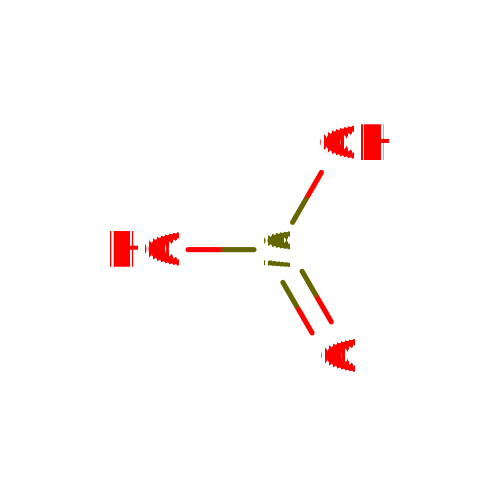
| Description | Endogenous sulfite is generated as a consequence of the body's normal processing of sulfur-containing amino acids. Sulfites occur as a consequence of fermentation and also occur naturally in a number of foods and beverages. As food additives, sulfiting agents were first used in 1664 and have been approved in the United States since the 1800s. Sulfite is an allergen, a neurotoxin, and a metabotoxin. An allergen is a compound that causes allergic reactions such as wheezing, rash, or rhinitis. A neurotoxin is a substance that causes damage to nerves or brain tissues. A metabotoxin is an endogenously produced metabolite that causes adverse health effects at chronically high levels. As an allergen, sulfite is known to induce asthmatic reactions. Sulfite sensitivity occurs most often in asthmatic adults (predominantly women), but it is also occasionally reported in preschool children. Adverse reactions to sulfites in nonasthmatics are extremely rare. Asthmatics who are steroid-dependent or who have a higher degree of airway hyperreactivity may be at greater risk of experiencing a reaction to sulfite-containing foods. Sulfite sensitivity reactions vary widely, ranging from no reaction to severe. The majority of reactions are mild. These manifestations may include dermatologic, respiratory, or gastrointestinal signs and symptoms. The precise mechanisms of the sensitivity responses have not been completely elucidated: inhalation of sulfur dioxide (SO2) generated in the stomach following ingestion of sulfite-containing foods or beverages, a deficiency in a mitochondrial enzyme, and an IgE-mediated immune response have all been implicated. Exogenously supplied sulfite is detoxified by the enzyme sulfite oxidase. Sulfite oxidase (EC 1.8.3.1) is 1 of 3 enzymes in humans that require molybdenum as a cofactor. Under certain circumstances, chronically high levels of sulfite can lead to serious neurotoxicity. Sulfite oxidase deficiency (also called molybdenum cofactor deficiency) is a rare autosomal inherited disease that is typified by high concentrations of sulfite in the blood and urine. It is characterized by severe neurological symptoms such as untreatable seizures, attenuated growth of the brain, and mental retardation. It results from defects in the enzyme sulfite oxidase, which is responsible for the oxidation of sulfite to sulfate. This sulfite to sulfate reaction is the final step in the degradation of sulfur-containing metabolites (including the amino acids cysteine and methionine). The term "isolated sulfite oxidase deficiency" is used to define the deficiency caused by mutations in the sulfite oxidase gene. This differentiates it from another version of sulfite oxidase deficiency that is due to defects in the molybdenum cofactor biosynthetic pathway (with mutations in the MOCS1 or MOCS2 genes). Isolated sulfite oxidase deficiency is a rare but devastating neurologic disease that usually presents in early infancy with seizures and alterations in muscle tone (PMID: 16234925 , 16140720 , 8586770 ). Sulfite oxidase deficiency (as caused by MOCS1 or MOCS2) may be treated with cPMP, a precursor of the molybdenum cofactor (PMID: 20385644 ). The mechanism behind sulfite neurotoxicity appears to be related to its ability to bind and inhibit glutamate dehydrogenase (GDH). Inhibition of GDH leads to a decrease in alpha-ketoglutarate and a diminished flux through the tricarboxylic acid cycle. This is accompanied by a decrease in NADH through the mitochondrial electron transport chain, which leads to a decrease in mitochondrial membrane potential and in ATP synthesis. Since glutamate is a major metabolite in the brain, inhibition of GDH by sulfite appears to contribute to neural damage characteristic of sulfite oxidase deficiency in human infants (PMID: 15273247 ). The hydrogen sulfite, or bisulfite, ion is the ion HSO3-. It is the conjugate base of sulfurous acid, H2SO3. Bisulfite has long been recognized as a reagent to react with organic compounds in various ways; prominent among them are additions to carbonyl groups and to carbon-carbon double bonds, and free radical reactions in the presence of oxygen. Bisulfite reacts with pyrimidine nucleosides, undergoing additions to the 5,6-double bond to form pyrimidine-5,6-dihydro-6-sulfonates. The addition across the 5,6-double bond is reversible. All these adducts are unstable in alkali. Bisulfite modification has been used to probe secondary or higher structures of polynucleotides as it reacts with pyrimidines in single-stranded regions specifically. In animal DNA, a portion of the pyrimidine base cytosine is methylated at position 5. 5-Methylcytosine in DNA is now an intensive focus of attention for its roles in gene functions. The methylation occurs by postreplication modification and is a heritable event. 5-Methylcytosine sites are known to be mutation hot spots. 5-Methylcytosine spontaneously deaminates into thymine, while cytosine does so more slowly. Determination of the position of 5-methylcytosine in a given DNA requires some means to distinguish 5-methylcytosine from cytosine. Chemical modification can be used as one such means. Treatment of DNA with bisulfite converts cytosine into uracil by deamination, while 5-methylcytosine remains mostly unaltered. The majority of recent research on 5-methylcytosine in DNA employs bisulfite treatment in the analytical procedure. The principle of this procedure is as follows. As uracil is a thymine-analog (5-methyluracil is thymine), it behaves toward DNA polymerases as thymine. When the bisulfite-modified DNA is subjected to PCR (polymerase chain reaction), a process necessary to amplify tiny samples of DNA, the uracil residues will become thymine residues in the amplified products. As 5-methylcytosine residues in the original DNA sample remain unaltered during the bisulfite treatment, the amplification will produce polynucleotides in which cytosine residues represent the 5-methylcytosine residues of the original (Genes and Environment (2006), 28(1), 1-8.). |
|---|
| Structure | InChI=1S/H2O3S/c1-4(2)3/h(H2,1,2,3) |
|---|
| Synonyms | | Value | Source |
|---|
| [SO(OH)2] | ChEBI | | Acide sulfureux | ChEBI | | Acido sulfuroso | ChEBI | | H2SO3 | ChEBI | | S(O)(OH)2 | ChEBI | | Schweflige saeure | ChEBI | | Sulphurous acid | ChEBI | | Sulfurous acid | Kegg | | Acide sulphureux | Generator | | Acido sulphuroso | Generator | | Sulphite | Generator | | Sulfur dioxide solution | HMDB | | Sulfuric(IV) acid (H2SO3) | HMDB | | Hydrogen sulfite | HMDB | | Sulfite | ChEBI |
|
|---|
| Chemical Formula | H2O3S |
|---|
| Average Molecular Weight | 82.079 |
|---|
| Monoisotopic Molecular Weight | 81.97246462 |
|---|
| IUPAC Name | sulfurous acid |
|---|
| Traditional Name | sulfurous acid |
|---|
| CAS Registry Number | 14265-45-3 |
|---|
| SMILES | OS(O)=O |
|---|
| InChI Identifier | InChI=1S/H2O3S/c1-4(2)3/h(H2,1,2,3) |
|---|
| InChI Key | LSNNMFCWUKXFEE-UHFFFAOYSA-N |
|---|
| Chemical Taxonomy |
|---|
| Description | Belongs to the class of inorganic compounds known as non-metal sulfites. These are inorganic non-metallic compounds containing a sulfite as its largest oxoanion. |
|---|
| Kingdom | Inorganic compounds |
|---|
| Super Class | Homogeneous non-metal compounds |
|---|
| Class | Non-metal oxoanionic compounds |
|---|
| Sub Class | Non-metal sulfites |
|---|
| Direct Parent | Non-metal sulfites |
|---|
| Alternative Parents | |
|---|
| Substituents | - Non-metal sulfite
- Inorganic oxide
|
|---|
| Molecular Framework | Not Available |
|---|
| External Descriptors | |
|---|
| Ontology |
|---|
| Physiological effect | Not Available |
|---|
| Disposition | |
|---|
| Process | Not Available |
|---|
| Role | Not Available |
|---|
| Physical Properties |
|---|
| State | Solid |
|---|
| Experimental Molecular Properties | | Property | Value | Reference |
|---|
| Melting Point | Not Available | Not Available | | Boiling Point | Not Available | Not Available | | Water Solubility | 558.5 mg/mL | Not Available | | LogP | Not Available | Not Available |
|
|---|
| Experimental Chromatographic Properties | Not Available |
|---|
| Predicted Molecular Properties | |
|---|
| Predicted Chromatographic Properties | Predicted Collision Cross SectionsPredicted Kovats Retention IndicesUnderivatizedDerivatized| Derivative Name / Structure | SMILES | Kovats RI Value | Column Type | Reference |
|---|
| Sulfite,1TMS,isomer #1 | C[Si](C)(C)OS(=O)O | 1009.7 | Semi standard non polar | 33892256 | | Sulfite,1TMS,isomer #1 | C[Si](C)(C)OS(=O)O | 1015.5 | Standard non polar | 33892256 | | Sulfite,1TMS,isomer #1 | C[Si](C)(C)OS(=O)O | 1425.4 | Standard polar | 33892256 | | Sulfite,2TMS,isomer #1 | C[Si](C)(C)OS(=O)O[Si](C)(C)C | 1062.3 | Semi standard non polar | 33892256 | | Sulfite,2TMS,isomer #1 | C[Si](C)(C)OS(=O)O[Si](C)(C)C | 1190.7 | Standard non polar | 33892256 | | Sulfite,2TMS,isomer #1 | C[Si](C)(C)OS(=O)O[Si](C)(C)C | 1083.3 | Standard polar | 33892256 | | Sulfite,1TBDMS,isomer #1 | CC(C)(C)[Si](C)(C)OS(=O)O | 1259.7 | Semi standard non polar | 33892256 | | Sulfite,1TBDMS,isomer #1 | CC(C)(C)[Si](C)(C)OS(=O)O | 1304.5 | Standard non polar | 33892256 | | Sulfite,1TBDMS,isomer #1 | CC(C)(C)[Si](C)(C)OS(=O)O | 1542.4 | Standard polar | 33892256 | | Sulfite,2TBDMS,isomer #1 | CC(C)(C)[Si](C)(C)OS(=O)O[Si](C)(C)C(C)(C)C | 1491.4 | Semi standard non polar | 33892256 | | Sulfite,2TBDMS,isomer #1 | CC(C)(C)[Si](C)(C)OS(=O)O[Si](C)(C)C(C)(C)C | 1704.4 | Standard non polar | 33892256 | | Sulfite,2TBDMS,isomer #1 | CC(C)(C)[Si](C)(C)OS(=O)O[Si](C)(C)C(C)(C)C | 1398.6 | Standard polar | 33892256 |
|
|---|
| GC-MS Spectra| Spectrum Type | Description | Splash Key | Deposition Date | Source | View |
|---|
| Predicted GC-MS | Predicted GC-MS Spectrum - Sulfite GC-MS (Non-derivatized) - 70eV, Positive | splash10-001i-9000000000-6e01fa26fbebd72ad6ac | 2017-09-01 | Wishart Lab | View Spectrum | | Predicted GC-MS | Predicted GC-MS Spectrum - Sulfite GC-MS (Non-derivatized) - 70eV, Positive | Not Available | 2021-10-12 | Wishart Lab | View Spectrum |
MS/MS Spectra| Spectrum Type | Description | Splash Key | Deposition Date | Source | View |
|---|
| Experimental LC-MS/MS | LC-MS/MS Spectrum - Sulfite Quattro_QQQ 10V, Positive-QTOF (Annotated) | splash10-0ue9-9000000000-f7ae469c0c0eb80e5bb9 | 2018-05-15 | HMDB team, MONA | View Spectrum | | Experimental LC-MS/MS | LC-MS/MS Spectrum - Sulfite Quattro_QQQ 25V, Positive-QTOF (Annotated) | splash10-001i-9300000000-8bbaba610a5e9ef617fe | 2018-05-15 | HMDB team, MONA | View Spectrum | | Experimental LC-MS/MS | LC-MS/MS Spectrum - Sulfite Quattro_QQQ 40V, Positive-QTOF (Annotated) | splash10-0udi-9300000000-460847a9238bf81b4b9c | 2018-05-15 | HMDB team, MONA | View Spectrum | | Predicted LC-MS/MS | Predicted LC-MS/MS Spectrum - Sulfite 10V, Positive-QTOF | splash10-001i-9000000000-0d5af2beca96b50eac8a | 2015-09-14 | Wishart Lab | View Spectrum | | Predicted LC-MS/MS | Predicted LC-MS/MS Spectrum - Sulfite 20V, Positive-QTOF | splash10-001i-9000000000-42884a642ace9e213e65 | 2015-09-14 | Wishart Lab | View Spectrum | | Predicted LC-MS/MS | Predicted LC-MS/MS Spectrum - Sulfite 40V, Positive-QTOF | splash10-01q9-9000000000-5357c61e80aaefe2133c | 2015-09-14 | Wishart Lab | View Spectrum | | Predicted LC-MS/MS | Predicted LC-MS/MS Spectrum - Sulfite 10V, Negative-QTOF | splash10-001i-9000000000-a7737b78e8d12bda4559 | 2015-09-15 | Wishart Lab | View Spectrum | | Predicted LC-MS/MS | Predicted LC-MS/MS Spectrum - Sulfite 20V, Negative-QTOF | splash10-001i-9000000000-1920e0308a2b8b74a3f4 | 2015-09-15 | Wishart Lab | View Spectrum | | Predicted LC-MS/MS | Predicted LC-MS/MS Spectrum - Sulfite 40V, Negative-QTOF | splash10-001i-9000000000-1920e0308a2b8b74a3f4 | 2015-09-15 | Wishart Lab | View Spectrum | | Predicted LC-MS/MS | Predicted LC-MS/MS Spectrum - Sulfite 10V, Negative-QTOF | splash10-001i-9000000000-a6fb8cd4d3dc149be309 | 2021-09-24 | Wishart Lab | View Spectrum | | Predicted LC-MS/MS | Predicted LC-MS/MS Spectrum - Sulfite 20V, Negative-QTOF | splash10-001i-9000000000-a6fb8cd4d3dc149be309 | 2021-09-24 | Wishart Lab | View Spectrum | | Predicted LC-MS/MS | Predicted LC-MS/MS Spectrum - Sulfite 40V, Negative-QTOF | splash10-001i-9000000000-a6fb8cd4d3dc149be309 | 2021-09-24 | Wishart Lab | View Spectrum | | Predicted LC-MS/MS | Predicted LC-MS/MS Spectrum - Sulfite 10V, Positive-QTOF | splash10-001i-9000000000-95d8eaf2b829c52ced6c | 2021-09-24 | Wishart Lab | View Spectrum | | Predicted LC-MS/MS | Predicted LC-MS/MS Spectrum - Sulfite 20V, Positive-QTOF | splash10-03di-9000000000-2c4a3db8921d94d7f526 | 2021-09-24 | Wishart Lab | View Spectrum | | Predicted LC-MS/MS | Predicted LC-MS/MS Spectrum - Sulfite 40V, Positive-QTOF | splash10-03di-9000000000-2c4a3db8921d94d7f526 | 2021-09-24 | Wishart Lab | View Spectrum |
IR Spectra| Spectrum Type | Description | Deposition Date | Source | View |
|---|
| Predicted IR Spectrum | IR Ion Spectrum (Predicted IRIS Spectrum, Adduct: [M-H]-) | 2023-02-03 | FELIX lab | View Spectrum | | Predicted IR Spectrum | IR Ion Spectrum (Predicted IRIS Spectrum, Adduct: [M+H]+) | 2023-02-03 | FELIX lab | View Spectrum | | Predicted IR Spectrum | IR Ion Spectrum (Predicted IRIS Spectrum, Adduct: [M+Na]+) | 2023-02-03 | FELIX lab | View Spectrum |
|
|---|
| General References | - Graf WD, Oleinik OE, Jack RM, Weiss AH, Johnson JL: Ahomocysteinemia in molybdenum cofactor deficiency. Neurology. 1998 Sep;51(3):860-2. [PubMed:9748040 ]
- Jeppesen C: Media for Aeromonas spp., Plesiomonas shigelloides and Pseudomonas spp. from food and environment. Int J Food Microbiol. 1995 Jun;26(1):25-41. [PubMed:7662518 ]
- Mitsuhashi H, Nojima Y, Tanaka T, Ueki K, Maezawa A, Yano S, Naruse T: Sulfite is released by human neutrophils in response to stimulation with lipopolysaccharide. J Leukoc Biol. 1998 Nov;64(5):595-9. [PubMed:9823763 ]
- von Graevenitz A, Bucher C: Evaluation of differential and selective media for isolation of Aeromonas and Plesiomonas spp. from human feces. J Clin Microbiol. 1983 Jan;17(1):16-21. [PubMed:6826700 ]
- Tsariuk LA, Rybachuk VN, Shevchenko LI, Tolstykh VM: [Determination of fibrinogen concentration in blood plasma by the sulfite precipitation method]. Vopr Med Khim. 1979 Jan-Feb;25(1):97-101. [PubMed:425377 ]
- Shea M, Howell S: High-performance liquid chromatographic measurement of exogenous thiosulfate in urine and plasma. Anal Biochem. 1984 Aug 1;140(2):589-94. [PubMed:6486442 ]
- Bor-Kucukatay M, Kucukatay V, Agar A, Baskurt OK: Effect of sulfite on red blood cell deformability ex vivo and in normal and sulfite oxidase-deficient rats in vivo. Arch Toxicol. 2005 Sep;79(9):542-6. Epub 2005 Apr 13. [PubMed:15827731 ]
- Gubash SM, Ingham L: Comparison of a new, bismuth-iron-sulfite-cycloserine agar for isolation of Clostridium perfringens with the tryptose-sulfite-cycloserine and blood agars. Zentralbl Bakteriol. 1997 Feb;285(3):397-402. [PubMed:9084113 ]
- Kim E, Driscoll CF, Minah GE: The effect of a denture adhesive on the colonization of Candida species in vivo. J Prosthodont. 2003 Sep;12(3):187-91. [PubMed:14508740 ]
- Willis CL, Cummings JH, Neale G, Gibson GR: Nutritional aspects of dissimilatory sulfate reduction in the human large intestine. Curr Microbiol. 1997 Nov;35(5):294-8. [PubMed:9462959 ]
- Sardesai VM: Molybdenum: an essential trace element. Nutr Clin Pract. 1993 Dec;8(6):277-81. [PubMed:8302261 ]
- Togawa T, Ogawa M, Nawata M, Ogasawara Y, Kawanabe K, Tanabe S: High performance liquid chromatographic determination of bound sulfide and sulfite and thiosulfate at their low levels in human serum by pre-column fluorescence derivatization with monobromobimane. Chem Pharm Bull (Tokyo). 1992 Nov;40(11):3000-4. [PubMed:1477915 ]
- Pearson SJ, Czudek C, Mercer K, Reynolds GP: Electrochemical detection of human brain transmitter amino acids by high-performance liquid chromatography of stable o-phthalaldehyde-sulphite derivatives. J Neural Transm Gen Sect. 1991;86(2):151-7. [PubMed:1683240 ]
- Mishra A, Dayal N, Beck-Speier I: Effect of sulphite on the oxidative metabolism of human neutrophils: studies with lucigenin- and luminol-dependent chemiluminescence. J Biolumin Chemilumin. 1995 Jan-Feb;10(1):9-19. [PubMed:7762419 ]
- Beck-Speier I, Lenz AG, Godleski JJ: Responses of human neutrophils to sulfite. J Toxicol Environ Health. 1994 Mar;41(3):285-97. [PubMed:8126751 ]
- Beck-Speier I, Liese JG, Belohradsky BH, Godleski JJ: Sulfite stimulates NADPH oxidase of human neutrophils to produce active oxygen radicals via protein kinase C and Ca2+/calmodulin pathways. Free Radic Biol Med. 1993 Jun;14(6):661-8. [PubMed:8392022 ]
- Zhang X, Vincent AS, Halliwell B, Wong KP: A mechanism of sulfite neurotoxicity: direct inhibition of glutamate dehydrogenase. J Biol Chem. 2004 Oct 8;279(41):43035-45. Epub 2004 Jul 23. [PubMed:15273247 ]
- Tan WH, Eichler FS, Hoda S, Lee MS, Baris H, Hanley CA, Grant PE, Krishnamoorthy KS, Shih VE: Isolated sulfite oxidase deficiency: a case report with a novel mutation and review of the literature. Pediatrics. 2005 Sep;116(3):757-66. [PubMed:16140720 ]
- Karakas E, Kisker C: Structural analysis of missense mutations causing isolated sulfite oxidase deficiency. Dalton Trans. 2005 Nov 7;(21):3459-63. Epub 2005 Sep 26. [PubMed:16234925 ]
- Lester MR: Sulfite sensitivity: significance in human health. J Am Coll Nutr. 1995 Jun;14(3):229-32. [PubMed:8586770 ]
- Veldman A, Santamaria-Araujo JA, Sollazzo S, Pitt J, Gianello R, Yaplito-Lee J, Wong F, Ramsden CA, Reiss J, Cook I, Fairweather J, Schwarz G: Successful treatment of molybdenum cofactor deficiency type A with cPMP. Pediatrics. 2010 May;125(5):e1249-54. doi: 10.1542/peds.2009-2192. Epub 2010 Apr 12. [PubMed:20385644 ]
- (). Yannai, Shmuel. (2004) Dictionary of food compounds with CD-ROM: Additives, flavors, and ingredients. Boca Raton: Chapman & Hall/CRC.. .
|
|---|