| Record Information |
|---|
| Version | 5.0 |
|---|
| Status | Detected and Quantified |
|---|
| Creation Date | 2005-11-16 15:48:42 UTC |
|---|
| Update Date | 2023-02-21 17:15:34 UTC |
|---|
| HMDB ID | HMDB0001264 |
|---|
| Secondary Accession Numbers | |
|---|
| Metabolite Identification |
|---|
| Common Name | Dehydroascorbic acid |
|---|
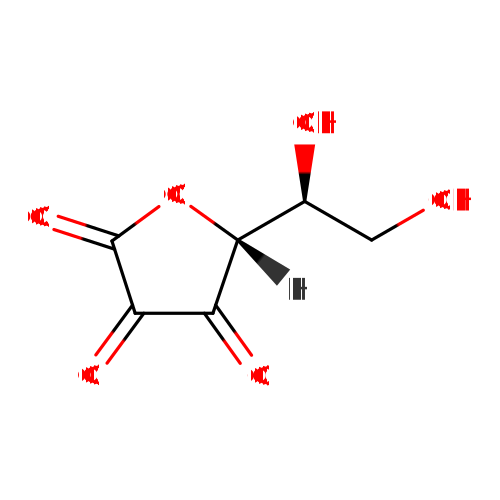
| Description | Dehydroascorbic acid (DHA) is an oxidized form of ascorbic acid (vitamin C). It is actively imported into the endoplasmic reticulum of cells via glucose transporters. It is trapped therein by reduction back to ascorbate by glutathione and other thiols. Dehydroascorbic acid, also known as L-dehydroascorbate or DHAA, belongs to the class of organic compounds known as gamma butyrolactones. Gamma butyrolactones are compounds containing a gamma butyrolactone moiety, which consists of an aliphatic five-member ring with four carbon atoms, one oxygen atom, and bears a ketone group on the carbon adjacent to the oxygen atom. Dehydroascorbic acid has similar biological activity as ascorbic acid. Currently dehydroascorbic acid is an experimental drug with no known approved indications. Dehydroascorbic acid may be a unique E. coli metabolite. Norepinephrine and dehydroascorbic acid can be biosynthesized from dopamine and ascorbic acid through its interaction with the enzyme dopamine beta-hydroxylase. In humans, dehydroascorbic acid is involved in the metabolic disorder called tyrosinemia type I. Concerning dehydroascorbic acid's antiviral effect against herpes simplex virus type 1, it is suggested that dehydroascorbic acid acts after replication of viral DNA and prevents the assembly of progeny virus particles. This is important because one study has found that after an ischemic stroke, dehydroascorbic acid has neuroprotective effects by reducing infarct volume, neurological deficits, and mortality. This reaction is reversible, but dehydroascorbic acid can instead undergo irreversible hydrolysis to 2,3-diketogulonic acid. In addition, unlike ascorbic Dehydroascorbic acid acid can cross the blood brain barrier and is then converted to ascorbic acid to enable retention in the brain. Dehydroascorbic acid is made from the oxidation of ascorbic acid. The exact mechanism of action is still being investigated, but some have been elucidated. Both compounds have been shown to have antiviral effects against herpes simplex virus type 1, influenza virus type A and poliovirus type 1 with dehydroascorbic acid having the stronger effect. In the body, both dehydroascorbic acid and ascorbic acid have similar biological activity as antivirals but dehydroascorbic acid also has neuroprotective effects. Even though dehydroascorbic acid and ascorbic acid have similar effects, their mechanism of action seems to be different. |
|---|
| Structure | [H][C@@]1(OC(=O)C(=O)C1=O)[C@@H](O)CO InChI=1S/C6H6O6/c7-1-2(8)5-3(9)4(10)6(11)12-5/h2,5,7-8H,1H2/t2-,5+/m0/s1 |
|---|
| Synonyms | | Value | Source |
|---|
| Dehydro-L-ascorbic acid | ChEBI | | Dehydroascorbic acid | ChEBI | | DHAA | ChEBI | | L-Dehydroascorbate | ChEBI | | L-threo-2,3-Hexodiulosonic acid, gamma-lactone | ChEBI | | L-threo-hexo-2,3-diulosono-1,4-Lactone | ChEBI | | Oxidized ascorbic acid | ChEBI | | Oxidized vitamin C | ChEBI | | Dehydro-L-ascorbate | Generator | | Dehydroascorbate | Generator | | L-threo-2,3-Hexodiulosonate, g-lactone | Generator | | L-threo-2,3-Hexodiulosonate, gamma-lactone | Generator | | L-threo-2,3-Hexodiulosonate, γ-lactone | Generator | | L-threo-2,3-Hexodiulosonic acid, g-lactone | Generator | | L-threo-2,3-Hexodiulosonic acid, γ-lactone | Generator | | Oxidized ascorbate | Generator | | Acid, dehydroascorbic | MeSH | | L-Dehydro-ascorbate | HMDB | | L-Dehydroascorbic acid | HMDB | | L-threo-Dehydroascorbic acid | HMDB |
|
|---|
| Chemical Formula | C6H6O6 |
|---|
| Average Molecular Weight | 174.1082 |
|---|
| Monoisotopic Molecular Weight | 174.016437924 |
|---|
| IUPAC Name | (5R)-5-[(1S)-1,2-dihydroxyethyl]oxolane-2,3,4-trione |
|---|
| Traditional Name | DHAA |
|---|
| CAS Registry Number | 490-83-5 |
|---|
| SMILES | [H][C@@]1(OC(=O)C(=O)C1=O)[C@@H](O)CO |
|---|
| InChI Identifier | InChI=1S/C6H6O6/c7-1-2(8)5-3(9)4(10)6(11)12-5/h2,5,7-8H,1H2/t2-,5+/m0/s1 |
|---|
| InChI Key | SBJKKFFYIZUCET-JLAZNSOCSA-N |
|---|
| Chemical Taxonomy |
|---|
| Description | Belongs to the class of organic compounds known as gamma butyrolactones. Gamma butyrolactones are compounds containing a gamma butyrolactone moiety, which consists of an aliphatic five-member ring with four carbon atoms, one oxygen atom, and bears a ketone group on the carbon adjacent to the oxygen atom. |
|---|
| Kingdom | Organic compounds |
|---|
| Super Class | Organoheterocyclic compounds |
|---|
| Class | Lactones |
|---|
| Sub Class | Gamma butyrolactones |
|---|
| Direct Parent | Gamma butyrolactones |
|---|
| Alternative Parents | |
|---|
| Substituents | - 3-furanone
- Gamma butyrolactone
- Tetrahydrofuran
- 1,2-diol
- Carboxylic acid ester
- Cyclic ketone
- Secondary alcohol
- Ketone
- Carboxylic acid derivative
- Oxacycle
- Monocarboxylic acid or derivatives
- Alcohol
- Hydrocarbon derivative
- Organic oxide
- Organic oxygen compound
- Carbonyl group
- Primary alcohol
- Organooxygen compound
- Aliphatic heteromonocyclic compound
|
|---|
| Molecular Framework | Aliphatic heteromonocyclic compounds |
|---|
| External Descriptors | |
|---|
| Ontology |
|---|
| Physiological effect | Not Available |
|---|
| Disposition | |
|---|
| Process | |
|---|
| Role | Not Available |
|---|
| Physical Properties |
|---|
| State | Solid |
|---|
| Experimental Molecular Properties | | Property | Value | Reference |
|---|
| Melting Point | Not Available | Not Available | | Boiling Point | Not Available | Not Available | | Water Solubility | Not Available | Not Available | | LogP | Not Available | Not Available |
|
|---|
| Experimental Chromatographic Properties | Not Available |
|---|
| Predicted Molecular Properties | |
|---|
| Predicted Chromatographic Properties | Predicted Collision Cross SectionsPredicted Kovats Retention IndicesUnderivatizedDerivatized| Derivative Name / Structure | SMILES | Kovats RI Value | Column Type | Reference |
|---|
| Dehydroascorbic acid,1TMS,isomer #1 | C[Si](C)(C)O[C@@H](CO)[C@H]1OC(=O)C(=O)C1=O | 1709.4 | Semi standard non polar | 33892256 | | Dehydroascorbic acid,1TMS,isomer #2 | C[Si](C)(C)OC[C@H](O)[C@H]1OC(=O)C(=O)C1=O | 1718.8 | Semi standard non polar | 33892256 | | Dehydroascorbic acid,1TMS,isomer #3 | C[Si](C)(C)OC1=C([C@@H](O)CO)OC(=O)C1=O | 1646.3 | Semi standard non polar | 33892256 | | Dehydroascorbic acid,2TMS,isomer #1 | C[Si](C)(C)OC[C@H](O[Si](C)(C)C)[C@H]1OC(=O)C(=O)C1=O | 1846.0 | Semi standard non polar | 33892256 | | Dehydroascorbic acid,2TMS,isomer #2 | C[Si](C)(C)OC1=C([C@H](CO)O[Si](C)(C)C)OC(=O)C1=O | 1786.2 | Semi standard non polar | 33892256 | | Dehydroascorbic acid,2TMS,isomer #3 | C[Si](C)(C)OC[C@H](O)C1=C(O[Si](C)(C)C)C(=O)C(=O)O1 | 1775.9 | Semi standard non polar | 33892256 | | Dehydroascorbic acid,3TMS,isomer #1 | C[Si](C)(C)OC[C@H](O[Si](C)(C)C)C1=C(O[Si](C)(C)C)C(=O)C(=O)O1 | 1903.8 | Semi standard non polar | 33892256 | | Dehydroascorbic acid,3TMS,isomer #1 | C[Si](C)(C)OC[C@H](O[Si](C)(C)C)C1=C(O[Si](C)(C)C)C(=O)C(=O)O1 | 1861.2 | Standard non polar | 33892256 | | Dehydroascorbic acid,3TMS,isomer #1 | C[Si](C)(C)OC[C@H](O[Si](C)(C)C)C1=C(O[Si](C)(C)C)C(=O)C(=O)O1 | 1954.0 | Standard polar | 33892256 | | Dehydroascorbic acid,1TBDMS,isomer #1 | CC(C)(C)[Si](C)(C)O[C@@H](CO)[C@H]1OC(=O)C(=O)C1=O | 1981.8 | Semi standard non polar | 33892256 | | Dehydroascorbic acid,1TBDMS,isomer #2 | CC(C)(C)[Si](C)(C)OC[C@H](O)[C@H]1OC(=O)C(=O)C1=O | 1975.7 | Semi standard non polar | 33892256 | | Dehydroascorbic acid,1TBDMS,isomer #3 | CC(C)(C)[Si](C)(C)OC1=C([C@@H](O)CO)OC(=O)C1=O | 1931.6 | Semi standard non polar | 33892256 | | Dehydroascorbic acid,2TBDMS,isomer #1 | CC(C)(C)[Si](C)(C)OC[C@H](O[Si](C)(C)C(C)(C)C)[C@H]1OC(=O)C(=O)C1=O | 2322.2 | Semi standard non polar | 33892256 | | Dehydroascorbic acid,2TBDMS,isomer #2 | CC(C)(C)[Si](C)(C)OC1=C([C@H](CO)O[Si](C)(C)C(C)(C)C)OC(=O)C1=O | 2314.1 | Semi standard non polar | 33892256 | | Dehydroascorbic acid,2TBDMS,isomer #3 | CC(C)(C)[Si](C)(C)OC[C@H](O)C1=C(O[Si](C)(C)C(C)(C)C)C(=O)C(=O)O1 | 2295.0 | Semi standard non polar | 33892256 | | Dehydroascorbic acid,3TBDMS,isomer #1 | CC(C)(C)[Si](C)(C)OC[C@H](O[Si](C)(C)C(C)(C)C)C1=C(O[Si](C)(C)C(C)(C)C)C(=O)C(=O)O1 | 2627.9 | Semi standard non polar | 33892256 | | Dehydroascorbic acid,3TBDMS,isomer #1 | CC(C)(C)[Si](C)(C)OC[C@H](O[Si](C)(C)C(C)(C)C)C1=C(O[Si](C)(C)C(C)(C)C)C(=O)C(=O)O1 | 2536.5 | Standard non polar | 33892256 | | Dehydroascorbic acid,3TBDMS,isomer #1 | CC(C)(C)[Si](C)(C)OC[C@H](O[Si](C)(C)C(C)(C)C)C1=C(O[Si](C)(C)C(C)(C)C)C(=O)C(=O)O1 | 2343.3 | Standard polar | 33892256 |
|
|---|
| GC-MS Spectra| Spectrum Type | Description | Splash Key | Deposition Date | Source | View |
|---|
| Experimental GC-MS | GC-MS Spectrum - Dehydroascorbic acid GC-MS (Non-derivatized) | splash10-05fr-1910000000-637a588dd38c4cc58ae5 | 2014-06-16 | HMDB team, MONA, MassBank | View Spectrum | | Experimental GC-MS | GC-MS Spectrum - Dehydroascorbic acid GC-EI-TOF (Non-derivatized) | splash10-05fs-1910000000-194039de8a412e640d7f | 2017-09-12 | HMDB team, MONA, MassBank | View Spectrum | | Experimental GC-MS | GC-MS Spectrum - Dehydroascorbic acid GC-EI-TOF (Non-derivatized) | splash10-05fs-1900000000-af0738c9bda7200b8742 | 2017-09-12 | HMDB team, MONA, MassBank | View Spectrum | | Predicted GC-MS | Predicted GC-MS Spectrum - Dehydroascorbic acid GC-MS (Non-derivatized) - 70eV, Positive | splash10-08iu-9200000000-bbb79c0fcf383789f477 | 2017-08-28 | Wishart Lab | View Spectrum | | Predicted GC-MS | Predicted GC-MS Spectrum - Dehydroascorbic acid GC-MS (Non-derivatized) - 70eV, Positive | Not Available | 2021-10-12 | Wishart Lab | View Spectrum | | Predicted GC-MS | Predicted GC-MS Spectrum - Dehydroascorbic acid GC-MS (Non-derivatized) - 70eV, Positive | Not Available | 2021-10-12 | Wishart Lab | View Spectrum |
MS/MS Spectra| Spectrum Type | Description | Splash Key | Deposition Date | Source | View |
|---|
| Experimental LC-MS/MS | LC-MS/MS Spectrum - Dehydroascorbic acid Quattro_QQQ 10V, Positive-QTOF (Annotated) | splash10-004i-4900000000-25a652482451303b3ca4 | 2020-06-23 | HMDB team, MONA | View Spectrum | | Predicted LC-MS/MS | Predicted LC-MS/MS Spectrum - Dehydroascorbic acid 10V, Positive-QTOF | splash10-056r-1900000000-c9ba5aa4017d618b9908 | 2017-07-26 | Wishart Lab | View Spectrum | | Predicted LC-MS/MS | Predicted LC-MS/MS Spectrum - Dehydroascorbic acid 20V, Positive-QTOF | splash10-0a4i-2900000000-52e4a1b574cf41140928 | 2017-07-26 | Wishart Lab | View Spectrum | | Predicted LC-MS/MS | Predicted LC-MS/MS Spectrum - Dehydroascorbic acid 40V, Positive-QTOF | splash10-0a4i-9200000000-e89ff5aa246bed40fed2 | 2017-07-26 | Wishart Lab | View Spectrum | | Predicted LC-MS/MS | Predicted LC-MS/MS Spectrum - Dehydroascorbic acid 10V, Negative-QTOF | splash10-0229-1900000000-c546ba0f061c1d25a934 | 2017-07-26 | Wishart Lab | View Spectrum | | Predicted LC-MS/MS | Predicted LC-MS/MS Spectrum - Dehydroascorbic acid 20V, Negative-QTOF | splash10-0mbc-2900000000-254c596333e32143329f | 2017-07-26 | Wishart Lab | View Spectrum | | Predicted LC-MS/MS | Predicted LC-MS/MS Spectrum - Dehydroascorbic acid 40V, Negative-QTOF | splash10-08fr-9700000000-a77d2c857a58b59513cc | 2017-07-26 | Wishart Lab | View Spectrum | | Predicted LC-MS/MS | Predicted LC-MS/MS Spectrum - Dehydroascorbic acid 10V, Negative-QTOF | splash10-03di-1900000000-649b7b705ac3b8d2acd6 | 2021-09-22 | Wishart Lab | View Spectrum | | Predicted LC-MS/MS | Predicted LC-MS/MS Spectrum - Dehydroascorbic acid 20V, Negative-QTOF | splash10-08mi-9700000000-aede5d559ec646353d18 | 2021-09-22 | Wishart Lab | View Spectrum | | Predicted LC-MS/MS | Predicted LC-MS/MS Spectrum - Dehydroascorbic acid 40V, Negative-QTOF | splash10-0ab9-9000000000-e10d14ae5b3c3444469c | 2021-09-22 | Wishart Lab | View Spectrum | | Predicted LC-MS/MS | Predicted LC-MS/MS Spectrum - Dehydroascorbic acid 10V, Positive-QTOF | splash10-05r9-1900000000-9797d9ac8e5d4a8c4536 | 2021-09-23 | Wishart Lab | View Spectrum | | Predicted LC-MS/MS | Predicted LC-MS/MS Spectrum - Dehydroascorbic acid 20V, Positive-QTOF | splash10-00kf-9500000000-0064fc20716aed5e9721 | 2021-09-23 | Wishart Lab | View Spectrum | | Predicted LC-MS/MS | Predicted LC-MS/MS Spectrum - Dehydroascorbic acid 40V, Positive-QTOF | splash10-0aou-9100000000-2305f252ccf8065c346d | 2021-09-23 | Wishart Lab | View Spectrum |
NMR Spectra| Spectrum Type | Description | Deposition Date | Source | View |
|---|
| Experimental 1D NMR | 1H NMR Spectrum (1D, 600 MHz, H2O, experimental) | 2020-06-23 | Wishart Lab | View Spectrum | | Predicted 1D NMR | 13C NMR Spectrum (1D, 100 MHz, D2O, predicted) | 2021-09-25 | Wishart Lab | View Spectrum | | Predicted 1D NMR | 1H NMR Spectrum (1D, 100 MHz, D2O, predicted) | 2021-09-25 | Wishart Lab | View Spectrum | | Predicted 1D NMR | 13C NMR Spectrum (1D, 1000 MHz, D2O, predicted) | 2021-09-25 | Wishart Lab | View Spectrum | | Predicted 1D NMR | 1H NMR Spectrum (1D, 1000 MHz, D2O, predicted) | 2021-09-25 | Wishart Lab | View Spectrum | | Predicted 1D NMR | 13C NMR Spectrum (1D, 200 MHz, D2O, predicted) | 2021-09-25 | Wishart Lab | View Spectrum | | Predicted 1D NMR | 1H NMR Spectrum (1D, 200 MHz, D2O, predicted) | 2021-09-25 | Wishart Lab | View Spectrum | | Predicted 1D NMR | 13C NMR Spectrum (1D, 300 MHz, D2O, predicted) | 2021-09-25 | Wishart Lab | View Spectrum | | Predicted 1D NMR | 1H NMR Spectrum (1D, 300 MHz, D2O, predicted) | 2021-09-25 | Wishart Lab | View Spectrum | | Predicted 1D NMR | 13C NMR Spectrum (1D, 400 MHz, D2O, predicted) | 2021-09-25 | Wishart Lab | View Spectrum | | Predicted 1D NMR | 1H NMR Spectrum (1D, 400 MHz, D2O, predicted) | 2021-09-25 | Wishart Lab | View Spectrum | | Predicted 1D NMR | 13C NMR Spectrum (1D, 500 MHz, D2O, predicted) | 2021-09-25 | Wishart Lab | View Spectrum | | Predicted 1D NMR | 1H NMR Spectrum (1D, 500 MHz, D2O, predicted) | 2021-09-25 | Wishart Lab | View Spectrum | | Predicted 1D NMR | 13C NMR Spectrum (1D, 600 MHz, D2O, predicted) | 2021-09-25 | Wishart Lab | View Spectrum | | Predicted 1D NMR | 1H NMR Spectrum (1D, 600 MHz, D2O, predicted) | 2021-09-25 | Wishart Lab | View Spectrum | | Predicted 1D NMR | 13C NMR Spectrum (1D, 700 MHz, D2O, predicted) | 2021-09-25 | Wishart Lab | View Spectrum | | Predicted 1D NMR | 1H NMR Spectrum (1D, 700 MHz, D2O, predicted) | 2021-09-25 | Wishart Lab | View Spectrum | | Predicted 1D NMR | 13C NMR Spectrum (1D, 800 MHz, D2O, predicted) | 2021-09-25 | Wishart Lab | View Spectrum | | Predicted 1D NMR | 1H NMR Spectrum (1D, 800 MHz, D2O, predicted) | 2021-09-25 | Wishart Lab | View Spectrum | | Predicted 1D NMR | 13C NMR Spectrum (1D, 900 MHz, D2O, predicted) | 2021-09-25 | Wishart Lab | View Spectrum | | Predicted 1D NMR | 1H NMR Spectrum (1D, 900 MHz, D2O, predicted) | 2021-09-25 | Wishart Lab | View Spectrum | | Experimental 2D NMR | [1H, 13C]-HSQC NMR Spectrum (2D, 600 MHz, H2O, experimental) | 2020-06-23 | Wishart Lab | View Spectrum |
IR Spectra| Spectrum Type | Description | Deposition Date | Source | View |
|---|
| Predicted IR Spectrum | IR Ion Spectrum (Predicted IRIS Spectrum, Adduct: [M-H]-) | 2023-02-03 | FELIX lab | View Spectrum | | Predicted IR Spectrum | IR Ion Spectrum (Predicted IRIS Spectrum, Adduct: [M+H]+) | 2023-02-03 | FELIX lab | View Spectrum | | Predicted IR Spectrum | IR Ion Spectrum (Predicted IRIS Spectrum, Adduct: [M+Na]+) | 2023-02-03 | FELIX lab | View Spectrum |
|
|---|
| General References | - Raghavan SA, Sharma P, Dikshit M: Role of ascorbic acid in the modulation of inhibition of platelet aggregation by polymorphonuclear leukocytes. Thromb Res. 2003 May 1;110(2-3):117-26. [PubMed:12893026 ]
- Kuo SM, Tan D, Boyer JC: Cellular vitamin C accumulation in the presence of copper. Biol Trace Elem Res. 2004 Aug;100(2):125-36. [PubMed:15326362 ]
- Bakaev VV, Duntau AP: Ascorbic acid in blood serum of patients with pulmonary tuberculosis and pneumonia. Int J Tuberc Lung Dis. 2004 Feb;8(2):263-6. [PubMed:15139458 ]
- Toivola DM, Isomaa B: Effects of dehydroabietic acid on the erythrocyte membrane. Chem Biol Interact. 1991;79(1):65-78. [PubMed:2060038 ]
- Dhariwal KR, Hartzell WO, Levine M: Ascorbic acid and dehydroascorbic acid measurements in human plasma and serum. Am J Clin Nutr. 1991 Oct;54(4):712-6. [PubMed:1897478 ]
- Trepanier LA, Yoder AR, Bajad S, Beckwith MD, Bellehumeur JL, Graziano FM: Plasma ascorbate deficiency is associated with impaired reduction of sulfamethoxazole-nitroso in HIV infection. J Acquir Immune Defic Syndr. 2004 Aug 15;36(5):1041-50. [PubMed:15247557 ]
- Mendiratta S, Qu ZC, May JM: Erythrocyte ascorbate recycling: antioxidant effects in blood. Free Radic Biol Med. 1998 Mar 15;24(5):789-97. [PubMed:9586809 ]
- Padilla CA, Spyrou G, Holmgren A: High-level expression of fully active human glutaredoxin (thioltransferase) in E. coli and characterization of Cys7 to Ser mutant protein. FEBS Lett. 1996 Jan 2;378(1):69-73. [PubMed:8549805 ]
- Shugalei IuS, Degtiar VV, Butvin IN, Grivenko GP: [Effect of alcohol intoxication on ascorbic and dehydroascorbic acid levels in rat tissue. and human blood]. Ukr Biokhim Zh (1978). 1986 May-Jun;58(3):81-3. [PubMed:3727042 ]
- Bakaev VV, Efremov AV, Tityaev II: Low levels of dehydroascorbic acid in uraemic serum and the partial correction of dehydroascorbic acid deficiency by haemodialysis. Nephrol Dial Transplant. 1999 Jun;14(6):1472-4. [PubMed:10383010 ]
- Margolis SA, Ziegler RG, Helzlsouer KJ: Ascorbic and dehydroascorbic acid measurement in human serum and plasma. Am J Clin Nutr. 1991 Dec;54(6 Suppl):1315S-1318S. [PubMed:1962589 ]
- Davis JL Jr, Mendiratta S, May JM: Similarities in the metabolism of alloxan and dehydroascorbate in human erythrocytes. Biochem Pharmacol. 1998 Apr 15;55(8):1301-7. [PubMed:9719486 ]
- Wells WW, Xu DP, Yang YF, Rocque PA: Mammalian thioltransferase (glutaredoxin) and protein disulfide isomerase have dehydroascorbate reductase activity. J Biol Chem. 1990 Sep 15;265(26):15361-4. [PubMed:2394726 ]
- Dubey SS, Palodhi GR, Jain AK: Ascorbic acid, dehydroascorbic acid and glutathione in liver disease. Indian J Physiol Pharmacol. 1987 Oct-Dec;31(4):279-83. [PubMed:3450633 ]
- May JM, Qu ZC, Whitesell RR, Cobb CE: Ascorbate recycling in human erythrocytes: role of GSH in reducing dehydroascorbate. Free Radic Biol Med. 1996;20(4):543-51. [PubMed:8904295 ]
- Elshenawy S, Pinney SE, Stuart T, Doulias PT, Zura G, Parry S, Elovitz MA, Bennett MJ, Bansal A, Strauss JF 3rd, Ischiropoulos H, Simmons RA: The Metabolomic Signature of the Placenta in Spontaneous Preterm Birth. Int J Mol Sci. 2020 Feb 4;21(3). pii: ijms21031043. doi: 10.3390/ijms21031043. [PubMed:32033212 ]
|
|---|