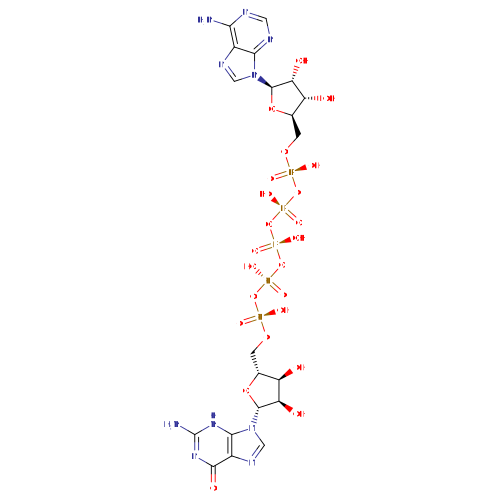
| Record Information |
|---|
| Version | 5.0 |
|---|
| Status | Expected but not Quantified |
|---|
| Creation Date | 2005-11-16 15:48:42 UTC |
|---|
| Update Date | 2021-09-14 14:58:17 UTC |
|---|
| HMDB ID | HMDB0001472 |
|---|
| Secondary Accession Numbers | |
|---|
| Metabolite Identification |
|---|
| Common Name | Guanosine pentaphosphate adenosine |
|---|
| Description | Guanosine pentaphosphate adenosine is a dinucleoside polyphosphate. Dinucleoside polyphosphates are an interesting group of signalling molecules that control numerous physiological functions. Diadenosine compounds, with a backbone of anything from two to seven phosphates, are known to occur naturally. Some of them have been isolated from cerebral nerve terminals and, acting via nucleoside (P1), nucleotide (P2), or dinucleotide receptors, can affect central nervous system function. Many of them have been isolated from human blood platelet secretory granules and are potentially involved in haemostatic mechanisms and peripheral control of vascular tone. Many visceral organs respond to the application of adenine dinucleotides and, although they act on receptors in the periphery that can be mainly defined as either P1 or P2, evidence is now accumulating for discrete dinucleotide receptors. In the periphery, adenine dinucleotides can be potent agonists, with diverse functions, causing contraction or relaxation of smooth muscle. Many P2X receptor proteins and P2Y receptors have been cloned and adenine dinucleotides have a variable pharmacological profile at these receptors and may be useful tools for characterising subtypes of P2X and P2Y receptors. Many extracellular roles of diadenosine polyphosphates are emerging as yet increasingly important, natural ligands for a plethora of structurally diverse mononucleotide and dinucleotide receptors. (PMID: 12772275 , 7767329 ). |
|---|
| Structure | NC1=NC(=O)C2=C(N1)N(C=N2)[C@@H]1O[C@H](CO[P@](O)(=O)O[P@](O)(=O)O[P@](O)(=O)O[P@@](O)(=O)O[P@](O)(=O)OC[C@H]2O[C@H]([C@H](O)[C@@H]2O)N2C=NC3=C(N)N=CN=C23)[C@@H](O)[C@H]1O InChI=1S/C20H29N10O23P5/c21-14-8-15(24-3-23-14)29(4-25-8)18-12(33)10(31)6(48-18)1-46-54(36,37)50-56(40,41)52-58(44,45)53-57(42,43)51-55(38,39)47-2-7-11(32)13(34)19(49-7)30-5-26-9-16(30)27-20(22)28-17(9)35/h3-7,10-13,18-19,31-34H,1-2H2,(H,36,37)(H,38,39)(H,40,41)(H,42,43)(H,44,45)(H2,21,23,24)(H3,22,27,28,35)/t6-,7-,10-,11-,12-,13-,18-,19-/m1/s1 |
|---|
| Synonyms | | Value | Source |
|---|
| Guanosine pentaphosphoric acid adenosine | Generator | | P1-(5'-Adenosyl)-P5-(5'-guanosyl) pentaphosphate | HMDB | | ({[({[(2R,3S,4R,5R)-5-(6-amino-9H-purin-9-yl)-3,4-dihydroxyoxolan-2-yl]methoxy}(hydroxy)phosphoryl)oxy](hydroxy)phosphoryl}oxy)({[({[(2R,3S,4R,5R)-3,4-dihydroxy-5-(6-hydroxy-2-imino-3,9-dihydro-2H-purin-9-yl)oxolan-2-yl]methoxy}(hydroxy)phosphoryl)oxy](hydroxy)phosphoryl}oxy)phosphinate | Generator, HMDB |
|
|---|
| Chemical Formula | C20H29N10O23P5 |
|---|
| Average Molecular Weight | 932.3663 |
|---|
| Monoisotopic Molecular Weight | 932.009509844 |
|---|
| IUPAC Name | {[(2R,3S,4R,5R)-5-(2-amino-6-oxo-6,9-dihydro-3H-purin-9-yl)-3,4-dihydroxyoxolan-2-yl]methoxy}[({[({[({[(2R,3S,4R,5R)-5-(6-amino-9H-purin-9-yl)-3,4-dihydroxyoxolan-2-yl]methoxy}(hydroxy)phosphoryl)oxy](hydroxy)phosphoryl}oxy)(hydroxy)phosphoryl]oxy}(hydroxy)phosphoryl)oxy]phosphinic acid |
|---|
| Traditional Name | [(2R,3S,4R,5R)-5-(2-amino-6-oxo-3H-purin-9-yl)-3,4-dihydroxyoxolan-2-yl]methoxy({[({[(2R,3S,4R,5R)-5-(6-aminopurin-9-yl)-3,4-dihydroxyoxolan-2-yl]methoxy(hydroxy)phosphoryl}oxy(hydroxy)phosphoryl)oxy(hydroxy)phosphoryl]oxy(hydroxy)phosphoryl}oxy)phosphinic acid |
|---|
| CAS Registry Number | 56983-24-5 |
|---|
| SMILES | NC1=NC(=O)C2=C(N1)N(C=N2)[C@@H]1O[C@H](CO[P@](O)(=O)O[P@](O)(=O)O[P@](O)(=O)O[P@@](O)(=O)O[P@](O)(=O)OC[C@H]2O[C@H]([C@H](O)[C@@H]2O)N2C=NC3=C(N)N=CN=C23)[C@@H](O)[C@H]1O |
|---|
| InChI Identifier | InChI=1S/C20H29N10O23P5/c21-14-8-15(24-3-23-14)29(4-25-8)18-12(33)10(31)6(48-18)1-46-54(36,37)50-56(40,41)52-58(44,45)53-57(42,43)51-55(38,39)47-2-7-11(32)13(34)19(49-7)30-5-26-9-16(30)27-20(22)28-17(9)35/h3-7,10-13,18-19,31-34H,1-2H2,(H,36,37)(H,38,39)(H,40,41)(H,42,43)(H,44,45)(H2,21,23,24)(H3,22,27,28,35)/t6-,7-,10-,11-,12-,13-,18-,19-/m1/s1 |
|---|
| InChI Key | CNMILLPGDWDFCZ-INFSMZHSSA-N |
|---|
| Chemical Taxonomy |
|---|
| Description | Belongs to the class of organic compounds known as (5'->5')-dinucleotides. These are dinucleotides where the two bases are connected via a (5'->5')-phosphodiester linkage. |
|---|
| Kingdom | Organic compounds |
|---|
| Super Class | Nucleosides, nucleotides, and analogues |
|---|
| Class | (5'->5')-dinucleotides |
|---|
| Sub Class | Not Available |
|---|
| Direct Parent | (5'->5')-dinucleotides |
|---|
| Alternative Parents | |
|---|
| Substituents | - (5'->5')-dinucleotide
- Purine ribonucleoside polyphosphate
- Purine nucleotide sugar
- Purine ribonucleoside monophosphate
- Pentose phosphate
- Pentose-5-phosphate
- Glycosyl compound
- N-glycosyl compound
- 6-aminopurine
- 6-oxopurine
- Hypoxanthine
- Monosaccharide phosphate
- Imidazopyrimidine
- Purine
- Pyrimidone
- Monoalkyl phosphate
- Aminopyrimidine
- Pyrimidine
- Alkyl phosphate
- Imidolactam
- Phosphoric acid ester
- Monosaccharide
- Organic phosphoric acid derivative
- N-substituted imidazole
- Tetrahydrofuran
- Vinylogous amide
- Azole
- Imidazole
- Heteroaromatic compound
- Secondary alcohol
- Organoheterocyclic compound
- Azacycle
- Oxacycle
- Alcohol
- Hydrocarbon derivative
- Organic oxide
- Organopnictogen compound
- Organic oxygen compound
- Primary amine
- Amine
- Organic nitrogen compound
- Organooxygen compound
- Organonitrogen compound
- Aromatic heteropolycyclic compound
|
|---|
| Molecular Framework | Aromatic heteropolycyclic compounds |
|---|
| External Descriptors | Not Available |
|---|
| Ontology |
|---|
| Not Available | Not Available |
|---|
| Physical Properties |
|---|
| State | Solid |
|---|
| Experimental Molecular Properties | | Property | Value | Reference |
|---|
| Melting Point | Not Available | Not Available | | Boiling Point | Not Available | Not Available | | Water Solubility | Not Available | Not Available | | LogP | Not Available | Not Available |
|
|---|
| Experimental Chromatographic Properties | Not Available |
|---|
| Predicted Molecular Properties | |
|---|
| Predicted Chromatographic Properties | Predicted Collision Cross SectionsPredicted Kovats Retention IndicesNot Available |
|---|
| MS/MS Spectra| Spectrum Type | Description | Splash Key | Deposition Date | Source | View |
|---|
| Predicted LC-MS/MS | Predicted LC-MS/MS Spectrum - Guanosine pentaphosphate adenosine 10V, Negative-QTOF | splash10-001i-0900002005-f4d66d2e82998cd23ba4 | 2017-09-01 | Wishart Lab | View Spectrum | | Predicted LC-MS/MS | Predicted LC-MS/MS Spectrum - Guanosine pentaphosphate adenosine 20V, Negative-QTOF | splash10-0gx0-1900001000-1dda77473ccebc329e08 | 2017-09-01 | Wishart Lab | View Spectrum | | Predicted LC-MS/MS | Predicted LC-MS/MS Spectrum - Guanosine pentaphosphate adenosine 40V, Negative-QTOF | splash10-0f8a-1905110000-3d32e7b6e6b7e674ceef | 2017-09-01 | Wishart Lab | View Spectrum | | Predicted LC-MS/MS | Predicted LC-MS/MS Spectrum - Guanosine pentaphosphate adenosine 10V, Negative-QTOF | splash10-001i-0100000009-8791650d7ea7f0a0d14f | 2021-09-22 | Wishart Lab | View Spectrum | | Predicted LC-MS/MS | Predicted LC-MS/MS Spectrum - Guanosine pentaphosphate adenosine 20V, Negative-QTOF | splash10-0gx0-0100012149-0aca1dc7ce62df9c81b5 | 2021-09-22 | Wishart Lab | View Spectrum | | Predicted LC-MS/MS | Predicted LC-MS/MS Spectrum - Guanosine pentaphosphate adenosine 40V, Negative-QTOF | splash10-066r-0115191012-684dc373538d53e067a0 | 2021-09-22 | Wishart Lab | View Spectrum | | Predicted LC-MS/MS | Predicted LC-MS/MS Spectrum - Guanosine pentaphosphate adenosine 10V, Positive-QTOF | splash10-0f79-0900110001-58e6ce954fa58c970751 | 2017-09-01 | Wishart Lab | View Spectrum | | Predicted LC-MS/MS | Predicted LC-MS/MS Spectrum - Guanosine pentaphosphate adenosine 20V, Positive-QTOF | splash10-0f79-0900000000-b2c7885b88d9064dc70f | 2017-09-01 | Wishart Lab | View Spectrum | | Predicted LC-MS/MS | Predicted LC-MS/MS Spectrum - Guanosine pentaphosphate adenosine 40V, Positive-QTOF | splash10-0f79-0900000000-633054d84367fd99e874 | 2017-09-01 | Wishart Lab | View Spectrum | | Predicted LC-MS/MS | Predicted LC-MS/MS Spectrum - Guanosine pentaphosphate adenosine 10V, Positive-QTOF | splash10-0ue9-0900000104-d86f1b572b8663163eb1 | 2021-09-22 | Wishart Lab | View Spectrum | | Predicted LC-MS/MS | Predicted LC-MS/MS Spectrum - Guanosine pentaphosphate adenosine 20V, Positive-QTOF | splash10-0f89-0800000709-0286db6345de9836a075 | 2021-09-22 | Wishart Lab | View Spectrum | | Predicted LC-MS/MS | Predicted LC-MS/MS Spectrum - Guanosine pentaphosphate adenosine 40V, Positive-QTOF | splash10-0f79-0920002000-cf5d7086160dacefe72f | 2021-09-22 | Wishart Lab | View Spectrum |
NMR Spectra| Spectrum Type | Description | Deposition Date | Source | View |
|---|
| Predicted 1D NMR | 1H NMR Spectrum (1D, 100 MHz, D2O, predicted) | 2021-09-25 | Wishart Lab | View Spectrum | | Predicted 1D NMR | 13C NMR Spectrum (1D, 100 MHz, D2O, predicted) | 2021-09-25 | Wishart Lab | View Spectrum | | Predicted 1D NMR | 1H NMR Spectrum (1D, 1000 MHz, D2O, predicted) | 2021-09-25 | Wishart Lab | View Spectrum | | Predicted 1D NMR | 13C NMR Spectrum (1D, 1000 MHz, D2O, predicted) | 2021-09-25 | Wishart Lab | View Spectrum | | Predicted 1D NMR | 1H NMR Spectrum (1D, 200 MHz, D2O, predicted) | 2021-09-25 | Wishart Lab | View Spectrum | | Predicted 1D NMR | 13C NMR Spectrum (1D, 200 MHz, D2O, predicted) | 2021-09-25 | Wishart Lab | View Spectrum | | Predicted 1D NMR | 1H NMR Spectrum (1D, 300 MHz, D2O, predicted) | 2021-09-25 | Wishart Lab | View Spectrum | | Predicted 1D NMR | 13C NMR Spectrum (1D, 300 MHz, D2O, predicted) | 2021-09-25 | Wishart Lab | View Spectrum | | Predicted 1D NMR | 1H NMR Spectrum (1D, 400 MHz, D2O, predicted) | 2021-09-25 | Wishart Lab | View Spectrum | | Predicted 1D NMR | 13C NMR Spectrum (1D, 400 MHz, D2O, predicted) | 2021-09-25 | Wishart Lab | View Spectrum | | Predicted 1D NMR | 1H NMR Spectrum (1D, 500 MHz, D2O, predicted) | 2021-09-25 | Wishart Lab | View Spectrum | | Predicted 1D NMR | 13C NMR Spectrum (1D, 500 MHz, D2O, predicted) | 2021-09-25 | Wishart Lab | View Spectrum | | Predicted 1D NMR | 1H NMR Spectrum (1D, 600 MHz, D2O, predicted) | 2021-09-25 | Wishart Lab | View Spectrum | | Predicted 1D NMR | 13C NMR Spectrum (1D, 600 MHz, D2O, predicted) | 2021-09-25 | Wishart Lab | View Spectrum | | Predicted 1D NMR | 1H NMR Spectrum (1D, 700 MHz, D2O, predicted) | 2021-09-25 | Wishart Lab | View Spectrum | | Predicted 1D NMR | 13C NMR Spectrum (1D, 700 MHz, D2O, predicted) | 2021-09-25 | Wishart Lab | View Spectrum | | Predicted 1D NMR | 1H NMR Spectrum (1D, 800 MHz, D2O, predicted) | 2021-09-25 | Wishart Lab | View Spectrum | | Predicted 1D NMR | 13C NMR Spectrum (1D, 800 MHz, D2O, predicted) | 2021-09-25 | Wishart Lab | View Spectrum | | Predicted 1D NMR | 1H NMR Spectrum (1D, 900 MHz, D2O, predicted) | 2021-09-25 | Wishart Lab | View Spectrum | | Predicted 1D NMR | 13C NMR Spectrum (1D, 900 MHz, D2O, predicted) | 2021-09-25 | Wishart Lab | View Spectrum |
|
|---|