| Record Information |
|---|
| Version | 5.0 |
|---|
| Status | Detected and Quantified |
|---|
| Creation Date | 2006-02-22 10:50:16 UTC |
|---|
| Update Date | 2023-02-21 17:15:50 UTC |
|---|
| HMDB ID | HMDB0001858 |
|---|
| Secondary Accession Numbers | - HMDB0013762
- HMDB01858
- HMDB13762
|
|---|
| Metabolite Identification |
|---|
| Common Name | p-Cresol |
|---|
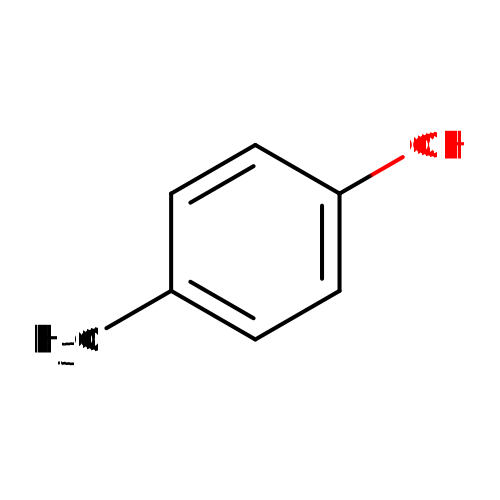
| Description | para-Cresol, also 4-methylphenol, is an organic compound with the formula CH3C6H4(OH). P-cresol is a cresol that consists of toluene substituted by a hydroxy group at position 4. It is a metabolite of aromatic amino acid metabolism produced by intestinal microflora in humans and animals. It has a role as a uremic toxin, a human metabolite and an Escherichia coli metabolite. It is a colourless solid that is widely used intermediate in the production of other chemicals. It is a derivative of phenol and is an isomer of o-cresol and m-cresol. It is a partially lipophilic moiety which strongly binds to plasma protein (close to 100%) under normal conditions. p-Cresol is metabolized through conjugation, mainly sulphation and glucuronization, but removal of the unconjugated p-cresol is, at least in part, via the urine. Therefore it is not surprising that this compound, together with several other phenoles, is retained when the kidneys fail. P-Cresol is an end-product of protein breakdown, and an increase of the nutritional protein load in healthy individuals results in enhanced generation and urinary excretion. The serum p-cresol concentration in uremic patients can be decreased by changing to a low-protein diet. p-Cresol is one of the metabolites of the amino acid tyrosine, and to a certain extent also of phenylalanine, which are converted to 4-hydroxyphenylacetic acid by intestinal bacteria, before being decarboxylated to p-cresol (putrefaction). The main contributing bacteria are aerobes (mainly enterobacteria), but to a certain extent also anaerobes play a role (mainly Clostridium perfringens). In uremia, modifications in the intestinal flora result in the specific overgrowth of bacteria that are specific p-cresol producers. The administration of antibiotics reduces urinary excretion of p-cresol, as a result of the liquidation of the producing bacteria. Environmental factors might also contribute. The liver cytochrome P450 metabolizes toluene to benzyl alcohol, but also to o-cresol and p-cresol. Toluene is not only used industrially, but it is also the most widely abusively inhaled solvent. Furthermore, p-cresol is a metabolite of menthofuran, one of the metabolites of R-(+)-pulegone, which is found in extracts from the plants Mentha pulegium and Hedeoma pulegioides, commonly known as pennyroyal oil and pennyroyal tea. These extracts are popular as unconventional herbal therapeutic agents and are applied as abortiva, diaphoretics, emmenagogues, and psychedelic drugs. Pennyroyal oil is extensively used for its pleasant mint-like smell in the flavoring industry. The toxicity of pennyroyal oil and menthofuran is well known. Another compound used in traditional medicine, especially in Japan, which is a precursor of p-cresol is wood tar creosote. p-Cresol has been reported to affect several biochemical, biological and physiological functions: (i) it diminishes the oxygen uptake of rat cerebral cortex slices; (ii) it increases the free active drug concentration of warfarin and diazepam; (iii) it has been related to growth retardation in the weanling pig; (iv) it alters cell membrane permeability, at least in bacteria; (v) it induces LDH leakage from rat liver slices; (vi) it induces susceptibility to auditive epileptic crises; and (vii) it blocks cell K+ channels. (PMID:10570076 ). p-Cresol is a uremic toxin that is at least partially removed by peritoneal dialysis in haemodialysis patients, and has been involved in the progression of renal failure (PMID:11169029 ). At concentrations encountered during uremia, p-cresol inhibits phagocyte function and decreases leukocyte adhesion to cytokine-stimulated endothelial cells. (PMID:14681860 ). p-Cresol can be found in Bacteroides, Bifidobacterium, Clostridium, Enterobacter and Lactobacillus (PMID:2394806 ; PMID:30208103 ). As a volatile organic compound, it has been identified as a fecal biomarker of Clostridium difficile infection (PMID:30986230 ). |
|---|
| Structure | InChI=1S/C7H8O/c1-6-2-4-7(8)5-3-6/h2-5,8H,1H3 |
|---|
| Synonyms | | Value | Source |
|---|
| 1-Hydroxy-4-methylbenzene | ChEBI | | 4-Cresol | ChEBI | | 4-Hydroxytoluene | ChEBI | | 4-Methylphenol | ChEBI | | p-Kresol | ChEBI | | p-Methylphenol | ChEBI | | p-Tolyl alcohol | ChEBI | | Paracresol | ChEBI | | 1-Methyl-4-hydroxybenzene | HMDB | | 4-(Pentafluorosulfanyl)phenol | HMDB | | 4-Methyl phenol | HMDB | | 4-Methyl-phenol | HMDB | | P-Cresylate | HMDB | | P-Cresylic acid | HMDB | | P-Hydroxytoluene | HMDB | | P-Methyl phenol | HMDB | | P-Methylhydroxybenzene | HMDB | | P-Oxytoluene | HMDB | | P-Toluol | HMDB | | Paramethyl phenol | HMDB | | 4-Cresol, potassium salt | MeSH, HMDB | | m-Cresol | MeSH, HMDB | | 4-Cresol, aluminum salt | MeSH, HMDB | | 4-Cresol, sodium salt | MeSH, HMDB | | Para-cresol | MeSH, HMDB |
|
|---|
| Chemical Formula | C7H8O |
|---|
| Average Molecular Weight | 108.1378 |
|---|
| Monoisotopic Molecular Weight | 108.057514878 |
|---|
| IUPAC Name | 4-methylphenol |
|---|
| Traditional Name | P-cresol |
|---|
| CAS Registry Number | 106-44-5 |
|---|
| SMILES | CC1=CC=C(O)C=C1 |
|---|
| InChI Identifier | InChI=1S/C7H8O/c1-6-2-4-7(8)5-3-6/h2-5,8H,1H3 |
|---|
| InChI Key | IWDCLRJOBJJRNH-UHFFFAOYSA-N |
|---|
| Chemical Taxonomy |
|---|
| Description | Belongs to the class of organic compounds known as para cresols. Para cresols are compounds containing a para cresol moiety, which consists of a benzene ring bearing one hydroxyl group at ring positions 1 and 4. |
|---|
| Kingdom | Organic compounds |
|---|
| Super Class | Benzenoids |
|---|
| Class | Phenols |
|---|
| Sub Class | Cresols |
|---|
| Direct Parent | Para cresols |
|---|
| Alternative Parents | |
|---|
| Substituents | - P-cresol
- 1-hydroxy-2-unsubstituted benzenoid
- Toluene
- Monocyclic benzene moiety
- Organic oxygen compound
- Hydrocarbon derivative
- Organooxygen compound
- Aromatic homomonocyclic compound
|
|---|
| Molecular Framework | Aromatic homomonocyclic compounds |
|---|
| External Descriptors | |
|---|
| Ontology |
|---|
| Physiological effect | |
|---|
| Disposition | |
|---|
| Process | |
|---|
| Role | |
|---|
| Physical Properties |
|---|
| State | Solid |
|---|
| Experimental Molecular Properties | | Property | Value | Reference |
|---|
| Melting Point | 35.5 °C | Not Available | | Boiling Point | 201.80 to 202.00 °C. @ 760.00 mm Hg | The Good Scents Company Information System | | Water Solubility | 21.5 mg/mL at 25 °C | Not Available | | LogP | 1.94 | HANSCH,C ET AL. (1995) |
|
|---|
| Experimental Chromatographic Properties | Not Available |
|---|
| Predicted Molecular Properties | |
|---|
| Predicted Chromatographic Properties | Predicted Collision Cross SectionsPredicted Kovats Retention IndicesUnderivatizedDerivatized |
|---|
| GC-MS Spectra| Spectrum Type | Description | Splash Key | Deposition Date | Source | View |
|---|
| Experimental GC-MS | GC-MS Spectrum - p-Cresol EI-B (Non-derivatized) | splash10-0a4i-5900000000-1d2bdfde621a5af9be73 | 2017-09-12 | HMDB team, MONA, MassBank | View Spectrum | | Experimental GC-MS | GC-MS Spectrum - p-Cresol EI-B (Non-derivatized) | splash10-0a4i-5900000000-b76093f53701327ab25f | 2017-09-12 | HMDB team, MONA, MassBank | View Spectrum | | Experimental GC-MS | GC-MS Spectrum - p-Cresol EI-B (Non-derivatized) | splash10-0a4i-4900000000-7d25deb1e39c6ef4866f | 2017-09-12 | HMDB team, MONA, MassBank | View Spectrum | | Experimental GC-MS | GC-MS Spectrum - p-Cresol EI-B (Non-derivatized) | splash10-0a4i-7900000000-15d473146e11e4b049b2 | 2017-09-12 | HMDB team, MONA, MassBank | View Spectrum | | Experimental GC-MS | GC-MS Spectrum - p-Cresol GC-EI-TOF (Non-derivatized) | splash10-014l-4900000000-14fef90a661a09457976 | 2017-09-12 | HMDB team, MONA, MassBank | View Spectrum | | Experimental GC-MS | GC-MS Spectrum - p-Cresol EI-B (Non-derivatized) | splash10-0a4i-5900000000-1d2bdfde621a5af9be73 | 2018-05-18 | HMDB team, MONA, MassBank | View Spectrum | | Experimental GC-MS | GC-MS Spectrum - p-Cresol EI-B (Non-derivatized) | splash10-0a4i-5900000000-b76093f53701327ab25f | 2018-05-18 | HMDB team, MONA, MassBank | View Spectrum | | Experimental GC-MS | GC-MS Spectrum - p-Cresol EI-B (Non-derivatized) | splash10-0a4i-4900000000-7d25deb1e39c6ef4866f | 2018-05-18 | HMDB team, MONA, MassBank | View Spectrum | | Experimental GC-MS | GC-MS Spectrum - p-Cresol EI-B (Non-derivatized) | splash10-0a4i-7900000000-15d473146e11e4b049b2 | 2018-05-18 | HMDB team, MONA, MassBank | View Spectrum | | Experimental GC-MS | GC-MS Spectrum - p-Cresol GC-EI-TOF (Non-derivatized) | splash10-014l-4900000000-14fef90a661a09457976 | 2018-05-18 | HMDB team, MONA, MassBank | View Spectrum | | Predicted GC-MS | Predicted GC-MS Spectrum - p-Cresol GC-MS (Non-derivatized) - 70eV, Positive | splash10-0a4i-6900000000-27534de20ade11dd5454 | 2016-09-22 | Wishart Lab | View Spectrum | | Predicted GC-MS | Predicted GC-MS Spectrum - p-Cresol GC-MS (1 TMS) - 70eV, Positive | splash10-06fr-9700000000-f41dd95ca553de6bafff | 2017-10-06 | Wishart Lab | View Spectrum | | Predicted GC-MS | Predicted GC-MS Spectrum - p-Cresol GC-MS (Non-derivatized) - 70eV, Positive | Not Available | 2021-10-12 | Wishart Lab | View Spectrum | | Predicted GC-MS | Predicted GC-MS Spectrum - p-Cresol GC-MS (Non-derivatized) - 70eV, Positive | Not Available | 2021-10-12 | Wishart Lab | View Spectrum | | MS | Mass Spectrum (Electron Ionization) | splash10-0a4i-6900000000-729e6f5bdb0da3ed9ded | 2014-09-20 | Not Available | View Spectrum |
MS/MS Spectra| Spectrum Type | Description | Splash Key | Deposition Date | Source | View |
|---|
| Experimental LC-MS/MS | LC-MS/MS Spectrum - p-Cresol Quattro_QQQ 10V, Positive-QTOF (Annotated) | splash10-0a4i-5900000000-ab55ada5cae0538f383e | 2012-07-24 | HMDB team, MONA | View Spectrum | | Experimental LC-MS/MS | LC-MS/MS Spectrum - p-Cresol Quattro_QQQ 25V, Positive-QTOF (Annotated) | splash10-0006-9000000000-385a7a99e0409c7f060d | 2012-07-24 | HMDB team, MONA | View Spectrum | | Experimental LC-MS/MS | LC-MS/MS Spectrum - p-Cresol Quattro_QQQ 40V, Positive-QTOF (Annotated) | splash10-02tl-9000000000-205f4e5245868e9debcc | 2012-07-24 | HMDB team, MONA | View Spectrum | | Experimental LC-MS/MS | LC-MS/MS Spectrum - p-Cresol EI-B (VARIAN MAT-44) , Positive-QTOF | splash10-0a4i-5900000000-fd438231ac0ed75fdf09 | 2012-08-31 | HMDB team, MONA | View Spectrum | | Experimental LC-MS/MS | LC-MS/MS Spectrum - p-Cresol EI-B (HITACHI RMU-7M) , Positive-QTOF | splash10-0a4i-5900000000-b76093f53701327ab25f | 2012-08-31 | HMDB team, MONA | View Spectrum | | Experimental LC-MS/MS | LC-MS/MS Spectrum - p-Cresol EI-B (JEOL JMS-D-3000) , Positive-QTOF | splash10-0a4i-4900000000-7d25deb1e39c6ef4866f | 2012-08-31 | HMDB team, MONA | View Spectrum | | Experimental LC-MS/MS | LC-MS/MS Spectrum - p-Cresol EI-B (HITACHI M-80B) , Positive-QTOF | splash10-0a4i-7900000000-0cdab17a1a95f3e65f45 | 2012-08-31 | HMDB team, MONA | View Spectrum | | Experimental LC-MS/MS | LC-MS/MS Spectrum - p-Cresol NA 35V, negative-QTOF | splash10-0a6u-9600000000-276b44cbbdb079cac718 | 2020-07-21 | HMDB team, MONA | View Spectrum | | Predicted LC-MS/MS | Predicted LC-MS/MS Spectrum - p-Cresol 10V, Positive-QTOF | splash10-0a4i-0900000000-cf0bed2b3a203309d9aa | 2016-09-12 | Wishart Lab | View Spectrum | | Predicted LC-MS/MS | Predicted LC-MS/MS Spectrum - p-Cresol 20V, Positive-QTOF | splash10-0a4i-1900000000-4f20c8bd2dde845b499c | 2016-09-12 | Wishart Lab | View Spectrum | | Predicted LC-MS/MS | Predicted LC-MS/MS Spectrum - p-Cresol 40V, Positive-QTOF | splash10-0fb9-9100000000-393b5f734646352622f9 | 2016-09-12 | Wishart Lab | View Spectrum | | Predicted LC-MS/MS | Predicted LC-MS/MS Spectrum - p-Cresol 10V, Negative-QTOF | splash10-0a4i-0900000000-0c45920f40546c2d8944 | 2016-09-12 | Wishart Lab | View Spectrum | | Predicted LC-MS/MS | Predicted LC-MS/MS Spectrum - p-Cresol 20V, Negative-QTOF | splash10-0a4i-0900000000-417774c01b748db1609d | 2016-09-12 | Wishart Lab | View Spectrum | | Predicted LC-MS/MS | Predicted LC-MS/MS Spectrum - p-Cresol 40V, Negative-QTOF | splash10-0a4i-9600000000-5583b6dc3ae583b8dab0 | 2016-09-12 | Wishart Lab | View Spectrum | | Predicted LC-MS/MS | Predicted LC-MS/MS Spectrum - p-Cresol 10V, Negative-QTOF | splash10-0a4i-0900000000-3f09649991cc4cfcf1ec | 2021-09-23 | Wishart Lab | View Spectrum | | Predicted LC-MS/MS | Predicted LC-MS/MS Spectrum - p-Cresol 20V, Negative-QTOF | splash10-0a4i-0900000000-3f09649991cc4cfcf1ec | 2021-09-23 | Wishart Lab | View Spectrum | | Predicted LC-MS/MS | Predicted LC-MS/MS Spectrum - p-Cresol 40V, Negative-QTOF | splash10-0006-9000000000-6eb0884733967edc9e6b | 2021-09-23 | Wishart Lab | View Spectrum | | Predicted LC-MS/MS | Predicted LC-MS/MS Spectrum - p-Cresol 10V, Positive-QTOF | splash10-0a4i-3900000000-621936189d60e194cefd | 2021-09-24 | Wishart Lab | View Spectrum | | Predicted LC-MS/MS | Predicted LC-MS/MS Spectrum - p-Cresol 20V, Positive-QTOF | splash10-056u-9100000000-2740c99af64b11309dfb | 2021-09-24 | Wishart Lab | View Spectrum | | Predicted LC-MS/MS | Predicted LC-MS/MS Spectrum - p-Cresol 40V, Positive-QTOF | splash10-00kf-9000000000-1c2034d922354f5d6682 | 2021-09-24 | Wishart Lab | View Spectrum |
NMR Spectra| Spectrum Type | Description | Deposition Date | Source | View |
|---|
| Experimental 1D NMR | 1H NMR Spectrum (1D, 600 MHz, H2O, experimental) | 2012-12-04 | Wishart Lab | View Spectrum | | Experimental 2D NMR | [1H, 13C]-HSQC NMR Spectrum (2D, 600 MHz, H2O, experimental) | 2012-12-05 | Wishart Lab | View Spectrum |
IR Spectra| Spectrum Type | Description | Deposition Date | Source | View |
|---|
| Predicted IR Spectrum | IR Ion Spectrum (Predicted IRIS Spectrum, Adduct: [M-H]-) | 2023-02-03 | FELIX lab | View Spectrum | | Predicted IR Spectrum | IR Ion Spectrum (Predicted IRIS Spectrum, Adduct: [M+H]+) | 2023-02-03 | FELIX lab | View Spectrum | | Predicted IR Spectrum | IR Ion Spectrum (Predicted IRIS Spectrum, Adduct: [M+Na]+) | 2023-02-03 | FELIX lab | View Spectrum |
|
|---|
| Disease References | | Hemodialysis |
|---|
- De Smet R, Van Kaer J, Liebich H, Lesaffer G, Verstraete A, Dhondt A, Duym P, Lameire N, Vanholder R: Heparin-induced release of protein-bound solutes during hemodialysis is an in vitro artifact. Clin Chem. 2001 May;47(5):901-9. [PubMed:11325895 ]
| | Uremia |
|---|
- Vanholder R, De Smet R, Glorieux G, Argiles A, Baurmeister U, Brunet P, Clark W, Cohen G, De Deyn PP, Deppisch R, Descamps-Latscha B, Henle T, Jorres A, Lemke HD, Massy ZA, Passlick-Deetjen J, Rodriguez M, Stegmayr B, Stenvinkel P, Tetta C, Wanner C, Zidek W: Review on uremic toxins: classification, concentration, and interindividual variability. Kidney Int. 2003 May;63(5):1934-43. doi: 10.1046/j.1523-1755.2003.00924.x. [PubMed:12675874 ]
| | Ulcerative colitis |
|---|
- Garner CE, Smith S, de Lacy Costello B, White P, Spencer R, Probert CS, Ratcliffe NM: Volatile organic compounds from feces and their potential for diagnosis of gastrointestinal disease. FASEB J. 2007 Jun;21(8):1675-88. Epub 2007 Feb 21. [PubMed:17314143 ]
- Le Gall G, Noor SO, Ridgway K, Scovell L, Jamieson C, Johnson IT, Colquhoun IJ, Kemsley EK, Narbad A: Metabolomics of fecal extracts detects altered metabolic activity of gut microbiota in ulcerative colitis and irritable bowel syndrome. J Proteome Res. 2011 Sep 2;10(9):4208-18. doi: 10.1021/pr2003598. Epub 2011 Aug 8. [PubMed:21761941 ]
- Walton C, Fowler DP, Turner C, Jia W, Whitehead RN, Griffiths L, Dawson C, Waring RH, Ramsden DB, Cole JA, Cauchi M, Bessant C, Hunter JO: Analysis of volatile organic compounds of bacterial origin in chronic gastrointestinal diseases. Inflamm Bowel Dis. 2013 Sep;19(10):2069-78. doi: 10.1097/MIB.0b013e31829a91f6. [PubMed:23867873 ]
- De Preter V, Machiels K, Joossens M, Arijs I, Matthys C, Vermeire S, Rutgeerts P, Verbeke K: Faecal metabolite profiling identifies medium-chain fatty acids as discriminating compounds in IBD. Gut. 2015 Mar;64(3):447-58. doi: 10.1136/gutjnl-2013-306423. Epub 2014 May 8. [PubMed:24811995 ]
| | Irritable bowel syndrome |
|---|
- Le Gall G, Noor SO, Ridgway K, Scovell L, Jamieson C, Johnson IT, Colquhoun IJ, Kemsley EK, Narbad A: Metabolomics of fecal extracts detects altered metabolic activity of gut microbiota in ulcerative colitis and irritable bowel syndrome. J Proteome Res. 2011 Sep 2;10(9):4208-18. doi: 10.1021/pr2003598. Epub 2011 Aug 8. [PubMed:21761941 ]
- Walton C, Fowler DP, Turner C, Jia W, Whitehead RN, Griffiths L, Dawson C, Waring RH, Ramsden DB, Cole JA, Cauchi M, Bessant C, Hunter JO: Analysis of volatile organic compounds of bacterial origin in chronic gastrointestinal diseases. Inflamm Bowel Dis. 2013 Sep;19(10):2069-78. doi: 10.1097/MIB.0b013e31829a91f6. [PubMed:23867873 ]
| | Celiac disease |
|---|
- Di Cagno R, De Angelis M, De Pasquale I, Ndagijimana M, Vernocchi P, Ricciuti P, Gagliardi F, Laghi L, Crecchio C, Guerzoni ME, Gobbetti M, Francavilla R: Duodenal and faecal microbiota of celiac children: molecular, phenotype and metabolome characterization. BMC Microbiol. 2011 Oct 4;11:219. doi: 10.1186/1471-2180-11-219. [PubMed:21970810 ]
| | Nonalcoholic fatty liver disease |
|---|
- Raman M, Ahmed I, Gillevet PM, Probert CS, Ratcliffe NM, Smith S, Greenwood R, Sikaroodi M, Lam V, Crotty P, Bailey J, Myers RP, Rioux KP: Fecal microbiome and volatile organic compound metabolome in obese humans with nonalcoholic fatty liver disease. Clin Gastroenterol Hepatol. 2013 Jul;11(7):868-75.e1-3. doi: 10.1016/j.cgh.2013.02.015. Epub 2013 Feb 27. [PubMed:23454028 ]
| | Diarrhoea predominant irritable bowel syndrome |
|---|
- Ahmed I, Greenwood R, Costello Bde L, Ratcliffe NM, Probert CS: An investigation of fecal volatile organic metabolites in irritable bowel syndrome. PLoS One. 2013;8(3):e58204. doi: 10.1371/journal.pone.0058204. Epub 2013 Mar 13. [PubMed:23516449 ]
| | Crohn's disease |
|---|
- Walton C, Fowler DP, Turner C, Jia W, Whitehead RN, Griffiths L, Dawson C, Waring RH, Ramsden DB, Cole JA, Cauchi M, Bessant C, Hunter JO: Analysis of volatile organic compounds of bacterial origin in chronic gastrointestinal diseases. Inflamm Bowel Dis. 2013 Sep;19(10):2069-78. doi: 10.1097/MIB.0b013e31829a91f6. [PubMed:23867873 ]
- De Preter V, Machiels K, Joossens M, Arijs I, Matthys C, Vermeire S, Rutgeerts P, Verbeke K: Faecal metabolite profiling identifies medium-chain fatty acids as discriminating compounds in IBD. Gut. 2015 Mar;64(3):447-58. doi: 10.1136/gutjnl-2013-306423. Epub 2014 May 8. [PubMed:24811995 ]
| | Autism |
|---|
- De Angelis M, Piccolo M, Vannini L, Siragusa S, De Giacomo A, Serrazzanetti DI, Cristofori F, Guerzoni ME, Gobbetti M, Francavilla R: Fecal microbiota and metabolome of children with autism and pervasive developmental disorder not otherwise specified. PLoS One. 2013 Oct 9;8(10):e76993. doi: 10.1371/journal.pone.0076993. eCollection 2013. [PubMed:24130822 ]
| | Pervasive developmental disorder not otherwise specified |
|---|
- De Angelis M, Piccolo M, Vannini L, Siragusa S, De Giacomo A, Serrazzanetti DI, Cristofori F, Guerzoni ME, Gobbetti M, Francavilla R: Fecal microbiota and metabolome of children with autism and pervasive developmental disorder not otherwise specified. PLoS One. 2013 Oct 9;8(10):e76993. doi: 10.1371/journal.pone.0076993. eCollection 2013. [PubMed:24130822 ]
| | Enteritis |
|---|
- Probert CS, Jones PR, Ratcliffe NM: A novel method for rapidly diagnosing the causes of diarrhoea. Gut. 2004 Jan;53(1):58-61. [PubMed:14684577 ]
| | Clostridium difficile infection |
|---|
- Patel M, Fowler D, Sizer J, Walton C: Faecal volatile biomarkers of Clostridium difficile infection. PLoS One. 2019 Apr 15;14(4):e0215256. doi: 10.1371/journal.pone.0215256. eCollection 2019. [PubMed:30986230 ]
| | Eosinophilic esophagitis |
|---|
- Slae, M., Huynh, H., Wishart, D.S. (2014). Analysis of 30 normal pediatric urine samples via NMR spectroscopy (unpublished work). NA.
| | Colorectal cancer |
|---|
- Cheng Y, Xie G, Chen T, Qiu Y, Zou X, Zheng M, Tan B, Feng B, Dong T, He P, Zhao L, Zhao A, Xu LX, Zhang Y, Jia W: Distinct urinary metabolic profile of human colorectal cancer. J Proteome Res. 2012 Feb 3;11(2):1354-63. doi: 10.1021/pr201001a. Epub 2011 Dec 28. [PubMed:22148915 ]
- Ni Y, Xie G, Jia W: Metabonomics of human colorectal cancer: new approaches for early diagnosis and biomarker discovery. J Proteome Res. 2014 Sep 5;13(9):3857-70. doi: 10.1021/pr500443c. Epub 2014 Aug 14. [PubMed:25105552 ]
- Brown DG, Rao S, Weir TL, O'Malia J, Bazan M, Brown RJ, Ryan EP: Metabolomics and metabolic pathway networks from human colorectal cancers, adjacent mucosa, and stool. Cancer Metab. 2016 Jun 6;4:11. doi: 10.1186/s40170-016-0151-y. eCollection 2016. [PubMed:27275383 ]
|
|
|---|
| General References | - Geyer H, Scheunert I, Korte F: Bioconcentration potential of organic environmental chemicals in humans. Regul Toxicol Pharmacol. 1986 Dec;6(4):313-47. [PubMed:3101145 ]
- Buhlmann P, Hayakawa M, Ohshiro T, Amemiya S, Umezawa Y: Influence of natural, electrically neutral lipids on the potentiometric responses of cation-selective polymeric membrane electrodes. Anal Chem. 2001 Jul 15;73(14):3199-205. [PubMed:11476216 ]
- Ogata N, Shibata T: Binding of alkyl- and alkoxy-substituted simple phenolic compounds to human serum proteins. Res Commun Mol Pathol Pharmacol. 2000;107(1-2):167-73. [PubMed:11334365 ]
- Cork A, Park KC: Identification of electrophysiologically-active compounds for the malaria mosquito, Anopheles gambiae, in human sweat extracts. Med Vet Entomol. 1996 Jul;10(3):269-76. [PubMed:8887339 ]
- Bone E, Tamm A, Hill M: The production of urinary phenols by gut bacteria and their possible role in the causation of large bowel cancer. Am J Clin Nutr. 1976 Dec;29(12):1448-54. [PubMed:826152 ]
- Akasaka K, Ohrui H, Meguro H, Tamura M: Determination of triacylglycerol and cholesterol ester hydroperoxides in human plasma by high-performance liquid chromatography with fluorometric postcolumn detection. J Chromatogr. 1993 Aug 11;617(2):205-11. [PubMed:8408385 ]
- Gostner A, Blaut M, Schaffer V, Kozianowski G, Theis S, Klingeberg M, Dombrowski Y, Martin D, Ehrhardt S, Taras D, Schwiertz A, Kleessen B, Luhrs H, Schauber J, Dorbath D, Menzel T, Scheppach W: Effect of isomalt consumption on faecal microflora and colonic metabolism in healthy volunteers. Br J Nutr. 2006 Jan;95(1):40-50. [PubMed:16441915 ]
- Letelier ME, Rodriguez E, Wallace A, Lorca M, Repetto Y, Morello A, Aldunate J: Trypanosoma cruzi: a possible control of transfusion-induced Chagas' disease by phenolic antioxidants. Exp Parasitol. 1990 Nov;71(4):357-63. [PubMed:2121515 ]
- Nishiyama T, Ohnishi J, Hashiguchi Y: Fused heterocyclic antioxidants: antioxidative activities of hydrocoumarins in a homogeneous solution. Biosci Biotechnol Biochem. 2001 May;65(5):1127-33. [PubMed:11440127 ]
- Dills RL, Bellamy GM, Kalman DA: Quantitation of o-, m- and p-cresol and deuterated analogs in human urine by gas chromatography with electron capture detection. J Chromatogr B Biomed Sci Appl. 1997 Dec 5;703(1-2):105-13. [PubMed:9448067 ]
- Bammens B, Verbeke K, Vanrenterghem Y, Evenepoel P: Evidence for impaired assimilation of protein in chronic renal failure. Kidney Int. 2003 Dec;64(6):2196-203. [PubMed:14633143 ]
- Brunet P, Dou L, Cerini C, Berland Y: Protein-bound uremic retention solutes. Adv Ren Replace Ther. 2003 Oct;10(4):310-20. [PubMed:14681860 ]
- Lameire N, Vanholder R, De Smet R: Uremic toxins and peritoneal dialysis. Kidney Int Suppl. 2001 Feb;78:S292-7. [PubMed:11169029 ]
- Vanholder R, De Smet R, Lesaffer G: p-cresol: a toxin revealing many neglected but relevant aspects of uraemic toxicity. Nephrol Dial Transplant. 1999 Dec;14(12):2813-5. [PubMed:10570076 ]
- Sivsammye G, Sims HV: Presumptive identification of Clostridium difficile by detection of p-cresol in prepared peptone yeast glucose broth supplemented with p-hydroxyphenylacetic acid. J Clin Microbiol. 1990 Aug;28(8):1851-3. [PubMed:2394806 ]
- Passmore IJ, Letertre MPM, Preston MD, Bianconi I, Harrison MA, Nasher F, Kaur H, Hong HA, Baines SD, Cutting SM, Swann JR, Wren BW, Dawson LF: Para-cresol production by Clostridium difficile affects microbial diversity and membrane integrity of Gram-negative bacteria. PLoS Pathog. 2018 Sep 12;14(9):e1007191. doi: 10.1371/journal.ppat.1007191. eCollection 2018 Sep. [PubMed:30208103 ]
- Patel M, Fowler D, Sizer J, Walton C: Faecal volatile biomarkers of Clostridium difficile infection. PLoS One. 2019 Apr 15;14(4):e0215256. doi: 10.1371/journal.pone.0215256. eCollection 2019. [PubMed:30986230 ]
|
|---|