| Record Information |
|---|
| Version | 5.0 |
|---|
| Status | Detected and Quantified |
|---|
| Creation Date | 2006-05-22 14:17:29 UTC |
|---|
| Update Date | 2020-10-09 21:02:11 UTC |
|---|
| HMDB ID | HMDB0001960 |
|---|
| Secondary Accession Numbers | |
|---|
| Metabolite Identification |
|---|
| Common Name | Tin |
|---|
| Description | Tin is a trace element that is required in bone formation. It has the atomic symbol Sn, atomic number 50, and atomic weight 118.71. (PubChem). Experimental studies over the last decade have suggested an association between thymus immune and homeostatic function and exogenous tin. It has been hypothesized that the thymus gland synthesizes and secretes one or more tin bearing factors that enhance immune defenses against malignancy and retard the gradual loss of immune capacity with senescence. (PMID 2195720 ). Physiologically, it exists as an ion in the body. Inorganic tin salts are poorly absorbed and rapidly excreted in the faeces; as a result they have a low toxicity. Only about 5 per cent is absorbed from the gastrointestinal tract, widely distributed in the body, then excreted by the kidney. Some tin is deposited in lung and bone. Some tin salts can cause renal necrosis after parenteral doses. Mutagenic studies on metallic tin and its compounds have been negative. Long-term animal carcinogenic studies have shown fewer malignant tumors in animals exposed to tin than in controls. Human volunteers developed mild signs of toxicity with tin, given in fruit juices, at a concentration of 1400 mg per litre. The WHO 1973 permissible limit for tin in tinned food is 250 micrograms per kg. The adult daily intake of tin was about 17 mg per day in 1940, but it has now decreased to about 3.5 mg, due to improvements in technique of tinning with enamel overcoat and crimped lids to minimize exposure to tin and lead solder. (PMID 3291572 ). |
|---|
| Structure | |
|---|
| Synonyms | | Value | Source |
|---|
| CI pigment metal 5 | HMDB | | Haro mix ZT-514 | HMDB | | Innohep | HMDB | | Metallic tin | HMDB | | Silver matt powder | HMDB | | SN | HMDB | | Stanum | HMDB | | Tin flake | HMDB | | Tin powder | HMDB | | Tindamax | HMDB | | ZINN | HMDB |
|
|---|
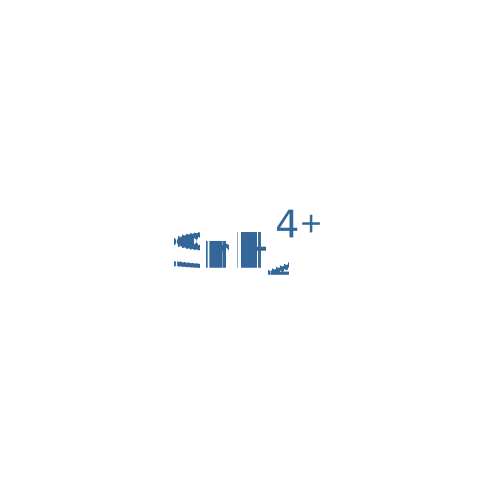
| Chemical Formula | H4Sn |
|---|
| Average Molecular Weight | 122.74 |
|---|
| Monoisotopic Molecular Weight | 123.933496699 |
|---|
| IUPAC Name | λ⁸-tin(4+) ion |
|---|
| Traditional Name | λ⁸-tin(4+) ion |
|---|
| CAS Registry Number | 7440-31-5 |
|---|
| SMILES | [SnH4+4] |
|---|
| InChI Identifier | InChI=1S/Sn.4H/q+4;;;; |
|---|
| InChI Key | PXQLTWWGPFDWNT-UHFFFAOYSA-N |
|---|
| Chemical Taxonomy |
|---|
| Description | Belongs to the class of inorganic compounds known as miscellaneous mixed metal/non-metals. These are inorganic compounds containing non-metal as well as metal atoms but not belonging to afore mentioned classes. |
|---|
| Kingdom | Inorganic compounds |
|---|
| Super Class | Mixed metal/non-metal compounds |
|---|
| Class | Miscellaneous mixed metal/non-metals |
|---|
| Sub Class | Not Available |
|---|
| Direct Parent | Miscellaneous mixed metal/non-metals |
|---|
| Alternative Parents | Not Available |
|---|
| Substituents | - Miscellaneous mixed metal/non-metal
|
|---|
| Molecular Framework | Not Available |
|---|
| External Descriptors | Not Available |
|---|
| Ontology |
|---|
| Not Available | Not Available |
|---|
| Physical Properties |
|---|
| State | Solid |
|---|
| Experimental Molecular Properties | | Property | Value | Reference |
|---|
| Melting Point | 231.93 °C | Not Available | | Boiling Point | Not Available | Not Available | | Water Solubility | Not Available | Not Available | | LogP | Not Available | Not Available |
|
|---|
| Experimental Chromatographic Properties | Not Available |
|---|
| Predicted Molecular Properties | |
|---|
| Predicted Chromatographic Properties | Predicted Collision Cross SectionsPredicted Kovats Retention IndicesNot Available |
|---|
| Spectra |
|---|
| |
|---|
| Biological Properties |
|---|
| Cellular Locations | Not Available |
|---|
| Biospecimen Locations | - Blood
- Cerebrospinal Fluid (CSF)
- Saliva
- Urine
|
|---|
| Tissue Locations | Not Available |
|---|
| Pathways | |
|---|
| Normal Concentrations |
|---|
| |
| Blood | Detected and Quantified | 0.0024-0.0212 uM | Adult (>18 years old) | Both | Normal | | details | | Blood | Detected and Quantified | 0.013 +/- 0.0051 uM | Adult (>18 years old) | Both | Normal | | details | | Blood | Detected and Quantified | 0.0065 +/- 0.0039 uM | Elderly (>65 years old) | Both | Normal | | details | | Cerebrospinal Fluid (CSF) | Detected and Quantified | 0.05 (0.03-0.18) uM | Adult (>18 years old) | Both | Normal | | details | | Saliva | Detected and Quantified | 0.020 +/- 0.02 uM | Adult (>18 years old) | Both | Normal | | details | | Urine | Detected and Quantified | 0.0011 (0.00016-0.0069) umol/mmol creatinine | Adult (>18 years old) | Both | Normal | | details | | Urine | Detected and Quantified | <0.00552 umol/mmol creatinine | Adult (>18 years old) | Not Specified | Normal | | details | | Urine | Detected and Quantified | < 0.00552 umol/mmol creatinine | Adult (>18 years old) | Not Specified | Normal | | details |
|
|---|
| Abnormal Concentrations |
|---|
| |
| Blood | Detected and Quantified | 0.004 +/- 0.0018 uM | Adult (>18 years old) | Both | Parkinson's disease | | details | | Blood | Detected and Quantified | 0.016 +/- 0.009 uM | Adult (>18 years old) | Both | Multiple sclerosis | | details | | Blood | Detected and Quantified | 0.011 +/- 0.0056 uM | Adult (>18 years old) | Both | Alzheimer's disease | | details |
|
|---|
| Associated Disorders and Diseases |
|---|
| Disease References | | Alzheimer's disease |
|---|
- Bocca B, Forte G, Petrucci F, Pino A, Marchione F, Bomboi G, Senofonte O, Giubilei F, Alimonti A: Monitoring of chemical elements and oxidative damage in patients affected by Alzheimer's disease. Ann Ist Super Sanita. 2005;41(2):197-203. [PubMed:16244393 ]
| | Multiple sclerosis |
|---|
- Forte G, Visconti A, Santucci S, Ghazaryan A, Figa-Talamanca L, Cannoni S, Bocca B, Pino A, Violante N, Alimonti A, Salvetti M, Ristori G: Quantification of chemical elements in blood of patients affected by multiple sclerosis. Ann Ist Super Sanita. 2005;41(2):213-6. [PubMed:16244395 ]
| | Parkinson's disease |
|---|
- Forte G, Alimonti A, Pino A, Stanzione P, Brescianini S, Brusa L, Sancesario G, Violante N, Bocca B: Metals and oxidative stress in patients with Parkinson's disease. Ann Ist Super Sanita. 2005;41(2):189-95. [PubMed:16244392 ]
|
|
|---|
| Associated OMIM IDs | |
|---|
| External Links |
|---|
| DrugBank ID | Not Available |
|---|
| Phenol Explorer Compound ID | Not Available |
|---|
| FooDB ID | FDB003722 |
|---|
| KNApSAcK ID | C00000001 |
|---|
| Chemspider ID | 10620886 |
|---|
| KEGG Compound ID | Not Available |
|---|
| BioCyc ID | Not Available |
|---|
| BiGG ID | Not Available |
|---|
| Wikipedia Link | Tin |
|---|
| METLIN ID | Not Available |
|---|
| PubChem Compound | Not Available |
|---|
| PDB ID | Not Available |
|---|
| ChEBI ID | 32990 |
|---|
| Food Biomarker Ontology | Not Available |
|---|
| VMH ID | Not Available |
|---|
| MarkerDB ID | MDB00000358 |
|---|
| Good Scents ID | Not Available |
|---|
| References |
|---|
| Synthesis Reference | Not Available |
|---|
| Material Safety Data Sheet (MSDS) | Download (PDF) |
|---|
| General References | - Cardarelli N: Tin and the thymus gland: a review. Thymus. 1990 Jun;15(4):223-31. [PubMed:2195720 ]
- Winship KA: Toxicity of tin and its compounds. Adverse Drug React Acute Poisoning Rev. 1988 Spring;7(1):19-38. [PubMed:3291572 ]
|
|---|