| Record Information |
|---|
| Version | 5.0 |
|---|
| Status | Detected and Quantified |
|---|
| Creation Date | 2006-05-22 14:17:43 UTC |
|---|
| Update Date | 2023-02-21 17:16:17 UTC |
|---|
| HMDB ID | HMDB0002243 |
|---|
| Secondary Accession Numbers | |
|---|
| Metabolite Identification |
|---|
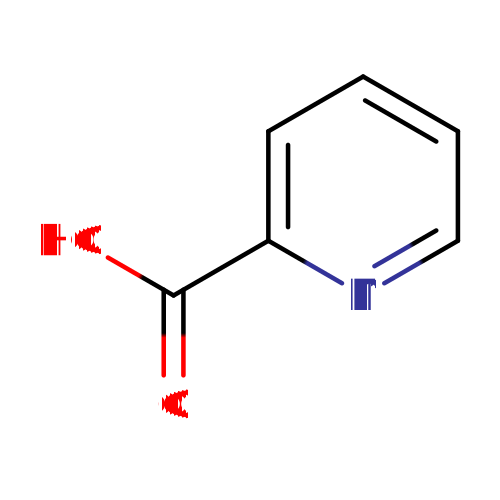
| Common Name | Picolinic acid |
|---|
| Description | Picolinic acid is a metabolite of the tryptophan catabolism. Picolinic acid is produced under inflammatory conditions and a costimulus with interferon-gamma (IFNgamma) of macrophage (Mphi) effector functions, is a selective inducer of the Mphi inflammatory protein-1alpha (MIP-1alpha) and -1beta (MIPs), two chemokines/cytokines involved in the elicitation of the inflammatory reactions and in the development of the Th1 responses. IFNgamma and picolinic acid have reciprocal effects on the production of MIPs chemokines and the expression of their receptor. The concerted action of IFNgamma and picolinic acid on MIP-1alpha/beta chemokine/receptor system is likely to be of pathophysiological significance and to represent an important regulatory mechanism for leukocyte recruitment and distribution into damaged tissues during inflammatory responses. Picolinic acid has an effect on the production of L-arginine-derived reactive nitrogen intermediates in macrophages, by augmenting IFN-gamma-induced NO2- production, and acts synergistically with IFN-gamma in activating macrophages. Children with acrodermatitis enteropathica (AE) are treated with oral zinc dipicolinate (zinc-PA). The concentration of picolinic acid in the plasma of asymptomatic children with AE was significantly less than that of normal children. However, oral treatment with PA alone is ineffective. The results support the hypothesis that the genetic defect in AE is in the tryptophan pathway, although the role of PA in zinc metabolism remains to be defined. (PMID:15206716 , 8473748 , 1701787 , 6694049 ). |
|---|
| Structure | InChI=1S/C6H5NO2/c8-6(9)5-3-1-2-4-7-5/h1-4H,(H,8,9) |
|---|
| Synonyms | | Value | Source |
|---|
| 2-Carboxypyridine | ChEBI | | 2-Picolinic acid | ChEBI | | 2-Pyridinecarboxylic acid | ChEBI | | alpha-Picolinic acid | ChEBI | | alpha-Pyridinecarboxylic acid | ChEBI | | O-Pyridinecarboxylic acid | ChEBI | | PYRIDINE-2-carboxylIC ACID | ChEBI | | 2-Picolinate | Generator | | 2-Pyridinecarboxylate | Generator | | a-Picolinate | Generator | | a-Picolinic acid | Generator | | alpha-Picolinate | Generator | | Α-picolinate | Generator | | Α-picolinic acid | Generator | | a-Pyridinecarboxylate | Generator | | a-Pyridinecarboxylic acid | Generator | | alpha-Pyridinecarboxylate | Generator | | Α-pyridinecarboxylate | Generator | | Α-pyridinecarboxylic acid | Generator | | O-Pyridinecarboxylate | Generator | | PYRIDINE-2-carboxylate | Generator | | Picolinate | Generator | | 2-Methoxy-5-aminopyridine | HMDB | | 4,5-Dehydropipecolic acid | HMDB | | 5-amino-2-Fluoropyridine | HMDB | | 5-amino-2-Methoxypyridine | HMDB | | 5-amino-2-Pyridinecarboxylic acid | HMDB | | 5-Aminopicolinic acid | HMDB | | 5-Aminopyridine-2-carboxylic acid | HMDB | | 6-Methoxy-pyridin-3-ylamine | HMDB | | Acide picolique | HMDB | | L-Baikiain | HMDB | | Phenyl-(2-pyridyl)acetonitrile | HMDB | | PLA | HMDB | | Pyridine-carboxylique-2 | HMDB | | Pyridinecarboxylic acid-(2) | HMDB | | Iron(III) picolinate | MeSH, HMDB | | Zinc picolinate | MeSH, HMDB | | Picolinic acid, sodium salt | MeSH, HMDB | | 2-Pyridine carboxylic acid | MeSH, HMDB | | Calcium dipicolinate trihydrate | MeSH, HMDB | | Picolinic acid, hydrochloride | MeSH, HMDB | | Chromium picolinate | MeSH, HMDB |
|
|---|
| Chemical Formula | C6H5NO2 |
|---|
| Average Molecular Weight | 123.1094 |
|---|
| Monoisotopic Molecular Weight | 123.032028409 |
|---|
| IUPAC Name | pyridine-2-carboxylic acid |
|---|
| Traditional Name | picolinic acid |
|---|
| CAS Registry Number | 98-98-6 |
|---|
| SMILES | OC(=O)C1=CC=CC=N1 |
|---|
| InChI Identifier | InChI=1S/C6H5NO2/c8-6(9)5-3-1-2-4-7-5/h1-4H,(H,8,9) |
|---|
| InChI Key | SIOXPEMLGUPBBT-UHFFFAOYSA-N |
|---|
| Chemical Taxonomy |
|---|
| Description | Belongs to the class of organic compounds known as pyridinecarboxylic acids. Pyridinecarboxylic acids are compounds containing a pyridine ring bearing a carboxylic acid group. |
|---|
| Kingdom | Organic compounds |
|---|
| Super Class | Organoheterocyclic compounds |
|---|
| Class | Pyridines and derivatives |
|---|
| Sub Class | Pyridinecarboxylic acids and derivatives |
|---|
| Direct Parent | Pyridinecarboxylic acids |
|---|
| Alternative Parents | |
|---|
| Substituents | - Pyridine carboxylic acid
- Heteroaromatic compound
- Azacycle
- Monocarboxylic acid or derivatives
- Carboxylic acid
- Carboxylic acid derivative
- Organic nitrogen compound
- Organic oxygen compound
- Organopnictogen compound
- Organic oxide
- Hydrocarbon derivative
- Organooxygen compound
- Organonitrogen compound
- Aromatic heteromonocyclic compound
|
|---|
| Molecular Framework | Aromatic heteromonocyclic compounds |
|---|
| External Descriptors | |
|---|
| Ontology |
|---|
| Physiological effect | Not Available |
|---|
| Disposition | |
|---|
| Process | Not Available |
|---|
| Role | |
|---|
| Physical Properties |
|---|
| State | Solid |
|---|
| Experimental Molecular Properties | | Property | Value | Reference |
|---|
| Melting Point | 136.5 °C | Not Available | | Boiling Point | Not Available | Not Available | | Water Solubility | 960 mg/mL at 20 °C | Not Available | | LogP | 0.72 | HANSCH,C ET AL. (1995) |
|
|---|
| Experimental Chromatographic Properties | Not Available |
|---|
| Predicted Molecular Properties | |
|---|
| Predicted Chromatographic Properties | Predicted Collision Cross SectionsPredicted Kovats Retention IndicesUnderivatizedDerivatized |
|---|
| Spectra |
|---|
| GC-MS Spectra| Spectrum Type | Description | Splash Key | Deposition Date | Source | View |
|---|
| Experimental GC-MS | GC-MS Spectrum - Picolinic acid GC-EI-TOF (Pegasus III TOF-MS system, Leco; GC 6890, Agilent Technologies) (Non-derivatized) | splash10-001r-0900000000-3d42fed18a7170ac902c | 2014-06-16 | HMDB team, MONA, MassBank | View Spectrum | | Experimental GC-MS | GC-MS Spectrum - Picolinic acid GC-MS (1 TMS) | splash10-005i-4900000000-ceebd42c8dcc23fdf3e4 | 2014-06-16 | HMDB team, MONA, MassBank | View Spectrum | | Experimental GC-MS | GC-MS Spectrum - Picolinic acid EI-B (Non-derivatized) | splash10-0fb9-9000000000-bab2bcb7bd27b0be1f51 | 2017-09-12 | HMDB team, MONA, MassBank | View Spectrum | | Experimental GC-MS | GC-MS Spectrum - Picolinic acid GC-EI-TOF (Non-derivatized) | splash10-001r-0900000000-3d42fed18a7170ac902c | 2017-09-12 | HMDB team, MONA, MassBank | View Spectrum | | Experimental GC-MS | GC-MS Spectrum - Picolinic acid GC-MS (Non-derivatized) | splash10-005i-4900000000-ceebd42c8dcc23fdf3e4 | 2017-09-12 | HMDB team, MONA, MassBank | View Spectrum | | Experimental GC-MS | GC-MS Spectrum - Picolinic acid GC-EI-TOF (Non-derivatized) | splash10-001r-0900000000-7276adde2578b546a8f2 | 2017-09-12 | HMDB team, MONA, MassBank | View Spectrum | | Predicted GC-MS | Predicted GC-MS Spectrum - Picolinic acid GC-MS (Non-derivatized) - 70eV, Positive | splash10-05i0-9400000000-7356d3453f3427cc9d89 | 2017-09-01 | Wishart Lab | View Spectrum | | Predicted GC-MS | Predicted GC-MS Spectrum - Picolinic acid GC-MS (1 TMS) - 70eV, Positive | splash10-05fr-9500000000-5d9f84aec4ab264b04db | 2017-10-06 | Wishart Lab | View Spectrum | | Predicted GC-MS | Predicted GC-MS Spectrum - Picolinic acid GC-MS (Non-derivatized) - 70eV, Positive | Not Available | 2021-10-12 | Wishart Lab | View Spectrum |
MS/MS Spectra| Spectrum Type | Description | Splash Key | Deposition Date | Source | View |
|---|
| Experimental LC-MS/MS | LC-MS/MS Spectrum - Picolinic acid Quattro_QQQ 10V, Positive-QTOF (Annotated) | splash10-0adi-3900000000-7fac959b15471dc94406 | 2012-07-25 | HMDB team, MONA | View Spectrum | | Experimental LC-MS/MS | LC-MS/MS Spectrum - Picolinic acid Quattro_QQQ 25V, Positive-QTOF (Annotated) | splash10-004i-9000000000-0e912cf3a3db8f8ee5df | 2012-07-25 | HMDB team, MONA | View Spectrum | | Experimental LC-MS/MS | LC-MS/MS Spectrum - Picolinic acid Quattro_QQQ 40V, Positive-QTOF (Annotated) | splash10-0fb9-9000000000-6d29f5dc4ddc1bb1adb5 | 2012-07-25 | HMDB team, MONA | View Spectrum | | Experimental LC-MS/MS | LC-MS/MS Spectrum - Picolinic acid EI-B (MX-1303) , Positive-QTOF | splash10-0fb9-9000000000-bab2bcb7bd27b0be1f51 | 2012-08-31 | HMDB team, MONA | View Spectrum | | Experimental LC-MS/MS | LC-MS/MS Spectrum - Picolinic acid LC-ESI-QQ (API3000, Applied Biosystems) 10V, Positive-QTOF | splash10-05fr-0900000000-e169ce1e815eac2ad211 | 2012-08-31 | HMDB team, MONA | View Spectrum | | Experimental LC-MS/MS | LC-MS/MS Spectrum - Picolinic acid LC-ESI-QQ (API3000, Applied Biosystems) 20V, Positive-QTOF | splash10-056s-9500000000-cd5fe946f692da4957ca | 2012-08-31 | HMDB team, MONA | View Spectrum | | Experimental LC-MS/MS | LC-MS/MS Spectrum - Picolinic acid LC-ESI-QQ (API3000, Applied Biosystems) 30V, Positive-QTOF | splash10-004i-9000000000-927c599edd5deaf854f0 | 2012-08-31 | HMDB team, MONA | View Spectrum | | Experimental LC-MS/MS | LC-MS/MS Spectrum - Picolinic acid LC-ESI-QQ (API3000, Applied Biosystems) 40V, Positive-QTOF | splash10-004i-9000000000-1d63eb2db32cd991a084 | 2012-08-31 | HMDB team, MONA | View Spectrum | | Experimental LC-MS/MS | LC-MS/MS Spectrum - Picolinic acid LC-ESI-QQ (API3000, Applied Biosystems) 50V, Positive-QTOF | splash10-004i-9000000000-219a58c586353210f1a3 | 2012-08-31 | HMDB team, MONA | View Spectrum | | Experimental LC-MS/MS | LC-MS/MS Spectrum - Picolinic acid LC-ESI-QTOF , positive-QTOF | splash10-00di-0900000000-fe37c7a3e725d6a622fd | 2017-09-14 | HMDB team, MONA | View Spectrum | | Experimental LC-MS/MS | LC-MS/MS Spectrum - Picolinic acid LC-ESI-QTOF , positive-QTOF | splash10-05fs-4900000000-b85a7afe0ba03853cfbf | 2017-09-14 | HMDB team, MONA | View Spectrum | | Experimental LC-MS/MS | LC-MS/MS Spectrum - Picolinic acid LC-ESI-QQ , positive-QTOF | splash10-05fr-0900000000-59ec49f98e7a39b33252 | 2017-09-14 | HMDB team, MONA | View Spectrum | | Experimental LC-MS/MS | LC-MS/MS Spectrum - Picolinic acid LC-ESI-QQ , positive-QTOF | splash10-056s-9500000000-cd5fe946f692da4957ca | 2017-09-14 | HMDB team, MONA | View Spectrum | | Experimental LC-MS/MS | LC-MS/MS Spectrum - Picolinic acid LC-ESI-QQ , positive-QTOF | splash10-004i-9000000000-927c599edd5deaf854f0 | 2017-09-14 | HMDB team, MONA | View Spectrum | | Experimental LC-MS/MS | LC-MS/MS Spectrum - Picolinic acid LC-ESI-QQ , positive-QTOF | splash10-004i-9000000000-1d63eb2db32cd991a084 | 2017-09-14 | HMDB team, MONA | View Spectrum | | Experimental LC-MS/MS | LC-MS/MS Spectrum - Picolinic acid LC-ESI-QQ , positive-QTOF | splash10-004i-9000000000-219a58c586353210f1a3 | 2017-09-14 | HMDB team, MONA | View Spectrum | | Experimental LC-MS/MS | LC-MS/MS Spectrum - Picolinic acid , positive-QTOF | splash10-00di-3900000000-9fd4a6ac15261e2c8d8e | 2017-09-14 | HMDB team, MONA | View Spectrum | | Experimental LC-MS/MS | LC-MS/MS Spectrum - Picolinic acid 40V, Negative-QTOF | splash10-02t9-9600000000-bc378bb03dd26ace9a39 | 2021-09-20 | HMDB team, MONA | View Spectrum | | Experimental LC-MS/MS | LC-MS/MS Spectrum - Picolinic acid 10V, Positive-QTOF | splash10-00di-0900000000-fe37c7a3e725d6a622fd | 2021-09-20 | HMDB team, MONA | View Spectrum | | Predicted LC-MS/MS | Predicted LC-MS/MS Spectrum - Picolinic acid 10V, Positive-QTOF | splash10-00di-0900000000-b09ed1d66b009b4624ee | 2015-04-24 | Wishart Lab | View Spectrum | | Predicted LC-MS/MS | Predicted LC-MS/MS Spectrum - Picolinic acid 20V, Positive-QTOF | splash10-00di-1900000000-a4d3409ab064e87942a9 | 2015-04-24 | Wishart Lab | View Spectrum | | Predicted LC-MS/MS | Predicted LC-MS/MS Spectrum - Picolinic acid 40V, Positive-QTOF | splash10-0udi-9000000000-ddbf2ed02e3b712aca5d | 2015-04-24 | Wishart Lab | View Spectrum | | Predicted LC-MS/MS | Predicted LC-MS/MS Spectrum - Picolinic acid 10V, Negative-QTOF | splash10-00di-2900000000-7de5e81309a53ea848ef | 2015-04-25 | Wishart Lab | View Spectrum | | Predicted LC-MS/MS | Predicted LC-MS/MS Spectrum - Picolinic acid 20V, Negative-QTOF | splash10-00fr-8900000000-0143384039159388b6eb | 2015-04-25 | Wishart Lab | View Spectrum | | Predicted LC-MS/MS | Predicted LC-MS/MS Spectrum - Picolinic acid 40V, Negative-QTOF | splash10-004i-9000000000-85d472523e404d49ec06 | 2015-04-25 | Wishart Lab | View Spectrum |
NMR Spectra| Spectrum Type | Description | Deposition Date | Source | View |
|---|
| Predicted 1D NMR | 1H NMR Spectrum (1D, 100 MHz, D2O, predicted) | 2021-09-25 | Wishart Lab | View Spectrum | | Predicted 1D NMR | 13C NMR Spectrum (1D, 100 MHz, D2O, predicted) | 2021-09-25 | Wishart Lab | View Spectrum | | Predicted 1D NMR | 1H NMR Spectrum (1D, 1000 MHz, D2O, predicted) | 2021-09-25 | Wishart Lab | View Spectrum | | Predicted 1D NMR | 13C NMR Spectrum (1D, 1000 MHz, D2O, predicted) | 2021-09-25 | Wishart Lab | View Spectrum | | Predicted 1D NMR | 1H NMR Spectrum (1D, 200 MHz, D2O, predicted) | 2021-09-25 | Wishart Lab | View Spectrum | | Predicted 1D NMR | 13C NMR Spectrum (1D, 200 MHz, D2O, predicted) | 2021-09-25 | Wishart Lab | View Spectrum | | Predicted 1D NMR | 1H NMR Spectrum (1D, 300 MHz, D2O, predicted) | 2021-09-25 | Wishart Lab | View Spectrum | | Predicted 1D NMR | 13C NMR Spectrum (1D, 300 MHz, D2O, predicted) | 2021-09-25 | Wishart Lab | View Spectrum | | Predicted 1D NMR | 1H NMR Spectrum (1D, 400 MHz, D2O, predicted) | 2021-09-25 | Wishart Lab | View Spectrum | | Predicted 1D NMR | 13C NMR Spectrum (1D, 400 MHz, D2O, predicted) | 2021-09-25 | Wishart Lab | View Spectrum | | Predicted 1D NMR | 1H NMR Spectrum (1D, 500 MHz, D2O, predicted) | 2021-09-25 | Wishart Lab | View Spectrum | | Predicted 1D NMR | 13C NMR Spectrum (1D, 500 MHz, D2O, predicted) | 2021-09-25 | Wishart Lab | View Spectrum | | Predicted 1D NMR | 1H NMR Spectrum (1D, 600 MHz, D2O, predicted) | 2021-09-25 | Wishart Lab | View Spectrum | | Predicted 1D NMR | 13C NMR Spectrum (1D, 600 MHz, D2O, predicted) | 2021-09-25 | Wishart Lab | View Spectrum | | Predicted 1D NMR | 1H NMR Spectrum (1D, 700 MHz, D2O, predicted) | 2021-09-25 | Wishart Lab | View Spectrum | | Predicted 1D NMR | 13C NMR Spectrum (1D, 700 MHz, D2O, predicted) | 2021-09-25 | Wishart Lab | View Spectrum | | Predicted 1D NMR | 1H NMR Spectrum (1D, 800 MHz, D2O, predicted) | 2021-09-25 | Wishart Lab | View Spectrum | | Predicted 1D NMR | 13C NMR Spectrum (1D, 800 MHz, D2O, predicted) | 2021-09-25 | Wishart Lab | View Spectrum | | Predicted 1D NMR | 1H NMR Spectrum (1D, 900 MHz, D2O, predicted) | 2021-09-25 | Wishart Lab | View Spectrum | | Predicted 1D NMR | 13C NMR Spectrum (1D, 900 MHz, D2O, predicted) | 2021-09-25 | Wishart Lab | View Spectrum | | Experimental 2D NMR | [1H, 13C]-HSQC NMR Spectrum (2D, 600 MHz, H2O, experimental) | 2012-12-05 | Wishart Lab | View Spectrum |
IR Spectra| Spectrum Type | Description | Deposition Date | Source | View |
|---|
| Predicted IR Spectrum | IR Ion Spectrum (Predicted IRIS Spectrum, Adduct: [M-H]-) | 2023-02-03 | FELIX lab | View Spectrum | | Predicted IR Spectrum | IR Ion Spectrum (Predicted IRIS Spectrum, Adduct: [M+H]+) | 2023-02-03 | FELIX lab | View Spectrum | | Predicted IR Spectrum | IR Ion Spectrum (Predicted IRIS Spectrum, Adduct: [M+Na]+) | 2023-02-03 | FELIX lab | View Spectrum |
|
|---|
| Biological Properties |
|---|
| Cellular Locations | Not Available |
|---|
| Biospecimen Locations | - Blood
- Cerebrospinal Fluid (CSF)
- Feces
- Saliva
- Urine
|
|---|
| Tissue Locations | |
|---|
| Pathways | |
|---|
| Normal Concentrations |
|---|
| |
| Blood | Detected but not Quantified | Not Quantified | Adult (>18 years old) | Both | Normal | | details | | Blood | Detected and Quantified | 0.299 +/- 0.034 uM | Adult (>18 years old) | Both | Normal | | details | | Cerebrospinal Fluid (CSF) | Detected and Quantified | 0.31 (0.21-0.46) uM | Adult (>18 years old) | Both | Normal | | details | | Feces | Detected but not Quantified | Not Quantified | Adult (>18 years old) | Both | Normal | | details | | Feces | Detected but not Quantified | Not Quantified | Adult (>18 years old) | Both | Normal | | details | | Saliva | Detected but not Quantified | Not Quantified | Adult (>18 years old) | Male | Normal | | details | | Saliva | Detected but not Quantified | Not Quantified | Adult (>18 years old) | Male | Normal | | details | | Saliva | Detected but not Quantified | Not Quantified | Adult (>18 years old) | Male | Normal | | details | | Saliva | Detected but not Quantified | Not Quantified | Adult (>18 years old) | Male | Normal | | details | | Saliva | Detected but not Quantified | Not Quantified | Adult (>18 years old) | Male | Normal | | details | | Saliva | Detected but not Quantified | Not Quantified | Adult (>18 years old) | Male | Normal | | details | | Saliva | Detected but not Quantified | Not Quantified | Adult (>18 years old) | Male | Normal | | details | | Saliva | Detected but not Quantified | Not Quantified | Adult (>18 years old) | Male | Normal | | details | | Saliva | Detected but not Quantified | Not Quantified | Adult (>18 years old) | Male | Normal | | details | | Saliva | Detected but not Quantified | Not Quantified | Adult (>18 years old) | Male | Normal | | details | | Urine | Detected and Quantified | 1.65-10.28 umol/mmol creatinine | Adult (>18 years old) | Both | Normal | | details | | Urine | Detected and Quantified | 19.4 (7.2-37.6) umol/mmol creatinine | Adult (>18 years old) | Both | Normal | | details | | Urine | Detected but not Quantified | Not Quantified | Adult (>18 years old) | Both | Normal | | details |
|
|---|
| Abnormal Concentrations |
|---|
| |
| Blood | Detected and Quantified | 0.0337 uM | Infant (0-1 year old) | Female | Nicotinamide Adenine Dinucleotide Deficiency | | details | | Cerebrospinal Fluid (CSF) | Detected and Quantified | 0.36 (0.18-0.71) uM | Adult (>18 years old) | Both | Circulatory system disorder | | details | | Cerebrospinal Fluid (CSF) | Detected and Quantified | 0.51 +/- 0.011 uM | Adult (>18 years old) | Not Specified | control | | details | | Cerebrospinal Fluid (CSF) | Detected and Quantified | 0.36 +/- 0.04 uM | Adult (>18 years old) | Male | amyotrophic lateral sclerosis | | details | | Cerebrospinal Fluid (CSF) | Detected and Quantified | 0.37 +/- 0.06 uM | Adult (>18 years old) | Female | amyotrophic lateral sclerosis | | details | | Cerebrospinal Fluid (CSF) | Detected and Quantified | 0.35 +/- 0.07 uM | Adult (>18 years old) | Not Specified | Sporadic amyotrophic lateral sclerosis | | details | | Cerebrospinal Fluid (CSF) | Detected and Quantified | 0.60 +/- 0.21 uM | Adult (>18 years old) | Not Specified | Familial amyotrophic lateral sclerosis | | details | | Cerebrospinal Fluid (CSF) | Detected and Quantified | 0.30 +/- 0.06 uM | Adult (>18 years old) | Not Specified | Amyotrophic lateral sclerosis (bulbar onset) | | details | | Urine | Detected but not Quantified | Not Quantified | Adult (>18 years old) | Both | Bladder cancer | | details |
|
|---|
| Associated Disorders and Diseases |
|---|
| Disease References | | Nicotinamide Adenine Dinucleotide Deficiency |
|---|
- Shi H, Enriquez A, Rapadas M, Martin EMMA, Wang R, Moreau J, Lim CK, Szot JO, Ip E, Hughes JN, Sugimoto K, Humphreys DT, McInerney-Leo AM, Leo PJ, Maghzal GJ, Halliday J, Smith J, Colley A, Mark PR, Collins F, Sillence DO, Winlaw DS, Ho JWK, Guillemin GJ, Brown MA, Kikuchi K, Thomas PQ, Stocker R, Giannoulatou E, Chapman G, Duncan EL, Sparrow DB, Dunwoodie SL: NAD Deficiency, Congenital Malformations, and Niacin Supplementation. N Engl J Med. 2017 Aug 10;377(6):544-552. doi: 10.1056/NEJMoa1616361. [PubMed:28792876 ]
| | Amyotrophic lateral sclerosis |
|---|
- Chen Y, Stankovic R, Cullen KM, Meininger V, Garner B, Coggan S, Grant R, Brew BJ, Guillemin GJ: The kynurenine pathway and inflammation in amyotrophic lateral sclerosis. Neurotox Res. 2010 Aug;18(2):132-42. doi: 10.1007/s12640-009-9129-7. Epub 2009 Nov 18. [PubMed:19921535 ]
| | Sporadic amyotrophic lateral sclerosis |
|---|
- Chen Y, Stankovic R, Cullen KM, Meininger V, Garner B, Coggan S, Grant R, Brew BJ, Guillemin GJ: The kynurenine pathway and inflammation in amyotrophic lateral sclerosis. Neurotox Res. 2010 Aug;18(2):132-42. doi: 10.1007/s12640-009-9129-7. Epub 2009 Nov 18. [PubMed:19921535 ]
| | Familial amyotrophic lateral sclerosis |
|---|
- Chen Y, Stankovic R, Cullen KM, Meininger V, Garner B, Coggan S, Grant R, Brew BJ, Guillemin GJ: The kynurenine pathway and inflammation in amyotrophic lateral sclerosis. Neurotox Res. 2010 Aug;18(2):132-42. doi: 10.1007/s12640-009-9129-7. Epub 2009 Nov 18. [PubMed:19921535 ]
|
|
|---|
| Associated OMIM IDs | - 105400 (Amyotrophic lateral sclerosis)
|
|---|
| External Links |
|---|
| DrugBank ID | Not Available |
|---|
| Phenol Explorer Compound ID | Not Available |
|---|
| FooDB ID | FDB022926 |
|---|
| KNApSAcK ID | C00002063 |
|---|
| Chemspider ID | 993 |
|---|
| KEGG Compound ID | C10164 |
|---|
| BioCyc ID | PICOLINATE |
|---|
| BiGG ID | Not Available |
|---|
| Wikipedia Link | Picolinic_acid |
|---|
| METLIN ID | Not Available |
|---|
| PubChem Compound | 1018 |
|---|
| PDB ID | Not Available |
|---|
| ChEBI ID | 28747 |
|---|
| Food Biomarker Ontology | Not Available |
|---|
| VMH ID | C10164 |
|---|
| MarkerDB ID | MDB00000386 |
|---|
| Good Scents ID | rw1274841 |
|---|
| References |
|---|
| Synthesis Reference | Hagedorn, Scott R.; East, Anthony J.; Barer, Sol J. Production of picolinic acid and pyridine products by Pseudomonas. U.S. (1989), 11 pp. |
|---|
| Material Safety Data Sheet (MSDS) | Download (PDF) |
|---|
| General References | - Sreekumar A, Poisson LM, Rajendiran TM, Khan AP, Cao Q, Yu J, Laxman B, Mehra R, Lonigro RJ, Li Y, Nyati MK, Ahsan A, Kalyana-Sundaram S, Han B, Cao X, Byun J, Omenn GS, Ghosh D, Pennathur S, Alexander DC, Berger A, Shuster JR, Wei JT, Varambally S, Beecher C, Chinnaiyan AM: Metabolomic profiles delineate potential role for sarcosine in prostate cancer progression. Nature. 2009 Feb 12;457(7231):910-4. doi: 10.1038/nature07762. [PubMed:19212411 ]
- Dazzi C, Candiano G, Massazza S, Ponzetto A, Varesio L: New high-performance liquid chromatographic method for the detection of picolinic acid in biological fluids. J Chromatogr B Biomed Sci Appl. 2001 Feb 10;751(1):61-8. [PubMed:11232856 ]
- Liebich HM, Forst C: Basic profiles of organic acids in urine. J Chromatogr. 1990 Jan 26;525(1):1-14. [PubMed:2338430 ]
- Bosco MC, Rapisarda A, Reffo G, Massazza S, Pastorino S, Varesio L: Macrophage activating properties of the tryptophan catabolite picolinic acid. Adv Exp Med Biol. 2003;527:55-65. [PubMed:15206716 ]
- Melillo G, Cox GW, Radzioch D, Varesio L: Picolinic acid, a catabolite of L-tryptophan, is a costimulus for the induction of reactive nitrogen intermediate production in murine macrophages. J Immunol. 1993 May 1;150(9):4031-40. [PubMed:8473748 ]
- Varesio L, Clayton M, Blasi E, Ruffman R, Radzioch D: Picolinic acid, a catabolite of tryptophan, as the second signal in the activation of IFN-gamma-primed macrophages. J Immunol. 1990 Dec 15;145(12):4265-71. [PubMed:1701787 ]
- Krieger I, Cash R, Evans GW: Picolinic acid in acrodermatitis enteropathica: evidence for a disorder of tryptophan metabolism. J Pediatr Gastroenterol Nutr. 1984;3(1):62-8. [PubMed:6694049 ]
|
|---|