| Record Information |
|---|
| Version | 5.0 |
|---|
| Status | Detected and Quantified |
|---|
| Creation Date | 2006-05-22 14:17:46 UTC |
|---|
| Update Date | 2023-02-21 17:16:19 UTC |
|---|
| HMDB ID | HMDB0002287 |
|---|
| Secondary Accession Numbers | |
|---|
| Metabolite Identification |
|---|
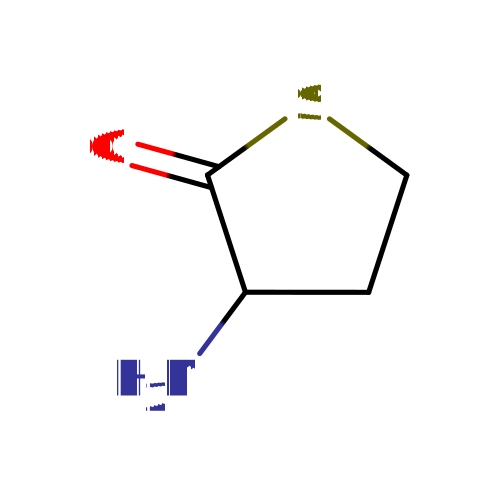
| Common Name | Homocysteine thiolactone |
|---|
| Description | Elevated level of the nonprotein amino acid homocysteine (Hcy) is a risk factor for cardiovascular diseases, neurodegenerative diseases, and neural tube defects. Metabolic conversion of Hcy to a chemically reactive metabolite, Hcy-thiolactone, catalyzed by methionyl-tRNA synthetase is the first step in a pathway that contributes to Hcy toxicity in humans. (PMID 16702349 ). The only known source of Hcy in the human body is dietary protein methionine; subsequent examinations of individual dietary amino acids have led to the conclusion that methionine, ingested in excess, is the most toxic amino acid. (Harper AE, Benevenga NJ, Wohlheuter RM. Effects of ingestion of disproportionate amounts of amino acids. Physiol Rev. 1970;50: 428 - 58; Benevenga NJ, Steele RD. Adverse effects of excessive consumption of amino acids. Annu Rev Nutr. 1984; 4:157-81). Animals fed high-protein or high-methionine diets for 2 years developed hyperhomocysteinemia and evidence of vascular disease (Fau D, Preret J, Hadjiisky P. Effects of ingestion of high protein or excess methionine diets by rats for two years. J Nutr. 1988; 118:128-33). |
|---|
| Structure | InChI=1S/C4H7NOS/c5-3-1-2-7-4(3)6/h3H,1-2,5H2 |
|---|
| Synonyms | | Value | Source |
|---|
| ( -)-3-amino-2-Thiolanon | HMDB | | ( -)-3-aminotetrahydro-2-Thiophenon | HMDB | | (+-)-3-aminodihydro-2(3H)-Thiophenone | HMDB | | 3-aminodihydro-2(3H)-Thiophenone | HMDB | | DL-3-aminotetrahydro-2-Thiophenone | HMDB | | DL-Homocysteine thiolactone | HMDB | | L-Homocysteine thiolactone | HMDB |
|
|---|
| Chemical Formula | C4H7NOS |
|---|
| Average Molecular Weight | 117.169 |
|---|
| Monoisotopic Molecular Weight | 117.024834541 |
|---|
| IUPAC Name | 3-aminothiolan-2-one |
|---|
| Traditional Name | DL-homocysteine thiolactone |
|---|
| CAS Registry Number | 3622-59-1 |
|---|
| SMILES | NC1CCSC1=O |
|---|
| InChI Identifier | InChI=1S/C4H7NOS/c5-3-1-2-7-4(3)6/h3H,1-2,5H2 |
|---|
| InChI Key | KIWQWJKWBHZMDT-UHFFFAOYSA-N |
|---|
| Chemical Taxonomy |
|---|
| Description | Belongs to the class of organic compounds known as alpha amino acids and derivatives. These are amino acids in which the amino group is attached to the carbon atom immediately adjacent to the carboxylate group (alpha carbon), or a derivative thereof. |
|---|
| Kingdom | Organic compounds |
|---|
| Super Class | Organic acids and derivatives |
|---|
| Class | Carboxylic acids and derivatives |
|---|
| Sub Class | Amino acids, peptides, and analogues |
|---|
| Direct Parent | Alpha amino acids and derivatives |
|---|
| Alternative Parents | |
|---|
| Substituents | - Alpha-amino acid or derivatives
- Thiolane
- Carbothioic s-lactone
- Thiocarboxylic acid ester
- Thiolactone
- Thiocarboxylic acid or derivatives
- Organoheterocyclic compound
- Organic oxide
- Organopnictogen compound
- Organic oxygen compound
- Primary amine
- Organooxygen compound
- Organonitrogen compound
- Primary aliphatic amine
- Carbonyl group
- Amine
- Hydrocarbon derivative
- Organic nitrogen compound
- Aliphatic heteromonocyclic compound
|
|---|
| Molecular Framework | Aliphatic heteromonocyclic compounds |
|---|
| External Descriptors | Not Available |
|---|
| Ontology |
|---|
| Physiological effect | Not Available |
|---|
| Disposition | |
|---|
| Process | Not Available |
|---|
| Role | Not Available |
|---|
| Physical Properties |
|---|
| State | Solid |
|---|
| Experimental Molecular Properties | | Property | Value | Reference |
|---|
| Melting Point | Not Available | Not Available | | Boiling Point | Not Available | Not Available | | Water Solubility | Not Available | Not Available | | LogP | Not Available | Not Available |
|
|---|
| Experimental Chromatographic Properties | Not Available |
|---|
| Predicted Molecular Properties | |
|---|
| Predicted Chromatographic Properties | Predicted Collision Cross SectionsPredicted Kovats Retention IndicesUnderivatizedDerivatized| Derivative Name / Structure | SMILES | Kovats RI Value | Column Type | Reference |
|---|
| Homocysteine thiolactone,1TMS,isomer #1 | C[Si](C)(C)NC1CCSC1=O | 1361.2 | Semi standard non polar | 33892256 | | Homocysteine thiolactone,1TMS,isomer #1 | C[Si](C)(C)NC1CCSC1=O | 1313.5 | Standard non polar | 33892256 | | Homocysteine thiolactone,1TMS,isomer #1 | C[Si](C)(C)NC1CCSC1=O | 2227.4 | Standard polar | 33892256 | | Homocysteine thiolactone,2TMS,isomer #1 | C[Si](C)(C)N(C1CCSC1=O)[Si](C)(C)C | 1561.6 | Semi standard non polar | 33892256 | | Homocysteine thiolactone,2TMS,isomer #1 | C[Si](C)(C)N(C1CCSC1=O)[Si](C)(C)C | 1554.8 | Standard non polar | 33892256 | | Homocysteine thiolactone,2TMS,isomer #1 | C[Si](C)(C)N(C1CCSC1=O)[Si](C)(C)C | 2013.1 | Standard polar | 33892256 | | Homocysteine thiolactone,1TBDMS,isomer #1 | CC(C)(C)[Si](C)(C)NC1CCSC1=O | 1621.9 | Semi standard non polar | 33892256 | | Homocysteine thiolactone,1TBDMS,isomer #1 | CC(C)(C)[Si](C)(C)NC1CCSC1=O | 1568.6 | Standard non polar | 33892256 | | Homocysteine thiolactone,1TBDMS,isomer #1 | CC(C)(C)[Si](C)(C)NC1CCSC1=O | 2314.5 | Standard polar | 33892256 | | Homocysteine thiolactone,2TBDMS,isomer #1 | CC(C)(C)[Si](C)(C)N(C1CCSC1=O)[Si](C)(C)C(C)(C)C | 1979.3 | Semi standard non polar | 33892256 | | Homocysteine thiolactone,2TBDMS,isomer #1 | CC(C)(C)[Si](C)(C)N(C1CCSC1=O)[Si](C)(C)C(C)(C)C | 2030.3 | Standard non polar | 33892256 | | Homocysteine thiolactone,2TBDMS,isomer #1 | CC(C)(C)[Si](C)(C)N(C1CCSC1=O)[Si](C)(C)C(C)(C)C | 2037.8 | Standard polar | 33892256 |
|
|---|
| GC-MS Spectra| Spectrum Type | Description | Splash Key | Deposition Date | Source | View |
|---|
| Predicted GC-MS | Predicted GC-MS Spectrum - Homocysteine thiolactone GC-MS (Non-derivatized) - 70eV, Positive | splash10-0a6u-9000000000-7b8e6410972444b84efc | 2017-09-01 | Wishart Lab | View Spectrum | | Predicted GC-MS | Predicted GC-MS Spectrum - Homocysteine thiolactone GC-MS (Non-derivatized) - 70eV, Positive | Not Available | 2021-10-12 | Wishart Lab | View Spectrum | | Predicted GC-MS | Predicted GC-MS Spectrum - Homocysteine thiolactone GC-MS (Non-derivatized) - 70eV, Positive | Not Available | 2021-10-12 | Wishart Lab | View Spectrum |
MS/MS Spectra| Spectrum Type | Description | Splash Key | Deposition Date | Source | View |
|---|
| Predicted LC-MS/MS | Predicted LC-MS/MS Spectrum - Homocysteine thiolactone 10V, Positive-QTOF | splash10-014i-0900000000-8f683c9002bf43fef10d | 2017-09-01 | Wishart Lab | View Spectrum | | Predicted LC-MS/MS | Predicted LC-MS/MS Spectrum - Homocysteine thiolactone 20V, Positive-QTOF | splash10-0076-9000000000-e26ebbd2d16a1aed5801 | 2017-09-01 | Wishart Lab | View Spectrum | | Predicted LC-MS/MS | Predicted LC-MS/MS Spectrum - Homocysteine thiolactone 40V, Positive-QTOF | splash10-0006-9100000000-649e7b0f78d61a745b45 | 2017-09-01 | Wishart Lab | View Spectrum | | Predicted LC-MS/MS | Predicted LC-MS/MS Spectrum - Homocysteine thiolactone 10V, Negative-QTOF | splash10-014i-2900000000-806166a012352ec0be63 | 2017-09-01 | Wishart Lab | View Spectrum | | Predicted LC-MS/MS | Predicted LC-MS/MS Spectrum - Homocysteine thiolactone 20V, Negative-QTOF | splash10-0aba-9000000000-a8839b6dcc9998e5eadc | 2017-09-01 | Wishart Lab | View Spectrum | | Predicted LC-MS/MS | Predicted LC-MS/MS Spectrum - Homocysteine thiolactone 40V, Negative-QTOF | splash10-0080-9000000000-97c8bd4bc30856bdda2e | 2017-09-01 | Wishart Lab | View Spectrum | | Predicted LC-MS/MS | Predicted LC-MS/MS Spectrum - Homocysteine thiolactone 10V, Negative-QTOF | splash10-014i-3900000000-a86fe79188b92a0f513e | 2021-09-22 | Wishart Lab | View Spectrum | | Predicted LC-MS/MS | Predicted LC-MS/MS Spectrum - Homocysteine thiolactone 20V, Negative-QTOF | splash10-053r-9100000000-bed3e8f03e106eedf1a8 | 2021-09-22 | Wishart Lab | View Spectrum | | Predicted LC-MS/MS | Predicted LC-MS/MS Spectrum - Homocysteine thiolactone 40V, Negative-QTOF | splash10-001i-9000000000-cfcd40acf2ab07b3f5f3 | 2021-09-22 | Wishart Lab | View Spectrum | | Predicted LC-MS/MS | Predicted LC-MS/MS Spectrum - Homocysteine thiolactone 10V, Positive-QTOF | splash10-014l-6900000000-587ed663ed27e0d79f57 | 2021-09-22 | Wishart Lab | View Spectrum | | Predicted LC-MS/MS | Predicted LC-MS/MS Spectrum - Homocysteine thiolactone 20V, Positive-QTOF | splash10-0a4i-9600000000-974a58cb3346970c79ff | 2021-09-22 | Wishart Lab | View Spectrum | | Predicted LC-MS/MS | Predicted LC-MS/MS Spectrum - Homocysteine thiolactone 40V, Positive-QTOF | splash10-052o-9000000000-4073e682ce58bd088e4e | 2021-09-22 | Wishart Lab | View Spectrum |
NMR Spectra| Spectrum Type | Description | Deposition Date | Source | View |
|---|
| Predicted 1D NMR | 13C NMR Spectrum (1D, 100 MHz, D2O, predicted) | 2021-09-25 | Wishart Lab | View Spectrum | | Predicted 1D NMR | 1H NMR Spectrum (1D, 100 MHz, D2O, predicted) | 2021-09-25 | Wishart Lab | View Spectrum | | Predicted 1D NMR | 13C NMR Spectrum (1D, 1000 MHz, D2O, predicted) | 2021-09-25 | Wishart Lab | View Spectrum | | Predicted 1D NMR | 1H NMR Spectrum (1D, 1000 MHz, D2O, predicted) | 2021-09-25 | Wishart Lab | View Spectrum | | Predicted 1D NMR | 13C NMR Spectrum (1D, 200 MHz, D2O, predicted) | 2021-09-25 | Wishart Lab | View Spectrum | | Predicted 1D NMR | 1H NMR Spectrum (1D, 200 MHz, D2O, predicted) | 2021-09-25 | Wishart Lab | View Spectrum | | Predicted 1D NMR | 13C NMR Spectrum (1D, 300 MHz, D2O, predicted) | 2021-09-25 | Wishart Lab | View Spectrum | | Predicted 1D NMR | 1H NMR Spectrum (1D, 300 MHz, D2O, predicted) | 2021-09-25 | Wishart Lab | View Spectrum | | Predicted 1D NMR | 13C NMR Spectrum (1D, 400 MHz, D2O, predicted) | 2021-09-25 | Wishart Lab | View Spectrum | | Predicted 1D NMR | 1H NMR Spectrum (1D, 400 MHz, D2O, predicted) | 2021-09-25 | Wishart Lab | View Spectrum | | Predicted 1D NMR | 13C NMR Spectrum (1D, 500 MHz, D2O, predicted) | 2021-09-25 | Wishart Lab | View Spectrum | | Predicted 1D NMR | 1H NMR Spectrum (1D, 500 MHz, D2O, predicted) | 2021-09-25 | Wishart Lab | View Spectrum | | Predicted 1D NMR | 13C NMR Spectrum (1D, 600 MHz, D2O, predicted) | 2021-09-25 | Wishart Lab | View Spectrum | | Predicted 1D NMR | 1H NMR Spectrum (1D, 600 MHz, D2O, predicted) | 2021-09-25 | Wishart Lab | View Spectrum | | Predicted 1D NMR | 13C NMR Spectrum (1D, 700 MHz, D2O, predicted) | 2021-09-25 | Wishart Lab | View Spectrum | | Predicted 1D NMR | 1H NMR Spectrum (1D, 700 MHz, D2O, predicted) | 2021-09-25 | Wishart Lab | View Spectrum | | Predicted 1D NMR | 13C NMR Spectrum (1D, 800 MHz, D2O, predicted) | 2021-09-25 | Wishart Lab | View Spectrum | | Predicted 1D NMR | 1H NMR Spectrum (1D, 800 MHz, D2O, predicted) | 2021-09-25 | Wishart Lab | View Spectrum | | Predicted 1D NMR | 13C NMR Spectrum (1D, 900 MHz, D2O, predicted) | 2021-09-25 | Wishart Lab | View Spectrum | | Predicted 1D NMR | 1H NMR Spectrum (1D, 900 MHz, D2O, predicted) | 2021-09-25 | Wishart Lab | View Spectrum |
IR Spectra| Spectrum Type | Description | Deposition Date | Source | View |
|---|
| Predicted IR Spectrum | IR Ion Spectrum (Predicted IRIS Spectrum, Adduct: [M-H]-) | 2023-02-03 | FELIX lab | View Spectrum | | Predicted IR Spectrum | IR Ion Spectrum (Predicted IRIS Spectrum, Adduct: [M+H]+) | 2023-02-03 | FELIX lab | View Spectrum | | Predicted IR Spectrum | IR Ion Spectrum (Predicted IRIS Spectrum, Adduct: [M+Na]+) | 2023-02-03 | FELIX lab | View Spectrum |
|
|---|
| General References | - Jakubowski H: Pathophysiological consequences of homocysteine excess. J Nutr. 2006 Jun;136(6 Suppl):1741S-1749S. [PubMed:16702349 ]
- Ricci G, Santoro L, Achilli M, Matarese RM, Nardini M, Cavallini D: Similarity of the oxidation products of L-cystathionine by L-amino acid oxidase to those excreted by cystathioninuric patients. J Biol Chem. 1983 Sep 10;258(17):10511-7. [PubMed:6885789 ]
- Jakubowski H: Homocysteine thiolactone: metabolic origin and protein homocysteinylation in humans. J Nutr. 2000 Feb;130(2S Suppl):377S-381S. [PubMed:10721911 ]
- Jakubowski H: Protein homocysteinylation: possible mechanism underlying pathological consequences of elevated homocysteine levels. FASEB J. 1999 Dec;13(15):2277-83. [PubMed:10593875 ]
- Kerkeni M, Addad F, Chauffert M, Chuniaud L, Miled A, Trivin F, Maaroufi K: Hyperhomocysteinemia, paraoxonase activity and risk of coronary artery disease. Clin Biochem. 2006 Aug;39(8):821-5. Epub 2006 Jun 7. [PubMed:16875684 ]
- Chwatko G, Jakubowski H: The determination of homocysteine-thiolactone in human plasma. Anal Biochem. 2005 Feb 15;337(2):271-7. [PubMed:15691507 ]
|
|---|