| Record Information |
|---|
| Version | 5.0 |
|---|
| Status | Detected and Quantified |
|---|
| Creation Date | 2006-08-13 14:58:41 UTC |
|---|
| Update Date | 2022-03-07 02:49:20 UTC |
|---|
| HMDB ID | HMDB0004236 |
|---|
| Secondary Accession Numbers | |
|---|
| Metabolite Identification |
|---|
| Common Name | Prostaglandin B2 |
|---|
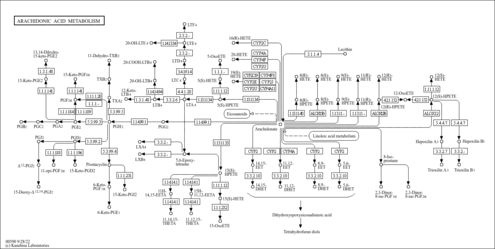
| Description | Prostaglandin B2 (PGB2) is a prostanoid. Prostanoids is a term that collectively describes prostaglandins, prostacyclines and thromboxanes. Prostanoids are a subclass of the lipid mediator group known as eicosanoids. They derive from C-20 polyunsaturated fatty acids, mainly dihomo-gamma-linoleic (20:3n-6), arachidonic (20:4n-6), and eicosapentaenoic (20:5n-3) acids, through the action of cyclooxygenases-1 and -2 (COX-1 and COX-2). The reaction product of COX is the unstable endoperoxide prostaglandin H (PGH) that is further transformed into the individual prostanoids by a series of specific prostanoid synthases. Prostanoids are local-acting mediators formed and inactivated within the same or neighbouring cells prior to their release into circulation as inactive metabolites (15-keto- and 13,14-dihydroketo metabolites). Non-enzymatic peroxidation of arachidonic acid and other fatty acids in vivo can result in prostaglandin-like substances isomeric to the COX-derived prostaglandins that are termed isoprostanes. Prostanoids take part in many physiological and pathophysiological processes in practically every organ, tissue and cell, including the vascular, renal, gastrointestinal and reproductive systems. Their activities are mediated through prostanoid-specific receptors and intracellular signalling pathways, whilst their biosynthesis and action are blocked by nonsteroidal antiinflammatory drugs (NSAID). Isoprostanes are considered to be reliable markers of oxidant stress status and have been linked to inflammation, ischaemia-reperfusion, diabetes, cardiovascular disease, reproductive disorders and diabetes. (PMID: 16986207 ). Prostaglandins are eicosanoids. The eicosanoids consist of the prostaglandins (PGs), thromboxanes (TXs), leukotrienes (LTs), and lipoxins (LXs). The PGs and TXs are collectively identified as prostanoids. Prostaglandins were originally shown to be synthesized in the prostate gland, thromboxanes from platelets (thrombocytes), and leukotrienes from leukocytes, hence the derivation of their names. All mammalian cells except erythrocytes synthesize eicosanoids. These molecules are extremely potent, able to cause profound physiological effects at very dilute concentrations. All eicosanoids function locally at the site of synthesis, through receptor-mediated G-protein linked signalling pathways. |
|---|
| Structure | CCCCC[C@@H](O)\C=C\C1=C(C\C=C/CCCC(O)=O)C(=O)CC1 InChI=1S/C20H30O4/c1-2-3-6-9-17(21)14-12-16-13-15-19(22)18(16)10-7-4-5-8-11-20(23)24/h4,7,12,14,17,21H,2-3,5-6,8-11,13,15H2,1H3,(H,23,24)/b7-4-,14-12+/t17-/m1/s1 |
|---|
| Synonyms | |
|---|
| Chemical Formula | C20H30O4 |
|---|
| Average Molecular Weight | 334.4498 |
|---|
| Monoisotopic Molecular Weight | 334.214409448 |
|---|
| IUPAC Name | (5Z)-7-{2-[(1E,3R)-3-hydroxyoct-1-en-1-yl]-5-oxocyclopent-1-en-1-yl}hept-5-enoic acid |
|---|
| Traditional Name | (5Z)-7-{2-[(1E,3R)-3-hydroxyoct-1-en-1-yl]-5-oxocyclopent-1-en-1-yl}hept-5-enoic acid |
|---|
| CAS Registry Number | 13367-85-6 |
|---|
| SMILES | CCCCC[C@@H](O)\C=C\C1=C(C\C=C/CCCC(O)=O)C(=O)CC1 |
|---|
| InChI Identifier | InChI=1S/C20H30O4/c1-2-3-6-9-17(21)14-12-16-13-15-19(22)18(16)10-7-4-5-8-11-20(23)24/h4,7,12,14,17,21H,2-3,5-6,8-11,13,15H2,1H3,(H,23,24)/b7-4-,14-12+/t17-/m1/s1 |
|---|
| InChI Key | PRFXRIUZNKLRHM-RYPCXPIFSA-N |
|---|
| Chemical Taxonomy |
|---|
| Description | Belongs to the class of organic compounds known as prostaglandins and related compounds. These are unsaturated carboxylic acids consisting of a 20 carbon skeleton that also contains a five member ring, and are based upon the fatty acid arachidonic acid. |
|---|
| Kingdom | Organic compounds |
|---|
| Super Class | Lipids and lipid-like molecules |
|---|
| Class | Fatty Acyls |
|---|
| Sub Class | Eicosanoids |
|---|
| Direct Parent | Prostaglandins and related compounds |
|---|
| Alternative Parents | |
|---|
| Substituents | - Prostaglandin skeleton
- Long-chain fatty acid
- Hydroxy fatty acid
- Fatty acid
- Unsaturated fatty acid
- Ketone
- Cyclic ketone
- Secondary alcohol
- Carboxylic acid derivative
- Carboxylic acid
- Monocarboxylic acid or derivatives
- Organic oxide
- Organic oxygen compound
- Alcohol
- Hydrocarbon derivative
- Carbonyl group
- Organooxygen compound
- Aliphatic homomonocyclic compound
|
|---|
| Molecular Framework | Aliphatic homomonocyclic compounds |
|---|
| External Descriptors | Not Available |
|---|
| Ontology |
|---|
| Physiological effect | Not Available |
|---|
| Disposition | |
|---|
| Process | |
|---|
| Role | |
|---|
| Physical Properties |
|---|
| State | Solid |
|---|
| Experimental Molecular Properties | | Property | Value | Reference |
|---|
| Melting Point | Not Available | Not Available | | Boiling Point | Not Available | Not Available | | Water Solubility | Not Available | Not Available | | LogP | 3.154 | Not Available |
|
|---|
| Experimental Chromatographic Properties | Not Available |
|---|
| Predicted Molecular Properties | |
|---|
| Predicted Chromatographic Properties | Predicted Collision Cross SectionsPredicted Kovats Retention IndicesUnderivatizedDerivatized| Derivative Name / Structure | SMILES | Kovats RI Value | Column Type | Reference |
|---|
| Prostaglandin B2,1TMS,isomer #1 | CCCCC[C@H](/C=C/C1=C(C/C=C\CCCC(=O)O)C(=O)CC1)O[Si](C)(C)C | 2887.3 | Semi standard non polar | 33892256 | | Prostaglandin B2,1TMS,isomer #2 | CCCCC[C@@H](O)/C=C/C1=C(C/C=C\CCCC(=O)O[Si](C)(C)C)C(=O)CC1 | 2819.0 | Semi standard non polar | 33892256 | | Prostaglandin B2,1TMS,isomer #3 | CCCCC[C@@H](O)/C=C/C1=C(C/C=C\CCCC(=O)O)C(O[Si](C)(C)C)=CC1 | 2862.8 | Semi standard non polar | 33892256 | | Prostaglandin B2,2TMS,isomer #1 | CCCCC[C@H](/C=C/C1=C(C/C=C\CCCC(=O)O[Si](C)(C)C)C(=O)CC1)O[Si](C)(C)C | 2855.1 | Semi standard non polar | 33892256 | | Prostaglandin B2,2TMS,isomer #2 | CCCCC[C@H](/C=C/C1=C(C/C=C\CCCC(=O)O)C(O[Si](C)(C)C)=CC1)O[Si](C)(C)C | 2900.6 | Semi standard non polar | 33892256 | | Prostaglandin B2,2TMS,isomer #3 | CCCCC[C@@H](O)/C=C/C1=C(C/C=C\CCCC(=O)O[Si](C)(C)C)C(O[Si](C)(C)C)=CC1 | 2838.8 | Semi standard non polar | 33892256 | | Prostaglandin B2,3TMS,isomer #1 | CCCCC[C@H](/C=C/C1=C(C/C=C\CCCC(=O)O[Si](C)(C)C)C(O[Si](C)(C)C)=CC1)O[Si](C)(C)C | 2859.7 | Semi standard non polar | 33892256 | | Prostaglandin B2,3TMS,isomer #1 | CCCCC[C@H](/C=C/C1=C(C/C=C\CCCC(=O)O[Si](C)(C)C)C(O[Si](C)(C)C)=CC1)O[Si](C)(C)C | 2758.5 | Standard non polar | 33892256 | | Prostaglandin B2,3TMS,isomer #1 | CCCCC[C@H](/C=C/C1=C(C/C=C\CCCC(=O)O[Si](C)(C)C)C(O[Si](C)(C)C)=CC1)O[Si](C)(C)C | 3005.4 | Standard polar | 33892256 | | Prostaglandin B2,1TBDMS,isomer #1 | CCCCC[C@H](/C=C/C1=C(C/C=C\CCCC(=O)O)C(=O)CC1)O[Si](C)(C)C(C)(C)C | 3115.1 | Semi standard non polar | 33892256 | | Prostaglandin B2,1TBDMS,isomer #2 | CCCCC[C@@H](O)/C=C/C1=C(C/C=C\CCCC(=O)O[Si](C)(C)C(C)(C)C)C(=O)CC1 | 3056.1 | Semi standard non polar | 33892256 | | Prostaglandin B2,1TBDMS,isomer #3 | CCCCC[C@@H](O)/C=C/C1=C(C/C=C\CCCC(=O)O)C(O[Si](C)(C)C(C)(C)C)=CC1 | 3096.0 | Semi standard non polar | 33892256 | | Prostaglandin B2,2TBDMS,isomer #1 | CCCCC[C@H](/C=C/C1=C(C/C=C\CCCC(=O)O[Si](C)(C)C(C)(C)C)C(=O)CC1)O[Si](C)(C)C(C)(C)C | 3353.0 | Semi standard non polar | 33892256 | | Prostaglandin B2,2TBDMS,isomer #2 | CCCCC[C@H](/C=C/C1=C(C/C=C\CCCC(=O)O)C(O[Si](C)(C)C(C)(C)C)=CC1)O[Si](C)(C)C(C)(C)C | 3356.5 | Semi standard non polar | 33892256 | | Prostaglandin B2,2TBDMS,isomer #3 | CCCCC[C@@H](O)/C=C/C1=C(C/C=C\CCCC(=O)O[Si](C)(C)C(C)(C)C)C(O[Si](C)(C)C(C)(C)C)=CC1 | 3322.3 | Semi standard non polar | 33892256 | | Prostaglandin B2,3TBDMS,isomer #1 | CCCCC[C@H](/C=C/C1=C(C/C=C\CCCC(=O)O[Si](C)(C)C(C)(C)C)C(O[Si](C)(C)C(C)(C)C)=CC1)O[Si](C)(C)C(C)(C)C | 3567.2 | Semi standard non polar | 33892256 | | Prostaglandin B2,3TBDMS,isomer #1 | CCCCC[C@H](/C=C/C1=C(C/C=C\CCCC(=O)O[Si](C)(C)C(C)(C)C)C(O[Si](C)(C)C(C)(C)C)=CC1)O[Si](C)(C)C(C)(C)C | 3164.7 | Standard non polar | 33892256 | | Prostaglandin B2,3TBDMS,isomer #1 | CCCCC[C@H](/C=C/C1=C(C/C=C\CCCC(=O)O[Si](C)(C)C(C)(C)C)C(O[Si](C)(C)C(C)(C)C)=CC1)O[Si](C)(C)C(C)(C)C | 3183.1 | Standard polar | 33892256 |
|
|---|
| GC-MS Spectra| Spectrum Type | Description | Splash Key | Deposition Date | Source | View |
|---|
| Predicted GC-MS | Predicted GC-MS Spectrum - Prostaglandin B2 GC-MS (Non-derivatized) - 70eV, Positive | splash10-00lm-6391000000-3b069d42dd8ba363e1c3 | 2017-09-01 | Wishart Lab | View Spectrum | | Predicted GC-MS | Predicted GC-MS Spectrum - Prostaglandin B2 GC-MS (2 TMS) - 70eV, Positive | splash10-020c-9107400000-3e378b304e81c9767275 | 2017-10-06 | Wishart Lab | View Spectrum | | Predicted GC-MS | Predicted GC-MS Spectrum - Prostaglandin B2 GC-MS (Non-derivatized) - 70eV, Positive | Not Available | 2021-10-12 | Wishart Lab | View Spectrum |
MS/MS Spectra| Spectrum Type | Description | Splash Key | Deposition Date | Source | View |
|---|
| Predicted LC-MS/MS | Predicted LC-MS/MS Spectrum - Prostaglandin B2 10V, Positive-QTOF | splash10-014j-0169000000-ab7e151e7512a9217570 | 2017-09-01 | Wishart Lab | View Spectrum | | Predicted LC-MS/MS | Predicted LC-MS/MS Spectrum - Prostaglandin B2 20V, Positive-QTOF | splash10-02ga-3951000000-6eb2a7a228914281a6f5 | 2017-09-01 | Wishart Lab | View Spectrum | | Predicted LC-MS/MS | Predicted LC-MS/MS Spectrum - Prostaglandin B2 40V, Positive-QTOF | splash10-0f76-9220000000-0ee4fdc9b2a755b944e0 | 2017-09-01 | Wishart Lab | View Spectrum | | Predicted LC-MS/MS | Predicted LC-MS/MS Spectrum - Prostaglandin B2 10V, Negative-QTOF | splash10-001i-0019000000-dbe0b0e74e1f3b041bda | 2017-09-01 | Wishart Lab | View Spectrum | | Predicted LC-MS/MS | Predicted LC-MS/MS Spectrum - Prostaglandin B2 20V, Negative-QTOF | splash10-0159-2159000000-e67ebc50c5d1f2b7f75f | 2017-09-01 | Wishart Lab | View Spectrum | | Predicted LC-MS/MS | Predicted LC-MS/MS Spectrum - Prostaglandin B2 40V, Negative-QTOF | splash10-0a4l-9140000000-dc05680aa61a1ac55903 | 2017-09-01 | Wishart Lab | View Spectrum | | Predicted LC-MS/MS | Predicted LC-MS/MS Spectrum - Prostaglandin B2 10V, Negative-QTOF | splash10-0159-0029000000-9e6efa43b3e01f68d9d3 | 2021-09-23 | Wishart Lab | View Spectrum | | Predicted LC-MS/MS | Predicted LC-MS/MS Spectrum - Prostaglandin B2 20V, Negative-QTOF | splash10-00lr-1397000000-82f85934c72172d6f0bd | 2021-09-23 | Wishart Lab | View Spectrum | | Predicted LC-MS/MS | Predicted LC-MS/MS Spectrum - Prostaglandin B2 40V, Negative-QTOF | splash10-05mo-7931000000-b9dc32b05b5d304a8c15 | 2021-09-23 | Wishart Lab | View Spectrum | | Predicted LC-MS/MS | Predicted LC-MS/MS Spectrum - Prostaglandin B2 10V, Positive-QTOF | splash10-00kb-0095000000-ec2f02e0ccce84d13240 | 2021-09-25 | Wishart Lab | View Spectrum | | Predicted LC-MS/MS | Predicted LC-MS/MS Spectrum - Prostaglandin B2 20V, Positive-QTOF | splash10-00kb-4291000000-c675b9e2faa54ccca098 | 2021-09-25 | Wishart Lab | View Spectrum | | Predicted LC-MS/MS | Predicted LC-MS/MS Spectrum - Prostaglandin B2 40V, Positive-QTOF | splash10-00nf-9510000000-f147c78bdfdeae923ab0 | 2021-09-25 | Wishart Lab | View Spectrum |
|
|---|