| Record Information |
|---|
| Version | 5.0 |
|---|
| Status | Detected and Quantified |
|---|
| Creation Date | 2006-08-14 00:30:47 UTC |
|---|
| Update Date | 2022-03-07 02:49:21 UTC |
|---|
| HMDB ID | HMDB0004688 |
|---|
| Secondary Accession Numbers | |
|---|
| Metabolite Identification |
|---|
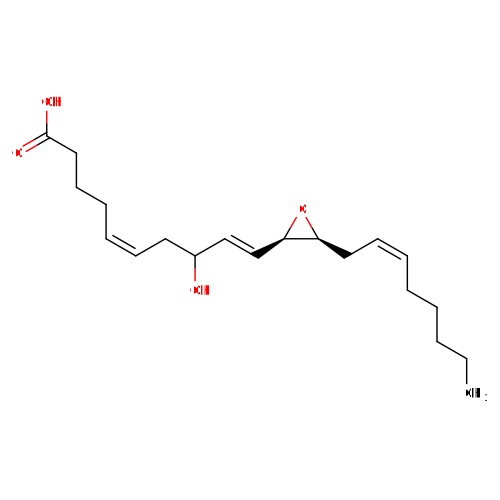
| Common Name | Hepoxilin A3 |
|---|
| Description | Hepoxilin A3 is an electrophilic eicosanoids synthesized during arachidonic acid oxidative metabolism, which can participate in the Michael addition reaction with glutathione (GSH, a major cellular antioxidant) catalyzed by the GSH-S-transferase (GST) family. GSH-adducts have been observed with molecules synthesized through the 12-lipoxygenase pathway. (PMID 12432937 ). Hepoxilins have biological actions that appear to have, as their basis, changes in intracellular concentrations of ions including calcium and potassium ions as well as changes in second messenger systems. Recent evidence suggests that the biological actions of the hepoxilins may be receptor-mediated as indicated from data showing the existence of hepoxilin-specific binding proteins in the human neutrophils. Such evidence also implicates the association of G-proteins both in hepoxilin-binding as well as in hepoxilin action. (PMID 7947989 ). |
|---|
| Structure | CCCCC\C=C/C[C@@H]1O[C@@H]1\C=C\C(O)C\C=C/CCCC(O)=O InChI=1S/C20H32O4/c1-2-3-4-5-6-10-13-18-19(24-18)16-15-17(21)12-9-7-8-11-14-20(22)23/h6-7,9-10,15-19,21H,2-5,8,11-14H2,1H3,(H,22,23)/b9-7-,10-6-,16-15+/t17?,18-,19+/m0/s1 |
|---|
| Synonyms | | Value | Source |
|---|
| (5Z,9E,14Z)-(8XI,11R,12S)-11,12-epoxy-8-hydroxyeicosa-5,9,14-trienoic acid | ChEBI | | (5Z,9E,14Z)-(8XI,11R,12S)-11,12-epoxy-8-hydroxyeicosa-5,9,14-trienoate | Generator | | 11,12-Epoxy-8-hydroxyeicosa-5,9,14-trienoate | HMDB | | 8-Hydroxy-11,12-epoxyeicosa-5,9,14-trienoic acid | HMDB | | Hexophilin a3 | HMDB | | HXA3 CPD | HMDB | | 8-EH-2 | HMDB | | Hepoxilin a | HMDB | | (5Z,9E)-8-Hydroxy-10-{(2S,3S)-3-[(2Z)-oct-2-en-1-yl]oxiran-2-yl}deca-5,9-dienoate | HMDB | | (5Z,9E)-8-Hydroxy-10-{(2S,3S)-3-[(2Z)-oct-2-en-1-yl]oxiran-2-yl}deca-5,9-dienoic acid | HMDB | | (5Z,9E,14Z)-(11S,12S)-11,12-Epoxy-8-hydroxyeicosa-5,9,14-trienoate | HMDB | | (5Z,9E,14Z)-(11S,12S)-11,12-Epoxy-8-hydroxyeicosa-5,9,14-trienoic acid | HMDB | | (5Z,9E,14Z)-(11S,12S)-11,12-Epoxy-8-hydroxyicosa-5,9,14-trienoate | HMDB | | (5Z,9E,14Z)-(11S,12S)-11,12-Epoxy-8-hydroxyicosa-5,9,14-trienoic acid | HMDB | | 8-Hydroxy-11,12-epoxyeicosa-5,9,14-trienoate | HMDB | | 8-Hydroxy-11S,12S-epoxy-5Z,14Z,9E-eicosatrienoate | HMDB | | 8-Hydroxy-11S,12S-epoxy-5Z,14Z,9E-eicosatrienoic acid | HMDB | | (5Z,9E,14Z)-(8XI,11R,12S)-11,12-epoxy-8-hydroxyicosa-5,9,14-trienoate | HMDB | | Hepoxilin a3 | MeSH |
|
|---|
| Chemical Formula | C20H32O4 |
|---|
| Average Molecular Weight | 336.4657 |
|---|
| Monoisotopic Molecular Weight | 336.230059512 |
|---|
| IUPAC Name | (5Z,9E)-8-hydroxy-10-[(2R,3S)-3-[(2Z)-oct-2-en-1-yl]oxiran-2-yl]deca-5,9-dienoic acid |
|---|
| Traditional Name | HXA3 cpd |
|---|
| CAS Registry Number | 85589-24-8 |
|---|
| SMILES | CCCCC\C=C/C[C@@H]1O[C@@H]1\C=C\C(O)C\C=C/CCCC(O)=O |
|---|
| InChI Identifier | InChI=1S/C20H32O4/c1-2-3-4-5-6-10-13-18-19(24-18)16-15-17(21)12-9-7-8-11-14-20(22)23/h6-7,9-10,15-19,21H,2-5,8,11-14H2,1H3,(H,22,23)/b9-7-,10-6-,16-15+/t17?,18-,19+/m0/s1 |
|---|
| InChI Key | SGTUOBURCVMACZ-CIQDQOFUSA-N |
|---|
| Chemical Taxonomy |
|---|
| Description | Belongs to the class of organic compounds known as hepoxilins. These are eicosanoids containing an oxirane group attached to the fatty acyl chain. |
|---|
| Kingdom | Organic compounds |
|---|
| Super Class | Lipids and lipid-like molecules |
|---|
| Class | Fatty Acyls |
|---|
| Sub Class | Eicosanoids |
|---|
| Direct Parent | Hepoxilins |
|---|
| Alternative Parents | |
|---|
| Substituents | - Hepoxilin
- Medium-chain hydroxy acid
- Medium-chain fatty acid
- Epoxy fatty acid
- Heterocyclic fatty acid
- Hydroxy fatty acid
- Fatty acid
- Unsaturated fatty acid
- Secondary alcohol
- Carboxylic acid derivative
- Carboxylic acid
- Dialkyl ether
- Oxirane
- Ether
- Oxacycle
- Organoheterocyclic compound
- Monocarboxylic acid or derivatives
- Organic oxide
- Hydrocarbon derivative
- Carbonyl group
- Alcohol
- Organic oxygen compound
- Organooxygen compound
- Aliphatic heteromonocyclic compound
|
|---|
| Molecular Framework | Aliphatic heteromonocyclic compounds |
|---|
| External Descriptors | |
|---|
| Ontology |
|---|
| Physiological effect | Not Available |
|---|
| Disposition | |
|---|
| Process | Not Available |
|---|
| Role | Not Available |
|---|
| Physical Properties |
|---|
| State | Solid |
|---|
| Experimental Molecular Properties | | Property | Value | Reference |
|---|
| Melting Point | Not Available | Not Available | | Boiling Point | Not Available | Not Available | | Water Solubility | Not Available | Not Available | | LogP | Not Available | Not Available |
|
|---|
| Experimental Chromatographic Properties | Not Available |
|---|
| Predicted Molecular Properties | |
|---|
| Predicted Chromatographic Properties | Predicted Collision Cross SectionsPredicted Kovats Retention IndicesUnderivatizedDerivatized| Derivative Name / Structure | SMILES | Kovats RI Value | Column Type | Reference |
|---|
| Hepoxilin A3,1TMS,isomer #1 | CCCCC/C=C\C[C@@H]1O[C@@H]1/C=C/C(C/C=C\CCCC(=O)O)O[Si](C)(C)C | 2718.9 | Semi standard non polar | 33892256 | | Hepoxilin A3,1TMS,isomer #2 | CCCCC/C=C\C[C@@H]1O[C@@H]1/C=C/C(O)C/C=C\CCCC(=O)O[Si](C)(C)C | 2635.3 | Semi standard non polar | 33892256 | | Hepoxilin A3,2TMS,isomer #1 | CCCCC/C=C\C[C@@H]1O[C@@H]1/C=C/C(C/C=C\CCCC(=O)O[Si](C)(C)C)O[Si](C)(C)C | 2688.4 | Semi standard non polar | 33892256 | | Hepoxilin A3,1TBDMS,isomer #1 | CCCCC/C=C\C[C@@H]1O[C@@H]1/C=C/C(C/C=C\CCCC(=O)O)O[Si](C)(C)C(C)(C)C | 2962.0 | Semi standard non polar | 33892256 | | Hepoxilin A3,1TBDMS,isomer #2 | CCCCC/C=C\C[C@@H]1O[C@@H]1/C=C/C(O)C/C=C\CCCC(=O)O[Si](C)(C)C(C)(C)C | 2891.9 | Semi standard non polar | 33892256 | | Hepoxilin A3,2TBDMS,isomer #1 | CCCCC/C=C\C[C@@H]1O[C@@H]1/C=C/C(C/C=C\CCCC(=O)O[Si](C)(C)C(C)(C)C)O[Si](C)(C)C(C)(C)C | 3167.0 | Semi standard non polar | 33892256 |
|
|---|
| GC-MS Spectra| Spectrum Type | Description | Splash Key | Deposition Date | Source | View |
|---|
| Predicted GC-MS | Predicted GC-MS Spectrum - Hepoxilin A3 GC-MS (Non-derivatized) - 70eV, Positive | splash10-02vi-8693000000-2485293cd435c17c3c1c | 2017-09-01 | Wishart Lab | View Spectrum | | Predicted GC-MS | Predicted GC-MS Spectrum - Hepoxilin A3 GC-MS (2 TMS) - 70eV, Positive | splash10-00fs-9504200000-b478b5ac38b9ea248120 | 2017-10-06 | Wishart Lab | View Spectrum | | Predicted GC-MS | Predicted GC-MS Spectrum - Hepoxilin A3 GC-MS (Non-derivatized) - 70eV, Positive | Not Available | 2021-10-12 | Wishart Lab | View Spectrum | | Predicted GC-MS | Predicted GC-MS Spectrum - Hepoxilin A3 GC-MS (Non-derivatized) - 70eV, Positive | Not Available | 2021-10-12 | Wishart Lab | View Spectrum |
MS/MS Spectra| Spectrum Type | Description | Splash Key | Deposition Date | Source | View |
|---|
| Predicted LC-MS/MS | Predicted LC-MS/MS Spectrum - Hepoxilin A3 10V, Positive-QTOF | splash10-014i-0119000000-f183a896d40b122d34a6 | 2017-09-01 | Wishart Lab | View Spectrum | | Predicted LC-MS/MS | Predicted LC-MS/MS Spectrum - Hepoxilin A3 20V, Positive-QTOF | splash10-0100-3912000000-8c6e6837752424382cf9 | 2017-09-01 | Wishart Lab | View Spectrum | | Predicted LC-MS/MS | Predicted LC-MS/MS Spectrum - Hepoxilin A3 40V, Positive-QTOF | splash10-05tf-9320000000-fd16a39bb680bae04d1e | 2017-09-01 | Wishart Lab | View Spectrum | | Predicted LC-MS/MS | Predicted LC-MS/MS Spectrum - Hepoxilin A3 10V, Negative-QTOF | splash10-000i-0029000000-babbe7e5cbfec6729e52 | 2017-09-01 | Wishart Lab | View Spectrum | | Predicted LC-MS/MS | Predicted LC-MS/MS Spectrum - Hepoxilin A3 20V, Negative-QTOF | splash10-014r-1849000000-46fca9cc7712fb3e7876 | 2017-09-01 | Wishart Lab | View Spectrum | | Predicted LC-MS/MS | Predicted LC-MS/MS Spectrum - Hepoxilin A3 40V, Negative-QTOF | splash10-0a4l-9510000000-19c94ffaa2521c24fe09 | 2017-09-01 | Wishart Lab | View Spectrum | | Predicted LC-MS/MS | Predicted LC-MS/MS Spectrum - Hepoxilin A3 10V, Positive-QTOF | splash10-0gb9-0119000000-2cd5dffbb345957a1712 | 2021-09-22 | Wishart Lab | View Spectrum | | Predicted LC-MS/MS | Predicted LC-MS/MS Spectrum - Hepoxilin A3 20V, Positive-QTOF | splash10-0gb9-9447000000-9642f8a03a6be023dd7d | 2021-09-22 | Wishart Lab | View Spectrum | | Predicted LC-MS/MS | Predicted LC-MS/MS Spectrum - Hepoxilin A3 40V, Positive-QTOF | splash10-014l-9100000000-81bd5dcd190a81446961 | 2021-09-22 | Wishart Lab | View Spectrum | | Predicted LC-MS/MS | Predicted LC-MS/MS Spectrum - Hepoxilin A3 10V, Negative-QTOF | splash10-000i-0009000000-9f5846a55564d3c61df3 | 2021-09-23 | Wishart Lab | View Spectrum | | Predicted LC-MS/MS | Predicted LC-MS/MS Spectrum - Hepoxilin A3 20V, Negative-QTOF | splash10-000i-1679000000-85590dd00f0e1fcb79da | 2021-09-23 | Wishart Lab | View Spectrum | | Predicted LC-MS/MS | Predicted LC-MS/MS Spectrum - Hepoxilin A3 40V, Negative-QTOF | splash10-00kf-8941000000-b2f817f4c6f5d27eefd8 | 2021-09-23 | Wishart Lab | View Spectrum |
|
|---|
| General References | - Savidge TC, Newman PG, Pan WH, Weng MQ, Shi HN, McCormick BA, Quaroni A, Walker WA: Lipopolysaccharide-induced human enterocyte tolerance to cytokine-mediated interleukin-8 production may occur independently of TLR-4/MD-2 signaling. Pediatr Res. 2006 Jan;59(1):89-95. Epub 2005 Dec 2. [PubMed:16326999 ]
- Sutherland M, Schewe T, Nigam S: Biological actions of the free acid of hepoxilin A3 on human neutrophils. Biochem Pharmacol. 2000 Feb 15;59(4):435-40. [PubMed:10644052 ]
- Demin PM, Reynaud D, Pace-Asciak CR: Chemical synthesis and actions of 11,12-thiirano-hepoxilin A3. J Lipid Mediat Cell Signal. 1996 Jan;13(1):63-72. [PubMed:8998598 ]
- Murphy RC, Zarini S: Glutathione adducts of oxyeicosanoids. Prostaglandins Other Lipid Mediat. 2002 Aug;68-69:471-82. [PubMed:12432937 ]
- Mills L, Reynaud D, Pace-Asciak CR: Hepoxilin-evoked intracellular reorganization of calcium in human neutrophils: a confocal microscopy study. Exp Cell Res. 1997 Feb 1;230(2):337-41. [PubMed:9024792 ]
- Pace-Asciak CR, Reynaud D, Laneuville O, Grinstein S, Nigam S: Hepoxilin A3 inhibits agonist-evoked rise in free intracellular calcium in human neutrophils. Adv Exp Med Biol. 1997;400A:375-80. [PubMed:9547579 ]
- Mrsny RJ, Gewirtz AT, Siccardi D, Savidge T, Hurley BP, Madara JL, McCormick BA: Identification of hepoxilin A3 in inflammatory events: a required role in neutrophil migration across intestinal epithelia. Proc Natl Acad Sci U S A. 2004 May 11;101(19):7421-6. Epub 2004 May 3. [PubMed:15123795 ]
- Nigam S, Patabhiraman S, Ciccoli R, Ishdorj G, Schwarz K, Petrucev B, Kuhn H, Haeggstrom JZ: The rat leukocyte-type 12-lipoxygenase exhibits an intrinsic hepoxilin A3 synthase activity. J Biol Chem. 2004 Jul 9;279(28):29023-30. Epub 2004 May 3. [PubMed:15123652 ]
- Reynaud D, Demin PM, Sutherland M, Nigam S, Pace-Asciak CR: Hepoxilin signaling in intact human neutrophils: biphasic elevation of intracellular calcium by unesterified hepoxilin A3. FEBS Lett. 1999 Mar 12;446(2-3):236-8. [PubMed:10100848 ]
- Yu Z, Schneider C, Boeglin WE, Marnett LJ, Brash AR: The lipoxygenase gene ALOXE3 implicated in skin differentiation encodes a hydroperoxide isomerase. Proc Natl Acad Sci U S A. 2003 Aug 5;100(16):9162-7. Epub 2003 Jul 24. [PubMed:12881489 ]
- Anton R, Puig L, Esgleyes T, de Moragas JM, Vila L: Occurrence of hepoxilins and trioxilins in psoriatic lesions. J Invest Dermatol. 1998 Apr;110(4):303-10. [PubMed:9540966 ]
- Pace-Asciak CR, Reynaud D, Rounova O, Demin P, Pivnitsky KK: Hepoxilin A3 is metabolized into its omega-hydroxy metabolite by human neutrophils. Adv Exp Med Biol. 1999;469:535-8. [PubMed:10667379 ]
- Dho S, Grinstein S, Corey EJ, Su WG, Pace-Asciak CR: Hepoxilin A3 induces changes in cytosolic calcium, intracellular pH and membrane potential in human neutrophils. Biochem J. 1990 Feb 15;266(1):63-8. [PubMed:2106877 ]
- Hurley BP, Siccardi D, Mrsny RJ, McCormick BA: Polymorphonuclear cell transmigration induced by Pseudomonas aeruginosa requires the eicosanoid hepoxilin A3. J Immunol. 2004 Nov 1;173(9):5712-20. [PubMed:15494523 ]
- Nigam S, Nodes S, Cichon G, Corey EJ, Pace-Asciak CR: Receptor-mediated action of hepoxilin A3 releases diacylglycerol and arachidonic acid from human neutrophils. Biochem Biophys Res Commun. 1990 Sep 28;171(3):944-8. [PubMed:2171511 ]
- Reynaud D, Rounova O, Demin PM, Pivnitsky KK, Pace-Asciak CR: Hepoxilin A3 is oxidized by human neutrophils into its omega-hydroxy metabolite by an activity independent of LTB4 omega-hydroxylase. Biochim Biophys Acta. 1997 Oct 18;1348(3):287-98. [PubMed:9366245 ]
- Pace-Asciak CR: Hepoxilins: a review on their cellular actions. Biochim Biophys Acta. 1994 Nov 17;1215(1-2):1-8. [PubMed:7947989 ]
|
|---|