| Record Information |
|---|
| Version | 5.0 |
|---|
| Status | Detected and Quantified |
|---|
| Creation Date | 2006-09-13 08:28:37 UTC |
|---|
| Update Date | 2023-02-21 17:17:05 UTC |
|---|
| HMDB ID | HMDB0004983 |
|---|
| Secondary Accession Numbers | - HMDB0006702
- HMDB04983
- HMDB06702
|
|---|
| Metabolite Identification |
|---|
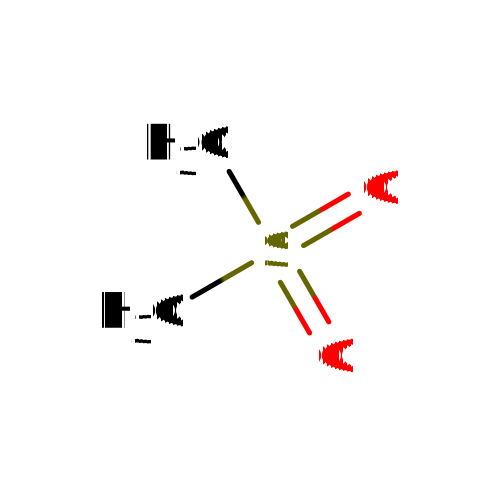
| Common Name | Dimethyl sulfone |
|---|
| Description | Dimethyl sulfone, also known as sulfonylbismethane or lignisul MSM, belongs to the class of organic compounds known as sulfones. Sulfones are compounds containing a sulfonyl group, which has the general structure RS(=O)2R' (R,R' =alkyl, aryl), attached to two carbon atoms. Dimethyl sulfone (DMSO2) is an organic sulfur compound belonging to a class of chemicals known as sulfones. It derives from dietary sources, from intestinal bacterial metabolism and from human endogenous methanethiol metabolism. DMSO2 reflects its close chemical relationship to dimethyl sulfoxide (DMSO), which differs only in the oxidation state of the sulfur atom. Dimethyl sulfone is possibly neutral. Dimethyl sulfone exists in all living organisms, ranging from bacteria to humans. DMSO2 is the primary metabolite of DMSO in humans, and it shares some of the properties of DMSO. Dimethyl sulfone is sulfurous tasting compound. dimethyl sulfone is found on average in the highest concentration in milk (cow). Dimethyl sulfone has also been detected, but not quantified in asparagus and guava. This could make dimethyl sulfone a potential biomarker for the consumption of these foods. Dimethyl sulfone can be found in Afipia. It occurs naturally in some primitive plants and is present in small amounts in many foods and beverages. Dimethyl sulfone can be found in plasma and CSF of normal humans. |
|---|
| Structure | InChI=1S/C2H6O2S/c1-5(2,3)4/h1-2H3 |
|---|
| Synonyms | | Value | Source |
|---|
| Dimethyl sulphone | ChEBI | | Methylsulfonylmethane | ChEBI | | Sulfonylbismethane | ChEBI | | Sulphonylbismethane | ChEBI | | Methylsulphonylmethane | Generator | | Dimethyl sulfone, 13C-labeled | MeSH | | Methyl sulfone | MeSH | | Methyl sulfonmethane | MeSH | | (Methylsulfonyl)methane | HMDB | | Dimethylsulfone | HMDB | | Lignisul MSM | HMDB | | Opti MSM | HMDB | | Sulfonylbis-methane | HMDB | | Dimethyl sulfone | ChEBI | | Sulphonyldimethane | Generator, HMDB |
|
|---|
| Chemical Formula | C2H6O2S |
|---|
| Average Molecular Weight | 94.133 |
|---|
| Monoisotopic Molecular Weight | 94.008850126 |
|---|
| IUPAC Name | methanesulfonylmethane |
|---|
| Traditional Name | methylsulfonylmethane |
|---|
| CAS Registry Number | 67-71-0 |
|---|
| SMILES | CS(C)(=O)=O |
|---|
| InChI Identifier | InChI=1S/C2H6O2S/c1-5(2,3)4/h1-2H3 |
|---|
| InChI Key | HHVIBTZHLRERCL-UHFFFAOYSA-N |
|---|
| Chemical Taxonomy |
|---|
| Description | Belongs to the class of organic compounds known as sulfones. Sulfones are compounds containing a sulfonyl group( which as the general structure RS(=O)2R' (R,R' =alkyl, aryl)) attached to two carbon atoms. |
|---|
| Kingdom | Organic compounds |
|---|
| Super Class | Organosulfur compounds |
|---|
| Class | Sulfonyls |
|---|
| Sub Class | Sulfones |
|---|
| Direct Parent | Sulfones |
|---|
| Alternative Parents | |
|---|
| Substituents | - Sulfone
- Organic oxygen compound
- Organic oxide
- Hydrocarbon derivative
- Aliphatic acyclic compound
|
|---|
| Molecular Framework | Aliphatic acyclic compounds |
|---|
| External Descriptors | |
|---|
| Ontology |
|---|
| Physiological effect | Not Available |
|---|
| Disposition | |
|---|
| Process | |
|---|
| Role | Not Available |
|---|
| Physical Properties |
|---|
| State | Solid |
|---|
| Experimental Molecular Properties | |
|---|
| Experimental Chromatographic Properties | Not Available |
|---|
| Predicted Molecular Properties | |
|---|
| Predicted Chromatographic Properties | Predicted Collision Cross SectionsPredicted Kovats Retention IndicesUnderivatized |
|---|
| GC-MS Spectra| Spectrum Type | Description | Splash Key | Deposition Date | Source | View |
|---|
| Predicted GC-MS | Predicted GC-MS Spectrum - Dimethyl sulfone GC-MS (Non-derivatized) - 70eV, Positive | splash10-002f-9000000000-3e72edc8bd8e168298a0 | 2017-09-01 | Wishart Lab | View Spectrum | | Predicted GC-MS | Predicted GC-MS Spectrum - Dimethyl sulfone GC-MS (Non-derivatized) - 70eV, Positive | Not Available | 2021-10-12 | Wishart Lab | View Spectrum | | Predicted GC-MS | Predicted GC-MS Spectrum - Dimethyl sulfone GC-MS (Non-derivatized) - 70eV, Positive | Not Available | 2021-10-12 | Wishart Lab | View Spectrum |
MS/MS Spectra| Spectrum Type | Description | Splash Key | Deposition Date | Source | View |
|---|
| Experimental LC-MS/MS | LC-MS/MS Spectrum - Dimethyl sulfone Quattro_QQQ 10V, Positive-QTOF (Annotated) | splash10-0002-9000000000-9896ec507f104ada81f3 | 2012-07-25 | HMDB team, MONA | View Spectrum | | Experimental LC-MS/MS | LC-MS/MS Spectrum - Dimethyl sulfone Quattro_QQQ 25V, Positive-QTOF (Annotated) | splash10-014i-9000000000-aad0ad2e46e9a93df295 | 2012-07-25 | HMDB team, MONA | View Spectrum | | Experimental LC-MS/MS | LC-MS/MS Spectrum - Dimethyl sulfone Quattro_QQQ 40V, Positive-QTOF (Annotated) | splash10-014i-9000000000-8cb5ee5ae152833c1e84 | 2012-07-25 | HMDB team, MONA | View Spectrum | | Predicted LC-MS/MS | Predicted LC-MS/MS Spectrum - Dimethyl sulfone 10V, Positive-QTOF | splash10-0002-9000000000-fb26633c75e592809868 | 2017-09-01 | Wishart Lab | View Spectrum | | Predicted LC-MS/MS | Predicted LC-MS/MS Spectrum - Dimethyl sulfone 20V, Positive-QTOF | splash10-0002-9000000000-3a6db80e12370ab204a9 | 2017-09-01 | Wishart Lab | View Spectrum | | Predicted LC-MS/MS | Predicted LC-MS/MS Spectrum - Dimethyl sulfone 40V, Positive-QTOF | splash10-002b-9000000000-c5c35fbdd4193d0ece0d | 2017-09-01 | Wishart Lab | View Spectrum | | Predicted LC-MS/MS | Predicted LC-MS/MS Spectrum - Dimethyl sulfone 10V, Negative-QTOF | splash10-0006-9000000000-c0a7fe921fa7e601fb70 | 2017-09-01 | Wishart Lab | View Spectrum | | Predicted LC-MS/MS | Predicted LC-MS/MS Spectrum - Dimethyl sulfone 20V, Negative-QTOF | splash10-0006-9000000000-113ab821ffdae95a6086 | 2017-09-01 | Wishart Lab | View Spectrum | | Predicted LC-MS/MS | Predicted LC-MS/MS Spectrum - Dimethyl sulfone 40V, Negative-QTOF | splash10-00fu-9000000000-2ef5cb880f6a43bd9df3 | 2017-09-01 | Wishart Lab | View Spectrum | | Predicted LC-MS/MS | Predicted LC-MS/MS Spectrum - Dimethyl sulfone 10V, Negative-QTOF | splash10-0006-9000000000-f0302cfc5bddee62ebdf | 2021-09-22 | Wishart Lab | View Spectrum | | Predicted LC-MS/MS | Predicted LC-MS/MS Spectrum - Dimethyl sulfone 20V, Negative-QTOF | splash10-0006-9000000000-f0302cfc5bddee62ebdf | 2021-09-22 | Wishart Lab | View Spectrum | | Predicted LC-MS/MS | Predicted LC-MS/MS Spectrum - Dimethyl sulfone 40V, Negative-QTOF | splash10-0006-9000000000-902b68745378a21a3ae9 | 2021-09-22 | Wishart Lab | View Spectrum | | Predicted LC-MS/MS | Predicted LC-MS/MS Spectrum - Dimethyl sulfone 10V, Positive-QTOF | splash10-0002-9000000000-dd5ad5c474bf2a0fc2ab | 2021-09-22 | Wishart Lab | View Spectrum | | Predicted LC-MS/MS | Predicted LC-MS/MS Spectrum - Dimethyl sulfone 20V, Positive-QTOF | splash10-0002-9000000000-dd5ad5c474bf2a0fc2ab | 2021-09-22 | Wishart Lab | View Spectrum | | Predicted LC-MS/MS | Predicted LC-MS/MS Spectrum - Dimethyl sulfone 40V, Positive-QTOF | splash10-0a4i-9000000000-d82cbf78ceb7825835f9 | 2021-09-22 | Wishart Lab | View Spectrum |
NMR Spectra| Spectrum Type | Description | Deposition Date | Source | View |
|---|
| Predicted 1D NMR | 13C NMR Spectrum (1D, 100 MHz, D2O, predicted) | 2021-09-24 | Wishart Lab | View Spectrum | | Predicted 1D NMR | 1H NMR Spectrum (1D, 100 MHz, D2O, predicted) | 2021-09-24 | Wishart Lab | View Spectrum | | Predicted 1D NMR | 13C NMR Spectrum (1D, 1000 MHz, D2O, predicted) | 2021-09-24 | Wishart Lab | View Spectrum | | Predicted 1D NMR | 1H NMR Spectrum (1D, 1000 MHz, D2O, predicted) | 2021-09-24 | Wishart Lab | View Spectrum | | Predicted 1D NMR | 13C NMR Spectrum (1D, 200 MHz, D2O, predicted) | 2021-09-24 | Wishart Lab | View Spectrum | | Predicted 1D NMR | 1H NMR Spectrum (1D, 200 MHz, D2O, predicted) | 2021-09-24 | Wishart Lab | View Spectrum | | Predicted 1D NMR | 13C NMR Spectrum (1D, 300 MHz, D2O, predicted) | 2021-09-24 | Wishart Lab | View Spectrum | | Predicted 1D NMR | 1H NMR Spectrum (1D, 300 MHz, D2O, predicted) | 2021-09-24 | Wishart Lab | View Spectrum | | Predicted 1D NMR | 13C NMR Spectrum (1D, 400 MHz, D2O, predicted) | 2021-09-24 | Wishart Lab | View Spectrum | | Predicted 1D NMR | 1H NMR Spectrum (1D, 400 MHz, D2O, predicted) | 2021-09-24 | Wishart Lab | View Spectrum | | Predicted 1D NMR | 13C NMR Spectrum (1D, 500 MHz, D2O, predicted) | 2021-09-24 | Wishart Lab | View Spectrum | | Predicted 1D NMR | 1H NMR Spectrum (1D, 500 MHz, D2O, predicted) | 2021-09-24 | Wishart Lab | View Spectrum | | Predicted 1D NMR | 13C NMR Spectrum (1D, 600 MHz, D2O, predicted) | 2021-09-24 | Wishart Lab | View Spectrum | | Predicted 1D NMR | 1H NMR Spectrum (1D, 600 MHz, D2O, predicted) | 2021-09-24 | Wishart Lab | View Spectrum | | Predicted 1D NMR | 13C NMR Spectrum (1D, 700 MHz, D2O, predicted) | 2021-09-24 | Wishart Lab | View Spectrum | | Predicted 1D NMR | 1H NMR Spectrum (1D, 700 MHz, D2O, predicted) | 2021-09-24 | Wishart Lab | View Spectrum | | Predicted 1D NMR | 13C NMR Spectrum (1D, 800 MHz, D2O, predicted) | 2021-09-24 | Wishart Lab | View Spectrum | | Predicted 1D NMR | 1H NMR Spectrum (1D, 800 MHz, D2O, predicted) | 2021-09-24 | Wishart Lab | View Spectrum | | Predicted 1D NMR | 13C NMR Spectrum (1D, 900 MHz, D2O, predicted) | 2021-09-24 | Wishart Lab | View Spectrum | | Predicted 1D NMR | 1H NMR Spectrum (1D, 900 MHz, D2O, predicted) | 2021-09-24 | Wishart Lab | View Spectrum | | Experimental 2D NMR | [1H, 13C]-HSQC NMR Spectrum (2D, 600 MHz, H2O, experimental) | 2012-12-05 | Wishart Lab | View Spectrum |
IR Spectra| Spectrum Type | Description | Deposition Date | Source | View |
|---|
| Predicted IR Spectrum | IR Ion Spectrum (Predicted IRIS Spectrum, Adduct: [M+H]+) | 2023-02-03 | FELIX lab | View Spectrum | | Predicted IR Spectrum | IR Ion Spectrum (Predicted IRIS Spectrum, Adduct: [M+Na]+) | 2023-02-03 | FELIX lab | View Spectrum |
|
|---|
| Disease References | | Pregnancy |
|---|
- Bahado-Singh RO, Ertl R, Mandal R, Bjorndahl TC, Syngelaki A, Han B, Dong E, Liu PB, Alpay-Savasan Z, Wishart DS, Nicolaides KH: Metabolomic prediction of fetal congenital heart defect in the first trimester. Am J Obstet Gynecol. 2014 Sep;211(3):240.e1-240.e14. doi: 10.1016/j.ajog.2014.03.056. Epub 2014 Apr 1. [PubMed:24704061 ]
| | Methionine adenosyltransferase deficiency |
|---|
- Engelke UF, Tangerman A, Willemsen MA, Moskau D, Loss S, Mudd SH, Wevers RA: Dimethyl sulfone in human cerebrospinal fluid and blood plasma confirmed by one-dimensional (1)H and two-dimensional (1)H-(13)C NMR. NMR Biomed. 2005 Aug;18(5):331-6. [PubMed:15996001 ]
| | Eosinophilic esophagitis |
|---|
- Slae, M., Huynh, H., Wishart, D.S. (2014). Analysis of 30 normal pediatric urine samples via NMR spectroscopy (unpublished work). NA.
|
|
|---|