| Record Information |
|---|
| Version | 5.0 |
|---|
| Status | Detected and Quantified |
|---|
| Creation Date | 2007-04-12 23:22:02 UTC |
|---|
| Update Date | 2023-02-21 17:17:14 UTC |
|---|
| HMDB ID | HMDB0006112 |
|---|
| Secondary Accession Numbers | |
|---|
| Metabolite Identification |
|---|
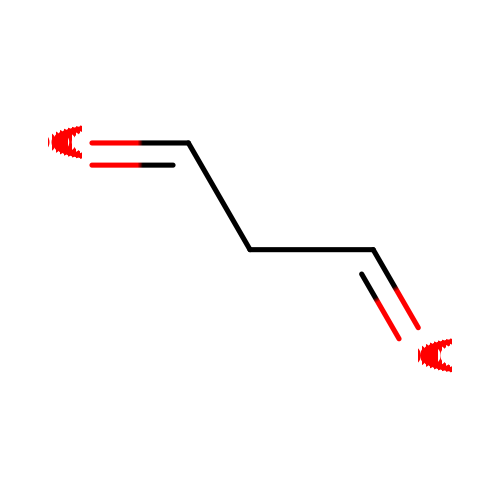
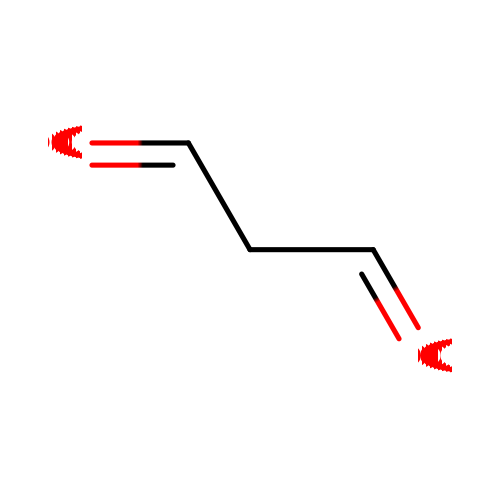
| Common Name | Malondialdehyde |
|---|
| Description | Malondialdehyde (MDA) is the dialdehyde of malonic acid and a biomarker of oxidative damage to lipids caused by smoking. Oxidized lipids are able to produce MDA as a decomposition product. The mechanism is thought to involve formation of prostaglandin-like endoperoxides from polyunsaturated fatty acids with two or more double bonds. An alternative mechanism is based on successive hydroperoxide formation and β-cleavage of polyunsaturated fatty acids. MDA is then directly formed by β-scission of a 3-hydroperoxyaldehyde or by reaction between acrolein and hydroxyl radicals. While oxidation of polyunsaturated fatty acids is the major source of MDA in vivo, other minor sources exists such as byproducts of free radical generation by ionizing radiation and of the biosynthesis of prostaglandins. Aldehydes are generally reactive species capable of forming adducts and complexes in biological systems and MDA is no exception although the main species at physiological pH is the enolate ion which is of relative low reactivity. Consistent evidence is available for the reaction between MDA and cellular macromolecules such as proteins, RNA and DNA. MDA reacts with DNA to form adducts to deoxyguanosine and deoxyadenosine which may be mutagenic and these can be quantified in several human tissues. Oxidative stress is an imbalance between oxidants and antioxidants on a cellular or individual level. Oxidative damage is one result of such an imbalance and includes oxidative modification of cellular macromolecules, induction of cell death by apoptosis or necrosis, as well as structural tissue damage. Chemically speaking, oxidants are compounds capable of oxidizing target molecules. This can take place in three ways: abstraction of hydrogen, abstraction of electrons or addition of oxygen. All cells living under aerobic conditions are continuously exposed to a large numbers of oxidants derived from various endogenous and exogenous sources. The endogenous sources of oxidants are several and include the respiratory chain in the mitochondria, immune reactions, enzymes such as xanthine oxidase and nitric oxide synthase and transition metal mediated oxidation. Various exogenous sources of ROS also contribute directly or indirectly to the total oxidant load. These include effects of ionizing and non-ionizing radiation, air pollution and natural toxic gases such as ozone, and chemicals and toxins including oxidizing disinfectants. A poor diet containing inadequate amounts of nutrients may also indirectly result in oxidative stress by impairing cellular defense mechanisms. The cellular macromolecules, in particular lipids, proteins and DNA, are natural targets of oxidation. Oxidants are capable of initiating lipid oxidation by abstraction of an allylic proton from a polyunsaturated fatty acid. This process, by multiple stages leading to the formation of lipid hydroperoxides, is a known contributor to the development of atherosclerosis. (PMID: 17336279 ). MDA has been identified as a uremic toxin according to the European Uremic Toxin Working Group (PMID: 22626821 ). |
|---|
| Structure | InChI=1S/C3H4O2/c4-2-1-3-5/h2-3H,1H2 |
|---|
| Synonyms | | Value | Source |
|---|
| 1,3-Propanedial | ChEBI | | 1,3-Propanedialdehyde | ChEBI | | 1,3-Propanedione | ChEBI | | Malonic aldehyde | ChEBI | | Malonic dialdehyde | ChEBI | | Malonodialdehyde | ChEBI | | Malonyldialdehyde | ChEBI | | MDA | ChEBI | | MDD | ChEBI | | Malonaldehyde | HMDB | | Propanedial | HMDB | | Malondialdehyde, sodium | MeSH, HMDB | | Malonylaldehyde | MeSH, HMDB | | Sodium malondialdehyde | MeSH, HMDB | | Malondialdehyde | ChEBI |
|
|---|
| Chemical Formula | C3H4O2 |
|---|
| Average Molecular Weight | 72.0627 |
|---|
| Monoisotopic Molecular Weight | 72.021129372 |
|---|
| IUPAC Name | propanedial |
|---|
| Traditional Name | malonaldehyde |
|---|
| CAS Registry Number | 542-78-9 |
|---|
| SMILES | O=CCC=O |
|---|
| InChI Identifier | InChI=1S/C3H4O2/c4-2-1-3-5/h2-3H,1H2 |
|---|
| InChI Key | WSMYVTOQOOLQHP-UHFFFAOYSA-N |
|---|
| Chemical Taxonomy |
|---|
| Description | Belongs to the class of organic compounds known as 1,3-dicarbonyl compounds. These are carbonyl compounds with the generic formula O=C(R)C(H)C(R')=O, where R and R' can be any group. |
|---|
| Kingdom | Organic compounds |
|---|
| Super Class | Organic oxygen compounds |
|---|
| Class | Organooxygen compounds |
|---|
| Sub Class | Carbonyl compounds |
|---|
| Direct Parent | 1,3-dicarbonyl compounds |
|---|
| Alternative Parents | |
|---|
| Substituents | - 1,3-dicarbonyl compound
- Alpha-hydrogen aldehyde
- Organic oxide
- Hydrocarbon derivative
- Short-chain aldehyde
- Aldehyde
- Aliphatic acyclic compound
|
|---|
| Molecular Framework | Aliphatic acyclic compounds |
|---|
| External Descriptors | |
|---|
| Ontology |
|---|
| Physiological effect | |
|---|
| Disposition | |
|---|
| Process | Not Available |
|---|
| Role | |
|---|
| Physical Properties |
|---|
| State | Solid |
|---|
| Experimental Molecular Properties | |
|---|
| Experimental Chromatographic Properties | Not Available |
|---|
| Predicted Molecular Properties | |
|---|
| Predicted Chromatographic Properties | Predicted Collision Cross SectionsPredicted Kovats Retention IndicesUnderivatizedDerivatized| Derivative Name / Structure | SMILES | Kovats RI Value | Column Type | Reference |
|---|
| Malondialdehyde,1TMS,isomer #1 | C[Si](C)(C)OC=CC=O | 943.3 | Semi standard non polar | 33892256 | | Malondialdehyde,1TMS,isomer #1 | C[Si](C)(C)OC=CC=O | 868.6 | Standard non polar | 33892256 | | Malondialdehyde,1TMS,isomer #1 | C[Si](C)(C)OC=CC=O | 1152.9 | Standard polar | 33892256 | | Malondialdehyde,1TBDMS,isomer #1 | CC(C)(C)[Si](C)(C)OC=CC=O | 1203.4 | Semi standard non polar | 33892256 | | Malondialdehyde,1TBDMS,isomer #1 | CC(C)(C)[Si](C)(C)OC=CC=O | 1105.9 | Standard non polar | 33892256 | | Malondialdehyde,1TBDMS,isomer #1 | CC(C)(C)[Si](C)(C)OC=CC=O | 1335.6 | Standard polar | 33892256 |
|
|---|
| Spectra |
|---|
| GC-MS Spectra| Spectrum Type | Description | Splash Key | Deposition Date | Source | View |
|---|
| Predicted GC-MS | Predicted GC-MS Spectrum - Malondialdehyde GC-MS (Non-derivatized) - 70eV, Positive | splash10-006x-9000000000-f27c7e0c26f7fd9a353b | 2017-09-01 | Wishart Lab | View Spectrum | | Predicted GC-MS | Predicted GC-MS Spectrum - Malondialdehyde GC-MS (Non-derivatized) - 70eV, Positive | Not Available | 2021-10-12 | Wishart Lab | View Spectrum |
MS/MS Spectra| Spectrum Type | Description | Splash Key | Deposition Date | Source | View |
|---|
| Predicted LC-MS/MS | Predicted LC-MS/MS Spectrum - Malondialdehyde 10V, Positive-QTOF | splash10-00di-9000000000-744a9fd4b0afe1939db8 | 2016-08-03 | Wishart Lab | View Spectrum | | Predicted LC-MS/MS | Predicted LC-MS/MS Spectrum - Malondialdehyde 20V, Positive-QTOF | splash10-05fr-9000000000-38c741cd3f463e2fdbb3 | 2016-08-03 | Wishart Lab | View Spectrum | | Predicted LC-MS/MS | Predicted LC-MS/MS Spectrum - Malondialdehyde 40V, Positive-QTOF | splash10-0a4i-9000000000-18018045cdfb4fd65e5b | 2016-08-03 | Wishart Lab | View Spectrum | | Predicted LC-MS/MS | Predicted LC-MS/MS Spectrum - Malondialdehyde 10V, Negative-QTOF | splash10-00di-9000000000-bd4fb7676d96faa15028 | 2016-08-03 | Wishart Lab | View Spectrum | | Predicted LC-MS/MS | Predicted LC-MS/MS Spectrum - Malondialdehyde 20V, Negative-QTOF | splash10-00di-9000000000-45f19081a5a0a9b81852 | 2016-08-03 | Wishart Lab | View Spectrum | | Predicted LC-MS/MS | Predicted LC-MS/MS Spectrum - Malondialdehyde 40V, Negative-QTOF | splash10-0ukc-9000000000-01e3136b16e8f53d525c | 2016-08-03 | Wishart Lab | View Spectrum | | Predicted LC-MS/MS | Predicted LC-MS/MS Spectrum - Malondialdehyde 10V, Positive-QTOF | splash10-0006-9000000000-3d8581e7b0d371dd2923 | 2021-09-24 | Wishart Lab | View Spectrum | | Predicted LC-MS/MS | Predicted LC-MS/MS Spectrum - Malondialdehyde 20V, Positive-QTOF | splash10-052f-9000000000-2a7f481a2402d9628b46 | 2021-09-24 | Wishart Lab | View Spectrum | | Predicted LC-MS/MS | Predicted LC-MS/MS Spectrum - Malondialdehyde 40V, Positive-QTOF | splash10-0a4i-9000000000-5846b4edd05c82b946ec | 2021-09-24 | Wishart Lab | View Spectrum | | Predicted LC-MS/MS | Predicted LC-MS/MS Spectrum - Malondialdehyde 10V, Negative-QTOF | splash10-00di-9000000000-85ee1d7f8db31720e3cf | 2021-09-24 | Wishart Lab | View Spectrum | | Predicted LC-MS/MS | Predicted LC-MS/MS Spectrum - Malondialdehyde 20V, Negative-QTOF | splash10-0006-9000000000-c9a8aeda6f81e0b439e2 | 2021-09-24 | Wishart Lab | View Spectrum | | Predicted LC-MS/MS | Predicted LC-MS/MS Spectrum - Malondialdehyde 40V, Negative-QTOF | splash10-0006-9000000000-6269ba171aca8de72e5f | 2021-09-24 | Wishart Lab | View Spectrum |
NMR Spectra| Spectrum Type | Description | Deposition Date | Source | View |
|---|
| Predicted 1D NMR | 13C NMR Spectrum (1D, 100 MHz, D2O, predicted) | 2021-09-25 | Wishart Lab | View Spectrum | | Predicted 1D NMR | 1H NMR Spectrum (1D, 100 MHz, D2O, predicted) | 2021-09-25 | Wishart Lab | View Spectrum | | Predicted 1D NMR | 13C NMR Spectrum (1D, 1000 MHz, D2O, predicted) | 2021-09-25 | Wishart Lab | View Spectrum | | Predicted 1D NMR | 1H NMR Spectrum (1D, 1000 MHz, D2O, predicted) | 2021-09-25 | Wishart Lab | View Spectrum | | Predicted 1D NMR | 13C NMR Spectrum (1D, 200 MHz, D2O, predicted) | 2021-09-25 | Wishart Lab | View Spectrum | | Predicted 1D NMR | 1H NMR Spectrum (1D, 200 MHz, D2O, predicted) | 2021-09-25 | Wishart Lab | View Spectrum | | Predicted 1D NMR | 13C NMR Spectrum (1D, 300 MHz, D2O, predicted) | 2021-09-25 | Wishart Lab | View Spectrum | | Predicted 1D NMR | 1H NMR Spectrum (1D, 300 MHz, D2O, predicted) | 2021-09-25 | Wishart Lab | View Spectrum | | Predicted 1D NMR | 13C NMR Spectrum (1D, 400 MHz, D2O, predicted) | 2021-09-25 | Wishart Lab | View Spectrum | | Predicted 1D NMR | 1H NMR Spectrum (1D, 400 MHz, D2O, predicted) | 2021-09-25 | Wishart Lab | View Spectrum | | Predicted 1D NMR | 13C NMR Spectrum (1D, 500 MHz, D2O, predicted) | 2021-09-25 | Wishart Lab | View Spectrum | | Predicted 1D NMR | 1H NMR Spectrum (1D, 500 MHz, D2O, predicted) | 2021-09-25 | Wishart Lab | View Spectrum | | Predicted 1D NMR | 13C NMR Spectrum (1D, 600 MHz, D2O, predicted) | 2021-09-25 | Wishart Lab | View Spectrum | | Predicted 1D NMR | 1H NMR Spectrum (1D, 600 MHz, D2O, predicted) | 2021-09-25 | Wishart Lab | View Spectrum | | Predicted 1D NMR | 13C NMR Spectrum (1D, 700 MHz, D2O, predicted) | 2021-09-25 | Wishart Lab | View Spectrum | | Predicted 1D NMR | 1H NMR Spectrum (1D, 700 MHz, D2O, predicted) | 2021-09-25 | Wishart Lab | View Spectrum | | Predicted 1D NMR | 13C NMR Spectrum (1D, 800 MHz, D2O, predicted) | 2021-09-25 | Wishart Lab | View Spectrum | | Predicted 1D NMR | 1H NMR Spectrum (1D, 800 MHz, D2O, predicted) | 2021-09-25 | Wishart Lab | View Spectrum | | Predicted 1D NMR | 13C NMR Spectrum (1D, 900 MHz, D2O, predicted) | 2021-09-25 | Wishart Lab | View Spectrum | | Predicted 1D NMR | 1H NMR Spectrum (1D, 900 MHz, D2O, predicted) | 2021-09-25 | Wishart Lab | View Spectrum |
IR Spectra| Spectrum Type | Description | Deposition Date | Source | View |
|---|
| Predicted IR Spectrum | IR Ion Spectrum (Predicted IRIS Spectrum, Adduct: [M+H]+) | 2023-02-03 | FELIX lab | View Spectrum | | Predicted IR Spectrum | IR Ion Spectrum (Predicted IRIS Spectrum, Adduct: [M+Na]+) | 2023-02-03 | FELIX lab | View Spectrum |
|
|---|
| Biological Properties |
|---|
| Cellular Locations | Not Available |
|---|
| Biospecimen Locations | - Blood
- Cerebrospinal Fluid (CSF)
- Urine
|
|---|
| Tissue Locations | Not Available |
|---|
| Pathways | |
|---|
| Normal Concentrations |
|---|
| |
| Blood | Detected and Quantified | 2.71 +/- 0.50 uM | Adult (>18 years old) | Both | Normal | | details | | Blood | Detected and Quantified | 0.69 +/- 0.13 uM | Adult (>18 years old) | Both | Normal | | details | | Blood | Detected and Quantified | 3.58 +/- 1.13 uM | Adult (>18 years old) | Both | Normal | | details | | Blood | Detected and Quantified | 2.36 +/- 0.55 uM | Adult (>18 years old) | Both | Normal | | details | | Blood | Detected and Quantified | 3.630 +/- 1.151 uM | Adult (>18 years old) | Both | Normal | | details | | Cerebrospinal Fluid (CSF) | Detected and Quantified | 3.85 (1.7 - 8.3) uM | Adult (>18 years old) | Both | Normal | | details | | Urine | Detected and Quantified | 0.22 +/- 0.089 umol/mmol creatinine | Adult (>18 years old) | Both | Normal | | details | | Urine | Detected and Quantified | 0.0013 +/- 0.0002 umol/mmol creatinine | Adult (>18 years old) | Both | Normal | | details |
|
|---|
| Abnormal Concentrations |
|---|
| |
| Blood | Detected and Quantified | 4.76 +/- 0.79 uM | Adult (>18 years old) | Both | Schizophrenia | | details | | Blood | Detected and Quantified | 5.40 +/- 0.30 uM | Adult (>18 years old) | Both | uremia | | details | | Blood | Detected and Quantified | 6.0394 +/- 2.400 uM | Adult (>18 years old) | Both | Uremia | | details | | Cerebrospinal Fluid (CSF) | Detected and Quantified | 0.32 +/- 0.073 uM | Not Specified | Not Specified | Guillain-Barre syndrome (GBS) | | details | | Cerebrospinal Fluid (CSF) | Detected and Quantified | 0.22 +/- 0.06 uM | Not Specified | Not Specified | multiple sclerosis | | details | | Cerebrospinal Fluid (CSF) | Detected and Quantified | 5.3 (0.38 - 55.0) uM | Adult (>18 years old) | Both | Parkinson's disease | | details | | Urine | Detected and Quantified | 0.002 +/- 0.0002 umol/mmol creatinine | Adult (>18 years old) | Both | Smoking | | details |
|
|---|
| Associated Disorders and Diseases |
|---|
| Disease References | | Uremia |
|---|
- Duranton F, Cohen G, De Smet R, Rodriguez M, Jankowski J, Vanholder R, Argiles A: Normal and pathologic concentrations of uremic toxins. J Am Soc Nephrol. 2012 Jul;23(7):1258-70. doi: 10.1681/ASN.2011121175. Epub 2012 May 24. [PubMed:22626821 ]
- Vanholder R, De Smet R, Glorieux G, Argiles A, Baurmeister U, Brunet P, Clark W, Cohen G, De Deyn PP, Deppisch R, Descamps-Latscha B, Henle T, Jorres A, Lemke HD, Massy ZA, Passlick-Deetjen J, Rodriguez M, Stegmayr B, Stenvinkel P, Tetta C, Wanner C, Zidek W: Review on uremic toxins: classification, concentration, and interindividual variability. Kidney Int. 2003 May;63(5):1934-43. doi: 10.1046/j.1523-1755.2003.00924.x. [PubMed:12675874 ]
| | Schizophrenia |
|---|
- Kuloglu M, Ustundag B, Atmaca M, Canatan H, Tezcan AE, Cinkilinc N: Lipid peroxidation and antioxidant enzyme levels in patients with schizophrenia and bipolar disorder. Cell Biochem Funct. 2002 Jun;20(2):171-5. [PubMed:11979513 ]
| | Parkinson's disease |
|---|
- Shukla R, Rajani M, Srivastava N, Barthwal MK, Dikshit M: Nitrite and malondialdehyde content in cerebrospinal fluid of patients with Parkinson's disease. Int J Neurosci. 2006 Dec;116(12):1391-402. [PubMed:17145675 ]
| | Guillain-Barré syndrome |
|---|
- Ghabaee M, Jabedari B, Al-E-Eshagh N, Ghaffarpour M, Asadi F: Serum and cerebrospinal fluid antioxidant activity and lipid peroxidation in Guillain-Barre syndrome and multiple sclerosis patients. Int J Neurosci. 2010 Apr;120(4):301-4. doi: 10.3109/00207451003695690. [PubMed:20374079 ]
| | Multiple sclerosis |
|---|
- Ghabaee M, Jabedari B, Al-E-Eshagh N, Ghaffarpour M, Asadi F: Serum and cerebrospinal fluid antioxidant activity and lipid peroxidation in Guillain-Barre syndrome and multiple sclerosis patients. Int J Neurosci. 2010 Apr;120(4):301-4. doi: 10.3109/00207451003695690. [PubMed:20374079 ]
| | Smoking |
|---|
- Li N, Jia X, Chen CY, Blumberg JB, Song Y, Zhang W, Zhang X, Ma G, Chen J: Almond consumption reduces oxidative DNA damage and lipid peroxidation in male smokers. J Nutr. 2007 Dec;137(12):2717-22. [PubMed:18029489 ]
|
|
|---|
| Associated OMIM IDs | |
|---|
| External Links |
|---|
| DrugBank ID | DB03057 |
|---|
| Phenol Explorer Compound ID | Not Available |
|---|
| FooDB ID | FDB008116 |
|---|
| KNApSAcK ID | Not Available |
|---|
| Chemspider ID | 10499 |
|---|
| KEGG Compound ID | C19440 |
|---|
| BioCyc ID | Not Available |
|---|
| BiGG ID | Not Available |
|---|
| Wikipedia Link | Malondialdehyde |
|---|
| METLIN ID | Not Available |
|---|
| PubChem Compound | 10964 |
|---|
| PDB ID | Not Available |
|---|
| ChEBI ID | 566274 |
|---|
| Food Biomarker Ontology | Not Available |
|---|
| VMH ID | CE0737 |
|---|
| MarkerDB ID | MDB00013453 |
|---|
| Good Scents ID | rw1349941 |
|---|
| References |
|---|
| Synthesis Reference | Not Available |
|---|
| Material Safety Data Sheet (MSDS) | Not Available |
|---|
| General References | - Lykkesfeldt J: Malondialdehyde as biomarker of oxidative damage to lipids caused by smoking. Clin Chim Acta. 2007 May 1;380(1-2):50-8. Epub 2007 Feb 7. [PubMed:17336279 ]
- Duranton F, Cohen G, De Smet R, Rodriguez M, Jankowski J, Vanholder R, Argiles A: Normal and pathologic concentrations of uremic toxins. J Am Soc Nephrol. 2012 Jul;23(7):1258-70. doi: 10.1681/ASN.2011121175. Epub 2012 May 24. [PubMed:22626821 ]
|
|---|