| Record Information |
|---|
| Version | 5.0 |
|---|
| Status | Expected but not Quantified |
|---|
| Creation Date | 2009-03-24 16:19:26 UTC |
|---|
| Update Date | 2022-11-30 19:04:05 UTC |
|---|
| HMDB ID | HMDB0011930 |
|---|
| Secondary Accession Numbers | |
|---|
| Metabolite Identification |
|---|
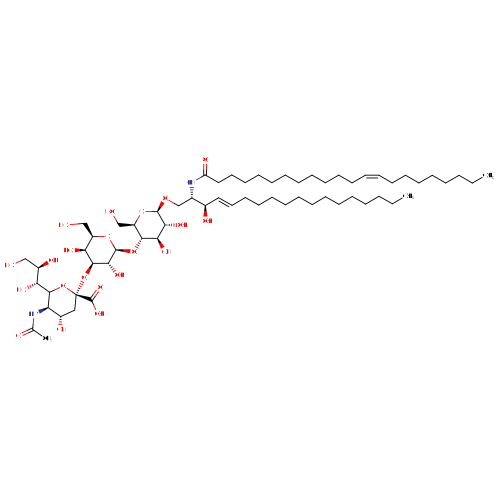
| Common Name | Ganglioside GM3 (d18:1/22:1(13Z)) |
|---|
| Description | Ganglioside GM3 (d18:1/22:1(13Z)) is a ganglioside. A ganglioside is a compound composed of a glycosphingolipid (ceramide and oligosaccharide) with one or more sialic acids (AKA n-acetylneuraminic acid, NANA) linked on the sugar chain. The 60+ known gangliosides differ mainly in the position and number of NANA residues. It is a component of the cell plasma membrane that modulates cell signal transduction events. It appears that they concentrate in lipid rafts. They have recently been found to be highly important in immunology. Natural and semisynthetic gangliosides are considered possible therapeutics for neurodegenerative disorders. Gangliosides are more complex glycosphingolipids in which oligosaccharide chains containing N-acetylneuraminic acid (NeuNAc) are attached to a ceramide. NeuNAc, an acetylated derivative of the carbohydrate sialic acid, makes the head groups of Gangliosides anionic. NB: the M in GM2 stands for monosialo, i.e., one NeuNAc residue. GM2 is the second monosialo ganglioside characterized, thus the subscript 2. Their structural diversity results from variation in the composition and sequence of the sugar residues. In all Gangliosides, the ceramide is linked through its C-1 to a beta-glucosyl residue, which, in turn, is bound to a beta-galactosyl residue. (Wikipedia) Particularly, Ganglioside GM3 (d18:1/22:1(13Z)) is a GM3 ganglioside. A glycosphingolipid (ceramide and oligosaccharide) or oligoglycosylceramide with one or more sialic acids (i.e. n-acetylneuraminic acid) linked on the sugar chain. It is a component the cell plasma membrane which modulates cell signal transduction events. Gangliosides have been found to be highly important in immunology. Ganglioside GM3 carries a net-negative charge at pH 7.0 and is acidic. Gangliosides can amount to 6% of the weight of lipids from brain, but they are found at low levels in all animal tissues. Gangliosides are glycosphingolipids. There are four types of glycosphingolipids, the cerebrosides, sulfatides, globosides and gangliosides. Gangliosides are very similar to globosides except that they also contain N-acetyl neuraminic acid (NANA) in varying amounts. The specific names for the gangliosides provide information about their structure. The letter G refers to ganglioside, and the subscripts M, D, T and Q indicate that the molecule contains mono-, di-, tri and quatra-sialic acid. The numbered subscripts 1, 2 and 3 refer to the carbohydrate sequence that is attached to the ceramide. In particular, 1 stands for GalGalNAcGalGlc-ceramide, 2 stands for GalNAcGalGlc-ceramide and 3 stands for GalGlc-ceramide. Deficiencies in lysosomal enzymes that degrade the carbohydrate portions of various gangliosides are responsible for a number of lysosomal storage diseases such as Tay-Sachs disease, Sandhoff disease, and GM1 gangliosidosis. The carbohydrate portion of the ganglioside GM1 is the site of attachment of cholera toxin, the protein secreted by Vibrio cholerae. |
|---|
| Structure | CCCCCCCCCCCCC\C=C\[C@@H](O)[C@H](CO[C@@H]1O[C@H](CO)[C@@H](O[C@@H]2O[C@H](CO)[C@H](O)[C@H](O[C@@]3(C[C@H](O)[C@@H](NC(C)=O)C(O3)[C@H](O)[C@H](O)CO)C(O)=O)[C@H]2O)[C@H](O)[C@H]1O)NC(=O)CCCCCCCCCCC\C=C/CCCCCCCC InChI=1S/C63H114N2O21/c1-4-6-8-10-12-14-16-18-19-20-21-22-23-25-27-29-31-33-35-37-50(73)65-44(45(70)36-34-32-30-28-26-24-17-15-13-11-9-7-5-2)42-81-60-55(77)54(76)57(49(41-68)83-60)84-61-56(78)59(53(75)48(40-67)82-61)86-63(62(79)80)38-46(71)51(64-43(3)69)58(85-63)52(74)47(72)39-66/h18-19,34,36,44-49,51-61,66-68,70-72,74-78H,4-17,20-33,35,37-42H2,1-3H3,(H,64,69)(H,65,73)(H,79,80)/b19-18-,36-34+/t44-,45+,46-,47+,48+,49+,51+,52+,53-,54+,55+,56+,57+,58?,59-,60+,61-,63-/m0/s1 |
|---|
| Synonyms | | Value | Source |
|---|
| (2S,4S,5R)-2-{[(2S,3R,4S,5S,6R)-2-{[(2R,3S,4R,5R,6R)-4,5-dihydroxy-6-{[(2S,3R,4E)-3-hydroxy-2-{[(13Z)-1-hydroxydocos-13-en-1-ylidene]amino}octadec-4-en-1-yl]oxy}-2-(hydroxymethyl)oxan-3-yl]oxy}-3,5-dihydroxy-6-(hydroxymethyl)oxan-4-yl]oxy}-4-hydroxy-5-[(1-hydroxyethylidene)amino]-6-[(1R,2R)-1,2,3-trihydroxypropyl]oxane-2-carboxylate | HMDB |
|
|---|
| Chemical Formula | C63H114N2O21 |
|---|
| Average Molecular Weight | 1235.5801 |
|---|
| Monoisotopic Molecular Weight | 1234.79140872 |
|---|
| IUPAC Name | (2S,4S,5R)-2-{[(2S,3R,4S,5S,6R)-2-{[(2R,3S,4R,5R,6R)-6-{[(2S,3R,4E)-2-[(13Z)-docos-13-enamido]-3-hydroxyoctadec-4-en-1-yl]oxy}-4,5-dihydroxy-2-(hydroxymethyl)oxan-3-yl]oxy}-3,5-dihydroxy-6-(hydroxymethyl)oxan-4-yl]oxy}-5-acetamido-4-hydroxy-6-[(1R,2R)-1,2,3-trihydroxypropyl]oxane-2-carboxylic acid |
|---|
| Traditional Name | (2S,4S,5R)-2-{[(2S,3R,4S,5S,6R)-2-{[(2R,3S,4R,5R,6R)-6-{[(2S,3R,4E)-2-[(13Z)-docos-13-enamido]-3-hydroxyoctadec-4-en-1-yl]oxy}-4,5-dihydroxy-2-(hydroxymethyl)oxan-3-yl]oxy}-3,5-dihydroxy-6-(hydroxymethyl)oxan-4-yl]oxy}-5-acetamido-4-hydroxy-6-[(1R,2R)-1,2,3-trihydroxypropyl]oxane-2-carboxylic acid |
|---|
| CAS Registry Number | Not Available |
|---|
| SMILES | CCCCCCCCCCCCC\C=C\[C@@H](O)[C@H](CO[C@@H]1O[C@H](CO)[C@@H](O[C@@H]2O[C@H](CO)[C@H](O)[C@H](O[C@@]3(C[C@H](O)[C@@H](NC(C)=O)C(O3)[C@H](O)[C@H](O)CO)C(O)=O)[C@H]2O)[C@H](O)[C@H]1O)NC(=O)CCCCCCCCCCC\C=C/CCCCCCCC |
|---|
| InChI Identifier | InChI=1S/C63H114N2O21/c1-4-6-8-10-12-14-16-18-19-20-21-22-23-25-27-29-31-33-35-37-50(73)65-44(45(70)36-34-32-30-28-26-24-17-15-13-11-9-7-5-2)42-81-60-55(77)54(76)57(49(41-68)83-60)84-61-56(78)59(53(75)48(40-67)82-61)86-63(62(79)80)38-46(71)51(64-43(3)69)58(85-63)52(74)47(72)39-66/h18-19,34,36,44-49,51-61,66-68,70-72,74-78H,4-17,20-33,35,37-42H2,1-3H3,(H,64,69)(H,65,73)(H,79,80)/b19-18-,36-34+/t44-,45+,46-,47+,48+,49+,51+,52+,53-,54+,55+,56+,57+,58?,59-,60+,61-,63-/m0/s1 |
|---|
| InChI Key | WVVWYQOPRPVQFM-VFUJCJJESA-N |
|---|
| Chemical Taxonomy |
|---|
| Description | Belongs to the class of organic compounds known as gangliosides. These are lipid molecules composed of a glycosphingolipid (ceramide and saccharide) with one or more sialic acids linked on the sugar chain. They are usually oligoglycosylceramides derived from lactosylceramide and containing a sialic acid residue such as N-acetylneuraminic acid. |
|---|
| Kingdom | Organic compounds |
|---|
| Super Class | Lipids and lipid-like molecules |
|---|
| Class | Sphingolipids |
|---|
| Sub Class | Glycosphingolipids |
|---|
| Direct Parent | Gangliosides |
|---|
| Alternative Parents | |
|---|
| Substituents | - Neuaca2-3galb1-4glcb-cer_backbone
- Glycosyl-n-acylsphingosine
- Oligosaccharide
- N-acylneuraminic acid or derivatives
- N-acylneuraminic acid
- Neuraminic acid
- Fatty acyl glycoside
- C-glucuronide
- Alkyl glycoside
- C-glycosyl compound
- Glycosyl compound
- O-glycosyl compound
- Ketal
- Fatty amide
- N-acyl-amine
- Fatty acyl
- Oxane
- Pyran
- Acetamide
- Secondary carboxylic acid amide
- Secondary alcohol
- Carboxamide group
- Polyol
- Carboxylic acid derivative
- Carboxylic acid
- Acetal
- Oxacycle
- Monocarboxylic acid or derivatives
- Organoheterocyclic compound
- Organic oxide
- Organic oxygen compound
- Organooxygen compound
- Organonitrogen compound
- Primary alcohol
- Hydrocarbon derivative
- Organic nitrogen compound
- Organopnictogen compound
- Alcohol
- Carbonyl group
- Aliphatic heteromonocyclic compound
|
|---|
| Molecular Framework | Aliphatic heteromonocyclic compounds |
|---|
| External Descriptors | Not Available |
|---|
| Ontology |
|---|
| Physiological effect | Not Available |
|---|
| Disposition | |
|---|
| Process | Not Available |
|---|
| Role | Not Available |
|---|
| Physical Properties |
|---|
| State | Solid |
|---|
| Experimental Molecular Properties | | Property | Value | Reference |
|---|
| Melting Point | Not Available | Not Available | | Boiling Point | Not Available | Not Available | | Water Solubility | Not Available | Not Available | | LogP | Not Available | Not Available |
|
|---|
| Experimental Chromatographic Properties | Not Available |
|---|
| Predicted Molecular Properties | |
|---|
| Predicted Chromatographic Properties | Predicted Collision Cross SectionsPredicted Kovats Retention IndicesNot Available |
|---|