| Record Information |
|---|
| Version | 5.0 |
|---|
| Status | Expected but not Quantified |
|---|
| Creation Date | 2009-06-16 18:13:01 UTC |
|---|
| Update Date | 2022-11-30 19:04:11 UTC |
|---|
| HMDB ID | HMDB0012447 |
|---|
| Secondary Accession Numbers | |
|---|
| Metabolite Identification |
|---|
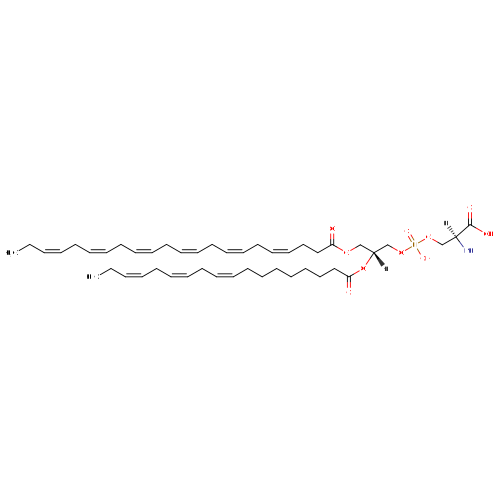
| Common Name | PS(22:6(4Z,7Z,10Z,13Z,16Z,19Z)/18:3(9Z,12Z,15Z)) |
|---|
| Description | PS(22:6(4Z,7Z,10Z,13Z,16Z,19Z)/18:3(9Z,12Z,15Z)) is a phosphatidylserine (PS or GPSer). It is a glycerophospholipid in which a phosphorylserine moiety occupies a glycerol substitution site. As is the case with diacylglycerols, glycerophosphoserines can have many different combinations of fatty acids of varying lengths and saturation attached at the C-1 and C-2 positions. Fatty acids containing 16, 18 and 20 carbons are the most common. PS(22:6(4Z,7Z,10Z,13Z,16Z,19Z)/18:3(9Z,12Z,15Z)), in particular, consists of one chain of docosahexaenoic acid at the C-1 position and one chain of a-linolenic acid at the C-2 position. The docosahexaenoic acid moiety is derived from fish oils, while the a-linolenic acid moiety is derived from seed oils, especially canola and soybean oil. Phosphatidylserine or 1,2-diacyl-sn-glycero-3-phospho-L-serine is distributed widely among animals, plants and microorganisms. It is usually less than 10% of the total phospholipids, the greatest concentration being in myelin from brain tissue. However, it may comprise 10 to 20 mol% of the total phospholipid in the plasma membrane and endoplasmic reticulum of the cell. Phosphatidylserine is an acidic (anionic) phospholipid with three ionizable groups, i.e. the phosphate moiety, the amino group and the carboxyl function. As with other acidic lipids, it exists in nature in salt form, but it has a high propensity to chelate to calcium via the charged oxygen atoms of both the carboxyl and phosphate moieties, modifying the conformation of the polar head group. This interaction may be of considerable relevance to the biological function of phosphatidylserine, especially during bone formation for example. As phosphatidylserine is located entirely on the inner monolayer surface of the plasma membrane (and of other cellular membranes) and it is the most abundant anionic phospholipids. Therefore phosphatidylseriine may make the largest contribution to interfacial effects in membranes involving non-specific electrostatic interactions. This normal distribution is disturbed during platelet activation and cellular apoptosis. In human plasma, 1-stearoyl-2-oleoyl and 1-stearoyl-2-arachidonoyl species predominate, but in brain (especially grey matter), retina and many other tissues 1-stearoyl-2-docosahexaenoyl species are very abundant. Indeed, the ratio of n-3 to n-6 fatty acids in brain phosphatidylserine is very much higher than in most other lipids. While most phospholipids have a saturated fatty acid on C-1 and an unsaturated fatty acid on C-2 of the glycerol backbone, the fatty acid distribution at the C-1 and C-2 positions of glycerol within phospholipids is continually in flux, owing to phospholipid degradation and the continuous phospholipid remodeling that occurs while these molecules are in membranes. Phosphatidylserines typically carry a net charge of -1 at physiological pH. They mostly have palmitic or stearic acid on carbon 1 and a long chain unsaturated fatty acid (e.g. 18:2, 20:4 and 22:6) on carbon 2. PS biosynthesis involves an exchange reaction of serine for ethanolamine in PE. |
|---|
| Structure | [H][C@](N)(COP(O)(=O)OC[C@@]([H])(COC(=O)CC\C=C/C\C=C/C\C=C/C\C=C/C\C=C/C\C=C/CC)OC(=O)CCCCCCC\C=C/C\C=C/C\C=C/CC)C(O)=O InChI=1S/C46H72NO10P/c1-3-5-7-9-11-13-15-17-19-20-21-22-24-25-27-29-31-33-35-37-44(48)54-39-42(40-55-58(52,53)56-41-43(47)46(50)51)57-45(49)38-36-34-32-30-28-26-23-18-16-14-12-10-8-6-4-2/h5-8,11-14,17-19,21-23,25,27,31,33,42-43H,3-4,9-10,15-16,20,24,26,28-30,32,34-41,47H2,1-2H3,(H,50,51)(H,52,53)/b7-5-,8-6-,13-11-,14-12-,19-17-,22-21-,23-18-,27-25-,33-31-/t42-,43+/m1/s1 |
|---|
| Synonyms | | Value | Source |
|---|
| 1-Docosahexaenoyl-2-a-linolenoyl-sn-glycero-3-phosphoserine | HMDB | | 1-Docosahexaenoyl-2-alpha-linolenoyl-sn-glycero-3-phosphoserine | HMDB | | Phosphatidylserine(22:6/18:3) | HMDB | | Phosphatidylserine(22:6n3/18:3n3) | HMDB | | Phosphatidylserine(22:6W3/18:3W3) | HMDB | | Phosphatidylserine(40:9) | HMDB | | PS(22:6/18:3) | HMDB | | PS(22:6N3/18:3N3) | HMDB | | PS(22:6W3/18:3W3) | HMDB | | PS(40:9) | HMDB | | pSer(22:6/18:3) | HMDB | | pSer(22:6n3/18:3n3) | HMDB | | pSer(22:6W3/18:3W3) | HMDB | | pSer(40:9) | HMDB | | 1-(4Z,7Z,10Z,13Z,16Z,19Z-Docosahexaenoyl)-2-(9Z,12Z,15Z-octadeatrienoyl)-sn-glycero-3-phosphoserine | HMDB | | PS(22:6(4Z,7Z,10Z,13Z,16Z,19Z)/18:3(9Z,12Z,15Z)) | Lipid Annotator |
|
|---|
| Chemical Formula | C46H72NO10P |
|---|
| Average Molecular Weight | 830.0383 |
|---|
| Monoisotopic Molecular Weight | 829.489384041 |
|---|
| IUPAC Name | (2S)-2-amino-3-({[(2R)-3-[(4Z,7Z,10Z,13Z,16Z,19Z)-docosa-4,7,10,13,16,19-hexaenoyloxy]-2-[(9Z,12Z,15Z)-octadeca-9,12,15-trienoyloxy]propoxy](hydroxy)phosphoryl}oxy)propanoic acid |
|---|
| Traditional Name | (2S)-2-amino-3-{[(2R)-3-[(4Z,7Z,10Z,13Z,16Z,19Z)-docosa-4,7,10,13,16,19-hexaenoyloxy]-2-[(9Z,12Z,15Z)-octadeca-9,12,15-trienoyloxy]propoxy(hydroxy)phosphoryl]oxy}propanoic acid |
|---|
| CAS Registry Number | Not Available |
|---|
| SMILES | [H][C@](N)(COP(O)(=O)OC[C@@]([H])(COC(=O)CC\C=C/C\C=C/C\C=C/C\C=C/C\C=C/C\C=C/CC)OC(=O)CCCCCCC\C=C/C\C=C/C\C=C/CC)C(O)=O |
|---|
| InChI Identifier | InChI=1S/C46H72NO10P/c1-3-5-7-9-11-13-15-17-19-20-21-22-24-25-27-29-31-33-35-37-44(48)54-39-42(40-55-58(52,53)56-41-43(47)46(50)51)57-45(49)38-36-34-32-30-28-26-23-18-16-14-12-10-8-6-4-2/h5-8,11-14,17-19,21-23,25,27,31,33,42-43H,3-4,9-10,15-16,20,24,26,28-30,32,34-41,47H2,1-2H3,(H,50,51)(H,52,53)/b7-5-,8-6-,13-11-,14-12-,19-17-,22-21-,23-18-,27-25-,33-31-/t42-,43+/m1/s1 |
|---|
| InChI Key | QWJIMQQYHINMQE-QJJGVXGTSA-N |
|---|
| Chemical Taxonomy |
|---|
| Description | Belongs to the class of organic compounds known as phosphatidylserines. These are glycerophosphoserines in which two fatty acids are bonded to the glycerol moiety through ester linkages. As is the case with diacylglycerols, phosphatidylserines can have many different combinations of fatty acids of varying lengths and saturation attached to the C-1 and C-2 positions. |
|---|
| Kingdom | Organic compounds |
|---|
| Super Class | Lipids and lipid-like molecules |
|---|
| Class | Glycerophospholipids |
|---|
| Sub Class | Glycerophosphoserines |
|---|
| Direct Parent | Phosphatidylserines |
|---|
| Alternative Parents | |
|---|
| Substituents | - Diacyl-glycerol-3-phosphoserine
- Alpha-amino acid
- Alpha-amino acid or derivatives
- L-alpha-amino acid
- Tricarboxylic acid or derivatives
- Phosphoethanolamine
- Fatty acid ester
- Dialkyl phosphate
- Organic phosphoric acid derivative
- Phosphoric acid ester
- Alkyl phosphate
- Fatty acyl
- Amino acid
- Amino acid or derivatives
- Carboxylic acid ester
- Carboxylic acid derivative
- Carboxylic acid
- Primary aliphatic amine
- Organopnictogen compound
- Organic oxygen compound
- Organic nitrogen compound
- Amine
- Carbonyl group
- Organic oxide
- Primary amine
- Hydrocarbon derivative
- Organonitrogen compound
- Organooxygen compound
- Aliphatic acyclic compound
|
|---|
| Molecular Framework | Aliphatic acyclic compounds |
|---|
| External Descriptors | |
|---|
| Ontology |
|---|
| Physiological effect | Not Available |
|---|
| Disposition | |
|---|
| Process | Naturally occurring processBiological processBiochemical pathwayMetabolic pathway- phosphatidylserine biosynthesis (HMDB: HMDB0012447)
- Phosphatidylcholine Biosynthesis PC(22:6(4Z,7Z,10Z,13Z,16Z,19Z)/18:3(9Z,12Z,15Z)) (PathBank: SMP0014979)
- Phosphatidylethanolamine Biosynthesis PE(22:6(4Z,7Z,10Z,13Z,16Z,19Z)/18:3(9Z,12Z,15Z)) (PathBank: SMP0015819)
|
|---|
| Role | |
|---|
| Physical Properties |
|---|
| State | Solid |
|---|
| Experimental Molecular Properties | | Property | Value | Reference |
|---|
| Melting Point | Not Available | Not Available | | Boiling Point | Not Available | Not Available | | Water Solubility | Not Available | Not Available | | LogP | Not Available | Not Available |
|
|---|
| Experimental Chromatographic Properties | Not Available |
|---|
| Predicted Molecular Properties | |
|---|
| Predicted Chromatographic Properties | Predicted Collision Cross SectionsPredicted Kovats Retention IndicesUnderivatized| Metabolite | SMILES | Kovats RI Value | Column Type | Reference |
|---|
| PS(22:6(4Z,7Z,10Z,13Z,16Z,19Z)/18:3(9Z,12Z,15Z)) | [H][C@](N)(COP(O)(=O)OC[C@@]([H])(COC(=O)CC\C=C/C\C=C/C\C=C/C\C=C/C\C=C/C\C=C/CC)OC(=O)CCCCCCC\C=C/C\C=C/C\C=C/CC)C(O)=O | 6379.9 | Standard polar | 33892256 | | PS(22:6(4Z,7Z,10Z,13Z,16Z,19Z)/18:3(9Z,12Z,15Z)) | [H][C@](N)(COP(O)(=O)OC[C@@]([H])(COC(=O)CC\C=C/C\C=C/C\C=C/C\C=C/C\C=C/C\C=C/CC)OC(=O)CCCCCCC\C=C/C\C=C/C\C=C/CC)C(O)=O | 5114.8 | Standard non polar | 33892256 | | PS(22:6(4Z,7Z,10Z,13Z,16Z,19Z)/18:3(9Z,12Z,15Z)) | [H][C@](N)(COP(O)(=O)OC[C@@]([H])(COC(=O)CC\C=C/C\C=C/C\C=C/C\C=C/C\C=C/C\C=C/CC)OC(=O)CCCCCCC\C=C/C\C=C/C\C=C/CC)C(O)=O | 5901.9 | Semi standard non polar | 33892256 |
|
|---|
| MS/MS Spectra| Spectrum Type | Description | Splash Key | Deposition Date | Source | View |
|---|
| Predicted LC-MS/MS | Predicted LC-MS/MS Spectrum - PS(22:6(4Z,7Z,10Z,13Z,16Z,19Z)/18:3(9Z,12Z,15Z)) 10V, Negative-QTOF | splash10-004i-0000000090-795da7a8f323669d0463 | 2021-09-22 | Wishart Lab | View Spectrum | | Predicted LC-MS/MS | Predicted LC-MS/MS Spectrum - PS(22:6(4Z,7Z,10Z,13Z,16Z,19Z)/18:3(9Z,12Z,15Z)) 20V, Negative-QTOF | splash10-004i-0000000190-9e23ba7b3111dec8c8d9 | 2021-09-22 | Wishart Lab | View Spectrum | | Predicted LC-MS/MS | Predicted LC-MS/MS Spectrum - PS(22:6(4Z,7Z,10Z,13Z,16Z,19Z)/18:3(9Z,12Z,15Z)) 40V, Negative-QTOF | splash10-01t9-0033900530-b370ade13ad5969ac9f4 | 2021-09-22 | Wishart Lab | View Spectrum | | Predicted LC-MS/MS | Predicted LC-MS/MS Spectrum - PS(22:6(4Z,7Z,10Z,13Z,16Z,19Z)/18:3(9Z,12Z,15Z)) 10V, Positive-QTOF | splash10-0uxr-0000001690-3b842367407493b77a57 | 2021-09-22 | Wishart Lab | View Spectrum | | Predicted LC-MS/MS | Predicted LC-MS/MS Spectrum - PS(22:6(4Z,7Z,10Z,13Z,16Z,19Z)/18:3(9Z,12Z,15Z)) 20V, Positive-QTOF | splash10-0udi-0000000290-14a001b3f7501ac7c461 | 2021-09-22 | Wishart Lab | View Spectrum | | Predicted LC-MS/MS | Predicted LC-MS/MS Spectrum - PS(22:6(4Z,7Z,10Z,13Z,16Z,19Z)/18:3(9Z,12Z,15Z)) 40V, Positive-QTOF | splash10-0a4i-0090003310-dcb3dbcc6ebc92d7ecd7 | 2021-09-22 | Wishart Lab | View Spectrum | | Predicted LC-MS/MS | Predicted LC-MS/MS Spectrum - PS(22:6(4Z,7Z,10Z,13Z,16Z,19Z)/18:3(9Z,12Z,15Z)) 10V, Positive-QTOF | splash10-001i-0000001090-6ebfb44bd192bad37d45 | 2021-09-23 | Wishart Lab | View Spectrum | | Predicted LC-MS/MS | Predicted LC-MS/MS Spectrum - PS(22:6(4Z,7Z,10Z,13Z,16Z,19Z)/18:3(9Z,12Z,15Z)) 20V, Positive-QTOF | splash10-000t-0003069160-2aa720134e9e7b90deb1 | 2021-09-23 | Wishart Lab | View Spectrum | | Predicted LC-MS/MS | Predicted LC-MS/MS Spectrum - PS(22:6(4Z,7Z,10Z,13Z,16Z,19Z)/18:3(9Z,12Z,15Z)) 40V, Positive-QTOF | splash10-0002-0003069110-f33003212a35311e0ca0 | 2021-09-23 | Wishart Lab | View Spectrum | | Predicted LC-MS/MS | Predicted LC-MS/MS Spectrum - PS(22:6(4Z,7Z,10Z,13Z,16Z,19Z)/18:3(9Z,12Z,15Z)) 10V, Positive-QTOF | splash10-000b-0000009990-b73a105ea77b75b20b1a | 2021-09-23 | Wishart Lab | View Spectrum | | Predicted LC-MS/MS | Predicted LC-MS/MS Spectrum - PS(22:6(4Z,7Z,10Z,13Z,16Z,19Z)/18:3(9Z,12Z,15Z)) 20V, Positive-QTOF | splash10-000e-0900009990-06f10b331887eb19d83a | 2021-09-23 | Wishart Lab | View Spectrum | | Predicted LC-MS/MS | Predicted LC-MS/MS Spectrum - PS(22:6(4Z,7Z,10Z,13Z,16Z,19Z)/18:3(9Z,12Z,15Z)) 40V, Positive-QTOF | splash10-000e-0900009990-06f10b331887eb19d83a | 2021-09-23 | Wishart Lab | View Spectrum |
|
|---|