| Record Information |
|---|
| Version | 5.0 |
|---|
| Status | Detected but not Quantified |
|---|
| Creation Date | 2005-11-16 15:48:42 UTC |
|---|
| Update Date | 2023-02-21 17:15:38 UTC |
|---|
| HMDB ID | HMDB0001366 |
|---|
| Secondary Accession Numbers | |
|---|
| Metabolite Identification |
|---|
| Common Name | Purine |
|---|
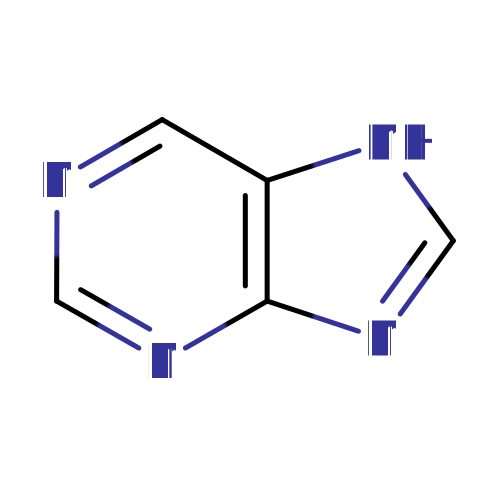
| Description | Purine, also known as purine base or 1H-purine, belongs to the class of organic compounds known as purines and purine derivatives. These are aromatic heterocyclic compounds containing a purine moiety, which is formed a pyrimidine-ring ring fused to an imidazole ring. Two of the bases in nucleic acids, adenine and guanine, are purines. Purines from food (or from tissue turnover) are metabolised by several enzymes, including xanthine oxidase, into uric acid. Purine exists in all living species, ranging from bacteria to humans. High levels of uric acid can predispose to gout when the acid crystalises in joints; this phenomenon only happens in humans and some animal species (e.g. dogs) that lack an intrinsic uricase enzyme that can further degrade uric acid. In humans, purine is involved in thioguanine action pathway. Outside of the human body, purine is found, on average, in the highest concentration within cocoa beans. Purine has also been detected, but not quantified in several different foods, such as rapinis, plains prickly pears, blackcurrants, radish, and parsley. This could make purine a potential biomarker for the consumption of these foods. Purine is a heterocyclic aromatic organic compound, consisting of a pyrimidine ring fused to an imidazole ring. |
|---|
| Structure | InChI=1S/C5H4N4/c1-4-5(8-2-6-1)9-3-7-4/h1-3H,(H,6,7,8,9) |
|---|
| Synonyms | | Value | Source |
|---|
| Purine base | ChEBI | | 1H-Purine | HMDB | | 6H-imidazo[4,5-D]Pyrimidine | HMDB | | 7-Methyltheophylline | HMDB | | 7H-imidazo(4,5-D)Pyrimidine | HMDB | | 7H-Purine | HMDB | | 9H-Purine | HMDB | | beta-Purine | HMDB | | Caffedrine | HMDB | | Caffein | HMDB | | Cafipel | HMDB | | Coffeine | HMDB | | Dasin | HMDB | | Dexitac | HMDB | | Diurex | HMDB | | Durvitan | HMDB | | imidazo(4,5-D)Pyrimidine | HMDB | | Isopurine | HMDB | | Koffein | HMDB | | Mateina | HMDB | | Methyltheobromine | HMDB | | Phensal | HMDB | | Propoxyphene compound 65 | HMDB | | {6h-imidazo[4,5-D]pyrimidine} | HMDB | | {7h-imidazo[4,} 5-D]pyrimidine | HMDB | | {Imidazo[4,5-D]pyrimidine} | HMDB |
|
|---|
| Chemical Formula | C5H4N4 |
|---|
| Average Molecular Weight | 120.1121 |
|---|
| Monoisotopic Molecular Weight | 120.043596148 |
|---|
| IUPAC Name | 7H-purine |
|---|
| Traditional Name | purine |
|---|
| CAS Registry Number | 120-73-0 |
|---|
| SMILES | N1C=NC2=C1C=NC=N2 |
|---|
| InChI Identifier | InChI=1S/C5H4N4/c1-4-5(8-2-6-1)9-3-7-4/h1-3H,(H,6,7,8,9) |
|---|
| InChI Key | KDCGOANMDULRCW-UHFFFAOYSA-N |
|---|
| Chemical Taxonomy |
|---|
| Description | Belongs to the class of organic compounds known as purines and purine derivatives. These are aromatic heterocyclic compounds containing a purine moiety, which is formed a pyrimidine-ring ring fused to an imidazole ring. |
|---|
| Kingdom | Organic compounds |
|---|
| Super Class | Organoheterocyclic compounds |
|---|
| Class | Imidazopyrimidines |
|---|
| Sub Class | Purines and purine derivatives |
|---|
| Direct Parent | Purines and purine derivatives |
|---|
| Alternative Parents | |
|---|
| Substituents | - Purine
- Pyrimidine
- Heteroaromatic compound
- Imidazole
- Azole
- Azacycle
- Organic nitrogen compound
- Organopnictogen compound
- Hydrocarbon derivative
- Organonitrogen compound
- Aromatic heteropolycyclic compound
|
|---|
| Molecular Framework | Aromatic heteropolycyclic compounds |
|---|
| External Descriptors | |
|---|
| Ontology |
|---|
| Not Available | Not Available |
|---|
| Physical Properties |
|---|
| State | Solid |
|---|
| Experimental Molecular Properties | | Property | Value | Reference |
|---|
| Melting Point | 214 °C | Not Available | | Boiling Point | Not Available | Not Available | | Water Solubility | 500 mg/mL | Not Available | | LogP | -0.37 | HANSCH,C ET AL. (1995) |
|
|---|
| Experimental Chromatographic Properties | Experimental Collision Cross Sections |
|---|
| Predicted Molecular Properties | |
|---|
| Predicted Chromatographic Properties | Predicted Collision Cross SectionsPredicted Retention Times Underivatized| Chromatographic Method | Retention Time | Reference |
|---|
| Measured using a Waters Acquity ultraperformance liquid chromatography (UPLC) ethylene-bridged hybrid (BEH) C18 column (100 mm × 2.1 mm; 1.7 μmparticle diameter). Predicted by Afia on May 17, 2022. Predicted by Afia on May 17, 2022. | 1.74 minutes | 32390414 | | Predicted by Siyang on May 30, 2022 | 8.5531 minutes | 33406817 | | Predicted by Siyang using ReTip algorithm on June 8, 2022 | 2.29 minutes | 32390414 | | AjsUoB = Accucore 150 Amide HILIC with 10mM Ammonium Formate, 0.1% Formic Acid | 78.0 seconds | 40023050 | | Fem_Long = Waters ACQUITY UPLC HSS T3 C18 with Water:MeOH and 0.1% Formic Acid | 1114.4 seconds | 40023050 | | Fem_Lipids = Ascentis Express C18 with (60:40 water:ACN):(90:10 IPA:ACN) and 10mM NH4COOH + 0.1% Formic Acid | 329.2 seconds | 40023050 | | Life_Old = Waters ACQUITY UPLC BEH C18 with Water:(20:80 acetone:ACN) and 0.1% Formic Acid | 87.0 seconds | 40023050 | | Life_New = RP Waters ACQUITY UPLC HSS T3 C18 with Water:(30:70 MeOH:ACN) and 0.1% Formic Acid | 233.4 seconds | 40023050 | | RIKEN = Waters ACQUITY UPLC BEH C18 with Water:ACN and 0.1% Formic Acid | 85.8 seconds | 40023050 | | Eawag_XBridgeC18 = XBridge C18 3.5u 2.1x50 mm with Water:MeOH and 0.1% Formic Acid | 273.7 seconds | 40023050 | | BfG_NTS_RP1 =Agilent Zorbax Eclipse Plus C18 (2.1 mm x 150 mm, 3.5 um) with Water:ACN and 0.1% Formic Acid | 289.7 seconds | 40023050 | | HILIC_BDD_2 = Merck SeQuant ZIC-HILIC with ACN(0.1% formic acid):water(16 mM ammonium formate) | 148.1 seconds | 40023050 | | UniToyama_Atlantis = RP Waters Atlantis T3 (2.1 x 150 mm, 5 um) with ACN:Water and 0.1% Formic Acid | 588.5 seconds | 40023050 | | BDD_C18 = Hypersil Gold 1.9µm C18 with Water:ACN and 0.1% Formic Acid | 62.6 seconds | 40023050 | | UFZ_Phenomenex = Kinetex Core-Shell C18 2.6 um, 3.0 x 100 mm, Phenomenex with Water:MeOH and 0.1% Formic Acid | 776.9 seconds | 40023050 | | SNU_RIKEN_POS = Waters ACQUITY UPLC BEH C18 with Water:ACN and 0.1% Formic Acid | 200.9 seconds | 40023050 | | RPMMFDA = Waters ACQUITY UPLC BEH C18 with Water:ACN and 0.1% Formic Acid | 211.6 seconds | 40023050 | | MTBLS87 = Merck SeQuant ZIC-pHILIC column with ACN:Water and :ammonium carbonate | 479.1 seconds | 40023050 | | KI_GIAR_zic_HILIC_pH2_7 = Merck SeQuant ZIC-HILIC with ACN:Water and 0.1% FA | 239.8 seconds | 40023050 | | Meister zic-pHILIC pH9.3 = Merck SeQuant ZIC-pHILIC column with ACN:Water 5mM NH4Ac pH9.3 and 5mM ammonium acetate in water | 128.1 seconds | 40023050 |
Predicted Kovats Retention IndicesUnderivatizedDerivatized| Derivative Name / Structure | SMILES | Kovats RI Value | Column Type | Reference |
|---|
| Purine,1TMS,isomer #1 | C[Si](C)(C)N1C=NC2=NC=NC=C21 | 1633.8 | Semi standard non polar | 33892256 | | Purine,1TMS,isomer #1 | C[Si](C)(C)N1C=NC2=NC=NC=C21 | 1513.0 | Standard non polar | 33892256 | | Purine,1TMS,isomer #1 | C[Si](C)(C)N1C=NC2=NC=NC=C21 | 2203.8 | Standard polar | 33892256 | | Purine,1TBDMS,isomer #1 | CC(C)(C)[Si](C)(C)N1C=NC2=NC=NC=C21 | 1864.3 | Semi standard non polar | 33892256 | | Purine,1TBDMS,isomer #1 | CC(C)(C)[Si](C)(C)N1C=NC2=NC=NC=C21 | 1702.0 | Standard non polar | 33892256 | | Purine,1TBDMS,isomer #1 | CC(C)(C)[Si](C)(C)N1C=NC2=NC=NC=C21 | 2313.6 | Standard polar | 33892256 |
|
|---|
| General References | - Gudbjornsson B, Zak A, Niklasson F, Hallgren R: Hypoxanthine, xanthine, and urate in synovial fluid from patients with inflammatory arthritides. Ann Rheum Dis. 1991 Oct;50(10):669-72. [PubMed:1958086 ]
- Yamamoto T, Moriwaki Y, Cheng J, Takahashi S, Tsutsumi Z, Ka T, Hada T: Effect of inosine on the plasma concentration of uridine and purine bases. Metabolism. 2002 Apr;51(4):438-42. [PubMed:11912550 ]
- van Os S, de Abreu R, Hopman J, Wethly K, Liem D, van de Bor M: Purine and pyrimidine metabolism and electrocortical brain activity during hypoxemia in near-term lambs. Pediatr Res. 2004 Jun;55(6):1018-25. Epub 2004 Mar 17. [PubMed:15028845 ]
- Yegutkin GG, Samburski SS, Jalkanen S: Soluble purine-converting enzymes circulate in human blood and regulate extracellular ATP level via counteracting pyrophosphatase and phosphotransfer reactions. FASEB J. 2003 Jul;17(10):1328-30. Epub 2003 May 20. [PubMed:12759341 ]
- Nakashima K, Inoue K, Mayahara K, Kuroda N, Hamachi Y, Akiyama S: Use of 3-(1,8-naphthalimido)propyl-modified silyl silica gel as a stationary phase for the high-performance liquid chromatographic separation of purine derivatives. J Chromatogr A. 1996 Jan 26;722(1-2):107-13. [PubMed:9019292 ]
- Schmidt H, Siems WG, Grune T, Grauel EL: Concentration of purine compounds in the cerebrospinal fluid of infants suffering from sepsis, convulsions and hydrocephalus. J Perinat Med. 1995;23(3):167-74. [PubMed:8568608 ]
- Lyoo IK, Demopulos CM, Hirashima F, Ahn KH, Renshaw PF: Oral choline decreases brain purine levels in lithium-treated subjects with rapid-cycling bipolar disorder: a double-blind trial using proton and lithium magnetic resonance spectroscopy. Bipolar Disord. 2003 Aug;5(4):300-6. [PubMed:12895208 ]
- Burnstock G: Purine-mediated signalling in pain and visceral perception. Trends Pharmacol Sci. 2001 Apr;22(4):182-8. [PubMed:11282418 ]
- Witte DP, Wiginton DA, Hutton JJ, Aronow BJ: Coordinate developmental regulation of purine catabolic enzyme expression in gastrointestinal and postimplantation reproductive tracts. J Cell Biol. 1991 Oct;115(1):179-90. [PubMed:1918135 ]
- Shore PM, Jackson EK, Wisniewski SR, Clark RS, Adelson PD, Kochanek PM: Vascular endothelial growth factor is increased in cerebrospinal fluid after traumatic brain injury in infants and children. Neurosurgery. 2004 Mar;54(3):605-11; discussion 611-2. [PubMed:15028134 ]
|
|---|