| Record Information |
|---|
| Version | 5.0 |
|---|
| Status | Expected but not Quantified |
|---|
| Creation Date | 2012-09-11 18:20:11 UTC |
|---|
| Update Date | 2023-02-21 17:23:27 UTC |
|---|
| HMDB ID | HMDB0033591 |
|---|
| Secondary Accession Numbers | - HMDB0002333
- HMDB02333
- HMDB33591
|
|---|
| Metabolite Identification |
|---|
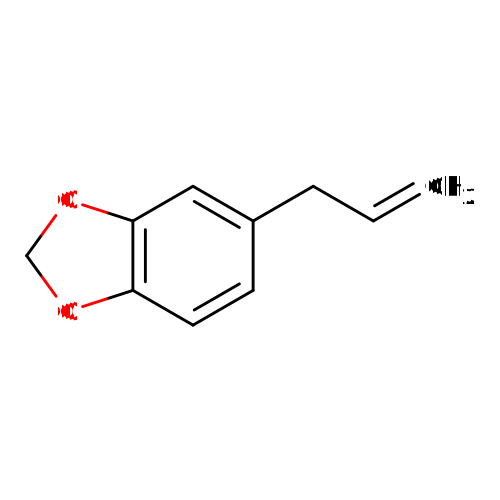
| Common Name | Safrole |
|---|
| Description | Safrole, also known as shikimol, is a colorless or slightly yellow oily liquid. It is typically extracted from the root-bark or the fruit of sassafras plants in the form of sassafras oil, or synthesized from other related methylenedioxy compounds. It is the principal component of brown camphor oil, and is found in small amounts in a wide variety of plants, where it functions as a natural pesticide. Safrole is found in anise and nutmeg. Banned by FDA for use in food. Safrole is formerly used as a food flavour It is a precursor in the synthesis of the insecticide synergist piperonyl butoxide and the recreational drug MDMA ("Ecstacy"). Safrole is a natural plant constituent, found in oil of sassafras and certain other essential oils. It is a member of the methylenedioxybenzene group of compounds, many of which (e.g. piperonyl butoxide) are extensively used as insecticide synergists. Safrole is a major source of human exposure to safrole is through consumption of spices, such as nutmeg, cinnamon and black pepper, in which safrole is a constituent. Safrole is also present in root beer, and has been used as an additive in chewing gum, toothpaste, soaps and certain pharmaceutical preparations. Safrole is a weak hepatocarcinogen and it is a matter of considerable interest whether the ally1 moiety or the methylenedioxy group, or both, are involved in the mechanism of its carcinogenesis. Safrole is extensively metabolized, giving rise to a large number of metabolites. Metabolism involves essentially two major routes, oxidation of the ally1 side chain, and oxidation of the methylenedioxy group with subsequent cleavage to form the catechol. Safrole undergoes oxidation of the allylic group to yield the 2, 3-epoxide (safrole epoxide). The dihydrodiol is one of the metabolites of safrole, and presumably arises from the hydration of the 2, 3-epoxide. The principal route of metabolism of safrole is through cleavage of the methylenedioxy group, the major metabolites being allylcatechol and its isomer, propenylcatechol. Eugenol and its isomer I-methoxy- 2-hydroxy-4-allylbenzene have been detected as minor metabolites in rat, mouse and human (PMID:6719936 ). The Ocotea cymbarum oil made of the Ocotea pretiosa, a plant growing in Brazil, and sassafras oil made of Sassafras albidum, a tree growing in eastern North America, are the main natural sources for safrole. It has a characteristic "candy-shop" aroma |
|---|
| Structure | InChI=1S/C10H10O2/c1-2-3-8-4-5-9-10(6-8)12-7-11-9/h2,4-6H,1,3,7H2 |
|---|
| Synonyms | | Value | Source |
|---|
| 1,2-Methylenedioxy-4-allylbenzene | ChEBI | | 1-Allyl-3,4-methylenedioxybenzene | ChEBI | | 3,4-(Methylenedioxy)allylbenzene | ChEBI | | 3-(3,4-Methylenedioxyphenyl)prop-1-ene | ChEBI | | 4-Allyl-1,2-methylenedioxybenzene | ChEBI | | 4-Allylpyrocatechol formaldehyde acetal | ChEBI | | 5-(2-Propenyl)-1,3-benzodioxole | ChEBI | | 5-Allyl-benzo[1,3]dioxole | ChEBI | | Allylcatechol methylene ether | ChEBI | | m-Allylpyrocatechin methylene ether | ChEBI | | Safrol | ChEBI | | Shikimol | ChEBI | | Shikimole | ChEBI | | (1,2-(Methylenedioxy)-4-allyl)benzene | HMDB | | (Allyldioxy)benzene methylene ether | HMDB | | (e)5-1-Propenyl]-1,3-benzodioxole | HMDB | | 1, 2-(Methylenedioxy)-4-allylbenzene | HMDB | | 1,2-(Methylenedioxy)-4-propenylbenzene | HMDB | | 1,2-Methylenedioxy-4-allyl-benzene | HMDB | | 1-Allyl,3,4-methylenedioxy benzene | HMDB | | 3, 4-(Methylenedioxy)allylbenzene | HMDB | | 3,4-(Methylenedioxy)-1-propenylbenzene | HMDB | | 3,4-Methylenedioxy-allybenzene | HMDB | | 3,4-Methylenedioxyallylbenzene | HMDB | | 4-Allyl-1, 2-(methylenedioxy)benzene | HMDB | | 4-Allyl-1,2-(methylenedioxy)benzene, 8ci | HMDB | | 4-Allylpyrocatechol | HMDB | | 4-Propenyl-1,2-methylenedioxybenzene | HMDB | | 4-Propenylcatechol methylene ether | HMDB | | 5-(1-Propenyl)-1,3-benzodioxole | HMDB | | 5-(2-Propenyl)-1,3-benzodioxole, 9ci | HMDB | | 5-Allyl-1,3-benzodioxolerlet DS base | HMDB | | 5-Prop-2-enyl-1,3-benzodioxole | HMDB | | 6-(1-Propenyl)-1,3-benzodioxole | HMDB | | Allyldioxybenzene methylene ether | HMDB | | Allylpyrocatechol methylene ether | HMDB | | Isosafrol | HMDB | | Isosafrole | HMDB | | Izosafrol | HMDB | | Shikomol | HMDB | | 4 Allyl 1,2 methylenedioxybenzene | MeSH | | 4-Allyl-1,2-methylenedioxybenzenes | MeSH | | Safroles | MeSH | | Shikimols | MeSH | | Safrols | MeSH |
|
|---|
| Chemical Formula | C10H10O2 |
|---|
| Average Molecular Weight | 162.1852 |
|---|
| Monoisotopic Molecular Weight | 162.068079564 |
|---|
| IUPAC Name | 5-(prop-2-en-1-yl)-2H-1,3-benzodioxole |
|---|
| Traditional Name | sassafras |
|---|
| CAS Registry Number | 94-59-7 |
|---|
| SMILES | C=CCC1=CC2=C(OCO2)C=C1 |
|---|
| InChI Identifier | InChI=1S/C10H10O2/c1-2-3-8-4-5-9-10(6-8)12-7-11-9/h2,4-6H,1,3,7H2 |
|---|
| InChI Key | ZMQAAUBTXCXRIC-UHFFFAOYSA-N |
|---|
| Chemical Taxonomy |
|---|
| Description | Belongs to the class of organic compounds known as benzodioxoles. These are organic compounds containing a benzene ring fused to either isomers of dioxole. Dioxole is a five-membered unsaturated ring of two oxygen atoms and three carbon atoms. |
|---|
| Kingdom | Organic compounds |
|---|
| Super Class | Organoheterocyclic compounds |
|---|
| Class | Benzodioxoles |
|---|
| Sub Class | Not Available |
|---|
| Direct Parent | Benzodioxoles |
|---|
| Alternative Parents | |
|---|
| Substituents | - Benzodioxole
- Benzenoid
- Oxacycle
- Acetal
- Organic oxygen compound
- Hydrocarbon derivative
- Organooxygen compound
- Aromatic heteropolycyclic compound
|
|---|
| Molecular Framework | Aromatic heteropolycyclic compounds |
|---|
| External Descriptors | |
|---|
| Ontology |
|---|
| Physiological effect | |
|---|
| Disposition | |
|---|
| Process | Not Available |
|---|
| Role | |
|---|
| Physical Properties |
|---|
| State | Liquid |
|---|
| Experimental Molecular Properties | |
|---|
| Experimental Chromatographic Properties | Experimental Collision Cross Sections |
|---|
| Predicted Molecular Properties | |
|---|
| Predicted Chromatographic Properties | Predicted Collision Cross SectionsPredicted Retention Times Underivatized| Chromatographic Method | Retention Time | Reference |
|---|
| Measured using a Waters Acquity ultraperformance liquid chromatography (UPLC) ethylene-bridged hybrid (BEH) C18 column (100 mm × 2.1 mm; 1.7 μmparticle diameter). Predicted by Afia on May 17, 2022. Predicted by Afia on May 17, 2022. | 6.0 minutes | 32390414 | | Predicted by Siyang on May 30, 2022 | 15.6238 minutes | 33406817 | | Predicted by Siyang using ReTip algorithm on June 8, 2022 | 2.29 minutes | 32390414 | | AjsUoB = Accucore 150 Amide HILIC with 10mM Ammonium Formate, 0.1% Formic Acid | 36.2 seconds | 40023050 | | Fem_Long = Waters ACQUITY UPLC HSS T3 C18 with Water:MeOH and 0.1% Formic Acid | 2008.7 seconds | 40023050 | | Fem_Lipids = Ascentis Express C18 with (60:40 water:ACN):(90:10 IPA:ACN) and 10mM NH4COOH + 0.1% Formic Acid | 556.2 seconds | 40023050 | | Life_Old = Waters ACQUITY UPLC BEH C18 with Water:(20:80 acetone:ACN) and 0.1% Formic Acid | 211.9 seconds | 40023050 | | Life_New = RP Waters ACQUITY UPLC HSS T3 C18 with Water:(30:70 MeOH:ACN) and 0.1% Formic Acid | 376.2 seconds | 40023050 | | RIKEN = Waters ACQUITY UPLC BEH C18 with Water:ACN and 0.1% Formic Acid | 269.3 seconds | 40023050 | | Eawag_XBridgeC18 = XBridge C18 3.5u 2.1x50 mm with Water:MeOH and 0.1% Formic Acid | 594.8 seconds | 40023050 | | BfG_NTS_RP1 =Agilent Zorbax Eclipse Plus C18 (2.1 mm x 150 mm, 3.5 um) with Water:ACN and 0.1% Formic Acid | 664.4 seconds | 40023050 | | HILIC_BDD_2 = Merck SeQuant ZIC-HILIC with ACN(0.1% formic acid):water(16 mM ammonium formate) | 184.1 seconds | 40023050 | | UniToyama_Atlantis = RP Waters Atlantis T3 (2.1 x 150 mm, 5 um) with ACN:Water and 0.1% Formic Acid | 1366.8 seconds | 40023050 | | BDD_C18 = Hypersil Gold 1.9µm C18 with Water:ACN and 0.1% Formic Acid | 484.8 seconds | 40023050 | | UFZ_Phenomenex = Kinetex Core-Shell C18 2.6 um, 3.0 x 100 mm, Phenomenex with Water:MeOH and 0.1% Formic Acid | 1442.4 seconds | 40023050 | | SNU_RIKEN_POS = Waters ACQUITY UPLC BEH C18 with Water:ACN and 0.1% Formic Acid | 471.2 seconds | 40023050 | | RPMMFDA = Waters ACQUITY UPLC BEH C18 with Water:ACN and 0.1% Formic Acid | 414.2 seconds | 40023050 | | MTBLS87 = Merck SeQuant ZIC-pHILIC column with ACN:Water and :ammonium carbonate | 542.6 seconds | 40023050 | | KI_GIAR_zic_HILIC_pH2_7 = Merck SeQuant ZIC-HILIC with ACN:Water and 0.1% FA | 487.2 seconds | 40023050 | | Meister zic-pHILIC pH9.3 = Merck SeQuant ZIC-pHILIC column with ACN:Water 5mM NH4Ac pH9.3 and 5mM ammonium acetate in water | 49.5 seconds | 40023050 |
Predicted Kovats Retention IndicesUnderivatized |
|---|
| General References | - Ioannides C, Lum PY, Parke DV: Cytochrome P-448 and the activation of toxic chemicals and carcinogens. Xenobiotica. 1984 Jan-Feb;14(1-2):119-37. [PubMed:6719936 ]
- Hung SL, Chen YL, Chen YT: Effects of safrole on the defensive functions of human neutrophils. J Periodontal Res. 2003 Apr;38(2):130-4. [PubMed:12608906 ]
- Zhao J, Miao J, Zhao B, Zhang S, Yin D: Safrole oxide inhibits angiogenesis by inducing apoptosis. Vascul Pharmacol. 2005 Jun;43(1):69-74. [PubMed:15936989 ]
- (). Yannai, Shmuel. (2004) Dictionary of food compounds with CD-ROM: Additives, flavors, and ingredients. Boca Raton: Chapman & Hall/CRC.. .
|
|---|