| Record Information |
|---|
| Version | 5.0 |
|---|
| Status | Detected but not Quantified |
|---|
| Creation Date | 2012-09-11 23:03:00 UTC |
|---|
| Update Date | 2023-02-21 17:26:04 UTC |
|---|
| HMDB ID | HMDB0037790 |
|---|
| Secondary Accession Numbers | - HMDB0240255
- HMDB0240256
- HMDB37790
|
|---|
| Metabolite Identification |
|---|
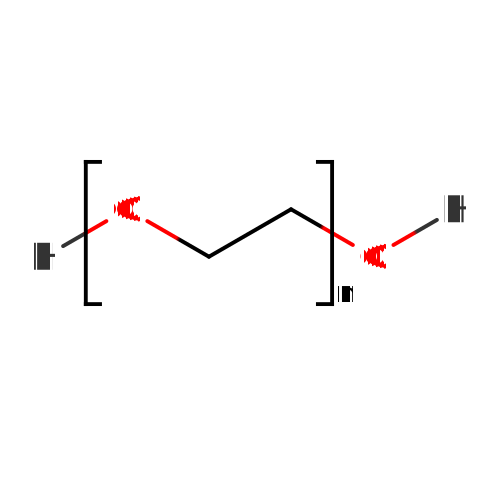
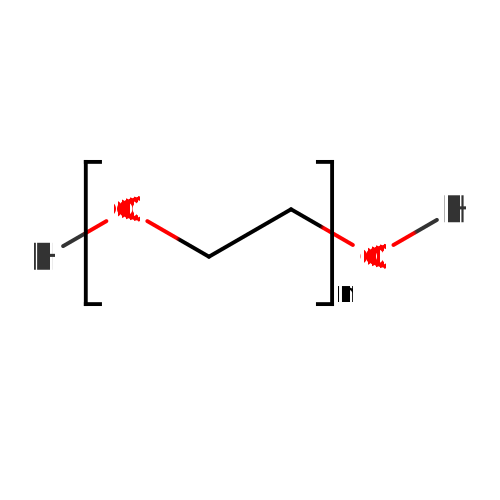
| Common Name | Polyethylene glycol |
|---|
| Description | Polyethylene glycol (PEG) is a polyether compound with many applications from industrial manufacturing to medicine. PEG is also known as polyethylene oxide (PEO) or polyoxyethylene (POE), depending on its molecular weight. PEG, PEO, or POE refers to an oligomer or polymer of ethylene oxide. Polyethylene glycol is produced by the interaction of ethylene oxide with water, ethylene glycol, or ethylene glycol oligomers. PEG is the basis of a number of laxatives (e.g. macrogol-containing products such as Movicol and polyethylene glycol 3350, or SoftLax, MiraLAX, or GlycoLax). Whole bowel irrigation with polyethylene glycol and added electrolytes is used for bowel preparation before surgery or colonoscopy. PEG is used as an excipient in many pharmaceutical products. Lower-molecular-weight variants are used as solvents in oral liquids and soft capsules, whereas solid variants are used as ointment bases, tablet binders, film coatings, and lubricants (Wikipedia ). It has been shown that polyethylene glycol can improve healing of spinal injuries in dogs. Earlier findings that polyethylene glycol can aid in nerve repair came from the University of Texas (Krause and Bittner). Polyethylene glycol is commonly used to fuse B-cells with myeloma cells in monoclonal antibody production. PEG has recently been proven to give better results in constipation patients than tegaserod. Since PEG is a flexible, water-soluble polymer, it can be used to create very high osmotic pressures (tens of atmospheres). It also is unlikely to have specific interactions with biological chemicals. These properties make PEG one of the most useful molecules for applying osmotic pressure in biochemistry experiments, particularly when using the osmotic stress technique. Polyethylene glycol has been shown to exhibit excitant, anesthetic, radical scavenger, anti-microbial, and laxative functions (PMID: 10726226 , 9485637 , 11179847 , 19089178 , 20011352 ). |
|---|
| Structure | InChI=1S/C2H6O2/c3-1-2-4/h3-4H,1-2H2 |
|---|
| Synonyms | | Value | Source |
|---|
| 1,2-Dihydroxyethane | ChEBI | | 1,2-Ethanediol | ChEBI | | 2-Hydroxyethanol | ChEBI | | Ethanediol | ChEBI | | Glycol | ChEBI | | HO-CH2-CH2-OH | ChEBI | | Monoethylene glycol | ChEBI | | 1,2 Ethanediol | HMDB | | Glycol, monoethylene | HMDB | | 2 Hydroxyethanol | HMDB | | Glycol, ethylene | HMDB | | Poly(ethylene glycol) | HMDB | | Polyethylene oxide | HMDB | | Poly(ethylene oxide) | HMDB | | Polyoxyethylene | HMDB | | Poly(oxyethylene) | HMDB | | PEG | HMDB | | PEO | HMDB | | POE | HMDB | | Alkox | HMDB | | Carbowax | HMDB | | Carbowax sentry | HMDB | | Macrogol | HMDB | | MiraLax | HMDB | | Α,ω-hydroxypoly(ethylene oxide) | HMDB | | Α-hydro-ω-hydroxypoly(oxy-1,2-ethanediyl) | HMDB | | Α-hydro-ω-hydroxypoly(oxyethylene) | HMDB | | alpha,Omega-hydroxypoly(ethylene oxide) | HMDB | | alpha-Hydro-omega-hydroxypoly(oxy-1,2-ethanediyl) | HMDB | | alpha-Hydro-omega-hydroxypoly(oxyethylene) | HMDB | | Ethylene glycol homopolymer | HMDB | | Ethylene glycol polymer | HMDB | | Ethylene oxide polymer | HMDB | | Ethylene polyoxide | HMDB | | Ethylene glycol | HMDB | | Polyethylene glycol | HMDB |
|
|---|
| Chemical Formula | C2H6O2 |
|---|
| Average Molecular Weight | 62.0678 |
|---|
| Monoisotopic Molecular Weight | 62.036779436 |
|---|
| IUPAC Name | Not Available |
|---|
| Traditional Name | Not Available |
|---|
| CAS Registry Number | 25322-68-3 |
|---|
| SMILES | [H]OCCO[H] |
|---|
| InChI Identifier | InChI=1S/C2H6O2/c3-1-2-4/h3-4H,1-2H2 |
|---|
| InChI Key | LYCAIKOWRPUZTN-UHFFFAOYSA-N |
|---|
| Chemical Taxonomy |
|---|
| Description | Belongs to the class of organic compounds known as 1,2-diols. These are polyols containing an alcohol group at two adjacent positions. |
|---|
| Kingdom | Organic compounds |
|---|
| Super Class | Organic oxygen compounds |
|---|
| Class | Organooxygen compounds |
|---|
| Sub Class | Alcohols and polyols |
|---|
| Direct Parent | 1,2-diols |
|---|
| Alternative Parents | |
|---|
| Substituents | - 1,2-diol
- Hydrocarbon derivative
- Primary alcohol
- Aliphatic acyclic compound
|
|---|
| Molecular Framework | Aliphatic acyclic compounds |
|---|
| External Descriptors | |
|---|
| Ontology |
|---|
| Physiological effect | Not Available |
|---|
| Disposition | |
|---|
| Process | |
|---|
| Role | |
|---|
| Physical Properties |
|---|
| State | Liquid |
|---|
| Experimental Molecular Properties | |
|---|
| Experimental Chromatographic Properties | Not Available |
|---|
| Predicted Molecular Properties | |
|---|
| Predicted Chromatographic Properties | Predicted Collision Cross SectionsPredicted Kovats Retention IndicesUnderivatizedDerivatized |
|---|
| GC-MS Spectra| Spectrum Type | Description | Splash Key | Deposition Date | Source | View |
|---|
| Experimental GC-MS | GC-MS Spectrum - Ethylene glycol EI-B (Non-derivatized) | splash10-001i-9000000000-3f04f129d6a8c819d7bc | 2017-09-12 | HMDB team, MONA, MassBank | View Spectrum | | Experimental GC-MS | GC-MS Spectrum - Ethylene glycol EI-B (Non-derivatized) | splash10-001i-9000000000-eaa1e5b7b88211fa7edb | 2017-09-12 | HMDB team, MONA, MassBank | View Spectrum | | Experimental GC-MS | GC-MS Spectrum - Ethylene glycol EI-B (Non-derivatized) | splash10-001i-9000000000-dcef056f352184a24448 | 2017-09-12 | HMDB team, MONA, MassBank | View Spectrum | | Experimental GC-MS | GC-MS Spectrum - Ethylene glycol EI-B (Non-derivatized) | splash10-001i-9000000000-3f04f129d6a8c819d7bc | 2018-05-18 | HMDB team, MONA, MassBank | View Spectrum | | Experimental GC-MS | GC-MS Spectrum - Ethylene glycol EI-B (Non-derivatized) | splash10-001i-9000000000-eaa1e5b7b88211fa7edb | 2018-05-18 | HMDB team, MONA, MassBank | View Spectrum | | Experimental GC-MS | GC-MS Spectrum - Ethylene glycol EI-B (Non-derivatized) | splash10-001i-9000000000-dcef056f352184a24448 | 2018-05-18 | HMDB team, MONA, MassBank | View Spectrum | | Predicted GC-MS | Predicted GC-MS Spectrum - Ethylene glycol GC-MS (Non-derivatized) - 70eV, Positive | splash10-03e9-9000000000-7d7e99366b74aa908fb5 | 2016-09-22 | Wishart Lab | View Spectrum | | Predicted GC-MS | Predicted GC-MS Spectrum - Ethylene glycol GC-MS (2 TMS) - 70eV, Positive | splash10-00di-9300000000-1cb14d2c8cf1747328eb | 2017-10-06 | Wishart Lab | View Spectrum | | Predicted GC-MS | Predicted GC-MS Spectrum - Ethylene glycol GC-MS (Non-derivatized) - 70eV, Positive | Not Available | 2021-10-12 | Wishart Lab | View Spectrum | | Predicted GC-MS | Predicted GC-MS Spectrum - Ethylene glycol GC-MS (Non-derivatized) - 70eV, Positive | Not Available | 2021-10-12 | Wishart Lab | View Spectrum | | MS | Mass Spectrum (Electron Ionization) | splash10-001i-9000000000-2fa6f85cb914a856ccc3 | 2014-09-20 | Not Available | View Spectrum |
MS/MS Spectra| Spectrum Type | Description | Splash Key | Deposition Date | Source | View |
|---|
| Predicted LC-MS/MS | Predicted LC-MS/MS Spectrum - Polyethylene glycol 10V, Positive-QTOF | splash10-03di-9000000000-1d69e3daf74c74648262 | 2015-09-15 | Wishart Lab | View Spectrum | | Predicted LC-MS/MS | Predicted LC-MS/MS Spectrum - Polyethylene glycol 20V, Positive-QTOF | splash10-03di-9000000000-7060d349c304512b9f75 | 2015-09-15 | Wishart Lab | View Spectrum | | Predicted LC-MS/MS | Predicted LC-MS/MS Spectrum - Polyethylene glycol 40V, Positive-QTOF | splash10-0002-9000000000-3bc95e388ddb6eadd69d | 2015-09-15 | Wishart Lab | View Spectrum | | Predicted LC-MS/MS | Predicted LC-MS/MS Spectrum - Polyethylene glycol 10V, Negative-QTOF | splash10-03di-9000000000-c649f289b243e440bfa9 | 2015-09-15 | Wishart Lab | View Spectrum | | Predicted LC-MS/MS | Predicted LC-MS/MS Spectrum - Polyethylene glycol 20V, Negative-QTOF | splash10-03di-9000000000-7d8813644ca43096609f | 2015-09-15 | Wishart Lab | View Spectrum | | Predicted LC-MS/MS | Predicted LC-MS/MS Spectrum - Polyethylene glycol 40V, Negative-QTOF | splash10-01ox-9000000000-17eed3caf789fe508145 | 2015-09-15 | Wishart Lab | View Spectrum | | Predicted LC-MS/MS | Predicted LC-MS/MS Spectrum - Polyethylene glycol 10V, Negative-QTOF | splash10-03di-9000000000-bc322895724fc86f7dc0 | 2021-09-23 | Wishart Lab | View Spectrum | | Predicted LC-MS/MS | Predicted LC-MS/MS Spectrum - Polyethylene glycol 20V, Negative-QTOF | splash10-03di-9000000000-8057e63671cfd392ae43 | 2021-09-23 | Wishart Lab | View Spectrum | | Predicted LC-MS/MS | Predicted LC-MS/MS Spectrum - Polyethylene glycol 40V, Negative-QTOF | splash10-0006-9000000000-f589ce99213e8dfb1d61 | 2021-09-23 | Wishart Lab | View Spectrum | | Predicted LC-MS/MS | Predicted LC-MS/MS Spectrum - Polyethylene glycol 10V, Positive-QTOF | splash10-0002-9000000000-8eeb88a032ec50107369 | 2021-09-24 | Wishart Lab | View Spectrum | | Predicted LC-MS/MS | Predicted LC-MS/MS Spectrum - Polyethylene glycol 20V, Positive-QTOF | splash10-0002-9000000000-00ba25458eb6c0cc2940 | 2021-09-24 | Wishart Lab | View Spectrum | | Predicted LC-MS/MS | Predicted LC-MS/MS Spectrum - Polyethylene glycol 40V, Positive-QTOF | splash10-0002-9000000000-00ba25458eb6c0cc2940 | 2021-09-24 | Wishart Lab | View Spectrum |
NMR Spectra| Spectrum Type | Description | Deposition Date | Source | View |
|---|
| Predicted 1D NMR | 13C NMR Spectrum (1D, 100 MHz, D2O, predicted) | 2021-09-24 | Wishart Lab | View Spectrum | | Predicted 1D NMR | 1H NMR Spectrum (1D, 100 MHz, D2O, predicted) | 2021-09-24 | Wishart Lab | View Spectrum | | Predicted 1D NMR | 13C NMR Spectrum (1D, 1000 MHz, D2O, predicted) | 2021-09-24 | Wishart Lab | View Spectrum | | Predicted 1D NMR | 1H NMR Spectrum (1D, 1000 MHz, D2O, predicted) | 2021-09-24 | Wishart Lab | View Spectrum | | Predicted 1D NMR | 13C NMR Spectrum (1D, 200 MHz, D2O, predicted) | 2021-09-24 | Wishart Lab | View Spectrum | | Predicted 1D NMR | 1H NMR Spectrum (1D, 200 MHz, D2O, predicted) | 2021-09-24 | Wishart Lab | View Spectrum | | Predicted 1D NMR | 13C NMR Spectrum (1D, 300 MHz, D2O, predicted) | 2021-09-24 | Wishart Lab | View Spectrum | | Predicted 1D NMR | 1H NMR Spectrum (1D, 300 MHz, D2O, predicted) | 2021-09-24 | Wishart Lab | View Spectrum | | Predicted 1D NMR | 13C NMR Spectrum (1D, 400 MHz, D2O, predicted) | 2021-09-24 | Wishart Lab | View Spectrum | | Predicted 1D NMR | 1H NMR Spectrum (1D, 400 MHz, D2O, predicted) | 2021-09-24 | Wishart Lab | View Spectrum | | Predicted 1D NMR | 13C NMR Spectrum (1D, 500 MHz, D2O, predicted) | 2021-09-24 | Wishart Lab | View Spectrum | | Predicted 1D NMR | 1H NMR Spectrum (1D, 500 MHz, D2O, predicted) | 2021-09-24 | Wishart Lab | View Spectrum | | Predicted 1D NMR | 13C NMR Spectrum (1D, 600 MHz, D2O, predicted) | 2021-09-24 | Wishart Lab | View Spectrum | | Predicted 1D NMR | 1H NMR Spectrum (1D, 600 MHz, D2O, predicted) | 2021-09-24 | Wishart Lab | View Spectrum | | Predicted 1D NMR | 13C NMR Spectrum (1D, 700 MHz, D2O, predicted) | 2021-09-24 | Wishart Lab | View Spectrum | | Predicted 1D NMR | 1H NMR Spectrum (1D, 700 MHz, D2O, predicted) | 2021-09-24 | Wishart Lab | View Spectrum | | Predicted 1D NMR | 13C NMR Spectrum (1D, 800 MHz, D2O, predicted) | 2021-09-24 | Wishart Lab | View Spectrum | | Predicted 1D NMR | 1H NMR Spectrum (1D, 800 MHz, D2O, predicted) | 2021-09-24 | Wishart Lab | View Spectrum | | Predicted 1D NMR | 13C NMR Spectrum (1D, 900 MHz, D2O, predicted) | 2021-09-24 | Wishart Lab | View Spectrum | | Predicted 1D NMR | 1H NMR Spectrum (1D, 900 MHz, D2O, predicted) | 2021-09-24 | Wishart Lab | View Spectrum |
IR Spectra| Spectrum Type | Description | Deposition Date | Source | View |
|---|
| Predicted IR Spectrum | IR Ion Spectrum (Predicted IRIS Spectrum, Adduct: [M-H]-) | 2023-02-04 | FELIX lab | View Spectrum | | Predicted IR Spectrum | IR Ion Spectrum (Predicted IRIS Spectrum, Adduct: [M+H]+) | 2023-02-04 | FELIX lab | View Spectrum | | Predicted IR Spectrum | IR Ion Spectrum (Predicted IRIS Spectrum, Adduct: [M+Na]+) | 2023-02-04 | FELIX lab | View Spectrum |
|
|---|