| Record Information |
|---|
| Version | 5.0 |
|---|
| Status | Detected and Quantified |
|---|
| Creation Date | 2006-05-22 14:17:53 UTC |
|---|
| Update Date | 2023-02-21 17:16:24 UTC |
|---|
| HMDB ID | HMDB0002434 |
|---|
| Secondary Accession Numbers | |
|---|
| Metabolite Identification |
|---|
| Common Name | Hydroquinone |
|---|
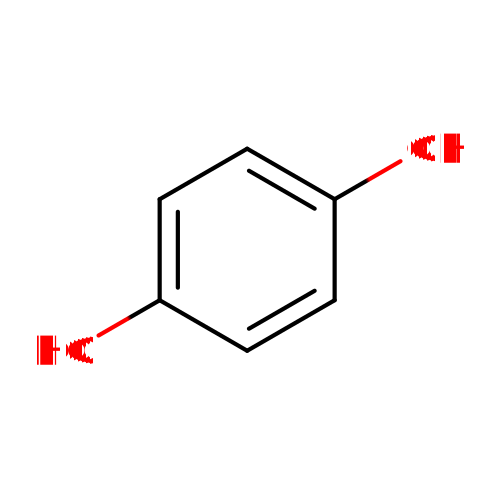
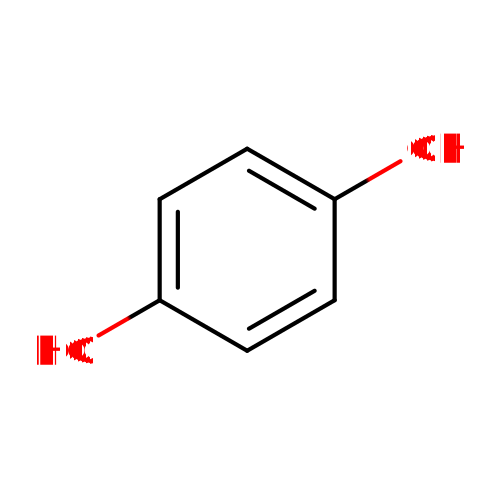
| Description | Hydroquinone, also known as benzene-1,4-diol, is an aromatic organic compound which is a type of phenol, having the chemical formula C6H4(OH)2. Its chemical structure has two hydroxyl groups bonded to a benzene ring in a para position. Hydroquinone is commonly used as a biomarker for benzene exposure. The presence of hydroquinone in normal individuals stems mainly from direct dietary ingestion, catabolism of tyrosine and other substrates by gut bacteria, ingestion of arbutin-containing foods, cigarette smoking, and the use of some over-the-counter medicines. Hydroquinone is a white granular solid at room temperature and pressure. The hydroxyl groups of hydroquinone are quite weakly acidic. Hydroquinone can lose an H+ from one of the hydroxyls to form a monophenolate ion or lose an H+ from both to form a diphenolate ion. Hydroquinone has a variety of uses principally associated with its action as a reducing agent which is soluble in water. It is a major component of most photographic developers where, with the compound Metol, it reduces silver halides to elemental silver. |
|---|
| Structure | InChI=1S/C6H6O2/c7-5-1-2-6(8)4-3-5/h1-4,7-8H |
|---|
| Synonyms | | Value | Source |
|---|
| 1,4-Benzenediol | ChEBI | | 1,4-Dihydroxybenzene | ChEBI | | 4-Hydroxyphenol | ChEBI | | Benzene-1,4-diol | ChEBI | | Eldoquin | ChEBI | | p-Benzenediol | ChEBI | | p-Hydroquinone | ChEBI | | p-Hydroxyphenol | ChEBI | | Quinol | ChEBI | | Artra | MeSH | | Eldopaque | MeSH | | Esoterica | MeSH | | Hidroquilaude | MeSH | | Hidroquin | MeSH | | Hidroquinona isdin | MeSH | | Licostrata | MeSH | | Lustra | MeSH | | Melanasa | MeSH | | Melanex | MeSH | | Melpaque | MeSH | | Melquin | MeSH | | Neostrata HQ | MeSH | | Phiaquin | MeSH | | Solaquin | MeSH | | Ultraquin | MeSH | | beta-Quinol | MeSH | | Hydroquinone, copper (1+) salt | MeSH | | Hydroquinone, lead (2+) salt (2:1) | MeSH | | Hydroquinone, monocopper (2+) salt | MeSH | | 1,4-Dihydroxy-benzeen | HMDB | | 1,4-Dihydroxy-benzol | HMDB | | 1,4-Dihydroxybenzen | HMDB | | 1,4-Diidrobenzene | HMDB | | a-Hydroquinone | HMDB | | alpha-Hydroquinone | HMDB | | b-Quinol | HMDB | | Benzohydroquinone | HMDB | | Benzoquinol | HMDB | | Dihydroquinone | HMDB | | Dihydroxybenzene | HMDB | | Hydrochinon | HMDB | | Hydrochinone | HMDB | | Hydroquinol | HMDB | | Hydroquinole | HMDB | | Hydroquinone for synthesis | HMDB | | Hydroquinone GR | HMDB | | Hydroquinoue | HMDB | | Idrochinone | HMDB | | p-Dihydroxybenzene | HMDB | | P-Dioxobenzene | HMDB | | p-Dioxybenzene | HMDB | | P-Hydroxybenzene | HMDB | | Solaquin forte | HMDB | | Eldoquin forte | MeSH, HMDB | | Stratus brand 1 OF hydroquinone | MeSH, HMDB | | ICN brand 1 OF hydroquinone | MeSH, HMDB | | Plough brand 2 OF hydroquinone | MeSH, HMDB | | Eldopaque forte | MeSH, HMDB | | ICN brand 4 OF hydroquinone | MeSH, HMDB | | Black and white | MeSH, HMDB | | ICN brand 2 OF hydroquinone | MeSH, HMDB | | ICN brand 3 OF hydroquinone | MeSH, HMDB | | Plough brand 1 OF hydroquinone | MeSH, HMDB | | Stratus brand 2 OF hydroquinone | MeSH, HMDB | | 1,4-Benzoquinol | PhytoBank | | 1,4-Phenylenediol | PhytoBank | | 1,4-p-Benzenediol | PhytoBank | | p-Dihydroquinone | PhytoBank | | p-Phenylenediol | PhytoBank | | p-Quinol | PhytoBank |
|
|---|
| Chemical Formula | C6H6O2 |
|---|
| Average Molecular Weight | 110.1106 |
|---|
| Monoisotopic Molecular Weight | 110.036779436 |
|---|
| IUPAC Name | benzene-1,4-diol |
|---|
| Traditional Name | α-hydroquinone |
|---|
| CAS Registry Number | 123-31-9 |
|---|
| SMILES | OC1=CC=C(O)C=C1 |
|---|
| InChI Identifier | InChI=1S/C6H6O2/c7-5-1-2-6(8)4-3-5/h1-4,7-8H |
|---|
| InChI Key | QIGBRXMKCJKVMJ-UHFFFAOYSA-N |
|---|
| Chemical Taxonomy |
|---|
| Description | Belongs to the class of organic compounds known as hydroquinones. Hydroquinones are compounds containing a hydroquinone moiety, which consists of a benzene ring with a hydroxyl groups at positions 1 and 4. |
|---|
| Kingdom | Organic compounds |
|---|
| Super Class | Benzenoids |
|---|
| Class | Phenols |
|---|
| Sub Class | Benzenediols |
|---|
| Direct Parent | Hydroquinones |
|---|
| Alternative Parents | |
|---|
| Substituents | - Hydroquinone
- 1-hydroxy-2-unsubstituted benzenoid
- Monocyclic benzene moiety
- Organic oxygen compound
- Hydrocarbon derivative
- Organooxygen compound
- Aromatic homomonocyclic compound
|
|---|
| Molecular Framework | Aromatic homomonocyclic compounds |
|---|
| External Descriptors | |
|---|
| Ontology |
|---|
| Not Available | Not Available |
|---|
| Physical Properties |
|---|
| State | Solid |
|---|
| Experimental Molecular Properties | | Property | Value | Reference |
|---|
| Melting Point | 172.3 °C | Not Available | | Boiling Point | 286.00 to 288.00 °C. @ 760.00 mm Hg | The Good Scents Company Information System | | Water Solubility | 72 mg/mL at 25 °C | Not Available | | LogP | 0.59 | HANSCH,C ET AL. (1995) |
|
|---|
| Experimental Chromatographic Properties | Experimental Collision Cross Sections |
|---|
| Predicted Molecular Properties | |
|---|
| Predicted Chromatographic Properties | Predicted Collision Cross SectionsPredicted Retention Times Underivatized| Chromatographic Method | Retention Time | Reference |
|---|
| Measured using a Waters Acquity ultraperformance liquid chromatography (UPLC) ethylene-bridged hybrid (BEH) C18 column (100 mm × 2.1 mm; 1.7 μmparticle diameter). Predicted by Afia on May 17, 2022. Predicted by Afia on May 17, 2022. | 1.92 minutes | 32390414 | | Predicted by Siyang on May 30, 2022 | 9.5679 minutes | 33406817 | | Predicted by Siyang using ReTip algorithm on June 8, 2022 | 1.82 minutes | 32390414 | | AjsUoB = Accucore 150 Amide HILIC with 10mM Ammonium Formate, 0.1% Formic Acid | 68.5 seconds | 40023050 | | Fem_Long = Waters ACQUITY UPLC HSS T3 C18 with Water:MeOH and 0.1% Formic Acid | 1124.7 seconds | 40023050 | | Fem_Lipids = Ascentis Express C18 with (60:40 water:ACN):(90:10 IPA:ACN) and 10mM NH4COOH + 0.1% Formic Acid | 339.3 seconds | 40023050 | | Life_Old = Waters ACQUITY UPLC BEH C18 with Water:(20:80 acetone:ACN) and 0.1% Formic Acid | 109.0 seconds | 40023050 | | Life_New = RP Waters ACQUITY UPLC HSS T3 C18 with Water:(30:70 MeOH:ACN) and 0.1% Formic Acid | 220.8 seconds | 40023050 | | RIKEN = Waters ACQUITY UPLC BEH C18 with Water:ACN and 0.1% Formic Acid | 228.9 seconds | 40023050 | | Eawag_XBridgeC18 = XBridge C18 3.5u 2.1x50 mm with Water:MeOH and 0.1% Formic Acid | 414.6 seconds | 40023050 | | BfG_NTS_RP1 =Agilent Zorbax Eclipse Plus C18 (2.1 mm x 150 mm, 3.5 um) with Water:ACN and 0.1% Formic Acid | 312.4 seconds | 40023050 | | HILIC_BDD_2 = Merck SeQuant ZIC-HILIC with ACN(0.1% formic acid):water(16 mM ammonium formate) | 258.2 seconds | 40023050 | | UniToyama_Atlantis = RP Waters Atlantis T3 (2.1 x 150 mm, 5 um) with ACN:Water and 0.1% Formic Acid | 720.9 seconds | 40023050 | | BDD_C18 = Hypersil Gold 1.9µm C18 with Water:ACN and 0.1% Formic Acid | 269.7 seconds | 40023050 | | UFZ_Phenomenex = Kinetex Core-Shell C18 2.6 um, 3.0 x 100 mm, Phenomenex with Water:MeOH and 0.1% Formic Acid | 901.7 seconds | 40023050 | | SNU_RIKEN_POS = Waters ACQUITY UPLC BEH C18 with Water:ACN and 0.1% Formic Acid | 258.1 seconds | 40023050 | | RPMMFDA = Waters ACQUITY UPLC BEH C18 with Water:ACN and 0.1% Formic Acid | 294.2 seconds | 40023050 | | MTBLS87 = Merck SeQuant ZIC-pHILIC column with ACN:Water and :ammonium carbonate | 655.1 seconds | 40023050 | | KI_GIAR_zic_HILIC_pH2_7 = Merck SeQuant ZIC-HILIC with ACN:Water and 0.1% FA | 366.6 seconds | 40023050 | | Meister zic-pHILIC pH9.3 = Merck SeQuant ZIC-pHILIC column with ACN:Water 5mM NH4Ac pH9.3 and 5mM ammonium acetate in water | 187.8 seconds | 40023050 |
Predicted Kovats Retention IndicesUnderivatizedDerivatized |
|---|
| Spectra |
|---|
| |
|---|
| Biological Properties |
|---|
| Cellular Locations | |
|---|
| Biospecimen Locations | |
|---|
| Tissue Locations | - Bone Marrow
- Epidermis
- Fibroblasts
- Kidney
- Liver
|
|---|
| Pathways | |
|---|
| Normal Concentrations |
|---|
| |
| Blood | Expected but not Quantified | Not Quantified | Not Available | Not Available | Normal | | details | | Urine | Detected and Quantified | <1 nmol/mmol creatinine | Adult (>18 years old) | Both | Normal | | details |
|
|---|
| Abnormal Concentrations |
|---|
| |
| Blood | Detected and Quantified | 0.460 +/- 0.770 uM | Adult (>18 years old) | Both | Uremia | | details | | Urine | Detected but not Quantified | Not Quantified | Adult (>18 years old) | Both | Bladder cancer | | details |
|
|---|
| Associated Disorders and Diseases |
|---|
| Disease References | | Uremia |
|---|
- Vanholder R, De Smet R, Glorieux G, Argiles A, Baurmeister U, Brunet P, Clark W, Cohen G, De Deyn PP, Deppisch R, Descamps-Latscha B, Henle T, Jorres A, Lemke HD, Massy ZA, Passlick-Deetjen J, Rodriguez M, Stegmayr B, Stenvinkel P, Tetta C, Wanner C, Zidek W: Review on uremic toxins: classification, concentration, and interindividual variability. Kidney Int. 2003 May;63(5):1934-43. doi: 10.1046/j.1523-1755.2003.00924.x. [PubMed:12675874 ]
|
|
|---|
| Associated OMIM IDs | None |
|---|
| External Links |
|---|
| DrugBank ID | DB09526 |
|---|
| Phenol Explorer Compound ID | 660 |
|---|
| FooDB ID | FDB000885 |
|---|
| KNApSAcK ID | C00002656 |
|---|
| Chemspider ID | 764 |
|---|
| KEGG Compound ID | C00530 |
|---|
| BioCyc ID | HYDROQUINONE |
|---|
| BiGG ID | Not Available |
|---|
| Wikipedia Link | Hydroquinone |
|---|
| METLIN ID | 6681 |
|---|
| PubChem Compound | 785 |
|---|
| PDB ID | Not Available |
|---|
| ChEBI ID | 17594 |
|---|
| Food Biomarker Ontology | Not Available |
|---|
| VMH ID | HQN |
|---|
| MarkerDB ID | Not Available |
|---|
| Good Scents ID | rw1250911 |
|---|
| References |
|---|
| Synthesis Reference | Miyanohara, Isao; Yanagihara, Tadahisa. Hydroquinone. Jpn. Kokai Tokkyo Koho (1977), 4 pp. |
|---|
| Material Safety Data Sheet (MSDS) | Download (PDF) |
|---|
| General References | - McDonald TA, Holland NT, Skibola C, Duramad P, Smith MT: Hypothesis: phenol and hydroquinone derived mainly from diet and gastrointestinal flora activity are causal factors in leukemia. Leukemia. 2001 Jan;15(1):10-20. [PubMed:11243376 ]
- Gaskell M, McLuckie KI, Farmer PB: Comparison of the repair of DNA damage induced by the benzene metabolites hydroquinone and p-benzoquinone: a role for hydroquinone in benzene genotoxicity. Carcinogenesis. 2005 Mar;26(3):673-80. Epub 2004 Dec 23. [PubMed:15618234 ]
- Inayat-Hussain SH, McGuinness SM, Johansson R, Lundstrom J, Ross D: Caspase-dependent and -independent mechanisms in apoptosis induced by hydroquinone and catechol metabolites of remoxipride in HL-60 cells. Chem Biol Interact. 2000 Aug 15;128(1):51-63. [PubMed:10996300 ]
- Carbonnelle P, Lison D, Leroy JY, Lauwerys R: Effect of the benzene metabolite, hydroquinone, on interleukin-1 secretion by human monocytes in vitro. Toxicol Appl Pharmacol. 1995 Jun;132(2):220-6. [PubMed:7540334 ]
- Keh ES, Hayakawa I, Takahashi H, Watanabe A, Iwasaki Y, Akiyoshi K, Nakabayashi N: Improving a self-curing dental resin by eliminating oxygen, hydroquinone and water from its curing process. Dent Mater J. 2002 Dec;21(4):373-82. [PubMed:12608426 ]
- Subrahmanyam VV, Kolachana P, Smith MT: Hydroxylation of phenol to hydroquinone catalyzed by a human myeloperoxidase-superoxide complex: possible implications in benzene-induced myelotoxicity. Free Radic Res Commun. 1991;15(5):285-96. [PubMed:1666626 ]
- Li X, Zhuang Z, Liu J, Huang H, Wei Q, Yang X: [Protein changes in human embryonic lung fibroblasts after hydroquinone stimulation using proteomic technique]. Wei Sheng Yan Jiu. 2004 Nov;33(6):654-7. [PubMed:15727168 ]
- Bucks DA, McMaster JR, Guy RH, Maibach HI: Percutaneous absorption of hydroquinone in humans: effect of 1-dodecylazacycloheptan-2-one (azone) and the 2-ethylhexyl ester of 4-(dimethylamino)benzoic acid (Escalol 507). J Toxicol Environ Health. 1988;24(3):279-89. [PubMed:3260963 ]
- Barber ED, Hill T, Schum DB: The percutaneous absorption of hydroquinone (HQ) through rat and human skin in vitro. Toxicol Lett. 1995 Oct;80(1-3):167-72. [PubMed:7482585 ]
- Boyle J, Kennedy CT: Hydroquinone concentrations in skin lightening creams. Br J Dermatol. 1986 Apr;114(4):501-4. [PubMed:3964548 ]
- Nilsson LB: High sensitivity determination of the remoxipride hydroquinone metabolite NCQ-344 in plasma by coupled column reversed-phase liquid chromatography and electrochemical detection. Biomed Chromatogr. 1998 Mar-Apr;12(2):65-8. [PubMed:9568272 ]
- Oliveira NL, Kalf GF: Induced differentiation of HL-60 promyelocytic leukemia cells to monocyte/macrophages is inhibited by hydroquinone, a hematotoxic metabolite of benzene. Blood. 1992 Feb 1;79(3):627-33. [PubMed:1732008 ]
- Wester RC, Melendres J, Hui X, Cox R, Serranzana S, Zhai H, Quan D, Maibach HI: Human in vivo and in vitro hydroquinone topical bioavailability, metabolism, and disposition. J Toxicol Environ Health A. 1998 Jun 26;54(4):301-17. [PubMed:9638901 ]
- Kooyers TJ, Westerhof W: [Toxicological aspects and health risks associated with hydroquinone in skin bleaching formula]. Ned Tijdschr Geneeskd. 2004 Apr 17;148(16):768-71. [PubMed:15129564 ]
|
|---|