| Record Information |
|---|
| Version | 5.0 |
|---|
| Status | Expected but not Quantified |
|---|
| Creation Date | 2006-08-13 10:18:14 UTC |
|---|
| Update Date | 2023-02-21 17:16:53 UTC |
|---|
| HMDB ID | HMDB0004072 |
|---|
| Secondary Accession Numbers | |
|---|
| Metabolite Identification |
|---|
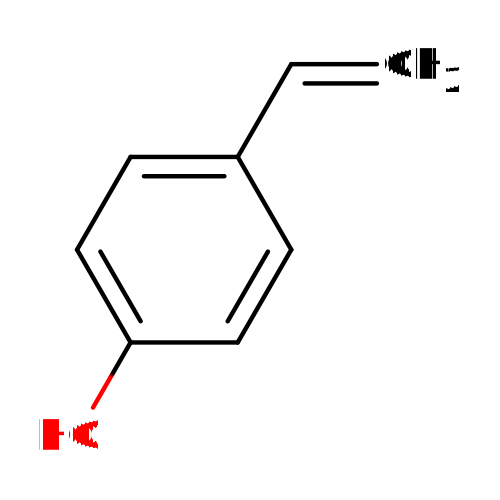
| Common Name | 4-Hydroxystyrene |
|---|
| Description | 4-Hydroxystyrene, also known as 4-vinylphenol, belongs to the class of organic compounds known as styrenes. These are organic compounds containing an ethenylbenzene moiety. 4-Hydroxystyrene is an extremely weak basic (essentially neutral) compound (based on its pKa). 4-Hydroxystyrene exists in all eukaryotes, ranging from yeast to humans. 4-Hydroxystyrene is a sweet, almond shell, and chemical tasting compound. Outside of the human body, 4-Hydroxystyrene is found, on average, in the highest concentration within a few different foods, such as white wines, beers, and corns and in a lower concentration in taco, bilberries, and tortilla. 4-Hydroxystyrene has also been detected, but not quantified in, several different foods, such as asparagus, cauliflowers, evergreen blackberries, tea, and tortilla chips. This could make 4-hydroxystyrene a potential biomarker for the consumption of these foods. Styrene is a prohapten metabolized in the skin by aryl hydrocarbon hydroxylase (AHH, EC1.14.14.1) to styrene epoxide acting as the true hapten. Styrene occurs in nature and as a synthetic product. 4-hydroxystyrene occurs frequently in different ciders, wines, foods and berries, e.g. cloudberry. |
|---|
| Structure | InChI=1S/C8H8O/c1-2-7-3-5-8(9)6-4-7/h2-6,9H,1H2 |
|---|
| Synonyms | | Value | Source |
|---|
| 4-Vinylphenol | ChEBI | | p-Hydroxystyrene | ChEBI | | p-Vinylphenol | ChEBI |
|
|---|
| Chemical Formula | C8H8O |
|---|
| Average Molecular Weight | 120.1485 |
|---|
| Monoisotopic Molecular Weight | 120.057514878 |
|---|
| IUPAC Name | 4-ethenylphenol |
|---|
| Traditional Name | 4-vinylphenol |
|---|
| CAS Registry Number | 2628-17-3 |
|---|
| SMILES | OC1=CC=C(C=C)C=C1 |
|---|
| InChI Identifier | InChI=1S/C8H8O/c1-2-7-3-5-8(9)6-4-7/h2-6,9H,1H2 |
|---|
| InChI Key | FUGYGGDSWSUORM-UHFFFAOYSA-N |
|---|
| Chemical Taxonomy |
|---|
| Description | Belongs to the class of organic compounds known as styrenes. These are organic compounds containing an ethenylbenzene moiety. |
|---|
| Kingdom | Organic compounds |
|---|
| Super Class | Benzenoids |
|---|
| Class | Benzene and substituted derivatives |
|---|
| Sub Class | Styrenes |
|---|
| Direct Parent | Styrenes |
|---|
| Alternative Parents | |
|---|
| Substituents | - Styrene
- 1-hydroxy-2-unsubstituted benzenoid
- Phenol
- Organic oxygen compound
- Hydrocarbon derivative
- Organooxygen compound
- Aromatic homomonocyclic compound
|
|---|
| Molecular Framework | Aromatic homomonocyclic compounds |
|---|
| External Descriptors | |
|---|
| Ontology |
|---|
| Physiological effect | Not Available |
|---|
| Disposition | |
|---|
| Process | Not Available |
|---|
| Role | Not Available |
|---|
| Physical Properties |
|---|
| State | Solid |
|---|
| Experimental Molecular Properties | | Property | Value | Reference |
|---|
| Melting Point | 73.5 °C | Not Available | | Boiling Point | Not Available | Not Available | | Water Solubility | Not Available | Not Available | | LogP | Not Available | Not Available |
|
|---|
| Experimental Chromatographic Properties | Not Available |
|---|
| Predicted Molecular Properties | |
|---|
| Predicted Chromatographic Properties | Predicted Collision Cross SectionsPredicted Retention Times Underivatized| Chromatographic Method | Retention Time | Reference |
|---|
| Measured using a Waters Acquity ultraperformance liquid chromatography (UPLC) ethylene-bridged hybrid (BEH) C18 column (100 mm × 2.1 mm; 1.7 μmparticle diameter). Predicted by Afia on May 17, 2022. Predicted by Afia on May 17, 2022. | 4.41 minutes | 32390414 | | Predicted by Siyang on May 30, 2022 | 12.3121 minutes | 33406817 | | Predicted by Siyang using ReTip algorithm on June 8, 2022 | 4.35 minutes | 32390414 | | AjsUoB = Accucore 150 Amide HILIC with 10mM Ammonium Formate, 0.1% Formic Acid | 44.6 seconds | 40023050 | | Fem_Long = Waters ACQUITY UPLC HSS T3 C18 with Water:MeOH and 0.1% Formic Acid | 1676.2 seconds | 40023050 | | Fem_Lipids = Ascentis Express C18 with (60:40 water:ACN):(90:10 IPA:ACN) and 10mM NH4COOH + 0.1% Formic Acid | 438.8 seconds | 40023050 | | Life_Old = Waters ACQUITY UPLC BEH C18 with Water:(20:80 acetone:ACN) and 0.1% Formic Acid | 174.7 seconds | 40023050 | | Life_New = RP Waters ACQUITY UPLC HSS T3 C18 with Water:(30:70 MeOH:ACN) and 0.1% Formic Acid | 289.7 seconds | 40023050 | | RIKEN = Waters ACQUITY UPLC BEH C18 with Water:ACN and 0.1% Formic Acid | 312.2 seconds | 40023050 | | Eawag_XBridgeC18 = XBridge C18 3.5u 2.1x50 mm with Water:MeOH and 0.1% Formic Acid | 541.1 seconds | 40023050 | | BfG_NTS_RP1 =Agilent Zorbax Eclipse Plus C18 (2.1 mm x 150 mm, 3.5 um) with Water:ACN and 0.1% Formic Acid | 539.0 seconds | 40023050 | | HILIC_BDD_2 = Merck SeQuant ZIC-HILIC with ACN(0.1% formic acid):water(16 mM ammonium formate) | 174.3 seconds | 40023050 | | UniToyama_Atlantis = RP Waters Atlantis T3 (2.1 x 150 mm, 5 um) with ACN:Water and 0.1% Formic Acid | 1077.5 seconds | 40023050 | | BDD_C18 = Hypersil Gold 1.9µm C18 with Water:ACN and 0.1% Formic Acid | 388.2 seconds | 40023050 | | UFZ_Phenomenex = Kinetex Core-Shell C18 2.6 um, 3.0 x 100 mm, Phenomenex with Water:MeOH and 0.1% Formic Acid | 1131.7 seconds | 40023050 | | SNU_RIKEN_POS = Waters ACQUITY UPLC BEH C18 with Water:ACN and 0.1% Formic Acid | 353.8 seconds | 40023050 | | RPMMFDA = Waters ACQUITY UPLC BEH C18 with Water:ACN and 0.1% Formic Acid | 383.0 seconds | 40023050 | | MTBLS87 = Merck SeQuant ZIC-pHILIC column with ACN:Water and :ammonium carbonate | 525.7 seconds | 40023050 | | KI_GIAR_zic_HILIC_pH2_7 = Merck SeQuant ZIC-HILIC with ACN:Water and 0.1% FA | 269.5 seconds | 40023050 | | Meister zic-pHILIC pH9.3 = Merck SeQuant ZIC-pHILIC column with ACN:Water 5mM NH4Ac pH9.3 and 5mM ammonium acetate in water | 99.0 seconds | 40023050 |
Predicted Kovats Retention IndicesUnderivatizedDerivatized |
|---|
| General References | - Manini P, De Palma G, Mozzoni P, Andreoli R, Poli D, Bergamaschi E, Franchini I, Mutti A: GSTM1 polymorphism and styrene metabolism: insights from an acute accidental exposure. Toxicol Lett. 2002 Aug 5;134(1-3):201-8. [PubMed:12191879 ]
- Manini P, Andreoli R, Poli D, De Palma G, Mutti A, Niessen WM: Liquid chromatography/electrospray tandem mass spectrometry characterization of styrene metabolism in man and in rat. Rapid Commun Mass Spectrom. 2002;16(24):2239-48. [PubMed:12478566 ]
- Sjoborg S, Fregert S, Trulsson L: Contact allergy to styrene and related chemicals. Contact Dermatitis. 1984 Feb;10(2):94-6. [PubMed:6713846 ]
|
|---|