| Record Information |
|---|
| Version | 5.0 |
|---|
| Status | Detected but not Quantified |
|---|
| Creation Date | 2012-09-11 17:38:57 UTC |
|---|
| Update Date | 2023-02-21 17:19:41 UTC |
|---|
| HMDB ID | HMDB0030776 |
|---|
| Secondary Accession Numbers | |
|---|
| Metabolite Identification |
|---|
| Common Name | Maltol |
|---|
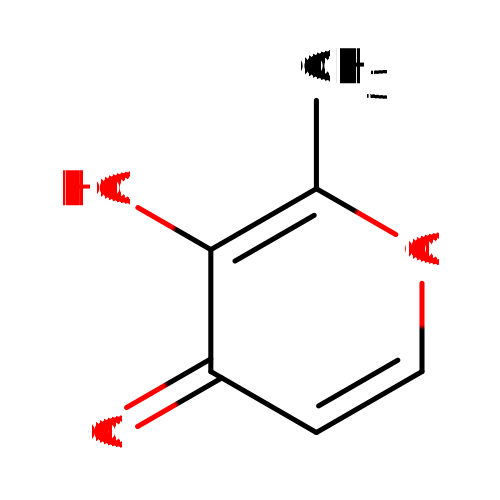
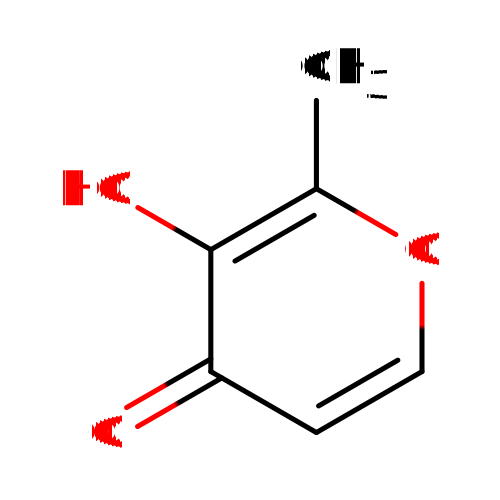
| Description | Maltol, also known as E636 or fema 2656, belongs to the class of organic compounds known as pyranones and derivatives. Pyranones and derivatives are compounds containing a pyran ring which bears a ketone. Some synthetic derivatives of maltol, developed at the University of Urbino, showed limited in vitro antiproliferative activity towards cancer cells lines, perhaps inducing apoptosis in these cells. Maltol is a sweet, baked, and bread tasting compound. Maltol has been detected, but not quantified, in several different foods, such as milk and milk products, nuts, soy beans, pepper (c. annuum), and coffee and coffee products. Maltol's sweetness adds to the odor of freshly baked bread, and is used as a flavor enhancer (INS Number 636) in breads and cakes. Related to this property, maltol has been reported to greatly increase aluminum uptake in the body and to increase the oral bioavailability of gallium and iron. Maltol is a naturally occurring organic compound that is used primarily as a flavor enhancer. It is a white crystalline powder that is soluble in hot water, chloroform, and other polar solvents. Maltol is registered as a flavor component in the EU. Maltol, like related 3-hydroxy-4-pyrones such as kojic acid, binds to hard metal centers such as Fe3+, Ga3+, Al3+, and VO2+. It is known in the European E number food additive series as E636. Because it has the odor of cotton candy and caramel, maltol is used to impart a sweet aroma to fragrances. |
|---|
| Structure | InChI=1S/C6H6O3/c1-4-6(8)5(7)2-3-9-4/h2-3,8H,1H3 |
|---|
| Synonyms | | Value | Source |
|---|
| e636 | ChEMBL, HMDB | | 2-Hydroxy-3-methyl-4H-pyran-4-one | HMDB | | 2-Methyl pyromeconic acid | HMDB | | 2-Methyl-3-hydroxy-4-pyranone | HMDB | | 2-Methyl-3-hydroxy-4-pyrone | HMDB | | 2-Methyl-3-hydroxypyrone | HMDB | | 2-Methyl-3-oxy-gamma-pyrone | HMDB | | 3-Hydroxy-2-methyl-1,4-pyrone | HMDB | | 3-Hydroxy-2-methyl-4-pyranone | HMDB | | 3-Hydroxy-2-methyl-4-pyrone | HMDB, MeSH | | 3-Hydroxy-2-methyl-4H-pyran-4-one | HMDB | | 3-Hydroxy-2-methyl-g-pyrone | HMDB | | 3-Hydroxy-2-methyl-gamma-pyrone | HMDB | | 3-Hydroxy-2-methylpyrone | HMDB | | 3-Hydroxy-2-pyran-4-one | HMDB | | 5-Hydroxy-6-methyl-4H-pyran-4-one | HMDB | | FEMA 2656 | HMDB | | Laricinic acid | HMDB | | Larixic acid | HMDB | | Larixinic acid | HMDB | | Palatone | HMDB | | Talmon | HMDB | | Veltol | HMDB | | Vetol | HMDB |
|
|---|
| Chemical Formula | C6H6O3 |
|---|
| Average Molecular Weight | 126.11 |
|---|
| Monoisotopic Molecular Weight | 126.031694058 |
|---|
| IUPAC Name | 3-hydroxy-2-methyl-4H-pyran-4-one |
|---|
| Traditional Name | talmon |
|---|
| CAS Registry Number | 118-71-8 |
|---|
| SMILES | CC1=C(O)C(=O)C=CO1 |
|---|
| InChI Identifier | InChI=1S/C6H6O3/c1-4-6(8)5(7)2-3-9-4/h2-3,8H,1H3 |
|---|
| InChI Key | XPCTZQVDEJYUGT-UHFFFAOYSA-N |
|---|
| Chemical Taxonomy |
|---|
| Description | Belongs to the class of organic compounds known as pyranones and derivatives. Pyranones and derivatives are compounds containing a pyran ring which bears a ketone. |
|---|
| Kingdom | Organic compounds |
|---|
| Super Class | Organoheterocyclic compounds |
|---|
| Class | Pyrans |
|---|
| Sub Class | Pyranones and derivatives |
|---|
| Direct Parent | Pyranones and derivatives |
|---|
| Alternative Parents | |
|---|
| Substituents | - Pyranone
- Heteroaromatic compound
- Cyclic ketone
- Oxacycle
- Organic oxygen compound
- Organic oxide
- Hydrocarbon derivative
- Organooxygen compound
- Aromatic heteromonocyclic compound
|
|---|
| Molecular Framework | Aromatic heteromonocyclic compounds |
|---|
| External Descriptors | |
|---|
| Ontology |
|---|
| Physiological effect | |
|---|
| Disposition | |
|---|
| Process | Not Available |
|---|
| Role | |
|---|
| Physical Properties |
|---|
| State | Solid |
|---|
| Experimental Molecular Properties | | Property | Value | Reference |
|---|
| Melting Point | 161 - 162 °C | Not Available | | Boiling Point | 284.70 °C. @ 760.00 mm Hg (est) | The Good Scents Company Information System | | Water Solubility | 10.9 mg/mL at 15 °C | Not Available | | LogP | 0.09 | Not Available |
|
|---|
| Experimental Chromatographic Properties | Experimental Collision Cross Sections |
|---|
| Predicted Molecular Properties | |
|---|
| Predicted Chromatographic Properties | Predicted Collision Cross SectionsPredicted Retention Times Underivatized| Chromatographic Method | Retention Time | Reference |
|---|
| Measured using a Waters Acquity ultraperformance liquid chromatography (UPLC) ethylene-bridged hybrid (BEH) C18 column (100 mm × 2.1 mm; 1.7 μmparticle diameter). Predicted by Afia on May 17, 2022. Predicted by Afia on May 17, 2022. | 2.38 minutes | 32390414 | | Predicted by Siyang on May 30, 2022 | 9.0367 minutes | 33406817 | | Predicted by Siyang using ReTip algorithm on June 8, 2022 | 1.42 minutes | 32390414 | | AjsUoB = Accucore 150 Amide HILIC with 10mM Ammonium Formate, 0.1% Formic Acid | 51.9 seconds | 40023050 | | Fem_Long = Waters ACQUITY UPLC HSS T3 C18 with Water:MeOH and 0.1% Formic Acid | 1190.4 seconds | 40023050 | | Fem_Lipids = Ascentis Express C18 with (60:40 water:ACN):(90:10 IPA:ACN) and 10mM NH4COOH + 0.1% Formic Acid | 333.7 seconds | 40023050 | | Life_Old = Waters ACQUITY UPLC BEH C18 with Water:(20:80 acetone:ACN) and 0.1% Formic Acid | 105.7 seconds | 40023050 | | Life_New = RP Waters ACQUITY UPLC HSS T3 C18 with Water:(30:70 MeOH:ACN) and 0.1% Formic Acid | 216.3 seconds | 40023050 | | RIKEN = Waters ACQUITY UPLC BEH C18 with Water:ACN and 0.1% Formic Acid | 65.0 seconds | 40023050 | | Eawag_XBridgeC18 = XBridge C18 3.5u 2.1x50 mm with Water:MeOH and 0.1% Formic Acid | 311.8 seconds | 40023050 | | BfG_NTS_RP1 =Agilent Zorbax Eclipse Plus C18 (2.1 mm x 150 mm, 3.5 um) with Water:ACN and 0.1% Formic Acid | 418.2 seconds | 40023050 | | HILIC_BDD_2 = Merck SeQuant ZIC-HILIC with ACN(0.1% formic acid):water(16 mM ammonium formate) | 141.4 seconds | 40023050 | | UniToyama_Atlantis = RP Waters Atlantis T3 (2.1 x 150 mm, 5 um) with ACN:Water and 0.1% Formic Acid | 669.6 seconds | 40023050 | | BDD_C18 = Hypersil Gold 1.9µm C18 with Water:ACN and 0.1% Formic Acid | 233.0 seconds | 40023050 | | UFZ_Phenomenex = Kinetex Core-Shell C18 2.6 um, 3.0 x 100 mm, Phenomenex with Water:MeOH and 0.1% Formic Acid | 941.8 seconds | 40023050 | | SNU_RIKEN_POS = Waters ACQUITY UPLC BEH C18 with Water:ACN and 0.1% Formic Acid | 253.0 seconds | 40023050 | | RPMMFDA = Waters ACQUITY UPLC BEH C18 with Water:ACN and 0.1% Formic Acid | 291.4 seconds | 40023050 | | MTBLS87 = Merck SeQuant ZIC-pHILIC column with ACN:Water and :ammonium carbonate | 509.7 seconds | 40023050 | | KI_GIAR_zic_HILIC_pH2_7 = Merck SeQuant ZIC-HILIC with ACN:Water and 0.1% FA | 295.9 seconds | 40023050 | | Meister zic-pHILIC pH9.3 = Merck SeQuant ZIC-pHILIC column with ACN:Water 5mM NH4Ac pH9.3 and 5mM ammonium acetate in water | 154.1 seconds | 40023050 |
Predicted Kovats Retention IndicesUnderivatizedDerivatized |
|---|
| Disease References | | Colorectal cancer |
|---|
- Goedert JJ, Sampson JN, Moore SC, Xiao Q, Xiong X, Hayes RB, Ahn J, Shi J, Sinha R: Fecal metabolomics: assay performance and association with colorectal cancer. Carcinogenesis. 2014 Sep;35(9):2089-96. doi: 10.1093/carcin/bgu131. Epub 2014 Jul 18. [PubMed:25037050 ]
|
|
|---|