| Record Information |
|---|
| Version | 5.0 |
|---|
| Status | Detected but not Quantified |
|---|
| Creation Date | 2006-08-12 23:25:38 UTC |
|---|
| Update Date | 2023-02-21 17:16:43 UTC |
|---|
| HMDB ID | HMDB0003543 |
|---|
| Secondary Accession Numbers | |
|---|
| Metabolite Identification |
|---|
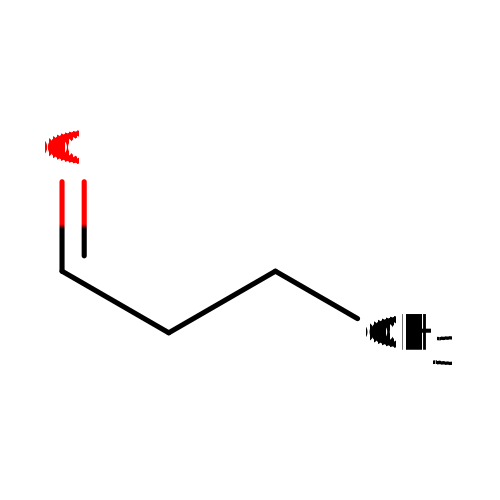
| Common Name | Butanal |
|---|
| Description | Butanal, also known as butyral or butyl aldehyde, belongs to the class of organic compounds known as alpha-hydrogen aldehydes. These are aldehydes with the general formula HC(H)(R)C(=O)H, where R is an organyl group. It is miscible with most organic solvents. Butanal exists in all living organisms, ranging from bacteria to humans. Upon prolonged exposure to air, butyraldehyde oxidizes to form butyric acid. Butanal is an apple, bready, and chocolate tasting compound. Outside of the human body, Butanal is found, on average, in the highest concentration within cow milk and carrots. Butanal has also been detected, but not quantified in several different foods, such as hard wheats, borages, ostrich ferns, skunk currants, and fennels. This could make butanal a potential biomarker for the consumption of these foods. The dominant technology involves the use of rhodium catalysts derived from the water-soluble ligand Tppts. Butyraldehyde is produced almost exclusively by the hydroformylation of propylene:CH3CHCH2 + H2 + CO → CH3CH2CH2CHO. Traditionally, hydroformylation was catalyzed by cobalt carbonyl and later rhodium complexes of triphenylphosphine. At one time, it was produced industrially by the catalytic hydrogenation of crotonaldehyde, which is derived from acetaldehyde. Butyraldehyde can be produced by the catalytic dehydrogenation of n-butanol. This compound is the aldehyde derivative of butane. An aqueous solution of the rhodium catalyst converts the propylene to the aldehyde, which forms a lighter immiscible phase. About 6 billion kilograms are produced annually by hydroformylation. It is a colourless flammable liquid with an unpleasant smell. |
|---|
| Structure | InChI=1S/C4H8O/c1-2-3-4-5/h4H,2-3H2,1H3 |
|---|
| Synonyms | | Value | Source |
|---|
| 1-Butanal | ChEBI | | Aldehyde butyrique | ChEBI | | Aldeide butirrica | ChEBI | | Butal | ChEBI | | Butaldehyde | ChEBI | | Butan-1-al | ChEBI | | Butanaldehyde | ChEBI | | Butyl aldehyde | ChEBI | | Butylaldehyde | ChEBI | | Butyral | ChEBI | | Butyraldehyd | ChEBI | | Butyraldehyde | ChEBI | | Butyric aldehyde | ChEBI | | Butyrylaldehyde | ChEBI | | N-Butanal | ChEBI | | N-Butyl aldehyde | ChEBI | | N-Butyraldehyde | ChEBI | | N-C3H7CHO | ChEBI | | Butalyde | HMDB | | N-Butylaldehyde | HMDB |
|
|---|
| Chemical Formula | C4H8O |
|---|
| Average Molecular Weight | 72.1057 |
|---|
| Monoisotopic Molecular Weight | 72.057514878 |
|---|
| IUPAC Name | butanal |
|---|
| Traditional Name | butoxide |
|---|
| CAS Registry Number | 123-72-8 |
|---|
| SMILES | CCCC=O |
|---|
| InChI Identifier | InChI=1S/C4H8O/c1-2-3-4-5/h4H,2-3H2,1H3 |
|---|
| InChI Key | ZTQSAGDEMFDKMZ-UHFFFAOYSA-N |
|---|
| Chemical Taxonomy |
|---|
| Description | Belongs to the class of organic compounds known as alpha-hydrogen aldehydes. These are aldehydes with the general formula HC(H)(R)C(=O)H, where R is an organyl group. |
|---|
| Kingdom | Organic compounds |
|---|
| Super Class | Organic oxygen compounds |
|---|
| Class | Organooxygen compounds |
|---|
| Sub Class | Carbonyl compounds |
|---|
| Direct Parent | Alpha-hydrogen aldehydes |
|---|
| Alternative Parents | |
|---|
| Substituents | - Alpha-hydrogen aldehyde
- Organic oxide
- Hydrocarbon derivative
- Short-chain aldehyde
- Aliphatic acyclic compound
|
|---|
| Molecular Framework | Aliphatic acyclic compounds |
|---|
| External Descriptors | |
|---|
| Ontology |
|---|
| Physiological effect | Not Available |
|---|
| Disposition | |
|---|
| Process | Not Available |
|---|
| Role | |
|---|
| Physical Properties |
|---|
| State | Liquid |
|---|
| Experimental Molecular Properties | | Property | Value | Reference |
|---|
| Melting Point | -99 °C | Not Available | | Boiling Point | 74.00 to 75.00 °C. @ 760.00 mm Hg | The Good Scents Company Information System | | Water Solubility | 71 mg/mL at 25 °C | Not Available | | LogP | 0.88 | HANSCH,C ET AL. (1995) |
|
|---|
| Experimental Chromatographic Properties | Not Available |
|---|
| Predicted Molecular Properties | |
|---|
| Predicted Chromatographic Properties | Predicted Collision Cross SectionsPredicted Retention Times Underivatized| Chromatographic Method | Retention Time | Reference |
|---|
| Measured using a Waters Acquity ultraperformance liquid chromatography (UPLC) ethylene-bridged hybrid (BEH) C18 column (100 mm × 2.1 mm; 1.7 μmparticle diameter). Predicted by Afia on May 17, 2022. Predicted by Afia on May 17, 2022. | 2.64 minutes | 32390414 | | Predicted by Siyang on May 30, 2022 | 12.5402 minutes | 33406817 | | Predicted by Siyang using ReTip algorithm on June 8, 2022 | 4.25 minutes | 32390414 | | Fem_Long = Waters ACQUITY UPLC HSS T3 C18 with Water:MeOH and 0.1% Formic Acid | 1418.5 seconds | 40023050 | | Fem_Lipids = Ascentis Express C18 with (60:40 water:ACN):(90:10 IPA:ACN) and 10mM NH4COOH + 0.1% Formic Acid | 485.0 seconds | 40023050 | | Life_Old = Waters ACQUITY UPLC BEH C18 with Water:(20:80 acetone:ACN) and 0.1% Formic Acid | 193.7 seconds | 40023050 | | Life_New = RP Waters ACQUITY UPLC HSS T3 C18 with Water:(30:70 MeOH:ACN) and 0.1% Formic Acid | 341.8 seconds | 40023050 | | RIKEN = Waters ACQUITY UPLC BEH C18 with Water:ACN and 0.1% Formic Acid | 209.6 seconds | 40023050 | | Eawag_XBridgeC18 = XBridge C18 3.5u 2.1x50 mm with Water:MeOH and 0.1% Formic Acid | 461.2 seconds | 40023050 | | BfG_NTS_RP1 =Agilent Zorbax Eclipse Plus C18 (2.1 mm x 150 mm, 3.5 um) with Water:ACN and 0.1% Formic Acid | 559.3 seconds | 40023050 | | HILIC_BDD_2 = Merck SeQuant ZIC-HILIC with ACN(0.1% formic acid):water(16 mM ammonium formate) | 253.2 seconds | 40023050 | | UniToyama_Atlantis = RP Waters Atlantis T3 (2.1 x 150 mm, 5 um) with ACN:Water and 0.1% Formic Acid | 961.4 seconds | 40023050 | | BDD_C18 = Hypersil Gold 1.9µm C18 with Water:ACN and 0.1% Formic Acid | 346.8 seconds | 40023050 | | UFZ_Phenomenex = Kinetex Core-Shell C18 2.6 um, 3.0 x 100 mm, Phenomenex with Water:MeOH and 0.1% Formic Acid | 1113.1 seconds | 40023050 | | SNU_RIKEN_POS = Waters ACQUITY UPLC BEH C18 with Water:ACN and 0.1% Formic Acid | 355.8 seconds | 40023050 | | RPMMFDA = Waters ACQUITY UPLC BEH C18 with Water:ACN and 0.1% Formic Acid | 326.0 seconds | 40023050 | | MTBLS87 = Merck SeQuant ZIC-pHILIC column with ACN:Water and :ammonium carbonate | 608.3 seconds | 40023050 | | KI_GIAR_zic_HILIC_pH2_7 = Merck SeQuant ZIC-HILIC with ACN:Water and 0.1% FA | 473.0 seconds | 40023050 | | Meister zic-pHILIC pH9.3 = Merck SeQuant ZIC-pHILIC column with ACN:Water 5mM NH4Ac pH9.3 and 5mM ammonium acetate in water | 117.4 seconds | 40023050 |
Predicted Kovats Retention IndicesUnderivatizedDerivatized| Derivative Name / Structure | SMILES | Kovats RI Value | Column Type | Reference |
|---|
| Butanal,1TMS,isomer #1 | CCC=CO[Si](C)(C)C | 830.3 | Semi standard non polar | 33892256 | | Butanal,1TMS,isomer #1 | CCC=CO[Si](C)(C)C | 786.7 | Standard non polar | 33892256 | | Butanal,1TMS,isomer #1 | CCC=CO[Si](C)(C)C | 915.1 | Standard polar | 33892256 | | Butanal,1TBDMS,isomer #1 | CCC=CO[Si](C)(C)C(C)(C)C | 1053.2 | Semi standard non polar | 33892256 | | Butanal,1TBDMS,isomer #1 | CCC=CO[Si](C)(C)C(C)(C)C | 1028.3 | Standard non polar | 33892256 | | Butanal,1TBDMS,isomer #1 | CCC=CO[Si](C)(C)C(C)(C)C | 1120.5 | Standard polar | 33892256 |
|
|---|
| Spectra |
|---|
| |
|---|
| Biological Properties |
|---|
| Cellular Locations | |
|---|
| Biospecimen Locations | |
|---|
| Tissue Locations | |
|---|
| Pathways | |
|---|
| Normal Concentrations |
|---|
| |
| Feces | Detected but not Quantified | Not Quantified | Adult (>18 years old) | Both | Normal | | details | | Feces | Detected but not Quantified | Not Quantified | Adult (>18 years old) | Both | Normal | | details | | Feces | Detected but not Quantified | Not Quantified | Newborn (0-30 days old) | Both | Normal | | details | | Feces | Detected but not Quantified | Not Quantified | Adult (>18 years old) | Both | Normal | | details | | Feces | Detected but not Quantified | Not Quantified | Adult (>18 years old) | Both | Normal | | details |
|
|---|
| Abnormal Concentrations |
|---|
| |
| Feces | Detected but not Quantified | Not Quantified | Adult (>18 years old) | Both | Campylobacter jejuni infection | | details | | Feces | Detected but not Quantified | Not Quantified | Adult (>18 years old) | Both | Clostridium difficile infection | | details | | Feces | Detected but not Quantified | Not Quantified | Adult (>18 years old) | Both | Ulcerative Colitis | | details | | Feces | Detected but not Quantified | Not Quantified | Adult (>18 years old) | Both | Ulcerative colitis | | details | | Feces | Detected but not Quantified | Not Quantified | Adult (>18 years old) | Both | Crohn's disease | | details |
|
|---|
| Associated Disorders and Diseases |
|---|
| Disease References | | Ulcerative colitis |
|---|
- Garner CE, Smith S, de Lacy Costello B, White P, Spencer R, Probert CS, Ratcliffe NM: Volatile organic compounds from feces and their potential for diagnosis of gastrointestinal disease. FASEB J. 2007 Jun;21(8):1675-88. Epub 2007 Feb 21. [PubMed:17314143 ]
- De Preter V, Machiels K, Joossens M, Arijs I, Matthys C, Vermeire S, Rutgeerts P, Verbeke K: Faecal metabolite profiling identifies medium-chain fatty acids as discriminating compounds in IBD. Gut. 2015 Mar;64(3):447-58. doi: 10.1136/gutjnl-2013-306423. Epub 2014 May 8. [PubMed:24811995 ]
| | Crohn's disease |
|---|
- De Preter V, Machiels K, Joossens M, Arijs I, Matthys C, Vermeire S, Rutgeerts P, Verbeke K: Faecal metabolite profiling identifies medium-chain fatty acids as discriminating compounds in IBD. Gut. 2015 Mar;64(3):447-58. doi: 10.1136/gutjnl-2013-306423. Epub 2014 May 8. [PubMed:24811995 ]
|
|
|---|
| Associated OMIM IDs | |
|---|
| External Links |
|---|
| DrugBank ID | Not Available |
|---|
| Phenol Explorer Compound ID | Not Available |
|---|
| FooDB ID | FDB003378 |
|---|
| KNApSAcK ID | C00050431 |
|---|
| Chemspider ID | 256 |
|---|
| KEGG Compound ID | C01412 |
|---|
| BioCyc ID | BUTANAL |
|---|
| BiGG ID | Not Available |
|---|
| Wikipedia Link | Butanal |
|---|
| METLIN ID | 6947 |
|---|
| PubChem Compound | 261 |
|---|
| PDB ID | Not Available |
|---|
| ChEBI ID | 15743 |
|---|
| Food Biomarker Ontology | Not Available |
|---|
| VMH ID | BTAL |
|---|
| MarkerDB ID | Not Available |
|---|
| Good Scents ID | rw1007681 |
|---|
| References |
|---|
| Synthesis Reference | Weizmann, Charles; Garrard, Stanley Frederick. Some condensations of butyl alcohol and butyraldehyde. Journal of the Chemical Society, Transactions (1920), 117 324-38. |
|---|
| Material Safety Data Sheet (MSDS) | Download (PDF) |
|---|
| General References | - Orhan H, van Holland B, Krab B, Moeken J, Vermeulen NP, Hollander P, Meerman JH: Evaluation of a multi-parameter biomarker set for oxidative damage in man: increased urinary excretion of lipid, protein and DNA oxidation products after one hour of exercise. Free Radic Res. 2004 Dec;38(12):1269-79. [PubMed:15763951 ]
- Holley AE, Walker MK, Cheeseman KH, Slater TF: Measurement of n-alkanals and hydroxyalkenals in biological samples. Free Radic Biol Med. 1993 Sep;15(3):281-9. [PubMed:8406128 ]
|
|---|