Hmdb loader
Record Information
Version5.0
StatusDetected and Quantified
Creation Date2005-11-16 15:48:42 UTC
Update Date2025-05-29 22:15:43 UTC
HMDB IDHMDB0000651
Secondary Accession Numbers
  • HMDB0062631
  • HMDB00651
  • HMDB62631
Metabolite Identification
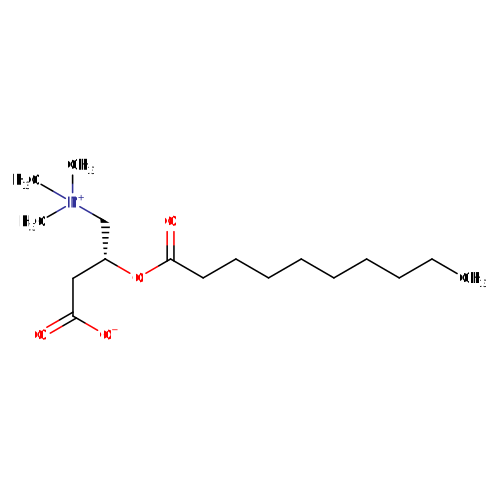
Common NameDecanoylcarnitine
DescriptionDecanoylcarnitine is a member of the class of compounds known as acylcarnitines. More specifically, it is a decanoic acid ester of carnitine. Acylcarnitines were first discovered in the 1940s (PMID: 13825279 ). It is believed that there are more than 1000 types of acylcarnitines in the human body. The general role of acylcarnitines is to transport acyl-groups (organic acids and fatty acids) from the cytoplasm into the mitochondria so that they can be broken down to produce energy. This process is known as beta-oxidation. According to a recent review (PMID: 35710135 ), acylcarnitines (ACs) can be classified into 9 different categories depending on the type and size of their acyl-group: 1) short-chain ACs; 2) medium-chain ACs; 3) long-chain ACs; 4) very long-chain ACs; 5) hydroxy ACs; 6) branched chain ACs; 7) unsaturated ACs; 8) dicarboxylic ACs and 9) miscellaneous ACs. Short-chain ACs have acyl-groups with two to five carbons (C2-C5), medium-chain ACs have acyl-groups with six to thirteen carbons (C6-C13), long-chain ACs have acyl-groups with fourteen to twenty once carbons (C14-C21) and very long-chain ACs have acyl groups with more than 22 carbons. Decanoylcarnitine is therefore classified as a medium chain AC. As a medium-chain acylcarnitine decanoylcarnitine is somewhat less abundant than short-chain acylcarnitines. These are formed either through esterification with L-carnitine or through the peroxisomal metabolism of longer chain acylcarnitines (PMID: 30540494 ). Many medium-chain acylcarnitines can serve as useful markers for inherited disorders of fatty acid metabolism. In particular decanoylcarnitine is elevated in the blood or plasma of individuals with obesity in adolescence (PMID: 26910390 ). It is also decreased in the blood or plasma of individuals with adolescent idiopathic scoliosis (PMID: 26928931 ). Carnitine octanoyltransferase (CrOT, EC:2.3.1.137) is responsible for the synthesis of all medium-chain (MCAC, C5-C12) and medium-length branched-chain acylcarnitines in peroxisomes (PMID: 10486279 ). The study of acylcarnitines is an active area of research and it is likely that many novel acylcarnitines will be discovered in the coming years. It is also likely that many novel roles in health and disease will be uncovered. An excellent review of the current state of knowledge for acylcarnitines is available (PMID: 35710135 ).
Structure
Data?1660697972
Synonyms
ValueSource
L-DecanoylcarnitineChEBI
O-Decanoyl-(R)-carnitineChEBI
O-Decanoyl-R-carnitineChEBI
Decanoyl-L-carnitineHMDB
Chemical FormulaC17H33NO4
Average Molecular Weight315.454
Monoisotopic Molecular Weight315.240958547
IUPAC Name(3R)-3-(decanoyloxy)-4-(trimethylazaniumyl)butanoate
Traditional NameO-decanoyl-L-carnitine
CAS Registry Number1492-27-9
SMILES
CCCCCCCCCC(=O)O[C@H](CC([O-])=O)C[N+](C)(C)C
InChI Identifier
InChI=1S/C17H33NO4/c1-5-6-7-8-9-10-11-12-17(21)22-15(13-16(19)20)14-18(2,3)4/h15H,5-14H2,1-4H3/t15-/m1/s1
InChI KeyLZOSYCMHQXPBFU-OAHLLOKOSA-N
Chemical Taxonomy
Description Belongs to the class of organic compounds known as acyl carnitines. These are organic compounds containing a fatty acid with the carboxylic acid attached to carnitine through an ester bond.
KingdomOrganic compounds
Super ClassLipids and lipid-like molecules
ClassFatty Acyls
Sub ClassFatty acid esters
Direct ParentAcyl carnitines
Alternative Parents
Substituents
  • Acyl-carnitine
  • Dicarboxylic acid or derivatives
  • Tetraalkylammonium salt
  • Quaternary ammonium salt
  • Carboxylic acid ester
  • Carboxylic acid salt
  • Carboxylic acid derivative
  • Carboxylic acid
  • Organic nitrogen compound
  • Organooxygen compound
  • Organonitrogen compound
  • Organic salt
  • Hydrocarbon derivative
  • Organic oxide
  • Organopnictogen compound
  • Organic oxygen compound
  • Carbonyl group
  • Amine
  • Aliphatic acyclic compound
Molecular FrameworkAliphatic acyclic compounds
External Descriptors
Ontology
Physiological effect
Disposition
ProcessNot Available
Role
Physical Properties
StateSolid
Experimental Molecular Properties
PropertyValueReference
Melting PointNot AvailableNot Available
Boiling PointNot AvailableNot Available
Water Solubility350.7 mg/L @ 25 °C (est)The Good Scents Company Information System
LogPNot AvailableNot Available
Experimental Chromatographic PropertiesNot Available
Predicted Molecular Properties
PropertyValueSource
Water Solubility0.00014 g/LALOGPS
logP-0.85ALOGPS
logP-0.63ChemAxon
logS-6.4ALOGPS
pKa (Strongest Acidic)4.22ChemAxon
pKa (Strongest Basic)-7.1ChemAxon
Physiological Charge0ChemAxon
Hydrogen Acceptor Count3ChemAxon
Hydrogen Donor Count0ChemAxon
Polar Surface Area66.43 ŲChemAxon
Rotatable Bond Count14ChemAxon
Refractivity109.47 m³·mol⁻¹ChemAxon
Polarizability37.53 ųChemAxon
Number of Rings0ChemAxon
BioavailabilityYesChemAxon
Rule of FiveYesChemAxon
Ghose FilterNoChemAxon
Veber's RuleNoChemAxon
MDDR-like RuleNoChemAxon
Predicted Chromatographic Properties

Predicted Collision Cross Sections

PredictorAdduct TypeCCS Value (Å2)Reference
AllCCS[M+H]+186.97432859911
AllCCS[M-H]-187.03232859911
DeepCCS[M+H]+194.830932474
DeepCCS[M-H]-190.78130932474
DeepCCS[M-2H]-227.32430932474
DeepCCS[M+Na]+203.61630932474
AllCCS[M+H]+187.032859911
AllCCS[M+H-H2O]+184.432859911
AllCCS[M+NH4]+189.332859911
AllCCS[M+Na]+190.032859911
AllCCS[M-H]-187.032859911
AllCCS[M+Na-2H]-188.132859911
AllCCS[M+HCOO]-189.332859911

Predicted Retention Times

Underivatized

Chromatographic MethodRetention TimeReference
Measured using a Waters Acquity ultraperformance liquid chromatography (UPLC) ethylene-bridged hybrid (BEH) C18 column (100 mm × 2.1 mm; 1.7 μmparticle diameter). Predicted by Afia on May 17, 2022. Predicted by Afia on May 17, 2022.5.8 minutes32390414
Predicted by Siyang on May 30, 202214.2915 minutes33406817
Predicted by Siyang using ReTip algorithm on June 8, 20223.4 minutes32390414
AjsUoB = Accucore 150 Amide HILIC with 10mM Ammonium Formate, 0.1% Formic Acid74.3 seconds40023050
Fem_Long = Waters ACQUITY UPLC HSS T3 C18 with Water:MeOH and 0.1% Formic Acid2013.0 seconds40023050
Fem_Lipids = Ascentis Express C18 with (60:40 water:ACN):(90:10 IPA:ACN) and 10mM NH4COOH + 0.1% Formic Acid205.5 seconds40023050
Life_Old = Waters ACQUITY UPLC BEH C18 with Water:(20:80 acetone:ACN) and 0.1% Formic Acid197.9 seconds40023050
Life_New = RP Waters ACQUITY UPLC HSS T3 C18 with Water:(30:70 MeOH:ACN) and 0.1% Formic Acid169.1 seconds40023050
RIKEN = Waters ACQUITY UPLC BEH C18 with Water:ACN and 0.1% Formic Acid258.8 seconds40023050
Eawag_XBridgeC18 = XBridge C18 3.5u 2.1x50 mm with Water:MeOH and 0.1% Formic Acid609.0 seconds40023050
BfG_NTS_RP1 =Agilent Zorbax Eclipse Plus C18 (2.1 mm x 150 mm, 3.5 um) with Water:ACN and 0.1% Formic Acid573.1 seconds40023050
HILIC_BDD_2 = Merck SeQuant ZIC-HILIC with ACN(0.1% formic acid):water(16 mM ammonium formate)540.3 seconds40023050
UniToyama_Atlantis = RP Waters Atlantis T3 (2.1 x 150 mm, 5 um) with ACN:Water and 0.1% Formic Acid1597.2 seconds40023050
BDD_C18 = Hypersil Gold 1.9µm C18 with Water:ACN and 0.1% Formic Acid428.7 seconds40023050
UFZ_Phenomenex = Kinetex Core-Shell C18 2.6 um, 3.0 x 100 mm, Phenomenex with Water:MeOH and 0.1% Formic Acid1774.6 seconds40023050
SNU_RIKEN_POS = Waters ACQUITY UPLC BEH C18 with Water:ACN and 0.1% Formic Acid313.9 seconds40023050
RPMMFDA = Waters ACQUITY UPLC BEH C18 with Water:ACN and 0.1% Formic Acid394.9 seconds40023050
MTBLS87 = Merck SeQuant ZIC-pHILIC column with ACN:Water and :ammonium carbonate258.0 seconds40023050
KI_GIAR_zic_HILIC_pH2_7 = Merck SeQuant ZIC-HILIC with ACN:Water and 0.1% FA119.6 seconds40023050
Meister zic-pHILIC pH9.3 = Merck SeQuant ZIC-pHILIC column with ACN:Water 5mM NH4Ac pH9.3 and 5mM ammonium acetate in water12.3 seconds40023050

Predicted Kovats Retention Indices

Underivatized

MetaboliteSMILESKovats RI ValueColumn TypeReference
DecanoylcarnitineCCCCCCCCCC(=O)OC(CC([O-])=O)C[N+](C)(C)C2537.8Standard polar33892256
DecanoylcarnitineCCCCCCCCCC(=O)OC(CC([O-])=O)C[N+](C)(C)C1821.2Standard non polar33892256
DecanoylcarnitineCCCCCCCCCC(=O)OC(CC([O-])=O)C[N+](C)(C)C2061.1Semi standard non polar33892256
Spectra
Biological Properties
Cellular Locations
  • Extracellular
  • Membrane
Biospecimen Locations
  • Blood
  • Feces
  • Urine
Tissue Locations
  • Placenta
Pathways
Normal Concentrations
BiospecimenStatusValueAgeSexConditionReferenceDetails
BloodDetected and Quantified0.005 (0.0-0.124) uMChildren (1-13 years old)BothNormal details
BloodDetected and Quantified0.12 ± 0.06 uMAdult (>18 years old)Both
Normal
    • Quantitative comp...
details
BloodDetected and Quantified0.27 ± 0.15 uMAdult (>18 years old)Both
Normal
    • Quantitative comp...
details
BloodDetected and Quantified0.24 ± 0.09 uMAdult (>18 years old)Both
Normal
    • Quantitative comp...
details
BloodDetected and Quantified0.1 ± 0.03 uMAdult (>18 years old)Both
Normal
    • Quantitative comp...
details
BloodDetected and Quantified0.2 ± 0.1 uMAdult (>18 years old)Both
Normal
    • Quantitative comp...
details
BloodDetected and Quantified0.19 ± 0.09 uMAdult (>18 years old)Both
Normal
    • Quantitative comp...
details
BloodDetected and Quantified0.1 ± 0.03 uMAdult (>18 years old)Both
Normal
    • Quantitative comp...
details
BloodDetected and Quantified0.18 ± 0.07 uMAdult (>18 years old)Both
Normal
    • Quantitative comp...
details
BloodDetected and Quantified0.17 ± 0.09 uMAdult (>18 years old)Both
Normal
    • Quantitative comp...
details
BloodDetected but not QuantifiedNot QuantifiedAdult (>18 years old)BothNormal details
BloodDetected and Quantified0.12 (0.11-0.14) uMNewborn (0-30 days old)Not Available
Normal
details
BloodDetected and Quantified<0.3 uMAdolescent (13-18 years old)MaleNormal details
BloodDetected and Quantified0.141 +/- 0.009 uMAdult (>18 years old)BothNormal details
BloodDetected and Quantified0.26 +/- 0.11 uMAdult (>18 years old)BothNormal details
BloodDetected and Quantified0.31 +/- 0.13 uMAdult (>18 years old)BothNormal details
BloodDetected and Quantified0.16-0.55 uMAdult (>18 years old)Both
Normal
details
BloodDetected and Quantified0.23(0.09) uMAdult (>18 years old)BothNormal details
BloodDetected and Quantified0.36 (0.29-0.5) uMInfant (0-1 year old)Not Available
Normal
details
BloodDetected and Quantified0.16-0.55 uMAdult (>18 years old)BothNormal details
FecesDetected but not QuantifiedNot QuantifiedChildren (6 - 18 years old)Not SpecifiedNormal details
FecesDetected and Quantified1.54 +/- 0.78 nmol/g wet fecesAdult (>18 years old)Both
Normal
details
FecesDetected and Quantified0.91 +/- 0.43 nmol/g wet fecesAdult (>18 years old)Both
Normal
details
FecesDetected but not QuantifiedNot QuantifiedAdult (>18 years old)Both
Normal
details
UrineDetected but not QuantifiedNot QuantifiedAdult (>18 years old)BothNormal details
UrineDetected and Quantified0.06(0.04-0.09) umol/mmol creatinineNewborn (0-30 days old)MaleNormal details
UrineDetected and Quantified0.06(0.04-0.14) umol/mmol creatinineNewborn (0-30 days old)FemaleNormal details
UrineDetected and Quantified0.04-0.13 umol/mmol creatinineNewborn (0-30 days old)BothNormal details
UrineDetected and Quantified0.0699 +/- 0.0206 umol/mmol creatinineChildren (1 - 13 years old)Not Specified
Normal
    • Analysis of 30 no...
details
UrineDetected and Quantified0.04 (0.02–0.06) umol/mmol creatinineAdult (>18 years old)Both
Normal
details
Abnormal Concentrations
BiospecimenStatusValueAgeSexConditionReferenceDetails
BloodDetected and Quantified0.103 +/- 0.008 uMAdult (>18 years old)BothCeliac disease details
BloodDetected and Quantified0.005 (0.0-0.012) uMAdult (>18 years old)BothVery long-chain acyl-CoA dehydrogenase deficiency (vLCAD) details
BloodDetected and Quantified0.1267 (0.0743) uMAdult (>18 years old)FemalePregnancy with fetus having congenital heart defect details
BloodDetected and Quantified0.2449 (0.1076) uMAdult (>18 years old)FemalePregnancy details
BloodDetected and Quantified0.31(0.13) uMAdult (>18 years old)BothHeart failure with preserved ejection fraction details
BloodDetected and Quantified0.72 uMAdolescent (13-18 years old)Male
Glutaric aciduria II
details
BloodDetected and Quantified1.09 uMAdolescent (13-18 years old)MaleGlutaric aciduria II details
BloodDetected and Quantified0.230 +/- 0.067 uMChildren (1-13 years old)Both
Obesity
    • Metabolomics reve...
details
BloodDetected and Quantified0.259 +/- 0.113 uMChildren (1-13 years old)Both
Obesity
    • Metabolomics reve...
details
FecesDetected but not QuantifiedNot QuantifiedChildren (6 - 18 years old)Not SpecifiedCrohns disease details
FecesDetected but not QuantifiedNot QuantifiedChildren (6 - 18 years old)Not SpecifiedUlcerative colitis details
FecesDetected but not QuantifiedNot QuantifiedChildren (6 - 18 years old)Not SpecifiedUnclassified IBD details
FecesDetected but not QuantifiedNot QuantifiedAdult (>18 years old)Both
Colorectal cancer
details
UrineDetected and Quantified0.0673 +/- 0.0193 umol/mmol creatinineChildren (1 - 13 years old)Not Specified
Eosinophilic esophagitis
    • Analysis of 30 no...
details
UrineDetected and Quantified0.0821 +/- 0.0263 umol/mmol creatinineChildren (1 - 13 years old)Not Specified
Gastroesophageal reflux disease
    • Analysis of 30 no...
details
Associated Disorders and Diseases
Disease References
Celiac disease
  1. Bene J, Komlosi K, Gasztonyi B, Juhasz M, Tulassay Z, Melegh B: Plasma carnitine ester profile in adult celiac disease patients maintained on long-term gluten free diet. World J Gastroenterol. 2005 Nov 14;11(42):6671-5. [PubMed:16425363 ]
Very Long Chain Acyl-CoA Dehydrogenase Deficiency
  1. Costa CG, Struys EA, Bootsma A, ten Brink HJ, Dorland L, Tavares de Almeida I, Duran M, Jakobs C: Quantitative analysis of plasma acylcarnitines using gas chromatography chemical ionization mass fragmentography. J Lipid Res. 1997 Jan;38(1):173-82. [PubMed:9034211 ]
Pregnancy
  1. Bahado-Singh RO, Ertl R, Mandal R, Bjorndahl TC, Syngelaki A, Han B, Dong E, Liu PB, Alpay-Savasan Z, Wishart DS, Nicolaides KH: Metabolomic prediction of fetal congenital heart defect in the first trimester. Am J Obstet Gynecol. 2014 Sep;211(3):240.e1-240.e14. doi: 10.1016/j.ajog.2014.03.056. Epub 2014 Apr 1. [PubMed:24704061 ]
Glutaric aciduria II
  1. Prasad M, Hussain S: Glutaric aciduria type II presenting as myopathy and rhabdomyolysis in a teenager. J Child Neurol. 2015 Jan;30(1):96-9. doi: 10.1177/0883073813516676. Epub 2014 Jan 21. [PubMed:24453145 ]
Obesity
  1. Simone Wahl, Christina Holzapfel, Zhonghao Yu, Michaela Breier, Ivan Kondofersky, Christiane Fuchs, Paula Singmann, Cornelia Prehn, Jerzy Adamski, Harald Grallert, Thomas Illig, Rui Wang-Sattler, Thomas Reinehr (2013). Metabolomics reveals determinants of weight loss during lifestyle intervention in obese children. Metabolomics.
Crohn's disease
  1. Kolho KL, Pessia A, Jaakkola T, de Vos WM, Velagapudi V: Faecal and Serum Metabolomics in Paediatric Inflammatory Bowel Disease. J Crohns Colitis. 2017 Mar 1;11(3):321-334. doi: 10.1093/ecco-jcc/jjw158. [PubMed:27609529 ]
Ulcerative colitis
  1. Kolho KL, Pessia A, Jaakkola T, de Vos WM, Velagapudi V: Faecal and Serum Metabolomics in Paediatric Inflammatory Bowel Disease. J Crohns Colitis. 2017 Mar 1;11(3):321-334. doi: 10.1093/ecco-jcc/jjw158. [PubMed:27609529 ]
Colorectal cancer
  1. Goedert JJ, Sampson JN, Moore SC, Xiao Q, Xiong X, Hayes RB, Ahn J, Shi J, Sinha R: Fecal metabolomics: assay performance and association with colorectal cancer. Carcinogenesis. 2014 Sep;35(9):2089-96. doi: 10.1093/carcin/bgu131. Epub 2014 Jul 18. [PubMed:25037050 ]
Eosinophilic esophagitis
  1. Slae, M., Huynh, H., Wishart, D.S. (2014). Analysis of 30 normal pediatric urine samples via NMR spectroscopy (unpublished work). NA.
Associated OMIM IDs
DrugBank IDNot Available
Phenol Explorer Compound IDNot Available
FooDB IDFDB022162
KNApSAcK IDC00052256
Chemspider ID10128122
KEGG Compound IDC03299
BioCyc IDNot Available
BiGG IDNot Available
Wikipedia LinkNot Available
METLIN IDNot Available
PubChem Compound11953821
PDB IDNot Available
ChEBI ID28717
Food Biomarker OntologyNot Available
VMH IDC10CRN
MarkerDB IDMDB00000208
Good Scents IDrw1896711
References
Synthesis ReferenceStrack, Erich; Mueller, Detlef M. Preparation of O-acylcarnitines. Hoppe-Seyler's Zeitschrift fuer Physiologische Chemie (1970), 351(1), 95-8.
Material Safety Data Sheet (MSDS)Not Available
General References
  1. Ferdinandusse S, Mulders J, IJlst L, Denis S, Dacremont G, Waterham HR, Wanders RJ: Molecular cloning and expression of human carnitine octanoyltransferase: evidence for its role in the peroxisomal beta-oxidation of branched-chain fatty acids. Biochem Biophys Res Commun. 1999 Sep 16;263(1):213-8. [PubMed:10486279 ]
  2. Guneral F, Bachmann C: Age-related reference values for urinary organic acids in a healthy Turkish pediatric population. Clin Chem. 1994 Jun;40(6):862-6. [PubMed:8087979 ]
  3. Okun JG, Kolker S, Schulze A, Kohlmuller D, Olgemoller K, Lindner M, Hoffmann GF, Wanders RJ, Mayatepek E: A method for quantitative acylcarnitine profiling in human skin fibroblasts using unlabelled palmitic acid: diagnosis of fatty acid oxidation disorders and differentiation between biochemical phenotypes of MCAD deficiency. Biochim Biophys Acta. 2002 Oct 10;1584(2-3):91-8. [PubMed:12385891 ]
  4. Schmidt-Sommerfeld E, Penn D, Duran M, Bennett MJ, Santer R, Stanley CA: Detection of inborn errors of fatty acid oxidation from acylcarnitine analysis of plasma and blood spots with the radioisotopic exchange-high-performance liquid chromatographic method. J Pediatr. 1993 May;122(5 Pt 1):708-14. [PubMed:8496747 ]
  5. Bene J, Komlosi K, Gasztonyi B, Juhasz M, Tulassay Z, Melegh B: Plasma carnitine ester profile in adult celiac disease patients maintained on long-term gluten free diet. World J Gastroenterol. 2005 Nov 14;11(42):6671-5. [PubMed:16425363 ]
  6. Wang C, Feng R, Sun D, Li Y, Bi X, Sun C: Metabolic profiling of urine in young obese men using ultra performance liquid chromatography and Q-TOF mass spectrometry (UPLC/Q-TOF MS). J Chromatogr B Analyt Technol Biomed Life Sci. 2011 Oct 1;879(27):2871-6. doi: 10.1016/j.jchromb.2011.08.014. Epub 2011 Aug 22. [PubMed:21890434 ]
  7. Kolho KL, Pessia A, Jaakkola T, de Vos WM, Velagapudi V: Faecal and Serum Metabolomics in Paediatric Inflammatory Bowel Disease. J Crohns Colitis. 2017 Mar 1;11(3):321-334. doi: 10.1093/ecco-jcc/jjw158. [PubMed:27609529 ]
  8. Bahado-Singh RO, Ertl R, Mandal R, Bjorndahl TC, Syngelaki A, Han B, Dong E, Liu PB, Alpay-Savasan Z, Wishart DS, Nicolaides KH: Metabolomic prediction of fetal congenital heart defect in the first trimester. Am J Obstet Gynecol. 2014 Sep;211(3):240.e1-240.e14. doi: 10.1016/j.ajog.2014.03.056. Epub 2014 Apr 1. [PubMed:24704061 ]
  9. Zordoky BN, Sung MM, Ezekowitz J, Mandal R, Han B, Bjorndahl TC, Bouatra S, Anderson T, Oudit GY, Wishart DS, Dyck JR: Metabolomic fingerprint of heart failure with preserved ejection fraction. PLoS One. 2015 May 26;10(5):e0124844. doi: 10.1371/journal.pone.0124844. eCollection 2015. [PubMed:26010610 ]
  10. Simons K, Toomre D: Lipid rafts and signal transduction. Nat Rev Mol Cell Biol. 2000 Oct;1(1):31-9. [PubMed:11413487 ]
  11. Watson AD: Thematic review series: systems biology approaches to metabolic and cardiovascular disorders. Lipidomics: a global approach to lipid analysis in biological systems. J Lipid Res. 2006 Oct;47(10):2101-11. Epub 2006 Aug 10. [PubMed:16902246 ]
  12. Sethi JK, Vidal-Puig AJ: Thematic review series: adipocyte biology. Adipose tissue function and plasticity orchestrate nutritional adaptation. J Lipid Res. 2007 Jun;48(6):1253-62. Epub 2007 Mar 20. [PubMed:17374880 ]
  13. Lingwood D, Simons K: Lipid rafts as a membrane-organizing principle. Science. 2010 Jan 1;327(5961):46-50. doi: 10.1126/science.1174621. [PubMed:20044567 ]
  14. Xiao JF, Varghese RS, Zhou B, Nezami Ranjbar MR, Zhao Y, Tsai TH, Di Poto C, Wang J, Goerlitz D, Luo Y, Cheema AK, Sarhan N, Soliman H, Tadesse MG, Ziada DH, Ressom HW: LC-MS based serum metabolomics for identification of hepatocellular carcinoma biomarkers in Egyptian cohort. J Proteome Res. 2012 Dec 7;11(12):5914-23. doi: 10.1021/pr300673x. Epub 2012 Nov 1. [PubMed:23078175 ]
  15. Prasad M, Hussain S: Glutaric aciduria type II presenting as myopathy and rhabdomyolysis in a teenager. J Child Neurol. 2015 Jan;30(1):96-9. doi: 10.1177/0883073813516676. Epub 2014 Jan 21. [PubMed:24453145 ]
  16. Cho K, Moon JS, Kang JH, Jang HB, Lee HJ, Park SI, Yu KS, Cho JY: Combined untargeted and targeted metabolomic profiling reveals urinary biomarkers for discriminating obese from normal-weight adolescents. Pediatr Obes. 2017 Apr;12(2):93-101. doi: 10.1111/ijpo.12114. Epub 2016 Feb 22. [PubMed:26910390 ]
  17. Brunk E, Sahoo S, Zielinski DC, Altunkaya A, Drager A, Mih N, Gatto F, Nilsson A, Preciat Gonzalez GA, Aurich MK, Prlic A, Sastry A, Danielsdottir AD, Heinken A, Noronha A, Rose PW, Burley SK, Fleming RMT, Nielsen J, Thiele I, Palsson BO: Recon3D enables a three-dimensional view of gene variation in human metabolism. Nat Biotechnol. 2018 Mar;36(3):272-281. doi: 10.1038/nbt.4072. Epub 2018 Feb 19. [PubMed:29457794 ]
  18. Elshenawy S, Pinney SE, Stuart T, Doulias PT, Zura G, Parry S, Elovitz MA, Bennett MJ, Bansal A, Strauss JF 3rd, Ischiropoulos H, Simmons RA: The Metabolomic Signature of the Placenta in Spontaneous Preterm Birth. Int J Mol Sci. 2020 Feb 4;21(3). pii: ijms21031043. doi: 10.3390/ijms21031043. [PubMed:32033212 ]
  19. FRITZ IB: Action of carnitine on long chain fatty acid oxidation by liver. Am J Physiol. 1959 Aug;197:297-304. doi: 10.1152/ajplegacy.1959.197.2.297. [PubMed:13825279 ]
  20. Violante S, Achetib N, van Roermund CWT, Hagen J, Dodatko T, Vaz FM, Waterham HR, Chen H, Baes M, Yu C, Argmann CA, Houten SM: Peroxisomes can oxidize medium- and long-chain fatty acids through a pathway involving ABCD3 and HSD17B4. FASEB J. 2019 Mar;33(3):4355-4364. doi: 10.1096/fj.201801498R. Epub 2018 Dec 12. [PubMed:30540494 ]
  21. Zhang X, Li Y, Liang Y, Sun P, Wu X, Song J, Sun X, Hong M, Gao P, Deng D: Distinguishing Intracerebral Hemorrhage from Acute Cerebral Infarction through Metabolomics. Rev Invest Clin. 2017 Nov-Dec;69(6):319-328. doi: 10.24875/RIC.17002348. [PubMed:29265114 ]
  22. Sun ZJ, Jia HM, Qiu GX, Zhou C, Guo S, Zhang JG, Shen JX, Zhao Y, Zou ZM: Identification of candidate diagnostic biomarkers for adolescent idiopathic scoliosis using UPLC/QTOF-MS analysis: a first report of lipid metabolism profiles. Sci Rep. 2016 Mar 1;6:22274. doi: 10.1038/srep22274. [PubMed:26928931 ]
  23. Adams SH, Hoppel CL, Lok KH, Zhao L, Wong SW, Minkler PE, Hwang DH, Newman JW, Garvey WT: Plasma acylcarnitine profiles suggest incomplete long-chain fatty acid beta-oxidation and altered tricarboxylic acid cycle activity in type 2 diabetic African-American women. J Nutr. 2009 Jun;139(6):1073-81. doi: 10.3945/jn.108.103754. Epub 2009 Apr 15. [PubMed:19369366 ]
  24. Mihalik SJ, Goodpaster BH, Kelley DE, Chace DH, Vockley J, Toledo FG, DeLany JP: Increased levels of plasma acylcarnitines in obesity and type 2 diabetes and identification of a marker of glucolipotoxicity. Obesity (Silver Spring). 2010 Sep;18(9):1695-700. doi: 10.1038/oby.2009.510. Epub 2010 Jan 28. [PubMed:20111019 ]
  25. Niziol J, Bonifay V, Ossolinski K, Ossolinski T, Ossolinska A, Sunner J, Beech I, Arendowski A, Ruman T: Metabolomic study of human tissue and urine in clear cell renal carcinoma by LC-HRMS and PLS-DA. Anal Bioanal Chem. 2018 Jun;410(16):3859-3869. doi: 10.1007/s00216-018-1059-x. Epub 2018 Apr 16. [PubMed:29658093 ]
  26. Zhao S, Feng XF, Huang T, Luo HH, Chen JX, Zeng J, Gu M, Li J, Sun XY, Sun D, Yang X, Fang ZZ, Cao YF: The Association Between Acylcarnitine Metabolites and Cardiovascular Disease in Chinese Patients With Type 2 Diabetes Mellitus. Front Endocrinol (Lausanne). 2020 May 5;11:212. doi: 10.3389/fendo.2020.00212. eCollection 2020. [PubMed:32431666 ]
  27. Woo HI, Park HD, Lee YW, Lee DH, Ki CS, Lee SY, Kim JW: Clinical, biochemical and genetic analyses in two Korean patients with medium-chain acyl-CoA dehydrogenase deficiency. Korean J Lab Med. 2011 Jan;31(1):54-60. doi: 10.3343/kjlm.2011.31.1.54. [PubMed:21239873 ]
  28. Kim M, Jung S, Lee SH, Lee JH: Association between arterial stiffness and serum L-octanoylcarnitine and lactosylceramide in overweight middle-aged subjects: 3-year follow-up study. PLoS One. 2015 Mar 17;10(3):e0119519. doi: 10.1371/journal.pone.0119519. eCollection 2015. [PubMed:25781947 ]
  29. Saral NY, Aksungar FB, Aktuglu-Zeybek C, Coskun J, Demirelce O, Serteser M: Glutaric acidemia type II patient with thalassemia minor and novel electron transfer flavoprotein-A gene mutations: A case report and review of literature. World J Clin Cases. 2018 Nov 26;6(14):786-790. doi: 10.12998/wjcc.v6.i14.786. [PubMed:30510944 ]
  30. Jung S, Kim OY, Kim M, Song J, Lee SH, Lee JH: Age-related increase in alanine aminotransferase correlates with elevated levels of plasma amino acids, decanoylcarnitine, Lp-PLA2 Activity, oxidative stress, and arterial stiffness. J Proteome Res. 2014 Jul 3;13(7):3467-75. doi: 10.1021/pr500422z. Epub 2014 Jun 12. [PubMed:24874467 ]
  31. Zoni E, Minoli M, Bovet C, Wehrhan A, Piscuoglio S, Ng CKY, Gray PC, Spahn M, Thalmann GN, Kruithof-de Julio M: Preoperative plasma fatty acid metabolites inform risk of prostate cancer progression and may be used for personalized patient stratification. BMC Cancer. 2019 Dec 16;19(1):1216. doi: 10.1186/s12885-019-6418-2. [PubMed:31842810 ]
  32. Yi WJ, Chen J, Li ZB, Jiang TT, Bi DQ, Liu CM, Yang S, Hu YT, Gan L, Tu HH, Huang H, Li JC: Screening of potential biomarkers for Yin-deficiency-heat syndrome based on UHPLC-MS method and the mechanism of Zhibai Dihuang granule therapeutic effect. Anat Rec (Hoboken). 2020 Aug;303(8):2095-2108. doi: 10.1002/ar.24352. Epub 2020 Jan 7. [PubMed:31909891 ]
  33. Seo WK, Jo G, Shin MJ, Oh K: Medium-Chain Acylcarnitines Are Associated With Cardioembolic Stroke and Stroke Recurrence. Arterioscler Thromb Vasc Biol. 2018 Sep;38(9):2245-2253. doi: 10.1161/ATVBAHA.118.311373. [PubMed:30026276 ]
  34. Tan B, Qiu Y, Zou X, Chen T, Xie G, Cheng Y, Dong T, Zhao L, Feng B, Hu X, Xu LX, Zhao A, Zhang M, Cai G, Cai S, Zhou Z, Zheng M, Zhang Y, Jia W: Metabonomics identifies serum metabolite markers of colorectal cancer. J Proteome Res. 2013 Jun 7;12(6):3000-9. doi: 10.1021/pr400337b. Epub 2013 May 29. [PubMed:23675754 ]
  35. Xu J, Chen Y, Zhang R, Song Y, Cao J, Bi N, Wang J, He J, Bai J, Dong L, Wang L, Zhan Q, Abliz Z: Global and targeted metabolomics of esophageal squamous cell carcinoma discovers potential diagnostic and therapeutic biomarkers. Mol Cell Proteomics. 2013 May;12(5):1306-18. doi: 10.1074/mcp.M112.022830. Epub 2013 Feb 8. [PubMed:23397110 ]
  36. Danese C, Cirene M, Colotto M, Aratari A, Amato S, Di Bona S, Curione M: Cardiac involvement in inflammatory bowel disease: role of acylcarnitine esters. Clin Ter. 2011;162(4):e105-9. [PubMed:21912810 ]
  37. Weigel C, Kiener C, Meier N, Schmid P, Rauh M, Rascher W, Knerr I: Carnitine status in early-treated children, adolescents and young adults with phenylketonuria on low phenylalanine diets. Ann Nutr Metab. 2008;53(2):91-5. doi: 10.1159/000165356. Epub 2008 Oct 22. [PubMed:18946205 ]
  38. Dambrova M, Makrecka-Kuka M, Kuka J, Vilskersts R, Nordberg D, Attwood MM, Smesny S, Sen ZD, Guo AC, Oler E, Tian S, Zheng J, Wishart DS, Liepinsh E, Schioth HB: Acylcarnitines: Nomenclature, Biomarkers, Therapeutic Potential, Drug Targets, and Clinical Trials. Pharmacol Rev. 2022 Jul;74(3):506-551. doi: 10.1124/pharmrev.121.000408. [PubMed:35710135 ]
  39. Gunstone, Frank D., John L. Harwood, and Albert J. Dijkstra (2007). The lipid handbook with CD-ROM. CRC Press.