| Record Information |
|---|
| Version | 5.0 |
|---|
| Status | Detected but not Quantified |
|---|
| Creation Date | 2005-11-16 15:48:42 UTC |
|---|
| Update Date | 2023-02-21 17:15:07 UTC |
|---|
| HMDB ID | HMDB0000734 |
|---|
| Secondary Accession Numbers | |
|---|
| Metabolite Identification |
|---|
| Common Name | Indoleacrylic acid |
|---|
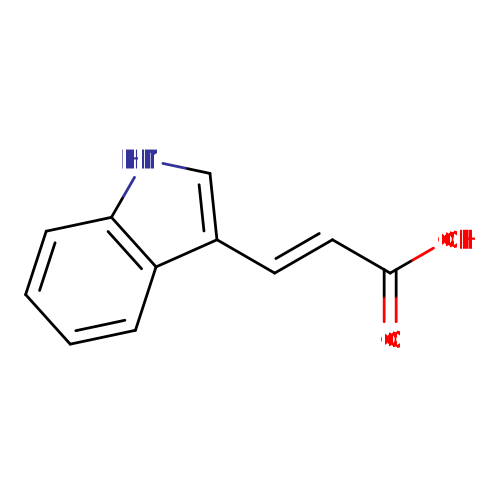
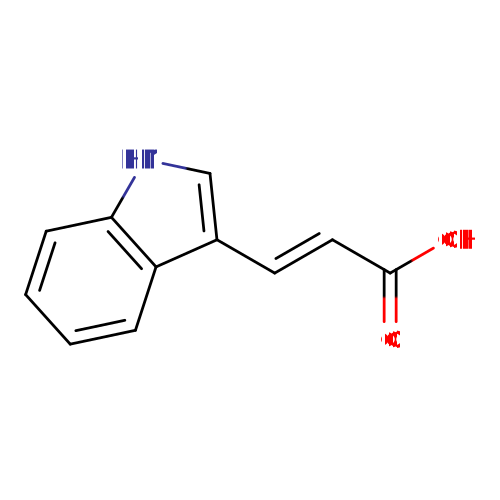
| Description | Indoleacrylic acid (CAS: 1204-06-4), also known as indoleacrylate, IA, and IAcrA, is a member of the class of compounds known as indoles. Indoles are compounds containing an indole moiety, which consists of pyrrole ring fused to benzene to form 2,3-benzopyrrole. Indoleacrylic acid is practically insoluble (in water) and a weak acidic compound (based on its pKa). Within the cell, indoleacrylic acid is primarily located in the membrane (predicted from logP). Indoleacrylic acid is best known as a plant growth hormone (a natural auxin), whereas its biological role in animals is still unknown. A two-stage production of this compound is likely: intestinal microorganisms catabolize tryptophan to indole derivatives which are then absorbed and converted into indoleacrylic acid and its glycine conjugate, indolylacryloylglycine (IAcrGly). Indolylacryloylglycine excretion in urine is especially pronounced in some myopathies, namely in boys with Duchenne muscular dystrophy (PMID: 10707769 ). It has been recently found that indoleacrylic acid promotes intestinal epithelial barrier function and mitigates inflammatory responses. Stimulating indoleacrylic acid production could promote anti-inflammatory responses and have therapeutic benefits (PMID: 28704649 ). Urinary Indole-3-acrylate is produced by Clostridium sporogenes (PMID: 29168502 ). Indoleacrylic acid is also a metabolite of Peptostreptococcus (PMID: 28704649 , 29168502 ). |
|---|
| Structure | OC(=O)\C=C\C1=CNC2=C1C=CC=C2 InChI=1S/C11H9NO2/c13-11(14)6-5-8-7-12-10-4-2-1-3-9(8)10/h1-7,12H,(H,13,14)/b6-5+ |
|---|
| Synonyms | | Value | Source |
|---|
| 3-(3-Indolyl)acrylic acid | ChEBI | | 3-Indoleacrylic acid | ChEBI | | 3-Indolylacrylic acid | ChEBI | | Indole-3-acrylic acid | ChEBI | | Indole-3beta-acrylic acid | ChEBI | | trans-3-Indoleacrylic acid | ChEBI | | trans-beta-Indoleacrylic acid | ChEBI | | 3-(3-Indolyl)acrylate | Generator | | 3-Indoleacrylate | Generator | | 3-Indolylacrylate | Generator | | Indole-3-acrylate | Generator | | Indole-3b-acrylate | Generator | | Indole-3b-acrylic acid | Generator | | Indole-3beta-acrylate | Generator | | Indole-3β-acrylate | Generator | | Indole-3β-acrylic acid | Generator | | trans-3-Indoleacrylate | Generator | | trans-b-Indoleacrylate | Generator | | trans-b-Indoleacrylic acid | Generator | | trans-beta-Indoleacrylate | Generator | | trans-Β-indoleacrylate | Generator | | trans-Β-indoleacrylic acid | Generator | | Indoleacrylate | Generator | | (e)-3-(indol-3-yl)Acrylate | HMDB | | Indoleacrylic acid, (e)-isomer | HMDB | | Indoleacrylic acid, sodium salt | HMDB | | Indole acrylic acid | HMDB | | (2E)-3-(1H-indol-3-yl)-2-Propenoic acid | HMDB | | (e)-3-(1H-indol-3-yl)-2-Propenoic acid | HMDB | | (e)-3-(1H-indol-3-yl)Prop-2-enoic acid | HMDB | | (e)-Indole-3-acrylic acid | HMDB | | 3-(1H-indol-3-yl)-2-Propenoic acid | HMDB | | 3-(1H-indol-3-yl)Acrylic acid | HMDB | | 3-(indol-3-yl)Prop-2-enoic acid | HMDB | | 3-beta-Indoleacrylic acid | HMDB | | 3-Β-indoleacrylic acid | HMDB | | IA | HMDB | | IAcrA | HMDB | | Indoleacrylic acid | ChEBI |
|
|---|
| Chemical Formula | C11H9NO2 |
|---|
| Average Molecular Weight | 187.198 |
|---|
| Monoisotopic Molecular Weight | 187.063328534 |
|---|
| IUPAC Name | (2E)-3-(1H-indol-3-yl)prop-2-enoic acid |
|---|
| Traditional Name | (2E)-3-(1H-indol-3-yl)prop-2-enoic acid |
|---|
| CAS Registry Number | 29953-71-7 |
|---|
| SMILES | OC(=O)\C=C\C1=CNC2=C1C=CC=C2 |
|---|
| InChI Identifier | InChI=1S/C11H9NO2/c13-11(14)6-5-8-7-12-10-4-2-1-3-9(8)10/h1-7,12H,(H,13,14)/b6-5+ |
|---|
| InChI Key | PLVPPLCLBIEYEA-AATRIKPKSA-N |
|---|
| Chemical Taxonomy |
|---|
| Description | Belongs to the class of organic compounds known as indoles. Indoles are compounds containing an indole moiety, which consists of pyrrole ring fused to benzene to form 2,3-benzopyrrole. |
|---|
| Kingdom | Organic compounds |
|---|
| Super Class | Organoheterocyclic compounds |
|---|
| Class | Indoles and derivatives |
|---|
| Sub Class | Indoles |
|---|
| Direct Parent | Indoles |
|---|
| Alternative Parents | |
|---|
| Substituents | - Indole
- Substituted pyrrole
- Benzenoid
- Heteroaromatic compound
- Pyrrole
- Azacycle
- Monocarboxylic acid or derivatives
- Carboxylic acid
- Carboxylic acid derivative
- Organic oxide
- Hydrocarbon derivative
- Carbonyl group
- Organooxygen compound
- Organonitrogen compound
- Organic nitrogen compound
- Organopnictogen compound
- Organic oxygen compound
- Aromatic heteropolycyclic compound
|
|---|
| Molecular Framework | Aromatic heteropolycyclic compounds |
|---|
| External Descriptors | Not Available |
|---|
| Ontology |
|---|
| Physiological effect | Not Available |
|---|
| Disposition | |
|---|
| Process | Not Available |
|---|
| Role | Not Available |
|---|
| Physical Properties |
|---|
| State | Solid |
|---|
| Experimental Molecular Properties | | Property | Value | Reference |
|---|
| Melting Point | 180 - 186 °C | Not Available | | Boiling Point | Not Available | Not Available | | Water Solubility | Not Available | Not Available | | LogP | Not Available | Not Available |
|
|---|
| Experimental Chromatographic Properties | Experimental Collision Cross Sections |
|---|
| Predicted Molecular Properties | |
|---|
| Predicted Chromatographic Properties | Predicted Collision Cross SectionsPredicted Retention Times Underivatized| Chromatographic Method | Retention Time | Reference |
|---|
| Measured using a Waters Acquity ultraperformance liquid chromatography (UPLC) ethylene-bridged hybrid (BEH) C18 column (100 mm × 2.1 mm; 1.7 μmparticle diameter). Predicted by Afia on May 17, 2022. Predicted by Afia on May 17, 2022. | 5.13 minutes | 32390414 | | Predicted by Siyang on May 30, 2022 | 11.2773 minutes | 33406817 | | Predicted by Siyang using ReTip algorithm on June 8, 2022 | 1.87 minutes | 32390414 | | Fem_Long = Waters ACQUITY UPLC HSS T3 C18 with Water:MeOH and 0.1% Formic Acid | 1919.8 seconds | 40023050 | | Fem_Lipids = Ascentis Express C18 with (60:40 water:ACN):(90:10 IPA:ACN) and 10mM NH4COOH + 0.1% Formic Acid | 362.0 seconds | 40023050 | | Life_Old = Waters ACQUITY UPLC BEH C18 with Water:(20:80 acetone:ACN) and 0.1% Formic Acid | 129.3 seconds | 40023050 | | Life_New = RP Waters ACQUITY UPLC HSS T3 C18 with Water:(30:70 MeOH:ACN) and 0.1% Formic Acid | 208.0 seconds | 40023050 | | RIKEN = Waters ACQUITY UPLC BEH C18 with Water:ACN and 0.1% Formic Acid | 302.3 seconds | 40023050 | | Eawag_XBridgeC18 = XBridge C18 3.5u 2.1x50 mm with Water:MeOH and 0.1% Formic Acid | 397.1 seconds | 40023050 | | BfG_NTS_RP1 =Agilent Zorbax Eclipse Plus C18 (2.1 mm x 150 mm, 3.5 um) with Water:ACN and 0.1% Formic Acid | 344.8 seconds | 40023050 | | HILIC_BDD_2 = Merck SeQuant ZIC-HILIC with ACN(0.1% formic acid):water(16 mM ammonium formate) | 122.7 seconds | 40023050 | | UniToyama_Atlantis = RP Waters Atlantis T3 (2.1 x 150 mm, 5 um) with ACN:Water and 0.1% Formic Acid | 1000.4 seconds | 40023050 | | BDD_C18 = Hypersil Gold 1.9µm C18 with Water:ACN and 0.1% Formic Acid | 381.3 seconds | 40023050 | | UFZ_Phenomenex = Kinetex Core-Shell C18 2.6 um, 3.0 x 100 mm, Phenomenex with Water:MeOH and 0.1% Formic Acid | 1161.5 seconds | 40023050 | | SNU_RIKEN_POS = Waters ACQUITY UPLC BEH C18 with Water:ACN and 0.1% Formic Acid | 328.4 seconds | 40023050 | | RPMMFDA = Waters ACQUITY UPLC BEH C18 with Water:ACN and 0.1% Formic Acid | 338.9 seconds | 40023050 | | MTBLS87 = Merck SeQuant ZIC-pHILIC column with ACN:Water and :ammonium carbonate | 401.4 seconds | 40023050 | | KI_GIAR_zic_HILIC_pH2_7 = Merck SeQuant ZIC-HILIC with ACN:Water and 0.1% FA | 310.0 seconds | 40023050 | | Meister zic-pHILIC pH9.3 = Merck SeQuant ZIC-pHILIC column with ACN:Water 5mM NH4Ac pH9.3 and 5mM ammonium acetate in water | 45.4 seconds | 40023050 |
Predicted Kovats Retention IndicesUnderivatizedDerivatized| Derivative Name / Structure | SMILES | Kovats RI Value | Column Type | Reference |
|---|
| Indoleacrylic acid,1TMS,isomer #1 | C[Si](C)(C)OC(=O)/C=C/C1=C[NH]C2=CC=CC=C12 | 2232.4 | Semi standard non polar | 33892256 | | Indoleacrylic acid,1TMS,isomer #2 | C[Si](C)(C)N1C=C(/C=C/C(=O)O)C2=CC=CC=C21 | 2350.6 | Semi standard non polar | 33892256 | | Indoleacrylic acid,2TMS,isomer #1 | C[Si](C)(C)OC(=O)/C=C/C1=CN([Si](C)(C)C)C2=CC=CC=C12 | 2410.3 | Semi standard non polar | 33892256 | | Indoleacrylic acid,2TMS,isomer #1 | C[Si](C)(C)OC(=O)/C=C/C1=CN([Si](C)(C)C)C2=CC=CC=C12 | 2298.3 | Standard non polar | 33892256 | | Indoleacrylic acid,2TMS,isomer #1 | C[Si](C)(C)OC(=O)/C=C/C1=CN([Si](C)(C)C)C2=CC=CC=C12 | 2288.4 | Standard polar | 33892256 | | Indoleacrylic acid,1TBDMS,isomer #1 | CC(C)(C)[Si](C)(C)OC(=O)/C=C/C1=C[NH]C2=CC=CC=C12 | 2506.1 | Semi standard non polar | 33892256 | | Indoleacrylic acid,1TBDMS,isomer #2 | CC(C)(C)[Si](C)(C)N1C=C(/C=C/C(=O)O)C2=CC=CC=C21 | 2599.5 | Semi standard non polar | 33892256 | | Indoleacrylic acid,2TBDMS,isomer #1 | CC(C)(C)[Si](C)(C)OC(=O)/C=C/C1=CN([Si](C)(C)C(C)(C)C)C2=CC=CC=C12 | 2812.7 | Semi standard non polar | 33892256 | | Indoleacrylic acid,2TBDMS,isomer #1 | CC(C)(C)[Si](C)(C)OC(=O)/C=C/C1=CN([Si](C)(C)C(C)(C)C)C2=CC=CC=C12 | 2673.4 | Standard non polar | 33892256 | | Indoleacrylic acid,2TBDMS,isomer #1 | CC(C)(C)[Si](C)(C)OC(=O)/C=C/C1=CN([Si](C)(C)C(C)(C)C)C2=CC=CC=C12 | 2502.5 | Standard polar | 33892256 |
|
|---|
| Spectra |
|---|
| GC-MS Spectra| Spectrum Type | Description | Splash Key | Deposition Date | Source | View |
|---|
| Predicted GC-MS | Predicted GC-MS Spectrum - Indoleacrylic acid GC-MS (Non-derivatized) - 70eV, Positive | Not Available | 2021-10-12 | Wishart Lab | View Spectrum | | Predicted GC-MS | Predicted GC-MS Spectrum - Indoleacrylic acid GC-MS (TMS_1_1) - 70eV, Positive | Not Available | 2021-11-05 | Wishart Lab | View Spectrum | | Predicted GC-MS | Predicted GC-MS Spectrum - Indoleacrylic acid GC-MS (TMS_1_2) - 70eV, Positive | Not Available | 2021-11-05 | Wishart Lab | View Spectrum | | Predicted GC-MS | Predicted GC-MS Spectrum - Indoleacrylic acid GC-MS (TBDMS_1_1) - 70eV, Positive | Not Available | 2021-11-05 | Wishart Lab | View Spectrum | | Predicted GC-MS | Predicted GC-MS Spectrum - Indoleacrylic acid GC-MS (TBDMS_1_2) - 70eV, Positive | Not Available | 2021-11-05 | Wishart Lab | View Spectrum |
MS/MS Spectra| Spectrum Type | Description | Splash Key | Deposition Date | Source | View |
|---|
| Experimental LC-MS/MS | LC-MS/MS Spectrum - Indoleacrylic acid 20V, Positive-QTOF | splash10-00xu-1900000000-b9703e40501d9e8edb5e | 2021-09-20 | HMDB team, MONA | View Spectrum | | Experimental LC-MS/MS | LC-MS/MS Spectrum - Indoleacrylic acid 30V, Positive-QTOF | splash10-014i-1900000000-b61bd7aa8af6bfffb9fa | 2021-09-20 | HMDB team, MONA | View Spectrum | | Experimental LC-MS/MS | LC-MS/MS Spectrum - Indoleacrylic acid 40V, Positive-QTOF | splash10-014i-2900000000-4f6e782714d62002ea7d | 2021-09-20 | HMDB team, MONA | View Spectrum | | Experimental LC-MS/MS | LC-MS/MS Spectrum - Indoleacrylic acid 30V, Positive-QTOF | splash10-014i-3900000000-7d161a840c2433ba3cc5 | 2021-09-20 | HMDB team, MONA | View Spectrum | | Experimental LC-MS/MS | LC-MS/MS Spectrum - Indoleacrylic acid 10V, Positive-QTOF | splash10-00di-1900000000-f0c356eafe61b0cff315 | 2021-09-20 | HMDB team, MONA | View Spectrum | | Experimental LC-MS/MS | LC-MS/MS Spectrum - Indoleacrylic acid 10V, Positive-QTOF | splash10-00di-0900000000-60502017fa96aaf92805 | 2021-09-20 | HMDB team, MONA | View Spectrum | | Experimental LC-MS/MS | LC-MS/MS Spectrum - Indoleacrylic acid 0V, Positive-QTOF | splash10-00dr-0900000000-1a63e095eac9d096de2f | 2021-09-20 | HMDB team, MONA | View Spectrum | | Predicted LC-MS/MS | Predicted LC-MS/MS Spectrum - Indoleacrylic acid 10V, Negative-QTOF | splash10-000f-0900000000-63452d36e3479aca369b | 2021-09-22 | Wishart Lab | View Spectrum | | Predicted LC-MS/MS | Predicted LC-MS/MS Spectrum - Indoleacrylic acid 20V, Negative-QTOF | splash10-0006-0900000000-23c0ffcf30e93321ff26 | 2021-09-22 | Wishart Lab | View Spectrum | | Predicted LC-MS/MS | Predicted LC-MS/MS Spectrum - Indoleacrylic acid 40V, Negative-QTOF | splash10-0006-0900000000-bd668265f9ca314a1b22 | 2021-09-22 | Wishart Lab | View Spectrum | | Predicted LC-MS/MS | Predicted LC-MS/MS Spectrum - Indoleacrylic acid 10V, Positive-QTOF | splash10-0079-0900000000-ea25947744f2eae98bd0 | 2021-09-22 | Wishart Lab | View Spectrum | | Predicted LC-MS/MS | Predicted LC-MS/MS Spectrum - Indoleacrylic acid 20V, Positive-QTOF | splash10-002f-0900000000-1d783e0bac13d081e15b | 2021-09-22 | Wishart Lab | View Spectrum | | Predicted LC-MS/MS | Predicted LC-MS/MS Spectrum - Indoleacrylic acid 40V, Positive-QTOF | splash10-00mo-3900000000-e7f6eb25881f509bdd0b | 2021-09-22 | Wishart Lab | View Spectrum |
IR Spectra| Spectrum Type | Description | Deposition Date | Source | View |
|---|
| Predicted IR Spectrum | IR Ion Spectrum (Predicted IRIS Spectrum, Adduct: [M-H]-) | 2023-02-03 | FELIX lab | View Spectrum | | Predicted IR Spectrum | IR Ion Spectrum (Predicted IRIS Spectrum, Adduct: [M+H]+) | 2023-02-03 | FELIX lab | View Spectrum | | Predicted IR Spectrum | IR Ion Spectrum (Predicted IRIS Spectrum, Adduct: [M+Na]+) | 2023-02-03 | FELIX lab | View Spectrum |
|
|---|
| Biological Properties |
|---|
| Cellular Locations | - Membrane (predicted from logP)
|
|---|
| Biospecimen Locations | |
|---|
| Tissue Locations | Not Available |
|---|
| Pathways | |
|---|
| Normal Concentrations |
|---|
| |
| Blood | Detected but not Quantified | Not Quantified | Adult (>18 years old) | Both | Normal | | details | | Feces | Detected but not Quantified | Not Quantified | Adult (>18 years old) | Both | Normal | | details | | Urine | Detected but not Quantified | Not Quantified | Adult (>18 years old) | Both | Normal | | details |
|
|---|
| Abnormal Concentrations |
|---|
| Not Available |
|---|
| Associated Disorders and Diseases |
|---|
| Disease References | None |
|---|
| Associated OMIM IDs | None |
|---|
| External Links |
|---|
| DrugBank ID | Not Available |
|---|
| Phenol Explorer Compound ID | Not Available |
|---|
| FooDB ID | FDB112378 |
|---|
| KNApSAcK ID | Not Available |
|---|
| Chemspider ID | 4524636 |
|---|
| KEGG Compound ID | Not Available |
|---|
| BioCyc ID | CPD-11578 |
|---|
| BiGG ID | Not Available |
|---|
| Wikipedia Link | Not Available |
|---|
| METLIN ID | Not Available |
|---|
| PubChem Compound | 5375048 |
|---|
| PDB ID | Not Available |
|---|
| ChEBI ID | 132244 |
|---|
| Food Biomarker Ontology | Not Available |
|---|
| VMH ID | Not Available |
|---|
| MarkerDB ID | Not Available |
|---|
| Good Scents ID | Not Available |
|---|
| References |
|---|
| Synthesis Reference | Moffatt, J. S. Preparation of b-3-indolylacrylic acid. Journal of the Chemical Society (1957), 1442-3.; Bauguess, Lyle C.; Berg, Clarence P. The availability of indole derivatives for supplementing diets deficient in tryptophan. Proceedings of the Iowa Academy of Science (1933), 40 110-11. |
|---|
| Material Safety Data Sheet (MSDS) | Download (PDF) |
|---|
| General References | - Marklova E: Where does indolylacrylic acid come from? Amino Acids. 1999;17(4):401-13. [PubMed:10707769 ]
- Wlodarska M, Luo C, Kolde R, d'Hennezel E, Annand JW, Heim CE, Krastel P, Schmitt EK, Omar AS, Creasey EA, Garner AL, Mohammadi S, O'Connell DJ, Abubucker S, Arthur TD, Franzosa EA, Huttenhower C, Murphy LO, Haiser HJ, Vlamakis H, Porter JA, Xavier RJ: Indoleacrylic Acid Produced by Commensal Peptostreptococcus Species Suppresses Inflammation. Cell Host Microbe. 2017 Jul 12;22(1):25-37.e6. doi: 10.1016/j.chom.2017.06.007. [PubMed:28704649 ]
- Dodd D, Spitzer MH, Van Treuren W, Merrill BD, Hryckowian AJ, Higginbottom SK, Le A, Cowan TM, Nolan GP, Fischbach MA, Sonnenburg JL: A gut bacterial pathway metabolizes aromatic amino acids into nine circulating metabolites. Nature. 2017 Nov 30;551(7682):648-652. doi: 10.1038/nature24661. Epub 2017 Nov 22. [PubMed:29168502 ]
|
|---|