| Record Information |
|---|
| Version | 5.0 |
|---|
| Status | Detected and Quantified |
|---|
| Creation Date | 2005-11-16 15:48:42 UTC |
|---|
| Update Date | 2023-02-21 17:15:07 UTC |
|---|
| HMDB ID | HMDB0000738 |
|---|
| Secondary Accession Numbers | |
|---|
| Metabolite Identification |
|---|
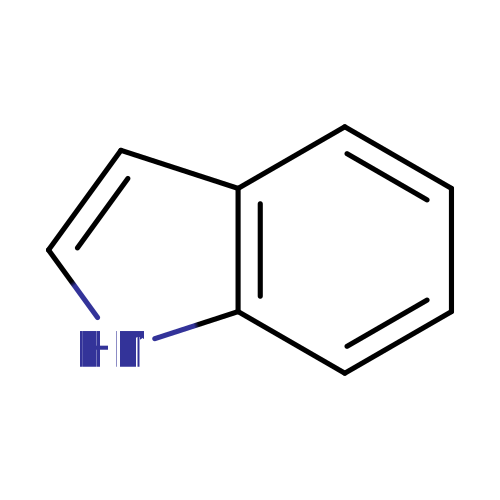
| Common Name | Indole |
|---|
| Description | Indole is an aromatic heterocyclic organic compound. It has a bicyclic structure, consisting of a six-membered benzene ring fused to a five-membered nitrogen-containing pyrrole ring. The participation of the nitrogen lone electron pair in the aromatic ring means that indole is not a base, and it does not behave like a simple amine. Indole is a microbial metabolite and it can be produced by bacteria as a degradation product of the amino acid tryptophan. It occurs naturally in human feces and has an intense fecal smell. At very low concentrations, however, indole has a flowery smell and is a constituent of many flower scents (such as orange blossoms) and perfumes. As a volatile organic compound, indole has been identified as a fecal biomarker of Clostridium difficile infection (PMID: 30986230 ). Natural jasmine oil, used in the perfume industry, contains around 2.5% of indole. Indole also occurs in coal tar. Indole has been found to be produced in a number of bacterial genera including Alcaligenes, Aspergillus, Escherichia, and Pseudomonas (PMID: 23194589 , 2310183 , 9680309 ). Indole plays a role in bacterial biofilm formation, bacterial motility, bacterial virulence, plasmid stability, and antibiotic resistance. It also functions as an intercellular signalling molecule (PMID: 26115989 ). Recently, it was determined that the bacterial membrane-bound histidine sensor kinase (HK) known as CpxA acts as a bacterial indole sensor to facilitate signalling (PMID: 31164470 ). It has been found that decreased indole concentrations in the gut promote bacterial pathogenesis, while increased levels of indole in the gut decrease bacterial virulence gene expression (PMID: 31164470 ). As a result, enteric pathogens sense a gradient of indole concentrations in the gut to migrate to different niches and successfully establish an infection. |
|---|
| Structure | InChI=1S/C8H7N/c1-2-4-8-7(3-1)5-6-9-8/h1-6,9H |
|---|
| Synonyms | | Value | Source |
|---|
| 2,3-Benzopyrrole | ChEBI | | indol | ChEBI | | 1-Azaindene | HMDB | | 1-Benzazole | HMDB | | Benzo[b]pyrrole | HMDB | | Ketole | HMDB | | Indole | HMDB |
|
|---|
| Chemical Formula | C8H7N |
|---|
| Average Molecular Weight | 117.1479 |
|---|
| Monoisotopic Molecular Weight | 117.057849229 |
|---|
| IUPAC Name | 1H-indole |
|---|
| Traditional Name | indole |
|---|
| CAS Registry Number | 120-72-9 |
|---|
| SMILES | N1C=CC2=C1C=CC=C2 |
|---|
| InChI Identifier | InChI=1S/C8H7N/c1-2-4-8-7(3-1)5-6-9-8/h1-6,9H |
|---|
| InChI Key | SIKJAQJRHWYJAI-UHFFFAOYSA-N |
|---|
| Chemical Taxonomy |
|---|
| Description | Belongs to the class of organic compounds known as indoles. Indoles are compounds containing an indole moiety, which consists of pyrrole ring fused to benzene to form 2,3-benzopyrrole. |
|---|
| Kingdom | Organic compounds |
|---|
| Super Class | Organoheterocyclic compounds |
|---|
| Class | Indoles and derivatives |
|---|
| Sub Class | Indoles |
|---|
| Direct Parent | Indoles |
|---|
| Alternative Parents | |
|---|
| Substituents | - Indole
- Benzenoid
- Heteroaromatic compound
- Pyrrole
- Azacycle
- Organic nitrogen compound
- Organopnictogen compound
- Hydrocarbon derivative
- Organonitrogen compound
- Aromatic heteropolycyclic compound
|
|---|
| Molecular Framework | Aromatic heteropolycyclic compounds |
|---|
| External Descriptors | |
|---|
| Ontology |
|---|
| Physiological effect | |
|---|
| Disposition | |
|---|
| Process | |
|---|
| Role | |
|---|
| Physical Properties |
|---|
| State | Solid |
|---|
| Experimental Molecular Properties | | Property | Value | Reference |
|---|
| Melting Point | 52.5 °C | Not Available | | Boiling Point | 253.00 to 254.00 °C. @ 760.00 mm Hg | The Good Scents Company Information System | | Water Solubility | 3.56 mg/mL | Not Available | | LogP | 2.14 | HANSCH,C ET AL. (1995) |
|
|---|
| Experimental Chromatographic Properties | Experimental Collision Cross Sections |
|---|
| Predicted Molecular Properties | |
|---|
| Predicted Chromatographic Properties | Predicted Collision Cross SectionsPredicted Retention Times Underivatized| Chromatographic Method | Retention Time | Reference |
|---|
| Measured using a Waters Acquity ultraperformance liquid chromatography (UPLC) ethylene-bridged hybrid (BEH) C18 column (100 mm × 2.1 mm; 1.7 μmparticle diameter). Predicted by Afia on May 17, 2022. Predicted by Afia on May 17, 2022. | 3.73 minutes | 32390414 | | Predicted by Siyang on May 30, 2022 | 12.5103 minutes | 33406817 | | Predicted by Siyang using ReTip algorithm on June 8, 2022 | 3.52 minutes | 32390414 | | Fem_Long = Waters ACQUITY UPLC HSS T3 C18 with Water:MeOH and 0.1% Formic Acid | 1811.0 seconds | 40023050 | | Fem_Lipids = Ascentis Express C18 with (60:40 water:ACN):(90:10 IPA:ACN) and 10mM NH4COOH + 0.1% Formic Acid | 481.4 seconds | 40023050 | | Life_Old = Waters ACQUITY UPLC BEH C18 with Water:(20:80 acetone:ACN) and 0.1% Formic Acid | 164.0 seconds | 40023050 | | Life_New = RP Waters ACQUITY UPLC HSS T3 C18 with Water:(30:70 MeOH:ACN) and 0.1% Formic Acid | 322.4 seconds | 40023050 | | RIKEN = Waters ACQUITY UPLC BEH C18 with Water:ACN and 0.1% Formic Acid | 310.0 seconds | 40023050 | | Eawag_XBridgeC18 = XBridge C18 3.5u 2.1x50 mm with Water:MeOH and 0.1% Formic Acid | 442.2 seconds | 40023050 | | BfG_NTS_RP1 =Agilent Zorbax Eclipse Plus C18 (2.1 mm x 150 mm, 3.5 um) with Water:ACN and 0.1% Formic Acid | 439.1 seconds | 40023050 | | HILIC_BDD_2 = Merck SeQuant ZIC-HILIC with ACN(0.1% formic acid):water(16 mM ammonium formate) | 277.0 seconds | 40023050 | | UniToyama_Atlantis = RP Waters Atlantis T3 (2.1 x 150 mm, 5 um) with ACN:Water and 0.1% Formic Acid | 983.8 seconds | 40023050 | | BDD_C18 = Hypersil Gold 1.9µm C18 with Water:ACN and 0.1% Formic Acid | 387.2 seconds | 40023050 | | UFZ_Phenomenex = Kinetex Core-Shell C18 2.6 um, 3.0 x 100 mm, Phenomenex with Water:MeOH and 0.1% Formic Acid | 1182.4 seconds | 40023050 | | SNU_RIKEN_POS = Waters ACQUITY UPLC BEH C18 with Water:ACN and 0.1% Formic Acid | 465.9 seconds | 40023050 | | RPMMFDA = Waters ACQUITY UPLC BEH C18 with Water:ACN and 0.1% Formic Acid | 323.1 seconds | 40023050 | | MTBLS87 = Merck SeQuant ZIC-pHILIC column with ACN:Water and :ammonium carbonate | 502.9 seconds | 40023050 | | KI_GIAR_zic_HILIC_pH2_7 = Merck SeQuant ZIC-HILIC with ACN:Water and 0.1% FA | 212.1 seconds | 40023050 | | Meister zic-pHILIC pH9.3 = Merck SeQuant ZIC-pHILIC column with ACN:Water 5mM NH4Ac pH9.3 and 5mM ammonium acetate in water | 62.6 seconds | 40023050 |
Predicted Kovats Retention IndicesUnderivatizedDerivatized| Derivative Name / Structure | SMILES | Kovats RI Value | Column Type | Reference |
|---|
| Indole,1TMS,isomer #1 | C[Si](C)(C)N1C=CC2=CC=CC=C21 | 1424.0 | Semi standard non polar | 33892256 | | Indole,1TMS,isomer #1 | C[Si](C)(C)N1C=CC2=CC=CC=C21 | 1424.2 | Standard non polar | 33892256 | | Indole,1TMS,isomer #1 | C[Si](C)(C)N1C=CC2=CC=CC=C21 | 1720.5 | Standard polar | 33892256 | | Indole,1TBDMS,isomer #1 | CC(C)(C)[Si](C)(C)N1C=CC2=CC=CC=C21 | 1688.3 | Semi standard non polar | 33892256 | | Indole,1TBDMS,isomer #1 | CC(C)(C)[Si](C)(C)N1C=CC2=CC=CC=C21 | 1628.0 | Standard non polar | 33892256 | | Indole,1TBDMS,isomer #1 | CC(C)(C)[Si](C)(C)N1C=CC2=CC=CC=C21 | 1851.5 | Standard polar | 33892256 |
|
|---|
| GC-MS Spectra| Spectrum Type | Description | Splash Key | Deposition Date | Source | View |
|---|
| Experimental GC-MS | GC-MS Spectrum - Indole EI-B (Non-derivatized) | splash10-014i-6900000000-09af4d0af4e5f7259a59 | 2017-09-12 | HMDB team, MONA, MassBank | View Spectrum | | Experimental GC-MS | GC-MS Spectrum - Indole EI-B (Non-derivatized) | splash10-014i-9800000000-4160749bd673d5e00048 | 2017-09-12 | HMDB team, MONA, MassBank | View Spectrum | | Experimental GC-MS | GC-MS Spectrum - Indole EI-B (Non-derivatized) | splash10-014i-9800000000-33bf321019a6a8e3401a | 2017-09-12 | HMDB team, MONA, MassBank | View Spectrum | | Experimental GC-MS | GC-MS Spectrum - Indole EI-B (Non-derivatized) | splash10-014i-6900000000-09af4d0af4e5f7259a59 | 2018-05-18 | HMDB team, MONA, MassBank | View Spectrum | | Experimental GC-MS | GC-MS Spectrum - Indole EI-B (Non-derivatized) | splash10-014i-9800000000-4160749bd673d5e00048 | 2018-05-18 | HMDB team, MONA, MassBank | View Spectrum | | Experimental GC-MS | GC-MS Spectrum - Indole EI-B (Non-derivatized) | splash10-014i-9800000000-33bf321019a6a8e3401a | 2018-05-18 | HMDB team, MONA, MassBank | View Spectrum | | Predicted GC-MS | Predicted GC-MS Spectrum - Indole GC-MS (Non-derivatized) - 70eV, Positive | splash10-014i-7900000000-2a9e4ccc61fee73a480e | 2016-09-22 | Wishart Lab | View Spectrum | | Predicted GC-MS | Predicted GC-MS Spectrum - Indole GC-MS (Non-derivatized) - 70eV, Positive | Not Available | 2021-10-12 | Wishart Lab | View Spectrum | | MS | Mass Spectrum (Electron Ionization) | splash10-014i-9700000000-3b1ec48b5bce79adb282 | 2014-09-20 | Not Available | View Spectrum |
MS/MS Spectra| Spectrum Type | Description | Splash Key | Deposition Date | Source | View |
|---|
| Experimental LC-MS/MS | LC-MS/MS Spectrum - Indole Quattro_QQQ 10V, Positive-QTOF (Annotated) | splash10-014i-0900000000-622dfed80152ea08d52a | 2012-07-24 | HMDB team, MONA | View Spectrum | | Experimental LC-MS/MS | LC-MS/MS Spectrum - Indole Quattro_QQQ 25V, Positive-QTOF (Annotated) | splash10-0006-9100000000-2531cceca05522a5489e | 2012-07-24 | HMDB team, MONA | View Spectrum | | Experimental LC-MS/MS | LC-MS/MS Spectrum - Indole Quattro_QQQ 40V, Positive-QTOF (Annotated) | splash10-014l-9000000000-5e07c15293929ff4440f | 2012-07-24 | HMDB team, MONA | View Spectrum | | Experimental LC-MS/MS | LC-MS/MS Spectrum - Indole EI-B (MX-1303) , Positive-QTOF | splash10-014i-6900000000-09af4d0af4e5f7259a59 | 2012-08-31 | HMDB team, MONA | View Spectrum | | Experimental LC-MS/MS | LC-MS/MS Spectrum - Indole EI-B (Unknown) , Positive-QTOF | splash10-014i-9800000000-4160749bd673d5e00048 | 2012-08-31 | HMDB team, MONA | View Spectrum | | Experimental LC-MS/MS | LC-MS/MS Spectrum - Indole EI-B (HITACHI M-68) , Positive-QTOF | splash10-014i-9800000000-33bf321019a6a8e3401a | 2012-08-31 | HMDB team, MONA | View Spectrum | | Experimental LC-MS/MS | LC-MS/MS Spectrum - Indole LC-ESI-QTOF (UPLC Q-Tof Premier, Waters) , Positive-QTOF | splash10-014i-0900000000-e6b11e225744a0d85f71 | 2012-08-31 | HMDB team, MONA | View Spectrum | | Experimental LC-MS/MS | LC-MS/MS Spectrum - Indole LC-ESI-QTOF , positive-QTOF | splash10-014i-0900000000-e6b11e225744a0d85f71 | 2017-09-14 | HMDB team, MONA | View Spectrum | | Experimental LC-MS/MS | LC-MS/MS Spectrum - Indole ESI-ITFT , positive-QTOF | splash10-014i-0900000000-7b49c1c370d7355c5e6f | 2017-09-14 | HMDB team, MONA | View Spectrum | | Experimental LC-MS/MS | LC-MS/MS Spectrum - Indole ESI-ITFT , positive-QTOF | splash10-0006-9000000000-050ef45f3ec404d7eb65 | 2017-09-14 | HMDB team, MONA | View Spectrum | | Experimental LC-MS/MS | LC-MS/MS Spectrum - Indole ESI-ITFT , positive-QTOF | splash10-0006-9000000000-79ff95be504a5efad264 | 2017-09-14 | HMDB team, MONA | View Spectrum | | Experimental LC-MS/MS | LC-MS/MS Spectrum - Indole ESI-ITFT , positive-QTOF | splash10-0006-9000000000-31ff8b484e0dc207fcc9 | 2017-09-14 | HMDB team, MONA | View Spectrum | | Experimental LC-MS/MS | LC-MS/MS Spectrum - Indole ESI-ITFT , positive-QTOF | splash10-0006-9000000000-864a48552fea562fc370 | 2017-09-14 | HMDB team, MONA | View Spectrum | | Experimental LC-MS/MS | LC-MS/MS Spectrum - Indole ESI-ITFT , positive-QTOF | splash10-014i-0900000000-bd82bfab4567619b5c41 | 2017-09-14 | HMDB team, MONA | View Spectrum | | Experimental LC-MS/MS | LC-MS/MS Spectrum - Indole ESI-ITFT , positive-QTOF | splash10-014i-0900000000-6bff353534e6f5f9105b | 2017-09-14 | HMDB team, MONA | View Spectrum | | Experimental LC-MS/MS | LC-MS/MS Spectrum - Indole ESI-ITFT , positive-QTOF | splash10-014i-0900000000-c4e339d4a1d3fda0a949 | 2017-09-14 | HMDB team, MONA | View Spectrum | | Experimental LC-MS/MS | LC-MS/MS Spectrum - Indole ESI-ITFT , positive-QTOF | splash10-014i-2900000000-100cd0cc67ac9eda3f4e | 2017-09-14 | HMDB team, MONA | View Spectrum | | Experimental LC-MS/MS | LC-MS/MS Spectrum - Indole ESI-ITFT , positive-QTOF | splash10-014l-5900000000-79447b563349d08aacc0 | 2017-09-14 | HMDB team, MONA | View Spectrum | | Experimental LC-MS/MS | LC-MS/MS Spectrum - Indole ESI-ITFT , positive-QTOF | splash10-00kf-9800000000-a1ce5da5416e6d003ff9 | 2017-09-14 | HMDB team, MONA | View Spectrum | | Predicted LC-MS/MS | Predicted LC-MS/MS Spectrum - Indole 10V, Positive-QTOF | splash10-014i-0900000000-aba5022e03d31dcbcc86 | 2016-09-14 | Wishart Lab | View Spectrum | | Predicted LC-MS/MS | Predicted LC-MS/MS Spectrum - Indole 20V, Positive-QTOF | splash10-014i-0900000000-78c0f569df5b7f51c52c | 2016-09-14 | Wishart Lab | View Spectrum | | Predicted LC-MS/MS | Predicted LC-MS/MS Spectrum - Indole 40V, Positive-QTOF | splash10-014i-6900000000-bacb6e9a65a688229f96 | 2016-09-14 | Wishart Lab | View Spectrum | | Predicted LC-MS/MS | Predicted LC-MS/MS Spectrum - Indole 10V, Negative-QTOF | splash10-014i-0900000000-e93b2f48040666dd7fe0 | 2016-09-14 | Wishart Lab | View Spectrum | | Predicted LC-MS/MS | Predicted LC-MS/MS Spectrum - Indole 20V, Negative-QTOF | splash10-014i-0900000000-07d8a93ec0ace38ef3b3 | 2016-09-14 | Wishart Lab | View Spectrum | | Predicted LC-MS/MS | Predicted LC-MS/MS Spectrum - Indole 40V, Negative-QTOF | splash10-014i-6900000000-8abfc9b162cc93f153ac | 2016-09-14 | Wishart Lab | View Spectrum |
NMR Spectra| Spectrum Type | Description | Deposition Date | Source | View |
|---|
| Experimental 1D NMR | 1H NMR Spectrum (1D, 500 MHz, H2O, experimental) | 2012-12-04 | Wishart Lab | View Spectrum | | Experimental 2D NMR | [1H, 13C]-HSQC NMR Spectrum (2D, 600 MHz, H2O, experimental) | 2012-12-05 | Wishart Lab | View Spectrum |
IR Spectra| Spectrum Type | Description | Deposition Date | Source | View |
|---|
| Predicted IR Spectrum | IR Ion Spectrum (Predicted IRIS Spectrum, Adduct: [M-H]-) | 2023-02-03 | FELIX lab | View Spectrum | | Predicted IR Spectrum | IR Ion Spectrum (Predicted IRIS Spectrum, Adduct: [M+H]+) | 2023-02-03 | FELIX lab | View Spectrum | | Predicted IR Spectrum | IR Ion Spectrum (Predicted IRIS Spectrum, Adduct: [M+Na]+) | 2023-02-03 | FELIX lab | View Spectrum |
|
|---|
| Disease References | | Ulcerative colitis |
|---|
- Garner CE, Smith S, de Lacy Costello B, White P, Spencer R, Probert CS, Ratcliffe NM: Volatile organic compounds from feces and their potential for diagnosis of gastrointestinal disease. FASEB J. 2007 Jun;21(8):1675-88. Epub 2007 Feb 21. [PubMed:17314143 ]
- Walton C, Fowler DP, Turner C, Jia W, Whitehead RN, Griffiths L, Dawson C, Waring RH, Ramsden DB, Cole JA, Cauchi M, Bessant C, Hunter JO: Analysis of volatile organic compounds of bacterial origin in chronic gastrointestinal diseases. Inflamm Bowel Dis. 2013 Sep;19(10):2069-78. doi: 10.1097/MIB.0b013e31829a91f6. [PubMed:23867873 ]
- De Preter V, Machiels K, Joossens M, Arijs I, Matthys C, Vermeire S, Rutgeerts P, Verbeke K: Faecal metabolite profiling identifies medium-chain fatty acids as discriminating compounds in IBD. Gut. 2015 Mar;64(3):447-58. doi: 10.1136/gutjnl-2013-306423. Epub 2014 May 8. [PubMed:24811995 ]
- Ahmed I, Greenwood R, Costello B, Ratcliffe N, Probert CS: Investigation of faecal volatile organic metabolites as novel diagnostic biomarkers in inflammatory bowel disease. Aliment Pharmacol Ther. 2016 Mar;43(5):596-611. doi: 10.1111/apt.13522. Epub 2016 Jan 25. [PubMed:26806034 ]
| | Nonalcoholic fatty liver disease |
|---|
- Raman M, Ahmed I, Gillevet PM, Probert CS, Ratcliffe NM, Smith S, Greenwood R, Sikaroodi M, Lam V, Crotty P, Bailey J, Myers RP, Rioux KP: Fecal microbiome and volatile organic compound metabolome in obese humans with nonalcoholic fatty liver disease. Clin Gastroenterol Hepatol. 2013 Jul;11(7):868-75.e1-3. doi: 10.1016/j.cgh.2013.02.015. Epub 2013 Feb 27. [PubMed:23454028 ]
| | Celiac disease |
|---|
- Di Cagno R, De Angelis M, De Pasquale I, Ndagijimana M, Vernocchi P, Ricciuti P, Gagliardi F, Laghi L, Crecchio C, Guerzoni ME, Gobbetti M, Francavilla R: Duodenal and faecal microbiota of celiac children: molecular, phenotype and metabolome characterization. BMC Microbiol. 2011 Oct 4;11:219. doi: 10.1186/1471-2180-11-219. [PubMed:21970810 ]
| | Crohn's disease |
|---|
- Walton C, Fowler DP, Turner C, Jia W, Whitehead RN, Griffiths L, Dawson C, Waring RH, Ramsden DB, Cole JA, Cauchi M, Bessant C, Hunter JO: Analysis of volatile organic compounds of bacterial origin in chronic gastrointestinal diseases. Inflamm Bowel Dis. 2013 Sep;19(10):2069-78. doi: 10.1097/MIB.0b013e31829a91f6. [PubMed:23867873 ]
- De Preter V, Machiels K, Joossens M, Arijs I, Matthys C, Vermeire S, Rutgeerts P, Verbeke K: Faecal metabolite profiling identifies medium-chain fatty acids as discriminating compounds in IBD. Gut. 2015 Mar;64(3):447-58. doi: 10.1136/gutjnl-2013-306423. Epub 2014 May 8. [PubMed:24811995 ]
- Ahmed I, Greenwood R, Costello B, Ratcliffe N, Probert CS: Investigation of faecal volatile organic metabolites as novel diagnostic biomarkers in inflammatory bowel disease. Aliment Pharmacol Ther. 2016 Mar;43(5):596-611. doi: 10.1111/apt.13522. Epub 2016 Jan 25. [PubMed:26806034 ]
| | Irritable bowel syndrome |
|---|
- Walton C, Fowler DP, Turner C, Jia W, Whitehead RN, Griffiths L, Dawson C, Waring RH, Ramsden DB, Cole JA, Cauchi M, Bessant C, Hunter JO: Analysis of volatile organic compounds of bacterial origin in chronic gastrointestinal diseases. Inflamm Bowel Dis. 2013 Sep;19(10):2069-78. doi: 10.1097/MIB.0b013e31829a91f6. [PubMed:23867873 ]
| | Autism |
|---|
- De Angelis M, Piccolo M, Vannini L, Siragusa S, De Giacomo A, Serrazzanetti DI, Cristofori F, Guerzoni ME, Gobbetti M, Francavilla R: Fecal microbiota and metabolome of children with autism and pervasive developmental disorder not otherwise specified. PLoS One. 2013 Oct 9;8(10):e76993. doi: 10.1371/journal.pone.0076993. eCollection 2013. [PubMed:24130822 ]
| | Pervasive developmental disorder not otherwise specified |
|---|
- De Angelis M, Piccolo M, Vannini L, Siragusa S, De Giacomo A, Serrazzanetti DI, Cristofori F, Guerzoni ME, Gobbetti M, Francavilla R: Fecal microbiota and metabolome of children with autism and pervasive developmental disorder not otherwise specified. PLoS One. 2013 Oct 9;8(10):e76993. doi: 10.1371/journal.pone.0076993. eCollection 2013. [PubMed:24130822 ]
| | Clostridium difficile infection |
|---|
- Darkoh C, Plants-Paris K, Bishoff D, DuPont HL: Clostridium difficile Modulates the Gut Microbiota by Inducing the Production of Indole, an Interkingdom Signaling and Antimicrobial Molecule. mSystems. 2019 Mar 19;4(2). pii: mSystems00346-18. doi: 10.1128/mSystems.00346-18. eCollection 2019 Mar-Apr. [PubMed:30944877 ]
- Patel M, Fowler D, Sizer J, Walton C: Faecal volatile biomarkers of Clostridium difficile infection. PLoS One. 2019 Apr 15;14(4):e0215256. doi: 10.1371/journal.pone.0215256. eCollection 2019. [PubMed:30986230 ]
| | Perillyl alcohol administration for cancer treatment |
|---|
- Silva CL, Passos M, Camara JS: Solid phase microextraction, mass spectrometry and metabolomic approaches for detection of potential urinary cancer biomarkers--a powerful strategy for breast cancer diagnosis. Talanta. 2012 Jan 30;89:360-8. doi: 10.1016/j.talanta.2011.12.041. Epub 2011 Dec 22. [PubMed:22284503 ]
|
|
|---|
| General References | - Raw I, Schmidt BJ, Merzel J: Catecholamines and congenital pain insensitivity. Braz J Med Biol Res. 1984;17(3-4):271-9. [PubMed:6085021 ]
- Cooke M, Leeves N, White C: Time profile of putrescine, cadaverine, indole and skatole in human saliva. Arch Oral Biol. 2003 Apr;48(4):323-7. [PubMed:12663078 ]
- Gambhir KK, McMenamy RH, Watson F: Positions in human serum albumin which involve the indole binding site. Sequence of 107-residue fragment. J Biol Chem. 1975 Sep 10;250(17):6711-9. [PubMed:1158878 ]
- Welch DF, Ahlin PA, Matsen JM: Differentiation of Haemophilus spp. in Respiratory isolate cultures by an indole spot test. J Clin Microbiol. 1982 Feb;15(2):216-9. [PubMed:7040445 ]
- Kunka RL, Hussey EK, Shaw S, Warner P, Aubert B, Richard I, Fowler PA, Pakes GE: Safety, tolerability, and pharmacokinetics of sumatriptan suppositories following single and multiple doses in healthy volunteers. Cephalalgia. 1997 Jun;17(4):532-40. [PubMed:9209775 ]
- Scott AK: Sumatriptan clinical pharmacokinetics. Clin Pharmacokinet. 1994 Nov;27(5):337-44. [PubMed:7851052 ]
- Coowar D, Bouissac J, Hanbali M, Paschaki M, Mohier E, Luu B: Effects of indole fatty alcohols on the differentiation of neural stem cell derived neurospheres. J Med Chem. 2004 Dec 2;47(25):6270-82. [PubMed:15566297 ]
- Citron DM, Baron EJ, Finegold SM, Goldstein EJ: Short prereduced anaerobically sterilized (PRAS) biochemical scheme for identification of clinical isolates of bile-resistant Bacteroides species. J Clin Microbiol. 1990 Oct;28(10):2220-3. [PubMed:2229345 ]
- Agatsuma S, Sekino H, Watanabe H: Indoxyl-beta-D-glucuronide and 3-indoxyl sulfate in plasma of hemodialysis patients. Clin Nephrol. 1996 Apr;45(4):250-6. [PubMed:8861801 ]
- Aoyama I, Miyazaki T, Niwa T: Preventive effects of an oral sorbent on nephropathy in rats. Miner Electrolyte Metab. 1999 Jul-Dec;25(4-6):365-72. [PubMed:10681668 ]
- Yoshida M, Mishiro Y: [Indole production in human whole saliva]. Shigaku. 1989 Aug;77(2):472-86. [PubMed:2489307 ]
- Freedman DX, Belendiuk K, Belendiuk GW, Crayton JW: Blood tryptophan metabolism in chronic schizophrenics. Arch Gen Psychiatry. 1981 Jun;38(6):655-9. [PubMed:7247628 ]
- Takken W, van Loon JJ, Adam W: Inhibition of host-seeking response and olfactory responsiveness in Anopheles gambiae following blood feeding. J Insect Physiol. 2001 Mar;47(3):303-310. [PubMed:11119776 ]
- Claus G, Kutzner HJ: Degradation of indole by Alcaligenes spec. Syst Appl Microbiol. 1983;4(2):169-80. doi: 10.1016/S0723-2020(83)80046-0. [PubMed:23194589 ]
- Kamath AV, Vaidyanathan CS: New pathway for the biodegradation of indole in Aspergillus niger. Appl Environ Microbiol. 1990 Jan;56(1):275-80. [PubMed:2310183 ]
- Doukyu N, Aono R: Biodegradation of indole at high concentration by persolvent fermentation with Pseudomonas sp. ST-200. Extremophiles. 1997 May;1(2):100-5. [PubMed:9680309 ]
- Patel M, Fowler D, Sizer J, Walton C: Faecal volatile biomarkers of Clostridium difficile infection. PLoS One. 2019 Apr 15;14(4):e0215256. doi: 10.1371/journal.pone.0215256. eCollection 2019. [PubMed:30986230 ]
- Kim J, Park W: Indole: a signaling molecule or a mere metabolic byproduct that alters bacterial physiology at a high concentration? J Microbiol. 2015 Jul;53(7):421-8. doi: 10.1007/s12275-015-5273-3. Epub 2015 Jun 27. [PubMed:26115989 ]
- Kumar A, Sperandio V: Indole Signaling at the Host-Microbiota-Pathogen Interface. mBio. 2019 Jun 4;10(3). pii: mBio.01031-19. doi: 10.1128/mBio.01031-19. [PubMed:31164470 ]
|
|---|