| Record Information |
|---|
| Version | 5.0 |
|---|
| Status | Detected and Quantified |
|---|
| Creation Date | 2005-11-16 15:48:42 UTC |
|---|
| Update Date | 2023-02-21 17:15:10 UTC |
|---|
| HMDB ID | HMDB0000792 |
|---|
| Secondary Accession Numbers | |
|---|
| Metabolite Identification |
|---|
| Common Name | Sebacic acid |
|---|
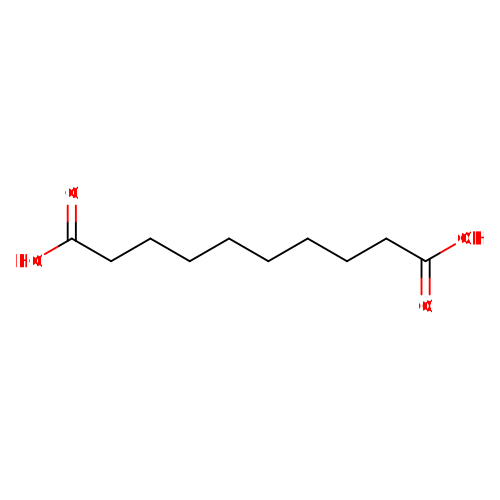
| Description | Sebacic acid is a saturated, straight-chain naturally occurring dicarboxylic acid with 10 carbon atoms. Sebacic acid is a normal urinary acid. In patients with multiple acyl-CoA-dehydrogenase deficiency (MADD), also known as glutaric aciduria type II (GAII), a group of metabolic disorders due to deficiency of either electron transfer flavoprotein or electron transfer flavoprotein ubiquinone oxidoreductase, biochemical data shows an increase in urine sebacic acid excretion. Sebacic acid is found to be associated with carnitine-acylcarnitine translocase deficiency and medium chain acyl-CoA dehydrogenase deficiency, which are inborn errors of metabolism. Sebacic acid is a white flake or powdered crystal slightly soluble in water that has been proposed as an alternative energy substrate in total parenteral nutrition. Sebacic Acid was named from the Latin sebaceus (tallow candle) or sebum (tallow) in reference to its use in the manufacture of candles. Sebacic acid and its derivatives such as azelaic acid have a variety of industrial uses as plasticizers, lubricants, hydraulic fluids, cosmetics, candles, etc. It is used in the synthesis of polyamide and alkyd resins. It is also used as an intermediate for aromatics, antiseptics and painting materials (PMID: 10556649 , 1738216 , 8442769 , 12706375 ). |
|---|
| Structure | InChI=1S/C10H18O4/c11-9(12)7-5-3-1-2-4-6-8-10(13)14/h1-8H2,(H,11,12)(H,13,14) |
|---|
| Synonyms | | Value | Source |
|---|
| 1,10-Decanedioic acid | ChEBI | | 1,8-Dicarboxyoctane | ChEBI | | Decanedioic acid | ChEBI | | Sebacinsaeure | ChEBI | | 1,10-Decanedioate | Generator | | Decanedioate | Generator | | Sebacate | Generator | | 1,8-Octanedicarboxylate | HMDB | | 1,8-Octanedicarboxylic acid | HMDB | | 4,7-Dioxosebacic acid | HMDB | | 4-Oxodecanedioate | HMDB | | 4-Oxodecanedioic acid | HMDB | | Acide sebacique | HMDB | | Decanedicarboxylic acid | HMDB | | Dicarboxylic acid C10 | HMDB | | Ipomic acid | HMDB | | N-Decanedioate | HMDB | | N-Decanedioic acid | HMDB | | Sebacic acids | HMDB | | Sebacinsaure | HMDB | | Seracic acid | HMDB | | Sebacic acid, aluminum salt | HMDB | | Sebacic acid, monocadmium salt | HMDB | | Sebacic acid, sodium salt | HMDB |
|
|---|
| Chemical Formula | C10H18O4 |
|---|
| Average Molecular Weight | 202.2475 |
|---|
| Monoisotopic Molecular Weight | 202.120509064 |
|---|
| IUPAC Name | decanedioic acid |
|---|
| Traditional Name | sebacic acid |
|---|
| CAS Registry Number | 111-20-6 |
|---|
| SMILES | OC(=O)CCCCCCCCC(O)=O |
|---|
| InChI Identifier | InChI=1S/C10H18O4/c11-9(12)7-5-3-1-2-4-6-8-10(13)14/h1-8H2,(H,11,12)(H,13,14) |
|---|
| InChI Key | CXMXRPHRNRROMY-UHFFFAOYSA-N |
|---|
| Chemical Taxonomy |
|---|
| Description | Belongs to the class of organic compounds known as medium-chain fatty acids. These are fatty acids with an aliphatic tail that contains between 4 and 12 carbon atoms. |
|---|
| Kingdom | Organic compounds |
|---|
| Super Class | Lipids and lipid-like molecules |
|---|
| Class | Fatty Acyls |
|---|
| Sub Class | Fatty acids and conjugates |
|---|
| Direct Parent | Medium-chain fatty acids |
|---|
| Alternative Parents | |
|---|
| Substituents | - Medium-chain fatty acid
- Dicarboxylic acid or derivatives
- Carboxylic acid
- Carboxylic acid derivative
- Organic oxygen compound
- Organic oxide
- Hydrocarbon derivative
- Organooxygen compound
- Carbonyl group
- Aliphatic acyclic compound
|
|---|
| Molecular Framework | Aliphatic acyclic compounds |
|---|
| External Descriptors | |
|---|
| Ontology |
|---|
| Physiological effect | Not Available |
|---|
| Disposition | |
|---|
| Process | |
|---|
| Role | |
|---|
| Physical Properties |
|---|
| State | Solid |
|---|
| Experimental Molecular Properties | |
|---|
| Experimental Chromatographic Properties | Experimental Collision Cross Sections |
|---|
| Predicted Molecular Properties | |
|---|
| Predicted Chromatographic Properties | Predicted Collision Cross SectionsPredicted Retention Times Underivatized| Chromatographic Method | Retention Time | Reference |
|---|
| Measured using a Waters Acquity ultraperformance liquid chromatography (UPLC) ethylene-bridged hybrid (BEH) C18 column (100 mm × 2.1 mm; 1.7 μmparticle diameter). Predicted by Afia on May 17, 2022. Predicted by Afia on May 17, 2022. | 5.73 minutes | 32390414 | | Predicted by Siyang on May 30, 2022 | 11.0731 minutes | 33406817 | | Predicted by Siyang using ReTip algorithm on June 8, 2022 | 2.23 minutes | 32390414 | | AjsUoB = Accucore 150 Amide HILIC with 10mM Ammonium Formate, 0.1% Formic Acid | 47.3 seconds | 40023050 | | Fem_Long = Waters ACQUITY UPLC HSS T3 C18 with Water:MeOH and 0.1% Formic Acid | 1826.0 seconds | 40023050 | | Fem_Lipids = Ascentis Express C18 with (60:40 water:ACN):(90:10 IPA:ACN) and 10mM NH4COOH + 0.1% Formic Acid | 288.4 seconds | 40023050 | | Life_Old = Waters ACQUITY UPLC BEH C18 with Water:(20:80 acetone:ACN) and 0.1% Formic Acid | 137.1 seconds | 40023050 | | Life_New = RP Waters ACQUITY UPLC HSS T3 C18 with Water:(30:70 MeOH:ACN) and 0.1% Formic Acid | 182.0 seconds | 40023050 | | RIKEN = Waters ACQUITY UPLC BEH C18 with Water:ACN and 0.1% Formic Acid | 300.8 seconds | 40023050 | | Eawag_XBridgeC18 = XBridge C18 3.5u 2.1x50 mm with Water:MeOH and 0.1% Formic Acid | 395.8 seconds | 40023050 | | BfG_NTS_RP1 =Agilent Zorbax Eclipse Plus C18 (2.1 mm x 150 mm, 3.5 um) with Water:ACN and 0.1% Formic Acid | 446.8 seconds | 40023050 | | HILIC_BDD_2 = Merck SeQuant ZIC-HILIC with ACN(0.1% formic acid):water(16 mM ammonium formate) | 122.9 seconds | 40023050 | | UniToyama_Atlantis = RP Waters Atlantis T3 (2.1 x 150 mm, 5 um) with ACN:Water and 0.1% Formic Acid | 966.8 seconds | 40023050 | | BDD_C18 = Hypersil Gold 1.9µm C18 with Water:ACN and 0.1% Formic Acid | 368.8 seconds | 40023050 | | UFZ_Phenomenex = Kinetex Core-Shell C18 2.6 um, 3.0 x 100 mm, Phenomenex with Water:MeOH and 0.1% Formic Acid | 1136.5 seconds | 40023050 | | SNU_RIKEN_POS = Waters ACQUITY UPLC BEH C18 with Water:ACN and 0.1% Formic Acid | 312.3 seconds | 40023050 | | RPMMFDA = Waters ACQUITY UPLC BEH C18 with Water:ACN and 0.1% Formic Acid | 313.1 seconds | 40023050 | | MTBLS87 = Merck SeQuant ZIC-pHILIC column with ACN:Water and :ammonium carbonate | 437.9 seconds | 40023050 | | KI_GIAR_zic_HILIC_pH2_7 = Merck SeQuant ZIC-HILIC with ACN:Water and 0.1% FA | 240.4 seconds | 40023050 | | Meister zic-pHILIC pH9.3 = Merck SeQuant ZIC-pHILIC column with ACN:Water 5mM NH4Ac pH9.3 and 5mM ammonium acetate in water | 246.5 seconds | 40023050 |
Predicted Kovats Retention IndicesUnderivatizedDerivatized |
|---|
| Disease References | | 3-Hydroxydicarboxylic aciduria |
|---|
- Hagenfeldt L, von Dobeln U, Holme E, Alm J, Brandberg G, Enocksson E, Lindeberg L: 3-Hydroxydicarboxylic aciduria--a fatty acid oxidation defect with severe prognosis. J Pediatr. 1990 Mar;116(3):387-92. [PubMed:2308028 ]
| | Iron deficiency |
|---|
- Lee T, Clavel T, Smirnov K, Schmidt A, Lagkouvardos I, Walker A, Lucio M, Michalke B, Schmitt-Kopplin P, Fedorak R, Haller D: Oral versus intravenous iron replacement therapy distinctly alters the gut microbiota and metabolome in patients with IBD. Gut. 2017 May;66(5):863-871. doi: 10.1136/gutjnl-2015-309940. Epub 2016 Feb 4. [PubMed:26848182 ]
| | Ulcerative colitis |
|---|
- Lee T, Clavel T, Smirnov K, Schmidt A, Lagkouvardos I, Walker A, Lucio M, Michalke B, Schmitt-Kopplin P, Fedorak R, Haller D: Oral versus intravenous iron replacement therapy distinctly alters the gut microbiota and metabolome in patients with IBD. Gut. 2017 May;66(5):863-871. doi: 10.1136/gutjnl-2015-309940. Epub 2016 Feb 4. [PubMed:26848182 ]
- Azario I, Pievani A, Del Priore F, Antolini L, Santi L, Corsi A, Cardinale L, Sawamoto K, Kubaski F, Gentner B, Bernardo ME, Valsecchi MG, Riminucci M, Tomatsu S, Aiuti A, Biondi A, Serafini M: Neonatal umbilical cord blood transplantation halts skeletal disease progression in the murine model of MPS-I. Sci Rep. 2017 Aug 25;7(1):9473. doi: 10.1038/s41598-017-09958-9. [PubMed:28842642 ]
| | Colorectal cancer |
|---|
- Sinha R, Ahn J, Sampson JN, Shi J, Yu G, Xiong X, Hayes RB, Goedert JJ: Fecal Microbiota, Fecal Metabolome, and Colorectal Cancer Interrelations. PLoS One. 2016 Mar 25;11(3):e0152126. doi: 10.1371/journal.pone.0152126. eCollection 2016. [PubMed:27015276 ]
- Brown DG, Rao S, Weir TL, O'Malia J, Bazan M, Brown RJ, Ryan EP: Metabolomics and metabolic pathway networks from human colorectal cancers, adjacent mucosa, and stool. Cancer Metab. 2016 Jun 6;4:11. doi: 10.1186/s40170-016-0151-y. eCollection 2016. [PubMed:27275383 ]
- Goedert JJ, Sampson JN, Moore SC, Xiao Q, Xiong X, Hayes RB, Ahn J, Shi J, Sinha R: Fecal metabolomics: assay performance and association with colorectal cancer. Carcinogenesis. 2014 Sep;35(9):2089-96. doi: 10.1093/carcin/bgu131. Epub 2014 Jul 18. [PubMed:25037050 ]
| | Carnitine-acylcarnitine translocase deficiency |
|---|
- Stanley CA, Hale DE, Berry GT, Deleeuw S, Boxer J, Bonnefont JP: Brief report: a deficiency of carnitine-acylcarnitine translocase in the inner mitochondrial membrane. N Engl J Med. 1992 Jul 2;327(1):19-23. [PubMed:1598097 ]
- Ogier de Baulny H, Slama A, Touati G, Turnbull DM, Pourfarzam M, Brivet M: Neonatal hyperammonemia caused by a defect of carnitine-acylcarnitine translocase. J Pediatr. 1995 Nov;127(5):723-8. [PubMed:7472823 ]
- G.Frauendienst-Egger, Friedrich K. Trefz (2017). MetaGene: Metabolic & Genetic Information Center (MIC: http://www.metagene.de). METAGENE consortium.
| | Eosinophilic esophagitis |
|---|
- Slae, M., Huynh, H., Wishart, D.S. (2014). Analysis of 30 normal pediatric urine samples via NMR spectroscopy (unpublished work). NA.
| | Medium Chain Acyl-CoA Dehydrogenase Deficiency |
|---|
- Tserng KY, Jin SJ, Kerr DS, Hoppel CL: Abnormal urinary excretion of unsaturated dicarboxylic acids in patients with medium-chain acyl-CoA dehydrogenase deficiency. J Lipid Res. 1990 May;31(5):763-71. [PubMed:2380628 ]
- Gregersen N, Kolvraa S, Rasmussen K, Mortensen PB, Divry P, David M, Hobolth N: General (medium-chain) acyl-CoA dehydrogenase deficiency (non-ketotic dicarboxylic aciduria): quantitative urinary excretion pattern of 23 biologically significant organic acids in three cases. Clin Chim Acta. 1983 Aug 15;132(2):181-91. [PubMed:6616873 ]
| | 3-Hydroxy-3-Methylglutaryl-CoA Synthase Deficiency |
|---|
- Conboy E, Vairo F, Schultz M, Agre K, Ridsdale R, Deyle D, Oglesbee D, Gavrilov D, Klee EW, Lanpher B: Mitochondrial 3-Hydroxy-3-Methylglutaryl-CoA Synthase Deficiency: Unique Presenting Laboratory Values and a Review of Biochemical and Clinical Features. JIMD Rep. 2017 Oct 14. doi: 10.1007/8904_2017_59. [PubMed:29030856 ]
|
|
|---|
| General References | - Shoemaker JD, Elliott WH: Automated screening of urine samples for carbohydrates, organic and amino acids after treatment with urease. J Chromatogr. 1991 Jan 2;562(1-2):125-38. [PubMed:2026685 ]
- Jakobs C, Sweetman L, Wadman SK, Duran M, Saudubray JM, Nyhan WL: Prenatal diagnosis of glutaric aciduria type II by direct chemical analysis of dicarboxylic acids in amniotic fluid. Eur J Pediatr. 1984 Jan;141(3):153-7. [PubMed:6698061 ]
- Fleming AB, Saltzman WM: Pharmacokinetics of the carmustine implant. Clin Pharmacokinet. 2002;41(6):403-19. [PubMed:12074689 ]
- Gregersen N, Kolvraa S, Mortensen PB, Rasmussen K: C6-C10-dicarboxylic aciduria: biochemical considerations in relation to diagnosis of beta-oxidation defects. Scand J Clin Lab Invest Suppl. 1982;161:15-27. [PubMed:6959231 ]
- Bertuzzi A, Finotti E, Mingrone G, Greco AV: Sebacic acid binding to human plasma albumin. Biochem Pharmacol. 1993 Feb 9;45(3):697-702. [PubMed:8442769 ]
- Capristo E, Mingrone G, De Gaetano A, Addolorato G, Greco AV, Gasbarrini G: A new HPLC method for the direct analysis of triglycerides of dicarboxylic acids in biological samples. Clin Chim Acta. 1999 Nov;289(1-2):11-21. [PubMed:10556649 ]
- Mingrone G, Tacchino RM, Castagneto M, Finotti E, Greco AV: Use of even-numbered carbon atom dicarboxylic salts in parenteral nutrition as fuel substrate. JPEN J Parenter Enteral Nutr. 1992 Jan-Feb;16(1):32-8. [PubMed:1738216 ]
- Curcoy A, Olsen RK, Ribes A, Trenchs V, Vilaseca MA, Campistol J, Osorio JH, Andresen BS, Gregersen N: Late-onset form of beta-electron transfer flavoprotein deficiency. Mol Genet Metab. 2003 Apr;78(4):247-9. [PubMed:12706375 ]
|
|---|