| Record Information |
|---|
| Version | 5.0 |
|---|
| Status | Detected but not Quantified |
|---|
| Creation Date | 2005-11-16 15:48:42 UTC |
|---|
| Update Date | 2022-03-07 02:49:07 UTC |
|---|
| HMDB ID | HMDB0000933 |
|---|
| Secondary Accession Numbers | |
|---|
| Metabolite Identification |
|---|
| Common Name | Traumatic acid |
|---|
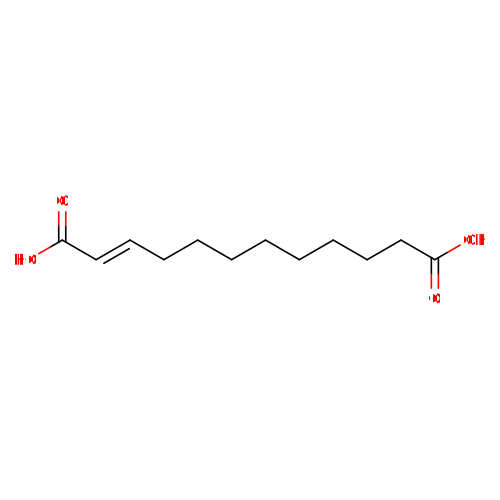
| Description | Traumatic acid is a monounsaturated dicarboxylic acid naturally ocurring in plants. The compound was first isolated from wounded bean plants by American chemists James English Jr. and James Frederick Bonner and Dutch scientist Aire Jan Haagen-Smit in 1939. Traumatic acid is a potent wound healing agent in plants ("wound hormone") that stimulates cell division near a trauma site to form a protective callus and to heal the damaged tissue. It may also act as a growth hormone, especially in inferior plants (e.g. algae). Traumatic acid is biosynthesized in plants by non-enzimatic oxidation of traumatin (12-oxo-trans-10-dodecanoic acid), another wound hormone. At normal conditions, traumatic acid is a solid, crystalized, water insoluble substance. |
|---|
| Structure | OC(=O)CCCCCCCC\C=C\C(O)=O InChI=1S/C12H20O4/c13-11(14)9-7-5-3-1-2-4-6-8-10-12(15)16/h7,9H,1-6,8,10H2,(H,13,14)(H,15,16)/b9-7+ |
|---|
| Synonyms | | Value | Source |
|---|
| (2E)-Dodecenedioic acid | ChEBI | | 2E-Dodecenedioic acid | ChEBI | | Dodec-2-enedioic acid | ChEBI | | trans-2-Dodecenedioic acid | ChEBI | | (2E)-Dodecenedioate | Generator | | 2E-Dodecenedioate | Generator | | Dodec-2-enedioate | Generator | | trans-2-Dodecenedioate | Generator | | Traumatate | Generator | | (Z)-2-Dodecenedioate | HMDB | | (Z)-2-Dodecenedioic acid | HMDB | | 1-Decene-1,10-dicarboxylic acid | HMDB | | 2-Dodecendioate | HMDB | | 2-Dodecendioic acid | HMDB | | 2-Dodecenedioate | HMDB | | 2-Dodecenedioic acid | HMDB | | Dodec-2C-enedioate | HMDB | | Dodec-2C-enedioic acid | HMDB | | Dodec-2t-enedioate | HMDB | | Dodec-2t-enedioic acid | HMDB | | Dodecanedioate | HMDB | | Dodecanedioic acid | HMDB | | Dodecanedioic acid-2-ene | HMDB | | trans-Traumatate | HMDB | | trans-Traumatic acid | HMDB | | 2-Dodecene-1,12-dicarboxylic acid | HMDB |
|
|---|
| Chemical Formula | C12H20O4 |
|---|
| Average Molecular Weight | 228.2848 |
|---|
| Monoisotopic Molecular Weight | 228.136159128 |
|---|
| IUPAC Name | (2E)-dodec-2-enedioic acid |
|---|
| Traditional Name | traumatic acid |
|---|
| CAS Registry Number | 6402-36-4 |
|---|
| SMILES | OC(=O)CCCCCCCC\C=C\C(O)=O |
|---|
| InChI Identifier | InChI=1S/C12H20O4/c13-11(14)9-7-5-3-1-2-4-6-8-10-12(15)16/h7,9H,1-6,8,10H2,(H,13,14)(H,15,16)/b9-7+ |
|---|
| InChI Key | MAZWDMBCPDUFDJ-VQHVLOKHSA-N |
|---|
| Chemical Taxonomy |
|---|
| Description | Belongs to the class of organic compounds known as medium-chain fatty acids. These are fatty acids with an aliphatic tail that contains between 4 and 12 carbon atoms. |
|---|
| Kingdom | Organic compounds |
|---|
| Super Class | Lipids and lipid-like molecules |
|---|
| Class | Fatty Acyls |
|---|
| Sub Class | Fatty acids and conjugates |
|---|
| Direct Parent | Medium-chain fatty acids |
|---|
| Alternative Parents | |
|---|
| Substituents | - Medium-chain fatty acid
- Unsaturated fatty acid
- Dicarboxylic acid or derivatives
- Carboxylic acid
- Carboxylic acid derivative
- Organic oxygen compound
- Organic oxide
- Hydrocarbon derivative
- Organooxygen compound
- Carbonyl group
- Aliphatic acyclic compound
|
|---|
| Molecular Framework | Aliphatic acyclic compounds |
|---|
| External Descriptors | |
|---|
| Ontology |
|---|
| Not Available | Not Available |
|---|
| Physical Properties |
|---|
| State | Solid |
|---|
| Experimental Molecular Properties | |
|---|
| Experimental Chromatographic Properties | Experimental Collision Cross Sections |
|---|
| Predicted Molecular Properties | |
|---|
| Predicted Chromatographic Properties | Predicted Collision Cross SectionsPredicted Retention Times Underivatized| Chromatographic Method | Retention Time | Reference |
|---|
| Measured using a Waters Acquity ultraperformance liquid chromatography (UPLC) ethylene-bridged hybrid (BEH) C18 column (100 mm × 2.1 mm; 1.7 μmparticle diameter). Predicted by Afia on May 17, 2022. Predicted by Afia on May 17, 2022. | 7.39 minutes | 32390414 | | Predicted by Siyang on May 30, 2022 | 13.772 minutes | 33406817 | | Predicted by Siyang using ReTip algorithm on June 8, 2022 | 1.59 minutes | 32390414 | | AjsUoB = Accucore 150 Amide HILIC with 10mM Ammonium Formate, 0.1% Formic Acid | 33.4 seconds | 40023050 | | Fem_Long = Waters ACQUITY UPLC HSS T3 C18 with Water:MeOH and 0.1% Formic Acid | 2214.4 seconds | 40023050 | | Fem_Lipids = Ascentis Express C18 with (60:40 water:ACN):(90:10 IPA:ACN) and 10mM NH4COOH + 0.1% Formic Acid | 333.8 seconds | 40023050 | | Life_Old = Waters ACQUITY UPLC BEH C18 with Water:(20:80 acetone:ACN) and 0.1% Formic Acid | 148.9 seconds | 40023050 | | Life_New = RP Waters ACQUITY UPLC HSS T3 C18 with Water:(30:70 MeOH:ACN) and 0.1% Formic Acid | 198.0 seconds | 40023050 | | RIKEN = Waters ACQUITY UPLC BEH C18 with Water:ACN and 0.1% Formic Acid | 382.8 seconds | 40023050 | | Eawag_XBridgeC18 = XBridge C18 3.5u 2.1x50 mm with Water:MeOH and 0.1% Formic Acid | 530.8 seconds | 40023050 | | BfG_NTS_RP1 =Agilent Zorbax Eclipse Plus C18 (2.1 mm x 150 mm, 3.5 um) with Water:ACN and 0.1% Formic Acid | 536.5 seconds | 40023050 | | HILIC_BDD_2 = Merck SeQuant ZIC-HILIC with ACN(0.1% formic acid):water(16 mM ammonium formate) | 116.8 seconds | 40023050 | | UniToyama_Atlantis = RP Waters Atlantis T3 (2.1 x 150 mm, 5 um) with ACN:Water and 0.1% Formic Acid | 1262.3 seconds | 40023050 | | BDD_C18 = Hypersil Gold 1.9µm C18 with Water:ACN and 0.1% Formic Acid | 443.3 seconds | 40023050 | | UFZ_Phenomenex = Kinetex Core-Shell C18 2.6 um, 3.0 x 100 mm, Phenomenex with Water:MeOH and 0.1% Formic Acid | 1320.3 seconds | 40023050 | | SNU_RIKEN_POS = Waters ACQUITY UPLC BEH C18 with Water:ACN and 0.1% Formic Acid | 425.5 seconds | 40023050 | | RPMMFDA = Waters ACQUITY UPLC BEH C18 with Water:ACN and 0.1% Formic Acid | 371.0 seconds | 40023050 | | MTBLS87 = Merck SeQuant ZIC-pHILIC column with ACN:Water and :ammonium carbonate | 452.1 seconds | 40023050 | | KI_GIAR_zic_HILIC_pH2_7 = Merck SeQuant ZIC-HILIC with ACN:Water and 0.1% FA | 340.7 seconds | 40023050 | | Meister zic-pHILIC pH9.3 = Merck SeQuant ZIC-pHILIC column with ACN:Water 5mM NH4Ac pH9.3 and 5mM ammonium acetate in water | 93.9 seconds | 40023050 |
Predicted Kovats Retention IndicesUnderivatizedDerivatized| Derivative Name / Structure | SMILES | Kovats RI Value | Column Type | Reference |
|---|
| Traumatic acid,1TMS,isomer #1 | C[Si](C)(C)OC(=O)CCCCCCCC/C=C/C(=O)O | 2080.4 | Semi standard non polar | 33892256 | | Traumatic acid,1TMS,isomer #2 | C[Si](C)(C)OC(=O)/C=C/CCCCCCCCC(=O)O | 2066.5 | Semi standard non polar | 33892256 | | Traumatic acid,2TMS,isomer #1 | C[Si](C)(C)OC(=O)/C=C/CCCCCCCCC(=O)O[Si](C)(C)C | 2130.2 | Semi standard non polar | 33892256 | | Traumatic acid,1TBDMS,isomer #1 | CC(C)(C)[Si](C)(C)OC(=O)CCCCCCCC/C=C/C(=O)O | 2313.6 | Semi standard non polar | 33892256 | | Traumatic acid,1TBDMS,isomer #2 | CC(C)(C)[Si](C)(C)OC(=O)/C=C/CCCCCCCCC(=O)O | 2294.5 | Semi standard non polar | 33892256 | | Traumatic acid,2TBDMS,isomer #1 | CC(C)(C)[Si](C)(C)OC(=O)/C=C/CCCCCCCCC(=O)O[Si](C)(C)C(C)(C)C | 2604.3 | Semi standard non polar | 33892256 |
|
|---|
| Disease References | | Colorectal cancer |
|---|
- Sinha R, Ahn J, Sampson JN, Shi J, Yu G, Xiong X, Hayes RB, Goedert JJ: Fecal Microbiota, Fecal Metabolome, and Colorectal Cancer Interrelations. PLoS One. 2016 Mar 25;11(3):e0152126. doi: 10.1371/journal.pone.0152126. eCollection 2016. [PubMed:27015276 ]
- Goedert JJ, Sampson JN, Moore SC, Xiao Q, Xiong X, Hayes RB, Ahn J, Shi J, Sinha R: Fecal metabolomics: assay performance and association with colorectal cancer. Carcinogenesis. 2014 Sep;35(9):2089-96. doi: 10.1093/carcin/bgu131. Epub 2014 Jul 18. [PubMed:25037050 ]
| | Ketosis |
|---|
- Kumps A, Duez P, Mardens Y: Metabolic, nutritional, iatrogenic, and artifactual sources of urinary organic acids: a comprehensive table. Clin Chem. 2002 May;48(5):708-17. [PubMed:11978597 ]
| | Very Long Chain Acyl-CoA Dehydrogenase Deficiency |
|---|
- Kumps A, Duez P, Mardens Y: Metabolic, nutritional, iatrogenic, and artifactual sources of urinary organic acids: a comprehensive table. Clin Chem. 2002 May;48(5):708-17. [PubMed:11978597 ]
| | Mitochondrial trifunctional protein deficiency |
|---|
- Kumps A, Duez P, Mardens Y: Metabolic, nutritional, iatrogenic, and artifactual sources of urinary organic acids: a comprehensive table. Clin Chem. 2002 May;48(5):708-17. [PubMed:11978597 ]
| | Myoadenylate deaminase deficiency |
|---|
- Kumps A, Duez P, Mardens Y: Metabolic, nutritional, iatrogenic, and artifactual sources of urinary organic acids: a comprehensive table. Clin Chem. 2002 May;48(5):708-17. [PubMed:11978597 ]
|
|
|---|