| Record Information |
|---|
| Version | 5.0 |
|---|
| Status | Detected and Quantified |
|---|
| Creation Date | 2005-11-16 15:48:42 UTC |
|---|
| Update Date | 2023-02-21 17:15:29 UTC |
|---|
| HMDB ID | HMDB0001161 |
|---|
| Secondary Accession Numbers | - HMDB0006831
- HMDB01161
- HMDB06831
|
|---|
| Metabolite Identification |
|---|
| Common Name | 4-Trimethylammoniobutanoic acid |
|---|
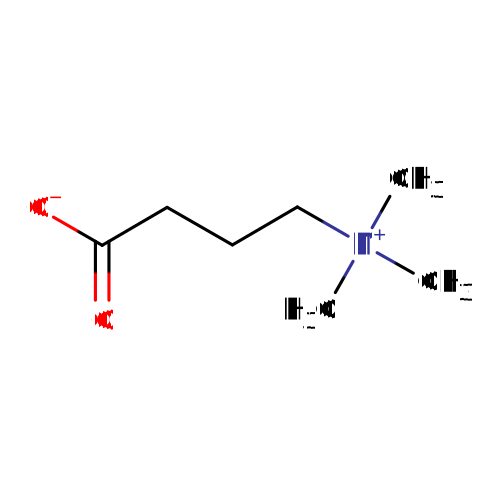
| Description | 4-Trimethylammoniobutanoic acid, also known as gamma-butyrobetaine (GBB) or 3-dehydroxycarnitine, is a highly water-soluble derivative of gamma-aminobutyric acid (GABA). It is also a precursor of L-carnitine. It is a substrate of gamma butyrobetaine hydroxylase/dioxygenase (also known as BBOX) which catalyzes the formation of L-carnitine from gamma-butyrobetaine, the last step in the L-carnitine biosynthesis pathway. Carnitine is essential for the transport of activated fatty acids across the mitochondrial membrane during mitochondrial beta-oxidation. Numerous disorders have been described that lead to disturbances in energy production and in intermediary metabolism which are characterized by the production and excretion of unusual acylcarnitines. A mutation in the gene coding for carnitine-acylcarnitine translocase, or the OCTN2 transporter aetiologically, causes a carnitine deficiency that results in poor intestinal absorption of dietary L-carnitine, impaired reabsorption by the kidney, and increased urinary loss. Determination of the qualitative pattern of acylcarnitines can be of diagnostic and therapeutic importance. The betaine structure of carnitine requires special analytical procedures for recording. The ionic nature of L-carnitine causes a high water solubility which decreases with increasing chain length of the ester group in the acylcarnitines. Therefore, the distribution of L-carnitine and acylcarnitines in various organs is defined by their function and their physicochemical properties as well. High-performance liquid chromatography (HPLC) permits screening for free and total carnitine, as well as complete quantitative acylcarnitine determination, including the long-chain acylcarnitine profile (PMID: 17508264 , Monatshefte fuer Chemie (2005), 136(8), 1279-1291., Int J Mass Spectrom. 1999;188:39-52.). |
|---|
| Structure | InChI=1S/C7H15NO2/c1-8(2,3)6-4-5-7(9)10/h4-6H2,1-3H3 |
|---|
| Synonyms | | Value | Source |
|---|
| 3-Dehydroxycarnitine | ChEBI | | 4-(N-Trimethylamino)butyrate | ChEBI | | 4-(Trimethylamino)butanoate | ChEBI | | 4-Butyrobetaine | ChEBI | | Actinine | ChEBI | | Butyrobetaine | ChEBI | | Deoxycarnitine | ChEBI | | gamma-Butyrobetain | ChEBI | | gamma-Butyrobetaine | ChEBI | | 4-(N-Trimethylamino)butyric acid | Generator | | 4-(Trimethylamino)butanoic acid | Generator | | g-Butyrobetain | Generator | | Γ-butyrobetain | Generator | | g-Butyrobetaine | Generator | | Γ-butyrobetaine | Generator | | 4-Trimethylammoniobutanoate | Generator | | Deoxy-carnitine | HMDB | | 4-Trimethylaminobutyrate | HMDB | | 4-N-Trimethylammonium butyrate | HMDB | | 4-Trimethylammoniobutanoic acid | HMDB |
|
|---|
| Chemical Formula | C7H15NO2 |
|---|
| Average Molecular Weight | 145.1995 |
|---|
| Monoisotopic Molecular Weight | 145.110278729 |
|---|
| IUPAC Name | 4-(trimethylazaniumyl)butanoate |
|---|
| Traditional Name | butyrobetaine |
|---|
| CAS Registry Number | 407-64-7 |
|---|
| SMILES | C[N+](C)(C)CCCC([O-])=O |
|---|
| InChI Identifier | InChI=1S/C7H15NO2/c1-8(2,3)6-4-5-7(9)10/h4-6H2,1-3H3 |
|---|
| InChI Key | JHPNVNIEXXLNTR-UHFFFAOYSA-N |
|---|
| Chemical Taxonomy |
|---|
| Description | Belongs to the class of organic compounds known as straight chain fatty acids. These are fatty acids with a straight aliphatic chain. |
|---|
| Kingdom | Organic compounds |
|---|
| Super Class | Lipids and lipid-like molecules |
|---|
| Class | Fatty Acyls |
|---|
| Sub Class | Fatty acids and conjugates |
|---|
| Direct Parent | Straight chain fatty acids |
|---|
| Alternative Parents | |
|---|
| Substituents | - Straight chain fatty acid
- Quaternary ammonium salt
- Tetraalkylammonium salt
- Carboxylic acid salt
- Monocarboxylic acid or derivatives
- Carboxylic acid
- Carboxylic acid derivative
- Organic oxide
- Amine
- Hydrocarbon derivative
- Organic salt
- Organic nitrogen compound
- Organooxygen compound
- Organonitrogen compound
- Carbonyl group
- Organopnictogen compound
- Organic oxygen compound
- Aliphatic acyclic compound
|
|---|
| Molecular Framework | Aliphatic acyclic compounds |
|---|
| External Descriptors | |
|---|
| Ontology |
|---|
| Physiological effect | Not Available |
|---|
| Disposition | |
|---|
| Process | |
|---|
| Role | Not Available |
|---|
| Physical Properties |
|---|
| State | Solid |
|---|
| Experimental Molecular Properties | | Property | Value | Reference |
|---|
| Melting Point | Not Available | Not Available | | Boiling Point | Not Available | Not Available | | Water Solubility | Not Available | Not Available | | LogP | Not Available | Not Available |
|
|---|
| Experimental Chromatographic Properties | Experimental Collision Cross Sections |
|---|
| Predicted Molecular Properties | |
|---|
| Predicted Chromatographic Properties | Predicted Collision Cross SectionsPredicted Retention Times Underivatized| Chromatographic Method | Retention Time | Reference |
|---|
| Measured using a Waters Acquity ultraperformance liquid chromatography (UPLC) ethylene-bridged hybrid (BEH) C18 column (100 mm × 2.1 mm; 1.7 μmparticle diameter). Predicted by Afia on May 17, 2022. Predicted by Afia on May 17, 2022. | 1.3 minutes | 32390414 | | Predicted by Siyang on May 30, 2022 | 8.9575 minutes | 33406817 | | Predicted by Siyang using ReTip algorithm on June 8, 2022 | 7.42 minutes | 32390414 | | AjsUoB = Accucore 150 Amide HILIC with 10mM Ammonium Formate, 0.1% Formic Acid | 333.1 seconds | 40023050 |
Predicted Kovats Retention IndicesUnderivatized |
|---|
| Spectra |
|---|
| |
|---|
| Biological Properties |
|---|
| Cellular Locations | - Cytoplasm
- Extracellular
- Membrane
|
|---|
| Biospecimen Locations | |
|---|
| Tissue Locations | |
|---|
| Pathways | |
|---|
| Normal Concentrations |
|---|
| |
| Blood | Detected but not Quantified | Not Quantified | Adult (>18 years old) | Both | Normal | | details | | Blood | Detected and Quantified | 10.0 (0.5-20.0) uM | Adult (>18 years old) | Both | Normal | | details | | Feces | Detected but not Quantified | Not Quantified | Adult (>18 years old) | Both | Normal | | details | | Feces | Detected but not Quantified | Not Quantified | Adult (>18 years old) | Both | Normal | | details | | Feces | Detected but not Quantified | Not Quantified | Adult (>18 years old) | Both | Normal | | details | | Feces | Detected but not Quantified | Not Quantified | Infant (0-1 year old) | Not Specified | Normal | | details | | Feces | Detected but not Quantified | Not Quantified | Infant (0-1 year old) | Not Specified | Normal | | details | | Feces | Detected but not Quantified | Not Quantified | Infant (0-1 year old) | Not Available | Normal | | details | | Saliva | Detected but not Quantified | Not Quantified | Adult (>18 years old) | Male | Normal | | details | | Saliva | Detected and Quantified | 1.10 +/- 0.713 uM | Adult (>18 years old) | Not Specified | Normal | | details | | Saliva | Detected and Quantified | 0.754 +/- 0.692 uM | Adult (>18 years old) | Not Specified | Normal | | details | | Saliva | Detected but not Quantified | Not Quantified | Adult (>18 years old) | Male | Normal | | details | | Saliva | Detected but not Quantified | Not Quantified | Adult (>18 years old) | Male | Normal | | details | | Saliva | Detected but not Quantified | Not Quantified | Adult (>18 years old) | Male | Normal | | details | | Saliva | Detected but not Quantified | Not Quantified | Adult (>18 years old) | Male | Normal | | details | | Saliva | Detected but not Quantified | Not Quantified | Adult (>18 years old) | Male | Normal | | details | | Saliva | Detected but not Quantified | Not Quantified | Adult (>18 years old) | Male | Normal | | details | | Saliva | Detected but not Quantified | Not Quantified | Adult (>18 years old) | Male | Normal | | details | | Saliva | Detected but not Quantified | Not Quantified | Adult (>18 years old) | Male | Normal | | details | | Saliva | Detected but not Quantified | Not Quantified | Adult (>18 years old) | Male | Normal | | details | | Urine | Detected but not Quantified | Not Quantified | Adult (>18 years old) | Both | Normal | | details | | Urine | Expected but not Quantified | Not Quantified | Not Available | Not Available | Normal | | details |
|
|---|
| Abnormal Concentrations |
|---|
| |
| Feces | Detected but not Quantified | Not Quantified | Adult (>18 years old) | Both | Colorectal Cancer | | details | | Feces | Detected but not Quantified | Not Quantified | Adult (>18 years old) | Both | Colorectal cancer | | details | | Feces | Detected but not Quantified | Not Quantified | Adult (>18 years old) | Both | Colorectal cancer | | details |
|
|---|
| Associated Disorders and Diseases |
|---|
| Disease References | | Colorectal cancer |
|---|
- Brown DG, Rao S, Weir TL, O'Malia J, Bazan M, Brown RJ, Ryan EP: Metabolomics and metabolic pathway networks from human colorectal cancers, adjacent mucosa, and stool. Cancer Metab. 2016 Jun 6;4:11. doi: 10.1186/s40170-016-0151-y. eCollection 2016. [PubMed:27275383 ]
- Sinha R, Ahn J, Sampson JN, Shi J, Yu G, Xiong X, Hayes RB, Goedert JJ: Fecal Microbiota, Fecal Metabolome, and Colorectal Cancer Interrelations. PLoS One. 2016 Mar 25;11(3):e0152126. doi: 10.1371/journal.pone.0152126. eCollection 2016. [PubMed:27015276 ]
- Goedert JJ, Sampson JN, Moore SC, Xiao Q, Xiong X, Hayes RB, Ahn J, Shi J, Sinha R: Fecal metabolomics: assay performance and association with colorectal cancer. Carcinogenesis. 2014 Sep;35(9):2089-96. doi: 10.1093/carcin/bgu131. Epub 2014 Jul 18. [PubMed:25037050 ]
|
|
|---|
| Associated OMIM IDs | |
|---|
| External Links |
|---|
| DrugBank ID | Not Available |
|---|
| Phenol Explorer Compound ID | Not Available |
|---|
| FooDB ID | FDB024107 |
|---|
| KNApSAcK ID | Not Available |
|---|
| Chemspider ID | 705 |
|---|
| KEGG Compound ID | C01181 |
|---|
| BioCyc ID | GAMMA-BUTYROBETAINE |
|---|
| BiGG ID | Not Available |
|---|
| Wikipedia Link | Not Available |
|---|
| METLIN ID | Not Available |
|---|
| PubChem Compound | 725 |
|---|
| PDB ID | Not Available |
|---|
| ChEBI ID | 16244 |
|---|
| Food Biomarker Ontology | Not Available |
|---|
| VMH ID | 4TMEABUTN |
|---|
| MarkerDB ID | Not Available |
|---|
| Good Scents ID | Not Available |
|---|
| References |
|---|
| Synthesis Reference | Kawamura, Masao; Akutsu, Seiichi; Fukuda, Hirosuke; Hata, Hiroyuki; Morishita, Tsuyoshi; Kano, Kenji; Nishimori, Hirokuni. Manufacture of g-butyrobetaine by fermentation. Jpn. Kokai Tokkyo Koho (1987), 6 pp. |
|---|
| Material Safety Data Sheet (MSDS) | Not Available |
|---|
| General References | - Hewawasam P, Ding M, Chen N, King D, Knipe J, Pajor L, Ortiz A, Gribkoff VK, Starrett J: Synthesis of water-soluble prodrugs of BMS-191011: a maxi-K channel opener targeted for post-stroke neuroprotection. Bioorg Med Chem Lett. 2003 May 19;13(10):1695-8. [PubMed:12729644 ]
- Siliprandi N, Ciman M, Sartorelli L: Myocardial carnitine transport. Basic Res Cardiol. 1987;82 Suppl 1:53-62. [PubMed:3311009 ]
- Rebouche CJ, Engel AG: Significance of renal gamma-butyrobetaine hydroxylase for carnitine biosynthesis in man. J Biol Chem. 1980 Sep 25;255(18):8700-5. [PubMed:6773946 ]
- Terada N, Inoue F, Okochi M, Nakajima H, Kizaki Z, Kinugasa A, Sawada T: Measurement of carnitine precursors, epsilon-trimethyllysine and gamma-butyrobetaine in human serum by tandem mass spectrometry. J Chromatogr B Biomed Sci Appl. 1999 Aug 6;731(1):89-95. [PubMed:10491993 ]
- Rebouche CJ, Chenard CA: Metabolic fate of dietary carnitine in human adults: identification and quantification of urinary and fecal metabolites. J Nutr. 1991 Apr;121(4):539-46. [PubMed:2007906 ]
- Pierre G, Macdonald A, Gray G, Hendriksz C, Preece MA, Chakrapani A: Prospective treatment in carnitine-acylcarnitine translocase deficiency. J Inherit Metab Dis. 2007 Oct;30(5):815. Epub 2007 May 12. [PubMed:17508264 ]
- Elshenawy S, Pinney SE, Stuart T, Doulias PT, Zura G, Parry S, Elovitz MA, Bennett MJ, Bansal A, Strauss JF 3rd, Ischiropoulos H, Simmons RA: The Metabolomic Signature of the Placenta in Spontaneous Preterm Birth. Int J Mol Sci. 2020 Feb 4;21(3). pii: ijms21031043. doi: 10.3390/ijms21031043. [PubMed:32033212 ]
|
|---|