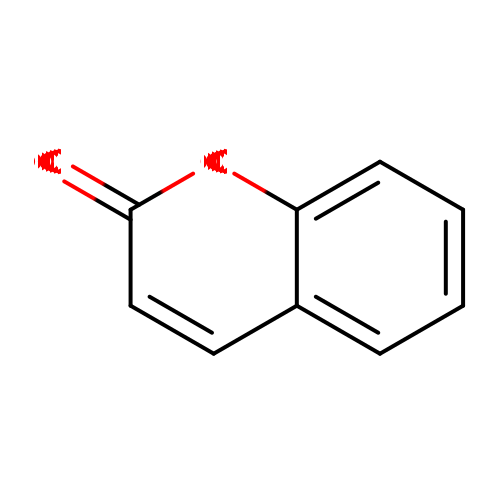
| Record Information |
|---|
| Version | 5.0 |
|---|
| Status | Detected but not Quantified |
|---|
| Creation Date | 2005-11-16 15:48:42 UTC |
|---|
| Update Date | 2023-02-21 17:15:32 UTC |
|---|
| HMDB ID | HMDB0001218 |
|---|
| Secondary Accession Numbers | |
|---|
| Metabolite Identification |
|---|
| Common Name | Coumarin |
|---|
| Description | Coumarin belongs to the class of chemicals known as chromenones. Specifically it is a chromenone having the keto group located at the 2-position. A chromenone is a benzene molecule with two adjacent hydrogen atoms replaced by a lactone-like chain forming a second six-membered heterocycle that shares two carbons with the benzene ring. Coumarin is also described as a benzopyrone and is considered as a lactone. Coumarin is a colorless crystalline solid with a bitter taste and sweet odor resembling the scent of vanilla or the scent of newly-mowed or recently cut hay. It is a chemical poison found in many plants where it may serve as a chemical defense against predators. Coumarin occurs naturally in many plants and foods such as the tonka bean, woodruff, bison grass, cassia (bastard cinnamon or Chinese cinnamon), cinnamon, melilot (sweet clover), green tea, peppermint, celery, bilberry, lavender, honey (derived both from sweet clover and lavender), and carrots, as well as in beer, tobacco, wine, and other foodstuffs. Coumarin concentrations in these plants, spices, and foods range from <1 mg/kg in celery, to 7000 mg/kg in cinnamon, and up to 87,000 mg/kg in cassia. An estimate of human exposure to coumarin from the diet has been calculated to be 0.02 mg/kg/day. Coumarin is used as an additive in perfumes and fragranced consumer products at concentrations ranging from <0.5% To 6.4% In fine fragrances to <0.01% In detergents. An estimate for systemic exposure of humans from the use of fragranced cosmetic products is 0.04 mg/kg BW/day, assuming complete dermal penetration. The use of coumarin as a food additive was banned by the FDA in 1954 based on reports of hepatotoxicity in rats. It has clinical value as the precursor for several anticoagulants, notably warfarin. Coumarins, as a class, are comprised of numerous naturally occurring benzo-alpha-pyrone compounds with important and diverse physiological activities. Due to its potential hepatotoxic effects in humans, the European Commission restricted coumarin from naturals as a direct food additive to 2 mg/kg food/day, with exceptions granting higher levels for alcoholic beverages, caramel, chewing gum, and certain 'traditional foods'. In addition to human exposure to coumarin from dietary sources and consumer products, coumarin is also used clinically as an antineoplastic and for the treatment of lymphedema and venous insufficiency. Exposure ranges from 11 mg/day for consumption of natural food ingredients to 7 g/day following clinical administration. Although adverse effects in humans following coumarin exposure are rare, and only associated with clinical doses, recent evidence indicates coumarin causes liver tumors in rats and mice and Clara cell toxicity and lung tumors in mice. The multiple effects as well as the ongoing human exposure to coumarin have resulted in a significant research effort focused on understanding the mechanism of coumarin induced toxicity/carcinogenicity and its human relevance. These investigations have revealed significant species differences in coumarin metabolism and toxicity such that the mechanism of coumarin induced effects in rodents, and the relevance of these findings for the safety assessment of coumarin exposure in humans are now better understood. In October 2004, the European Food Safety Authority (EFSA, 2004) reviewed coumarin to establish a tolerable daily intake (TDI) in foods. EFSA issued an opinion indicating that coumarin is not genotoxic, and that a threshold approach to safety assessment was most appropriate. EFSA recommended a TDI of 0 to 0.1 Mg/kg BW/day. Including dietary contributions, the total human exposure is estimated to be 0.06 Mg/kg/day. As a pharmaceutical, coumarin has been used in diverse applications with a wide variety of dosing regimens. Unlike coumadin and other coumarin derivatives, coumarin has no anti-coagulant activity. However, at low doses (typically 7 to 10 mg/day), coumarin has been used as a 'venotonic' to promote vein health and small venule blood flow. Additionally, coumarin has been used clinically in the treatment of high-protein lymphedema arising from various etiologies. (PMID: 16203076 ). |
|---|
| Structure | InChI=1S/C9H6O2/c10-9-6-5-7-3-1-2-4-8(7)11-9/h1-6H |
|---|
| Synonyms | | Value | Source |
|---|
| 1,2-Benzopyrone | ChEBI | | 2-Propenoic acid, 3-(2-hydroxyphenyl)-, D-lactone | ChEBI | | 2-Propenoic acid, 3-(2-hydroxyphenyl)-, delta-lactone | ChEBI | | 2H-1-Benzopyran-2-one | ChEBI | | 2H-Benzo[b]pyran-2-one | ChEBI | | 5,6-Benzo-2-pyrone | ChEBI | | Benzo-a-pyrone | ChEBI | | Benzo-alpha-pyrone | ChEBI | | cis-O-Coumarinic acid lactone | ChEBI | | Coumarine | ChEBI | | Coumarinic anhydride | ChEBI | | Cumarin | ChEBI | | O-Hydroxycinnamic acid delta-lactone | ChEBI | | O-Hydroxycinnamic acid lactone | ChEBI | | Rattex | ChEBI | | Tonka bean camphor | ChEBI | | Venalot mono | Kegg | | 2-Propenoate, 3-(2-hydroxyphenyl)-, D-lactone | Generator | | 2-Propenoate, 3-(2-hydroxyphenyl)-, delta-lactone | Generator | | 2-Propenoate, 3-(2-hydroxyphenyl)-, δ-lactone | Generator | | 2-Propenoic acid, 3-(2-hydroxyphenyl)-, δ-lactone | Generator | | Benzo-α-pyrone | Generator | | cis-O-Coumarinate lactone | Generator | | O-Hydroxycinnamate delta-lactone | Generator | | O-Hydroxycinnamate δ-lactone | Generator | | O-Hydroxycinnamic acid δ-lactone | Generator | | O-Hydroxycinnamate lactone | Generator | | 5,6-Benzo-alpha-pyrone | MeSH | | 1, 2-Benzopyrone | HMDB | | 2-oxo-1,2-Benzopyran | HMDB | | 2-oxo-2H-1-Benzopyran | HMDB | | 2H-Chromen-2-one | HMDB | | 2H-Chromen-2-one (acd/name 4.0) | HMDB | | Kumarin | HMDB | | O-Hydroxycinnamic lactone | HMDB | | O-Hydroxyzimtsaure-lacton | HMDB | | {2h-benzo[b]pyran-2-one} | HMDB |
|
|---|
| Chemical Formula | C9H6O2 |
|---|
| Average Molecular Weight | 146.145 |
|---|
| Monoisotopic Molecular Weight | 146.036779433 |
|---|
| IUPAC Name | 2H-chromen-2-one |
|---|
| Traditional Name | coumarin |
|---|
| CAS Registry Number | 91-64-5 |
|---|
| SMILES | O=C1OC2=CC=CC=C2C=C1 |
|---|
| InChI Identifier | InChI=1S/C9H6O2/c10-9-6-5-7-3-1-2-4-8(7)11-9/h1-6H |
|---|
| InChI Key | ZYGHJZDHTFUPRJ-UHFFFAOYSA-N |
|---|
| Chemical Taxonomy |
|---|
| Description | Belongs to the class of organic compounds known as coumarins and derivatives. These are polycyclic aromatic compounds containing a 1-benzopyran moiety with a ketone group at the C2 carbon atom (1-benzopyran-2-one). |
|---|
| Kingdom | Organic compounds |
|---|
| Super Class | Phenylpropanoids and polyketides |
|---|
| Class | Coumarins and derivatives |
|---|
| Sub Class | Not Available |
|---|
| Direct Parent | Coumarins and derivatives |
|---|
| Alternative Parents | |
|---|
| Substituents | - Coumarin
- 1-benzopyran
- Benzopyran
- Pyranone
- Benzenoid
- Pyran
- Heteroaromatic compound
- Lactone
- Oxacycle
- Organoheterocyclic compound
- Organic oxygen compound
- Organic oxide
- Hydrocarbon derivative
- Organooxygen compound
- Aromatic heteropolycyclic compound
|
|---|
| Molecular Framework | Aromatic heteropolycyclic compounds |
|---|
| External Descriptors | |
|---|
| Ontology |
|---|
| Not Available | Not Available |
|---|
| Physical Properties |
|---|
| State | Solid |
|---|
| Experimental Molecular Properties | |
|---|
| Experimental Chromatographic Properties | Experimental Collision Cross Sections |
|---|
| Predicted Molecular Properties | |
|---|
| Predicted Chromatographic Properties | Predicted Collision Cross SectionsPredicted Retention Times Underivatized| Chromatographic Method | Retention Time | Reference |
|---|
| Measured using a Waters Acquity ultraperformance liquid chromatography (UPLC) ethylene-bridged hybrid (BEH) C18 column (100 mm × 2.1 mm; 1.7 μmparticle diameter). Predicted by Afia on May 17, 2022. Predicted by Afia on May 17, 2022. | 5.52 minutes | 32390414 | | Predicted by Siyang on May 30, 2022 | 13.1524 minutes | 33406817 | | Predicted by Siyang using ReTip algorithm on June 8, 2022 | 1.95 minutes | 32390414 | | Fem_Long = Waters ACQUITY UPLC HSS T3 C18 with Water:MeOH and 0.1% Formic Acid | 1794.4 seconds | 40023050 | | Fem_Lipids = Ascentis Express C18 with (60:40 water:ACN):(90:10 IPA:ACN) and 10mM NH4COOH + 0.1% Formic Acid | 508.3 seconds | 40023050 | | Life_Old = Waters ACQUITY UPLC BEH C18 with Water:(20:80 acetone:ACN) and 0.1% Formic Acid | 186.0 seconds | 40023050 | | Life_New = RP Waters ACQUITY UPLC HSS T3 C18 with Water:(30:70 MeOH:ACN) and 0.1% Formic Acid | 323.1 seconds | 40023050 | | RIKEN = Waters ACQUITY UPLC BEH C18 with Water:ACN and 0.1% Formic Acid | 211.4 seconds | 40023050 | | Eawag_XBridgeC18 = XBridge C18 3.5u 2.1x50 mm with Water:MeOH and 0.1% Formic Acid | 468.7 seconds | 40023050 | | BfG_NTS_RP1 =Agilent Zorbax Eclipse Plus C18 (2.1 mm x 150 mm, 3.5 um) with Water:ACN and 0.1% Formic Acid | 504.6 seconds | 40023050 | | HILIC_BDD_2 = Merck SeQuant ZIC-HILIC with ACN(0.1% formic acid):water(16 mM ammonium formate) | 165.4 seconds | 40023050 | | UniToyama_Atlantis = RP Waters Atlantis T3 (2.1 x 150 mm, 5 um) with ACN:Water and 0.1% Formic Acid | 1066.0 seconds | 40023050 | | BDD_C18 = Hypersil Gold 1.9µm C18 with Water:ACN and 0.1% Formic Acid | 389.9 seconds | 40023050 | | UFZ_Phenomenex = Kinetex Core-Shell C18 2.6 um, 3.0 x 100 mm, Phenomenex with Water:MeOH and 0.1% Formic Acid | 1228.2 seconds | 40023050 | | SNU_RIKEN_POS = Waters ACQUITY UPLC BEH C18 with Water:ACN and 0.1% Formic Acid | 347.4 seconds | 40023050 | | RPMMFDA = Waters ACQUITY UPLC BEH C18 with Water:ACN and 0.1% Formic Acid | 338.7 seconds | 40023050 | | MTBLS87 = Merck SeQuant ZIC-pHILIC column with ACN:Water and :ammonium carbonate | 479.4 seconds | 40023050 | | KI_GIAR_zic_HILIC_pH2_7 = Merck SeQuant ZIC-HILIC with ACN:Water and 0.1% FA | 378.4 seconds | 40023050 | | Meister zic-pHILIC pH9.3 = Merck SeQuant ZIC-pHILIC column with ACN:Water 5mM NH4Ac pH9.3 and 5mM ammonium acetate in water | 61.9 seconds | 40023050 |
Predicted Kovats Retention IndicesUnderivatized |
|---|