| Record Information |
|---|
| Version | 5.0 |
|---|
| Status | Detected but not Quantified |
|---|
| Creation Date | 2005-11-16 15:48:42 UTC |
|---|
| Update Date | 2023-02-21 17:15:32 UTC |
|---|
| HMDB ID | HMDB0001229 |
|---|
| Secondary Accession Numbers | |
|---|
| Metabolite Identification |
|---|
| Common Name | Dopaquinone |
|---|
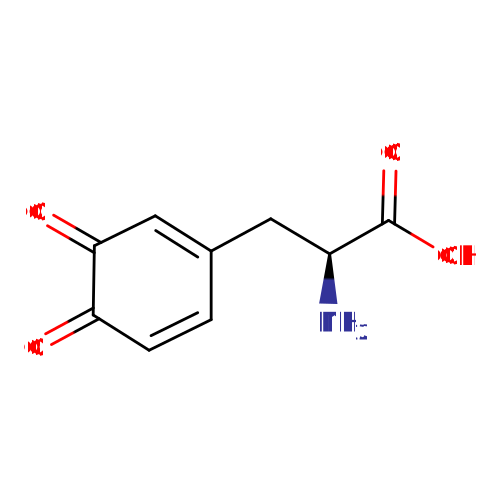
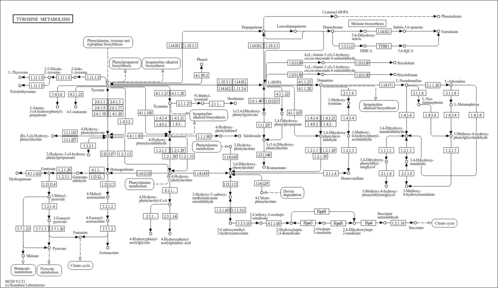
| Description | Dopaquinone, also known as o-dopaquinone or L-dopaquinone, is a member of the class of compounds known as L-alpha-amino acids. L-alpha-amino acids are alpha-amino acids which have the L-configuration of the alpha-carbon atom. Dopaquinone is slightly soluble (in water) and a moderately acidic compound (based on its pKa). L-Dopaquinone is a metabolite of L-DOPA and a precursor of melanin. Melanin is synthesized from tyrosine by hydroxylation to dihydroxyphenylalanine (DOPA) and subsequent oxidation to dopaquinone. Both reactions are catalyzed by the enzyme tyrosinase, which is the rate-limiting step. Dopaquinone has an ortho-quinone ring, which is known to be neurotoxic and highly reactive with many other compounds (PMID: 413870 ). Dopaquinone typically combines with cysteine to form pheomelanin (a pigment-polymer). Alternatively, dopaquinone can be converted to leucodopachrome and eventually to eumelanin (also a pigment-polymer). Dopaquinone can be found in skin and feces. Within the cell, dopaquinone is primarily located in the cytoplasm. Dopaquinone is involved in several metabolic disorders, some of which include transient tyrosinemia, hawkinsinuria, tyrosinemia type I, and alkaptonuria. Chronically high levels of dopaquinone are associated with Parkinson's disease (PD). Many Parkinson's patients are treated with L-DOPA. However, long-term treatment with L-DOPA may actually worsen symptoms or result in neurotic and psychotic symptoms. These may be due to dopachrome and dopaquinone accumulating in the brain of L-DOPA treated patients (PMID: 19131041 , PMID: 12373519 ). |
|---|
| Structure | N[C@@H](CC1=CC(=O)C(=O)C=C1)C(O)=O InChI=1S/C9H9NO4/c10-6(9(13)14)3-5-1-2-7(11)8(12)4-5/h1-2,4,6H,3,10H2,(H,13,14)/t6-/m0/s1 |
|---|
| Synonyms | | Value | Source |
|---|
| (S)-2-Amino-3-(3,4-dioxocyclohexa-1,5-dien-1-yl)propanoate | ChEBI | | (S)-2-Amino-3-(3,4-dioxocyclohexa-1,5-dien-1-yl)propanoic acid | Generator | | O-Dopaquinone | HMDB | | 4-(2-Carboxy-2-aminoethyl)-1,2-benzoquinone | HMDB | | Dopaquinone, (S)-isomer | HMDB | | L-Dopaquinone | HMDB |
|
|---|
| Chemical Formula | C9H9NO4 |
|---|
| Average Molecular Weight | 195.1721 |
|---|
| Monoisotopic Molecular Weight | 195.053157781 |
|---|
| IUPAC Name | (2S)-2-amino-3-(3,4-dioxocyclohexa-1,5-dien-1-yl)propanoic acid |
|---|
| Traditional Name | dopaquinone |
|---|
| CAS Registry Number | 4430-97-1 |
|---|
| SMILES | N[C@@H](CC1=CC(=O)C(=O)C=C1)C(O)=O |
|---|
| InChI Identifier | InChI=1S/C9H9NO4/c10-6(9(13)14)3-5-1-2-7(11)8(12)4-5/h1-2,4,6H,3,10H2,(H,13,14)/t6-/m0/s1 |
|---|
| InChI Key | AHMIDUVKSGCHAU-LURJTMIESA-N |
|---|
| Chemical Taxonomy |
|---|
| Description | Belongs to the class of organic compounds known as l-alpha-amino acids. These are alpha amino acids which have the L-configuration of the alpha-carbon atom. |
|---|
| Kingdom | Organic compounds |
|---|
| Super Class | Organic acids and derivatives |
|---|
| Class | Carboxylic acids and derivatives |
|---|
| Sub Class | Amino acids, peptides, and analogues |
|---|
| Direct Parent | L-alpha-amino acids |
|---|
| Alternative Parents | |
|---|
| Substituents | - L-alpha-amino acid
- O-benzoquinone
- Quinone
- Ketone
- Amino acid
- Cyclic ketone
- Carboxylic acid
- Monocarboxylic acid or derivatives
- Amine
- Hydrocarbon derivative
- Primary amine
- Organooxygen compound
- Organonitrogen compound
- Organic oxide
- Organopnictogen compound
- Primary aliphatic amine
- Organic oxygen compound
- Organic nitrogen compound
- Carbonyl group
- Aliphatic homomonocyclic compound
|
|---|
| Molecular Framework | Aliphatic homomonocyclic compounds |
|---|
| External Descriptors | |
|---|
| Ontology |
|---|
| Not Available | Not Available |
|---|
| Physical Properties |
|---|
| State | Solid |
|---|
| Experimental Molecular Properties | | Property | Value | Reference |
|---|
| Melting Point | Not Available | Not Available | | Boiling Point | Not Available | Not Available | | Water Solubility | Not Available | Not Available | | LogP | Not Available | Not Available |
|
|---|
| Experimental Chromatographic Properties | Not Available |
|---|
| Predicted Molecular Properties | |
|---|
| Predicted Chromatographic Properties | Predicted Collision Cross SectionsPredicted Retention Times Underivatized| Chromatographic Method | Retention Time | Reference |
|---|
| Measured using a Waters Acquity ultraperformance liquid chromatography (UPLC) ethylene-bridged hybrid (BEH) C18 column (100 mm × 2.1 mm; 1.7 μmparticle diameter). Predicted by Afia on May 17, 2022. Predicted by Afia on May 17, 2022. | 1.88 minutes | 32390414 | | Predicted by Siyang on May 30, 2022 | 9.7868 minutes | 33406817 | | Predicted by Siyang using ReTip algorithm on June 8, 2022 | 7.47 minutes | 32390414 | | AjsUoB = Accucore 150 Amide HILIC with 10mM Ammonium Formate, 0.1% Formic Acid | 309.0 seconds | 40023050 | | Fem_Long = Waters ACQUITY UPLC HSS T3 C18 with Water:MeOH and 0.1% Formic Acid | 595.2 seconds | 40023050 | | Fem_Lipids = Ascentis Express C18 with (60:40 water:ACN):(90:10 IPA:ACN) and 10mM NH4COOH + 0.1% Formic Acid | 305.1 seconds | 40023050 | | Life_Old = Waters ACQUITY UPLC BEH C18 with Water:(20:80 acetone:ACN) and 0.1% Formic Acid | 66.1 seconds | 40023050 | | Life_New = RP Waters ACQUITY UPLC HSS T3 C18 with Water:(30:70 MeOH:ACN) and 0.1% Formic Acid | 182.6 seconds | 40023050 | | RIKEN = Waters ACQUITY UPLC BEH C18 with Water:ACN and 0.1% Formic Acid | 48.4 seconds | 40023050 | | Eawag_XBridgeC18 = XBridge C18 3.5u 2.1x50 mm with Water:MeOH and 0.1% Formic Acid | 275.9 seconds | 40023050 | | BfG_NTS_RP1 =Agilent Zorbax Eclipse Plus C18 (2.1 mm x 150 mm, 3.5 um) with Water:ACN and 0.1% Formic Acid | 253.0 seconds | 40023050 | | HILIC_BDD_2 = Merck SeQuant ZIC-HILIC with ACN(0.1% formic acid):water(16 mM ammonium formate) | 724.7 seconds | 40023050 | | UniToyama_Atlantis = RP Waters Atlantis T3 (2.1 x 150 mm, 5 um) with ACN:Water and 0.1% Formic Acid | 664.5 seconds | 40023050 | | BDD_C18 = Hypersil Gold 1.9µm C18 with Water:ACN and 0.1% Formic Acid | 52.6 seconds | 40023050 | | UFZ_Phenomenex = Kinetex Core-Shell C18 2.6 um, 3.0 x 100 mm, Phenomenex with Water:MeOH and 0.1% Formic Acid | 714.4 seconds | 40023050 | | SNU_RIKEN_POS = Waters ACQUITY UPLC BEH C18 with Water:ACN and 0.1% Formic Acid | 187.3 seconds | 40023050 | | RPMMFDA = Waters ACQUITY UPLC BEH C18 with Water:ACN and 0.1% Formic Acid | 190.5 seconds | 40023050 | | MTBLS87 = Merck SeQuant ZIC-pHILIC column with ACN:Water and :ammonium carbonate | 600.1 seconds | 40023050 | | KI_GIAR_zic_HILIC_pH2_7 = Merck SeQuant ZIC-HILIC with ACN:Water and 0.1% FA | 470.1 seconds | 40023050 | | Meister zic-pHILIC pH9.3 = Merck SeQuant ZIC-pHILIC column with ACN:Water 5mM NH4Ac pH9.3 and 5mM ammonium acetate in water | 254.3 seconds | 40023050 |
Predicted Kovats Retention IndicesUnderivatizedDerivatized| Derivative Name / Structure | SMILES | Kovats RI Value | Column Type | Reference |
|---|
| Dopaquinone,1TMS,isomer #1 | C[Si](C)(C)OC(=O)[C@@H](N)CC1=CC(=O)C(=O)C=C1 | 2063.1 | Semi standard non polar | 33892256 | | Dopaquinone,1TMS,isomer #2 | C[Si](C)(C)N[C@@H](CC1=CC(=O)C(=O)C=C1)C(=O)O | 2136.6 | Semi standard non polar | 33892256 | | Dopaquinone,2TMS,isomer #1 | C[Si](C)(C)N[C@@H](CC1=CC(=O)C(=O)C=C1)C(=O)O[Si](C)(C)C | 2162.5 | Semi standard non polar | 33892256 | | Dopaquinone,2TMS,isomer #1 | C[Si](C)(C)N[C@@H](CC1=CC(=O)C(=O)C=C1)C(=O)O[Si](C)(C)C | 2039.3 | Standard non polar | 33892256 | | Dopaquinone,2TMS,isomer #1 | C[Si](C)(C)N[C@@H](CC1=CC(=O)C(=O)C=C1)C(=O)O[Si](C)(C)C | 3018.7 | Standard polar | 33892256 | | Dopaquinone,2TMS,isomer #2 | C[Si](C)(C)N([C@@H](CC1=CC(=O)C(=O)C=C1)C(=O)O)[Si](C)(C)C | 2268.6 | Semi standard non polar | 33892256 | | Dopaquinone,2TMS,isomer #2 | C[Si](C)(C)N([C@@H](CC1=CC(=O)C(=O)C=C1)C(=O)O)[Si](C)(C)C | 2106.1 | Standard non polar | 33892256 | | Dopaquinone,2TMS,isomer #2 | C[Si](C)(C)N([C@@H](CC1=CC(=O)C(=O)C=C1)C(=O)O)[Si](C)(C)C | 3121.6 | Standard polar | 33892256 | | Dopaquinone,3TMS,isomer #1 | C[Si](C)(C)OC(=O)[C@H](CC1=CC(=O)C(=O)C=C1)N([Si](C)(C)C)[Si](C)(C)C | 2276.6 | Semi standard non polar | 33892256 | | Dopaquinone,3TMS,isomer #1 | C[Si](C)(C)OC(=O)[C@H](CC1=CC(=O)C(=O)C=C1)N([Si](C)(C)C)[Si](C)(C)C | 2183.4 | Standard non polar | 33892256 | | Dopaquinone,3TMS,isomer #1 | C[Si](C)(C)OC(=O)[C@H](CC1=CC(=O)C(=O)C=C1)N([Si](C)(C)C)[Si](C)(C)C | 2949.5 | Standard polar | 33892256 | | Dopaquinone,1TBDMS,isomer #1 | CC(C)(C)[Si](C)(C)OC(=O)[C@@H](N)CC1=CC(=O)C(=O)C=C1 | 2328.9 | Semi standard non polar | 33892256 | | Dopaquinone,1TBDMS,isomer #2 | CC(C)(C)[Si](C)(C)N[C@@H](CC1=CC(=O)C(=O)C=C1)C(=O)O | 2387.6 | Semi standard non polar | 33892256 | | Dopaquinone,2TBDMS,isomer #1 | CC(C)(C)[Si](C)(C)N[C@@H](CC1=CC(=O)C(=O)C=C1)C(=O)O[Si](C)(C)C(C)(C)C | 2642.8 | Semi standard non polar | 33892256 | | Dopaquinone,2TBDMS,isomer #1 | CC(C)(C)[Si](C)(C)N[C@@H](CC1=CC(=O)C(=O)C=C1)C(=O)O[Si](C)(C)C(C)(C)C | 2501.2 | Standard non polar | 33892256 | | Dopaquinone,2TBDMS,isomer #1 | CC(C)(C)[Si](C)(C)N[C@@H](CC1=CC(=O)C(=O)C=C1)C(=O)O[Si](C)(C)C(C)(C)C | 3149.8 | Standard polar | 33892256 | | Dopaquinone,2TBDMS,isomer #2 | CC(C)(C)[Si](C)(C)N([C@@H](CC1=CC(=O)C(=O)C=C1)C(=O)O)[Si](C)(C)C(C)(C)C | 2772.2 | Semi standard non polar | 33892256 | | Dopaquinone,2TBDMS,isomer #2 | CC(C)(C)[Si](C)(C)N([C@@H](CC1=CC(=O)C(=O)C=C1)C(=O)O)[Si](C)(C)C(C)(C)C | 2535.4 | Standard non polar | 33892256 | | Dopaquinone,2TBDMS,isomer #2 | CC(C)(C)[Si](C)(C)N([C@@H](CC1=CC(=O)C(=O)C=C1)C(=O)O)[Si](C)(C)C(C)(C)C | 3226.8 | Standard polar | 33892256 | | Dopaquinone,3TBDMS,isomer #1 | CC(C)(C)[Si](C)(C)OC(=O)[C@H](CC1=CC(=O)C(=O)C=C1)N([Si](C)(C)C(C)(C)C)[Si](C)(C)C(C)(C)C | 2996.1 | Semi standard non polar | 33892256 | | Dopaquinone,3TBDMS,isomer #1 | CC(C)(C)[Si](C)(C)OC(=O)[C@H](CC1=CC(=O)C(=O)C=C1)N([Si](C)(C)C(C)(C)C)[Si](C)(C)C(C)(C)C | 2809.2 | Standard non polar | 33892256 | | Dopaquinone,3TBDMS,isomer #1 | CC(C)(C)[Si](C)(C)OC(=O)[C@H](CC1=CC(=O)C(=O)C=C1)N([Si](C)(C)C(C)(C)C)[Si](C)(C)C(C)(C)C | 3101.0 | Standard polar | 33892256 |
|
|---|
| General References | - Rorsman H, Tegner E: Biochemical observations in UV-induced pigmentation. Photodermatol. 1988 Feb;5(1):30-8. [PubMed:3281148 ]
- Tsukamoto K, Furue M, Sato Y, Takayama O, Akasu R, Ohtake N, Wakamatsu K, Ito S, Tamaki K, Shimada S: Generalized melanosis in metastatic malignant melanoma: the possible role of DOPAquinone metabolites. Dermatology. 1998;197(4):338-42. [PubMed:9873171 ]
- Graham DG, Tiffany SM, Vogel FS: The toxicity of melanin precursors. J Invest Dermatol. 1978 Feb;70(2):113-6. [PubMed:413870 ]
- Hattoria N, Wanga M, Taka H, Fujimura T, Yoritaka A, Kubo S, Mochizuki H: Toxic effects of dopamine metabolism in Parkinson's disease. Parkinsonism Relat Disord. 2009 Jan;15 Suppl 1:S35-8. doi: 10.1016/S1353-8020(09)70010-0. [PubMed:19131041 ]
- Kostrzewa RM, Kostrzewa JP, Brus R: Neuroprotective and neurotoxic roles of levodopa (L-DOPA) in neurodegenerative disorders relating to Parkinson's disease. Amino Acids. 2002;23(1-3):57-63. doi: 10.1007/s00726-001-0110-x. [PubMed:12373519 ]
|
|---|