| Record Information |
|---|
| Version | 5.0 |
|---|
| Status | Detected and Quantified |
|---|
| Creation Date | 2006-05-22 14:17:32 UTC |
|---|
| Update Date | 2020-10-09 21:02:16 UTC |
|---|
| HMDB ID | HMDB0002012 |
|---|
| Secondary Accession Numbers | |
|---|
| Metabolite Identification |
|---|
| Common Name | Ubiquinone-1 |
|---|
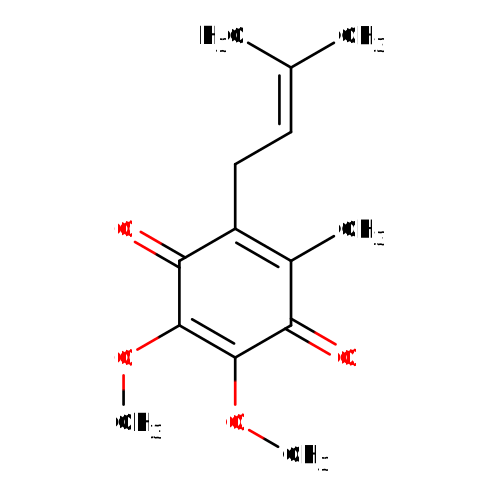
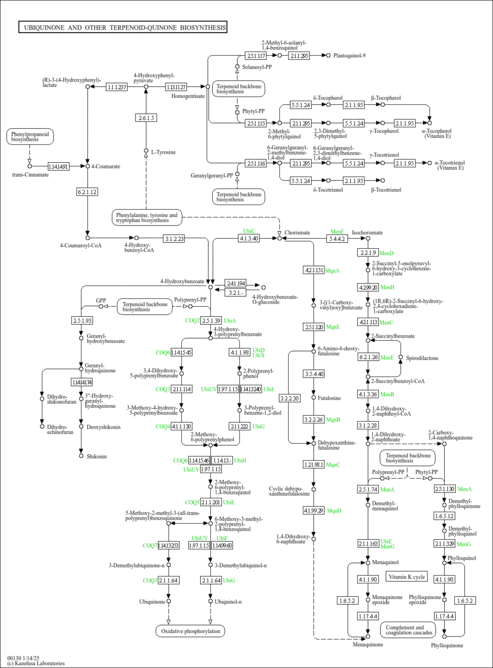
| Description | Ubiquinone-1 is a member of the chemical class known as Polyprenylbenzoquinones. These are compounds containing a polyisoprene chain attached to a quinone at the second ring position. Ubiquione-1 has just 1 isoprene unit. Normally in humans it has 10. Ubiquinone-1 is an intermediate in the synthesis of Ubiquionone 10, which is also called Coenzyme Q (CoQ). CoQ is found in the membranes of endoplasmic reticulum, peroxisomes, lysosomes, vesicles and notably the inner membrane of the mitochondrion where it is an important part of the electron transport chain; there it passes reducing equivalents to acceptors such as Coenzyme Q : cytochrome c - oxidoreductase. CoQ is also essential in the formation of the apoptosome along with other adapter proteins. The loss of trophic factors activates pro-apoptotic enzymes, causing the breakdown of mitochondria. Because of its ability to transfer electrons and therefore act as an antioxidant, Coenzyme Q has become a valued dietary supplement. CoQ10 has been widely used for the treatment of heart disease (especially heart failure), gum diseases, and also breast cancer. The benzoquinone portion of Coenzyme Q10 is synthesized from amino acids, while the isoprene sidechain is synthesized from acetyl CoA through the mevalonate pathway. The mevalonate pathway is used for the first steps of cholesterol biosynthesis. |
|---|
| Structure | COC1=C(OC)C(=O)C(CC=C(C)C)=C(C)C1=O InChI=1S/C14H18O4/c1-8(2)6-7-10-9(3)11(15)13(17-4)14(18-5)12(10)16/h6H,7H2,1-5H3 |
|---|
| Synonyms | | Value | Source |
|---|
| 2,3-Dimethoxy-5-methyl-6-(3-methyl-2-butenyl)-2,5-cyclohexadiene-1,4-dione | ChEBI | | 2,3-Dimethoxy-5-methyl-6-(3-methylbut-2-en-1-yl)-1,4-benzoquinone | ChEBI | | 2,3-Dimethoxy-5-methyl-6-(3-methylbut-2-enyl)benzo-1,4-quinone | ChEBI | | Coenzyme Q1 | ChEBI | | Coenzyme Q5 | ChEBI | | CoQ1 | ChEBI | | Ubiquinone Q1 | ChEBI | | Ubiquinone-Q1 | HMDB | | Ubiquionone 1 | HMDB | | Ubiquinone 5 | HMDB |
|
|---|
| Chemical Formula | C14H18O4 |
|---|
| Average Molecular Weight | 250.2903 |
|---|
| Monoisotopic Molecular Weight | 250.120509064 |
|---|
| IUPAC Name | 2,3-dimethoxy-5-methyl-6-(3-methylbut-2-en-1-yl)cyclohexa-2,5-diene-1,4-dione |
|---|
| Traditional Name | ubiquinone-1 |
|---|
| CAS Registry Number | 727-81-1 |
|---|
| SMILES | COC1=C(OC)C(=O)C(CC=C(C)C)=C(C)C1=O |
|---|
| InChI Identifier | InChI=1S/C14H18O4/c1-8(2)6-7-10-9(3)11(15)13(17-4)14(18-5)12(10)16/h6H,7H2,1-5H3 |
|---|
| InChI Key | SOECUQMRSRVZQQ-UHFFFAOYSA-N |
|---|
| Chemical Taxonomy |
|---|
| Description | Belongs to the class of organic compounds known as ubiquinones. These are coenzyme Q derivatives containing a 5, 6-dimethoxy-3-methyl(1,4-benzoquinone) moiety to which an isoprenyl group is attached at ring position 2(or 6). |
|---|
| Kingdom | Organic compounds |
|---|
| Super Class | Lipids and lipid-like molecules |
|---|
| Class | Prenol lipids |
|---|
| Sub Class | Quinone and hydroquinone lipids |
|---|
| Direct Parent | Ubiquinones |
|---|
| Alternative Parents | |
|---|
| Substituents | - Ubiquinone skeleton
- Monoterpenoid
- Monocyclic monoterpenoid
- Quinone
- P-benzoquinone
- Vinylogous ester
- Cyclic ketone
- Ketone
- Organic oxygen compound
- Organic oxide
- Hydrocarbon derivative
- Organooxygen compound
- Carbonyl group
- Aliphatic homomonocyclic compound
|
|---|
| Molecular Framework | Aliphatic homomonocyclic compounds |
|---|
| External Descriptors | |
|---|
| Ontology |
|---|
| Physiological effect | |
|---|
| Disposition | |
|---|
| Process | |
|---|
| Role | |
|---|
| Physical Properties |
|---|
| State | Solid |
|---|
| Experimental Molecular Properties | | Property | Value | Reference |
|---|
| Melting Point | Not Available | Not Available | | Boiling Point | Not Available | Not Available | | Water Solubility | Not Available | Not Available | | LogP | Not Available | Not Available |
|
|---|
| Experimental Chromatographic Properties | Not Available |
|---|
| Predicted Molecular Properties | |
|---|
| Predicted Chromatographic Properties | Predicted Collision Cross SectionsPredicted Retention Times Underivatized| Chromatographic Method | Retention Time | Reference |
|---|
| Measured using a Waters Acquity ultraperformance liquid chromatography (UPLC) ethylene-bridged hybrid (BEH) C18 column (100 mm × 2.1 mm; 1.7 μmparticle diameter). Predicted by Afia on May 17, 2022. Predicted by Afia on May 17, 2022. | 7.26 minutes | 32390414 | | Predicted by Siyang on May 30, 2022 | 14.1115 minutes | 33406817 | | Predicted by Siyang using ReTip algorithm on June 8, 2022 | 0.73 minutes | 32390414 | | Fem_Long = Waters ACQUITY UPLC HSS T3 C18 with Water:MeOH and 0.1% Formic Acid | 2493.0 seconds | 40023050 | | Fem_Lipids = Ascentis Express C18 with (60:40 water:ACN):(90:10 IPA:ACN) and 10mM NH4COOH + 0.1% Formic Acid | 379.2 seconds | 40023050 | | Life_Old = Waters ACQUITY UPLC BEH C18 with Water:(20:80 acetone:ACN) and 0.1% Formic Acid | 180.8 seconds | 40023050 | | Life_New = RP Waters ACQUITY UPLC HSS T3 C18 with Water:(30:70 MeOH:ACN) and 0.1% Formic Acid | 195.1 seconds | 40023050 | | RIKEN = Waters ACQUITY UPLC BEH C18 with Water:ACN and 0.1% Formic Acid | 46.5 seconds | 40023050 | | Eawag_XBridgeC18 = XBridge C18 3.5u 2.1x50 mm with Water:MeOH and 0.1% Formic Acid | 500.2 seconds | 40023050 | | BfG_NTS_RP1 =Agilent Zorbax Eclipse Plus C18 (2.1 mm x 150 mm, 3.5 um) with Water:ACN and 0.1% Formic Acid | 578.0 seconds | 40023050 | | HILIC_BDD_2 = Merck SeQuant ZIC-HILIC with ACN(0.1% formic acid):water(16 mM ammonium formate) | 113.8 seconds | 40023050 | | UniToyama_Atlantis = RP Waters Atlantis T3 (2.1 x 150 mm, 5 um) with ACN:Water and 0.1% Formic Acid | 1184.9 seconds | 40023050 | | BDD_C18 = Hypersil Gold 1.9µm C18 with Water:ACN and 0.1% Formic Acid | 516.8 seconds | 40023050 | | UFZ_Phenomenex = Kinetex Core-Shell C18 2.6 um, 3.0 x 100 mm, Phenomenex with Water:MeOH and 0.1% Formic Acid | 1242.3 seconds | 40023050 | | SNU_RIKEN_POS = Waters ACQUITY UPLC BEH C18 with Water:ACN and 0.1% Formic Acid | 277.9 seconds | 40023050 | | RPMMFDA = Waters ACQUITY UPLC BEH C18 with Water:ACN and 0.1% Formic Acid | 370.1 seconds | 40023050 | | MTBLS87 = Merck SeQuant ZIC-pHILIC column with ACN:Water and :ammonium carbonate | 292.7 seconds | 40023050 | | KI_GIAR_zic_HILIC_pH2_7 = Merck SeQuant ZIC-HILIC with ACN:Water and 0.1% FA | 338.4 seconds | 40023050 | | Meister zic-pHILIC pH9.3 = Merck SeQuant ZIC-pHILIC column with ACN:Water 5mM NH4Ac pH9.3 and 5mM ammonium acetate in water | 9.0 seconds | 40023050 |
Predicted Kovats Retention IndicesUnderivatized |
|---|
| Spectra |
|---|
| |
|---|
| Biological Properties |
|---|
| Cellular Locations | - Membrane (predicted from logP)
|
|---|
| Biospecimen Locations | |
|---|
| Tissue Locations | - Brain
- Fibroblasts
- Intestine
- Leukocyte
- Liver
- Neuron
- Pancreas
- Platelet
- Prostate
- Skeletal Muscle
|
|---|
| Pathways | |
|---|
| Normal Concentrations |
|---|
| |
| Blood | Detected and Quantified | 0.00312 +/- 0.00032 uM | Adult (>18 years old) | Both | Normal | | details |
|
|---|
| Abnormal Concentrations |
|---|
| |
| Blood | Detected and Quantified | 0.00084 +/- 0.00040 uM | Adult (>18 years old) | Both | Multiple sclerosis | | details |
|
|---|
| Associated Disorders and Diseases |
|---|
| Disease References | | Multiple sclerosis |
|---|
- Syburra C, Passi S: Oxidative stress in patients with multiple sclerosis. Ukr Biokhim Zh (1999). 1999 May-Jun;71(3):112-5. [PubMed:10609336 ]
|
|
|---|
| Associated OMIM IDs | |
|---|
| External Links |
|---|
| DrugBank ID | DB08689 |
|---|
| Phenol Explorer Compound ID | Not Available |
|---|
| FooDB ID | FDB022794 |
|---|
| KNApSAcK ID | Not Available |
|---|
| Chemspider ID | 4307 |
|---|
| KEGG Compound ID | C00399 |
|---|
| BioCyc ID | Not Available |
|---|
| BiGG ID | Not Available |
|---|
| Wikipedia Link | Not Available |
|---|
| METLIN ID | 6435 |
|---|
| PubChem Compound | 4462 |
|---|
| PDB ID | Not Available |
|---|
| ChEBI ID | 46234 |
|---|
| Food Biomarker Ontology | Not Available |
|---|
| VMH ID | Q10 |
|---|
| MarkerDB ID | MDB00000364 |
|---|
| Good Scents ID | Not Available |
|---|
| References |
|---|
| Synthesis Reference | Naruta, Yoshinori; Maruyama, Kazuhiro. . Ubiquinone-1. Organic Syntheses (1993), 71 125-32. |
|---|
| Material Safety Data Sheet (MSDS) | Not Available |
|---|
| General References | - Pastore A, Giovamberardino GD, Bertini E, Tozzi G, Gaeta LM, Federici G, Piemonte F: Simultaneous determination of ubiquinol and ubiquinone in skeletal muscle of pediatric patients. Anal Biochem. 2005 Jul 15;342(2):352-5. Epub 2005 Mar 7. [PubMed:15989930 ]
- Karlsson J, Lin L, Gunnes S, Sylven C, Astrom H: Muscle ubiquinone in male effort angina patients. Mol Cell Biochem. 1996 Mar 23;156(2):173-8. [PubMed:9095475 ]
- Passi S, Stancato A, Aleo E, Dmitrieva A, Littarru GP: Statins lower plasma and lymphocyte ubiquinol/ubiquinone without affecting other antioxidants and PUFA. Biofactors. 2003;18(1-4):113-24. [PubMed:14695926 ]
- Karlsson J, Lin L, Sylven C, Jansson E: Muscle ubiquinone in healthy physically active males. Mol Cell Biochem. 1996 Mar 23;156(2):169-72. [PubMed:9095474 ]
- Laaksonen R, Jokelainen K, Sahi T, Tikkanen MJ, Himberg JJ: Decreases in serum ubiquinone concentrations do not result in reduced levels in muscle tissue during short-term simvastatin treatment in humans. Clin Pharmacol Ther. 1995 Jan;57(1):62-6. [PubMed:7828383 ]
- Zhang Y, Eriksson M, Dallner G, Appelkvist EL: Analysis of ubiquinone and tocopherol levels in normal and hyperlipidemic human plasma. Lipids. 1998 Aug;33(8):811-5. [PubMed:9727612 ]
- Edlund C, Soderberg M, Kristensson K, Dallner G: Ubiquinone, dolichol, and cholesterol metabolism in aging and Alzheimer's disease. Biochem Cell Biol. 1992 Jun;70(6):422-8. [PubMed:1449707 ]
- Elmberger PG, Kalen A, Brunk UT, Dallner G: Discharge of newly-synthesized dolichol and ubiquinone with lipoproteins to rat liver perfusate and to the bile. Lipids. 1989 Nov;24(11):919-30. [PubMed:2615561 ]
- Yamashita S, Yamamoto Y: Simultaneous detection of ubiquinol and ubiquinone in human plasma as a marker of oxidative stress. Anal Biochem. 1997 Jul 15;250(1):66-73. [PubMed:9234900 ]
- Mancini A, Conte G, Milardi D, De Marinis L, Littarru GP: Relationship between sperm cell ubiquinone and seminal parameters in subjects with and without varicocele. Andrologia. 1998 Feb-Mar;30(1):1-4. [PubMed:9567163 ]
|
|---|