| Record Information |
|---|
| Version | 5.0 |
|---|
| Status | Detected and Quantified |
|---|
| Creation Date | 2008-09-16 13:20:19 UTC |
|---|
| Update Date | 2025-05-29 19:44:29 UTC |
|---|
| HMDB ID | HMDB0010405 |
|---|
| Secondary Accession Numbers | |
|---|
| Metabolite Identification |
|---|
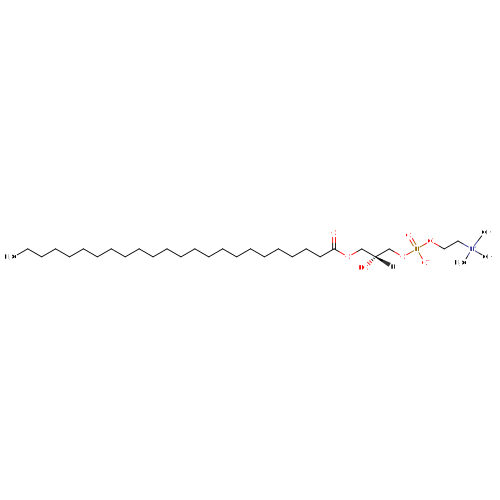
| Common Name | LysoPC(24:0/0:0) |
|---|
| Description | LysoPC(24:0) is a lysophospholipid (LyP). It is a monoglycerophospholipid in which a phosphorylcholine moiety occupies a glycerol substitution site. Lysophosphatidylcholines can have different combinations of fatty acids of varying lengths and saturation attached at the C-1 (sn-1) position. Fatty acids containing 16, 18 and 20 carbons are the most common. LysoPC(24:0), in particular, consists of one chain of lignoceric acid at the C-1 position. The lignoceric acid moiety is derived from groundnut oil. Lysophosphatidylcholine is found in small amounts in most tissues. It is formed by hydrolysis of phosphatidylcholine by the enzyme phospholipase A2, as part of the de-acylation/re-acylation cycle that controls its overall molecular species composition. It can also be formed inadvertently during extraction of lipids from tissues if the phospholipase is activated by careless handling. In blood plasma significant amounts of lysophosphatidylcholine are formed by a specific enzyme system, lecithin:cholesterol acyltransferase (LCAT), which is secreted from the liver. The enzyme catalyzes the transfer of the fatty acids of position sn-2 of phosphatidylcholine to the free cholesterol in plasma, with formation of cholesterol esters and lysophosphatidylcholine. Lysophospholipids have a role in lipid signaling by acting on lysophospholipid receptors (LPL-R). LPL-R's are members of the G protein-coupled receptor family of integral membrane proteins. LPL-R's are members of the G protein-coupled receptor (GPR) family of integral membrane proteins. Lysophosphatidylcholines (LPCs) specifically bind to GPR119, GPR40, GPR55 and GPR4. binding of LPCs to GPR119, GPR40 and GPR55 induces intracellular calcium mobilization and leads to increased glucose-stimulated insulin secretion in different cell systems. In blood or plasma LPCs are bound mainly to albumin and to a lesser extent to lipoproteins. Inflammation, cell damage and other pathophysiological conditions can profoundly alter the ratio of free to albumin bound LPC through increased production of LPC or decreased plasma levels of albumin (PMID: 32599910 ). In particular, lower levels of albumin (hypoalbuminemia) lead to lower levels of LPC in the blood. Hypoalbuminemia with albumin concentrations of <20 g/L are typical of patients with sepsis, burns or serious trauma (PMID: 26557421 ). Such low levels of albumin often lead to LPC levels that are 50-80 % lower than that seen in healthy individuals (PMID: 27501420 ). Decreased levels of LPC have been observed in a number of other inflammatory conditions beyond sepsis, including rheumatoid arthritis, diabetes, schizophrenia, polycystic ovary syndrome, Alzheimer’s disease, pulmonary arterial hypertension, aging, asthma and liver cirrhosis, where they were associated with increased mortality risk (PMID: 32599910 ). LPCs have a number of protective or anti-inflammatory effects. Higher levels of LPC induce cyclooxygenase-2 and endothelial nitric oxide synthase (eNOS) expression in endothelial cells, both of which can have vasoprotective effects either via production of prostacyclin or nitric oxide (PMID: 32599910 ). LPCs have been shown to elicit a number of effects on the innate immune system and effectively serve as dual-activity ligand molecules. In particular, LPCs directly activate toll-like receptor (TLR) 4 and TLR-2-1 receptors in the absence of classical TLR ligands. However, LPCs can also inhibit TLR-mediated signaling in the presence of classical TLR ligands, thereby acting as anti-inflammatory molecules (PMID: 32599910 ). Low levels of LPC during a bacterial or viral infection with TLR-mediated signalling can lead to opposing (inflammatory vs. anti-inflammatory) effects and immune dysregulation. |
|---|
| Structure | [H][C@@](O)(COC(=O)CCCCCCCCCCCCCCCCCCCCCCC)COP([O-])(=O)OCC[N+](C)(C)C InChI=1S/C32H66NO7P/c1-5-6-7-8-9-10-11-12-13-14-15-16-17-18-19-20-21-22-23-24-25-26-32(35)38-29-31(34)30-40-41(36,37)39-28-27-33(2,3)4/h31,34H,5-30H2,1-4H3/t31-/m1/s1 |
|---|
| Synonyms | | Value | Source |
|---|
| 1-Lignoceroyl-glycero-3-phosphocholine | ChEBI | | 1-Lignoceroyl-GPC | ChEBI | | 1-Lignoceroyl-GPC (24:0) | ChEBI | | GPC(24:0) | ChEBI | | GPC(24:0/0:0) | ChEBI | | LPC(24:0) | ChEBI | | LPC(24:0/0:0) | ChEBI | | LyPC(24:0) | ChEBI | | LyPC(24:0/0:0) | ChEBI | | LysoPC(24:0) | ChEBI | | Lysophosphatidylcholine(24:0) | ChEBI | | Lysophosphatidylcholine(24:0/0:0) | ChEBI | | PC(24:0) | ChEBI | | PC(24:0/0:0) | ChEBI | | 1-tetracosanoyl-glycero-3-phosphocholine | Lipid Annotator, HMDB | | LysoPC(24:0/0:0) | Lipid Annotator, HMDB, ChEBI | | LysoPC a C24:0 | HMDB | | 1-Lignoceroylglycerophosphocholine | HMDB | | 1-Tetracosanoylglycerophosphocholine | HMDB |
|
|---|
| Chemical Formula | C32H66NO7P |
|---|
| Average Molecular Weight | 607.8427 |
|---|
| Monoisotopic Molecular Weight | 607.457689983 |
|---|
| IUPAC Name | (2-{[(2R)-2-hydroxy-3-(tetracosanoyloxy)propyl phosphono]oxy}ethyl)trimethylazanium |
|---|
| Traditional Name | (2-{[(2R)-2-hydroxy-3-(tetracosanoyloxy)propyl phosphono]oxy}ethyl)trimethylazanium |
|---|
| CAS Registry Number | Not Available |
|---|
| SMILES | [H][C@@](O)(COC(=O)CCCCCCCCCCCCCCCCCCCCCCC)COP([O-])(=O)OCC[N+](C)(C)C |
|---|
| InChI Identifier | InChI=1S/C32H66NO7P/c1-5-6-7-8-9-10-11-12-13-14-15-16-17-18-19-20-21-22-23-24-25-26-32(35)38-29-31(34)30-40-41(36,37)39-28-27-33(2,3)4/h31,34H,5-30H2,1-4H3/t31-/m1/s1 |
|---|
| InChI Key | SKJMUADLQLZAGH-WJOKGBTCSA-N |
|---|
| Chemical Taxonomy |
|---|
| Description | Belongs to the class of organic compounds known as 1-acyl-sn-glycero-3-phosphocholines. These are glycerophosphocholines in which the glycerol is esterified with a fatty acid at O-1 position, and linked at position 3 to a phosphocholine. |
|---|
| Kingdom | Organic compounds |
|---|
| Super Class | Lipids and lipid-like molecules |
|---|
| Class | Glycerophospholipids |
|---|
| Sub Class | Glycerophosphocholines |
|---|
| Direct Parent | 1-acyl-sn-glycero-3-phosphocholines |
|---|
| Alternative Parents | |
|---|
| Substituents | - 1-acyl-sn-glycero-3-phosphocholine
- Phosphocholine
- Fatty acid ester
- Dialkyl phosphate
- Organic phosphoric acid derivative
- Phosphoric acid ester
- Alkyl phosphate
- Fatty acyl
- Tetraalkylammonium salt
- Quaternary ammonium salt
- Secondary alcohol
- Carboxylic acid ester
- Carboxylic acid derivative
- Monocarboxylic acid or derivatives
- Organic oxide
- Organooxygen compound
- Organonitrogen compound
- Organic nitrogen compound
- Alcohol
- Organic oxygen compound
- Organopnictogen compound
- Carbonyl group
- Organic salt
- Amine
- Hydrocarbon derivative
- Aliphatic acyclic compound
|
|---|
| Molecular Framework | Aliphatic acyclic compounds |
|---|
| External Descriptors | |
|---|
| Ontology |
|---|
| Physiological effect | |
|---|
| Disposition | Biological locationRoute of exposureSourceEndogenousExogenousFood- Food (HMDB: HMDB0010405)
Animal originMilk and milk productUnfermented milk- Cow milk, pasteurized, vitamin A + D added, 0% fat (FooDB: FOOD00889)
- Cow milk, pasteurized, vitamin A + D added, 1% fat (FooDB: FOOD00890)
- Cow milk, pasteurized, vitamin A + D added, 2% fat (FooDB: FOOD00891)
- Cow milk, pasteurized, vitamin D added, 3.25% fat (FooDB: FOOD00892)
- Exogenous (HMDB: HMDB0010405)
|
|---|
| Process | |
|---|
| Role | |
|---|
| Physical Properties |
|---|
| State | Solid |
|---|
| Experimental Molecular Properties | | Property | Value | Reference |
|---|
| Melting Point | Not Available | Not Available | | Boiling Point | Not Available | Not Available | | Water Solubility | Not Available | Not Available | | LogP | Not Available | Not Available |
|
|---|
| Experimental Chromatographic Properties | Not Available |
|---|
| Predicted Molecular Properties | |
|---|
| Predicted Chromatographic Properties | Predicted Collision Cross SectionsPredicted Retention Times Underivatized| Chromatographic Method | Retention Time | Reference |
|---|
| Measured using a Waters Acquity ultraperformance liquid chromatography (UPLC) ethylene-bridged hybrid (BEH) C18 column (100 mm × 2.1 mm; 1.7 μmparticle diameter). Predicted by Afia on May 17, 2022. Predicted by Afia on May 17, 2022. | 10.21 minutes | 32390414 | | Predicted by Siyang on May 30, 2022 | 24.906 minutes | 33406817 | | Predicted by Siyang using ReTip algorithm on June 8, 2022 | 2.97 minutes | 32390414 | | AjsUoB = Accucore 150 Amide HILIC with 10mM Ammonium Formate, 0.1% Formic Acid | 80.9 seconds | 40023050 | | Fem_Long = Waters ACQUITY UPLC HSS T3 C18 with Water:MeOH and 0.1% Formic Acid | 3916.1 seconds | 40023050 | | Fem_Lipids = Ascentis Express C18 with (60:40 water:ACN):(90:10 IPA:ACN) and 10mM NH4COOH + 0.1% Formic Acid | 251.5 seconds | 40023050 | | Life_Old = Waters ACQUITY UPLC BEH C18 with Water:(20:80 acetone:ACN) and 0.1% Formic Acid | 304.5 seconds | 40023050 | | Life_New = RP Waters ACQUITY UPLC HSS T3 C18 with Water:(30:70 MeOH:ACN) and 0.1% Formic Acid | 182.1 seconds | 40023050 | | RIKEN = Waters ACQUITY UPLC BEH C18 with Water:ACN and 0.1% Formic Acid | 798.1 seconds | 40023050 | | Eawag_XBridgeC18 = XBridge C18 3.5u 2.1x50 mm with Water:MeOH and 0.1% Formic Acid | 1239.3 seconds | 40023050 | | BfG_NTS_RP1 =Agilent Zorbax Eclipse Plus C18 (2.1 mm x 150 mm, 3.5 um) with Water:ACN and 0.1% Formic Acid | 1140.8 seconds | 40023050 | | HILIC_BDD_2 = Merck SeQuant ZIC-HILIC with ACN(0.1% formic acid):water(16 mM ammonium formate) | 592.3 seconds | 40023050 | | UniToyama_Atlantis = RP Waters Atlantis T3 (2.1 x 150 mm, 5 um) with ACN:Water and 0.1% Formic Acid | 2781.5 seconds | 40023050 | | BDD_C18 = Hypersil Gold 1.9µm C18 with Water:ACN and 0.1% Formic Acid | 809.4 seconds | 40023050 | | UFZ_Phenomenex = Kinetex Core-Shell C18 2.6 um, 3.0 x 100 mm, Phenomenex with Water:MeOH and 0.1% Formic Acid | 2639.0 seconds | 40023050 | | SNU_RIKEN_POS = Waters ACQUITY UPLC BEH C18 with Water:ACN and 0.1% Formic Acid | 808.1 seconds | 40023050 | | RPMMFDA = Waters ACQUITY UPLC BEH C18 with Water:ACN and 0.1% Formic Acid | 616.6 seconds | 40023050 | | MTBLS87 = Merck SeQuant ZIC-pHILIC column with ACN:Water and :ammonium carbonate | 288.3 seconds | 40023050 | | KI_GIAR_zic_HILIC_pH2_7 = Merck SeQuant ZIC-HILIC with ACN:Water and 0.1% FA | 177.1 seconds | 40023050 | | Meister zic-pHILIC pH9.3 = Merck SeQuant ZIC-pHILIC column with ACN:Water 5mM NH4Ac pH9.3 and 5mM ammonium acetate in water | 8.5 seconds | 40023050 |
Predicted Kovats Retention IndicesUnderivatizedDerivatized |
|---|
| General References | - Wernly B, Lichtenauer M, Hoppe UC, Jung C: Hyperglycemia in septic patients: an essential stress survival response in all, a robust marker for risk stratification in some, to be messed with in none. J Thorac Dis. 2016 Jul;8(7):E621-4. doi: 10.21037/jtd.2016.05.24. [PubMed:27501420 ]
- Knuplez E, Marsche G: An Updated Review of Pro- and Anti-Inflammatory Properties of Plasma Lysophosphatidylcholines in the Vascular System. Int J Mol Sci. 2020 Jun 24;21(12). pii: ijms21124501. doi: 10.3390/ijms21124501. [PubMed:32599910 ]
- Sun JK, Sun F, Wang X, Yuan ST, Zheng SY, Mu XW: Risk factors and prognosis of hypoalbuminemia in surgical septic patients. PeerJ. 2015 Oct 1;3:e1267. doi: 10.7717/peerj.1267. eCollection 2015. [PubMed:26557421 ]
|
|---|