| Record Information |
|---|
| Version | 5.0 |
|---|
| Status | Detected and Quantified |
|---|
| Creation Date | 2005-11-16 15:48:42 UTC |
|---|
| Update Date | 2023-05-30 20:55:57 UTC |
|---|
| HMDB ID | HMDB0000232 |
|---|
| Secondary Accession Numbers | |
|---|
| Metabolite Identification |
|---|
| Common Name | Quinolinic acid |
|---|
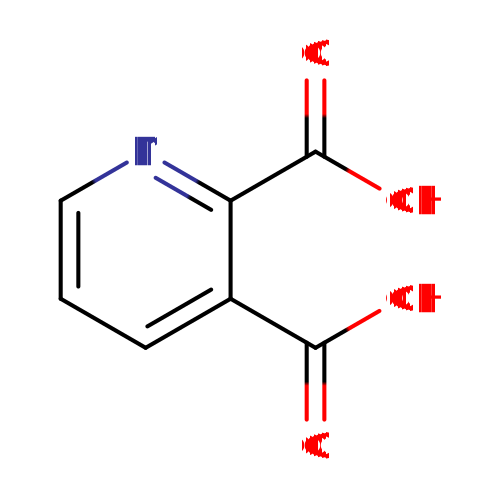
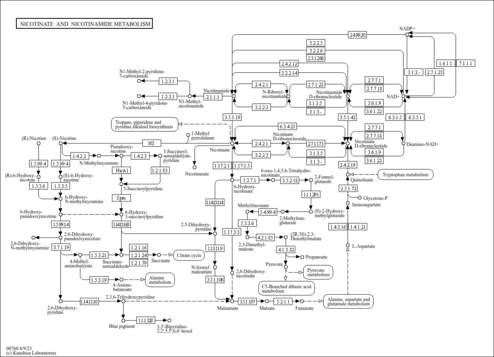
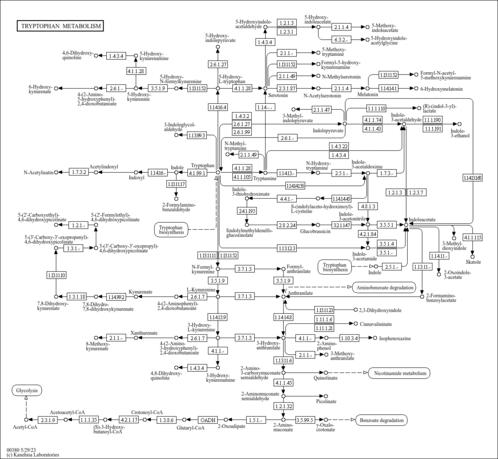
| Description | Quinolinic acid, also known as quinolinate, belongs to the class of organic compounds known as pyridinecarboxylic acids. Pyridinecarboxylic acids are compounds containing a pyridine ring bearing a carboxylic acid group. It is also classified as a pyridine-2,3-dicarboxylic acid, which is a dicarboxylic acid with a pyridine backbone. Quinolinic acid is a colorless solid. In plants, it is the biosynthetic precursor to nicotine. Quinolinic acid is found in all organisms, from microbes to plants to animals. Quinolinic acid can be biosynthesized via aspartic acid in plants. Oxidation of aspartate by the enzyme aspartate oxidase gives iminosuccinate, containing the two carboxylic acid groups that are found in quinolinic acid. Condensation of iminosuccinate with glyceraldehyde-3-phosphate, mediated by quinolinate synthase, affords quinolinic acid Quinolinic acid is also a downstream product of the kynurenine pathway, which metabolizes the amino acid tryptophan ((PMID: 22678511 ). The kynurenine/tryptophan degradation pathway is important for its production of the coenzyme nicotinamide adenine dinucleotide (NAD+) and produces several neuroactive intermediates including quinolinic acid, kynurenine (KYN), kynurenic acid (KYNA), 3-hydroxykynurenine (3-HK), and 3-hydroxyanthranilic acid (3-HANA). In animals quinolinic acid acts as an NMDA receptor agonist and has a possible role in neurodegenerative disorders (PMID: 22678511 ). It also acts as a neurotoxin, gliotoxin, proinflammatory mediator, and pro-oxidant molecule (PMID: 22248144 ). Quinolinic acid can act as an endogenous brain excitotoxin when released by activated macrophages (PMID: 15013955 ). Within the brain, quinolinic acid is only produced by activated microglia and macrophages. Quinolinic acid is unable to pass through the blood-brain barrier (BBB) and must be produced within the brain by microglial cells or macrophages that have passed the BBB (PMID: 22248144 ). While quinolinic acid cannot pass through the BBB, kynurenic acid, tryptophan and 3-hydroxykynurenine can and can subsequently act as precursors to the production of quinolinic acid in the brain (PMID: 22248144 ). Quinolinic acid has potent neurotoxic effects. Studies have demonstrated that quinolinic acid may be involved in many psychiatric disorders and neurodegenerative diseases in the brain including ALS, Alzheimer’s disease, brain ischemia, Parkinson’s disease, Huntington’s disease and AIDS-dementia. Elevated CSF levels of quinolinic acid are correlated with the severity of neuropsychological deficits in patients who have AIDS. Indeed, levels of quinolinic acid in the CSF of AIDS patients suffering from AIDS-dementia can be up to twenty times higher than normal (PMID: 10936623 ). Quinolinic acid levels are increased in the brains of children infected with a range of bacterial infections of the central nervous system (CNS), of poliovirus patients, and of Lyme disease with CNS involvement patients. In addition, raised quinolinic acid levels have been found in traumatic CNS injury patients, patients suffering from cognitive decline with ageing, hyperammonaemia patients, hypoglycaemia patients, and systemic lupus erythematosus patients. Quinolinic acid has also been detected, but not quantified in, several different foods, such as Ceylon cinnamons, pitanga, Oregon yampahs, red bell peppers, and durians. This could make quinolinic acid a potential biomarker for the consumption of these foods. |
|---|
| Structure | InChI=1S/C7H5NO4/c9-6(10)4-2-1-3-8-5(4)7(11)12/h1-3H,(H,9,10)(H,11,12) |
|---|
| Synonyms | | Value | Source |
|---|
| 2,3-Pyridinedicarboxylic acid | ChEBI | | Pyridine-2,3-dicarboxylate | ChEBI | | 2,3-Pyridinedicarboxylate | Generator | | Quinolinate | Generator | | Pyridine-2,3-dicarboxylic acid | Generator | | 3,4-Pyridinedicarboxylic acid | HMDB | | Pyridin-2,3-dicarbonsaeure | HMDB | | Pyridine-2,3-carboxylate | HMDB | | Quinolinic acid | HMDB |
|
|---|
| Chemical Formula | C7H5NO4 |
|---|
| Average Molecular Weight | 167.1189 |
|---|
| Monoisotopic Molecular Weight | 167.021857653 |
|---|
| IUPAC Name | pyridine-2,3-dicarboxylic acid |
|---|
| Traditional Name | quinolinic acid |
|---|
| CAS Registry Number | 89-00-9 |
|---|
| SMILES | OC(=O)C1=CC=CN=C1C(O)=O |
|---|
| InChI Identifier | InChI=1S/C7H5NO4/c9-6(10)4-2-1-3-8-5(4)7(11)12/h1-3H,(H,9,10)(H,11,12) |
|---|
| InChI Key | GJAWHXHKYYXBSV-UHFFFAOYSA-N |
|---|
| Chemical Taxonomy |
|---|
| Description | Belongs to the class of organic compounds known as pyridinecarboxylic acids. Pyridinecarboxylic acids are compounds containing a pyridine ring bearing a carboxylic acid group. |
|---|
| Kingdom | Organic compounds |
|---|
| Super Class | Organoheterocyclic compounds |
|---|
| Class | Pyridines and derivatives |
|---|
| Sub Class | Pyridinecarboxylic acids and derivatives |
|---|
| Direct Parent | Pyridinecarboxylic acids |
|---|
| Alternative Parents | |
|---|
| Substituents | - Pyridine carboxylic acid
- Dicarboxylic acid or derivatives
- Heteroaromatic compound
- Azacycle
- Carboxylic acid
- Carboxylic acid derivative
- Organic nitrogen compound
- Organic oxygen compound
- Organopnictogen compound
- Organic oxide
- Hydrocarbon derivative
- Organooxygen compound
- Organonitrogen compound
- Aromatic heteromonocyclic compound
|
|---|
| Molecular Framework | Aromatic heteromonocyclic compounds |
|---|
| External Descriptors | |
|---|
| Ontology |
|---|
| Physiological effect | |
|---|
| Disposition | |
|---|
| Process | |
|---|
| Role | |
|---|
| Physical Properties |
|---|
| State | Solid |
|---|
| Experimental Molecular Properties | | Property | Value | Reference |
|---|
| Melting Point | 190 °C | Not Available | | Boiling Point | Not Available | Not Available | | Water Solubility | 11 mg/mL | Not Available | | LogP | Not Available | Not Available |
|
|---|
| Experimental Chromatographic Properties | Experimental Collision Cross Sections |
|---|
| Predicted Molecular Properties | |
|---|
| Predicted Chromatographic Properties | Predicted Collision Cross SectionsPredicted Kovats Retention IndicesUnderivatizedDerivatized| Derivative Name / Structure | SMILES | Kovats RI Value | Column Type | Reference |
|---|
| Quinolinic acid,1TMS,isomer #1 | C[Si](C)(C)OC(=O)C1=CC=CN=C1C(=O)O | 1696.6 | Semi standard non polar | 33892256 | | Quinolinic acid,1TMS,isomer #2 | C[Si](C)(C)OC(=O)C1=NC=CC=C1C(=O)O | 1698.4 | Semi standard non polar | 33892256 | | Quinolinic acid,2TMS,isomer #1 | C[Si](C)(C)OC(=O)C1=CC=CN=C1C(=O)O[Si](C)(C)C | 1715.9 | Semi standard non polar | 33892256 | | Quinolinic acid,1TBDMS,isomer #1 | CC(C)(C)[Si](C)(C)OC(=O)C1=CC=CN=C1C(=O)O | 1918.9 | Semi standard non polar | 33892256 | | Quinolinic acid,1TBDMS,isomer #2 | CC(C)(C)[Si](C)(C)OC(=O)C1=NC=CC=C1C(=O)O | 1932.5 | Semi standard non polar | 33892256 | | Quinolinic acid,2TBDMS,isomer #1 | CC(C)(C)[Si](C)(C)OC(=O)C1=CC=CN=C1C(=O)O[Si](C)(C)C(C)(C)C | 2115.2 | Semi standard non polar | 33892256 |
|
|---|
| Spectra |
|---|
| GC-MS Spectra| Spectrum Type | Description | Splash Key | Deposition Date | Source | View |
|---|
| Experimental GC-MS | GC-MS Spectrum - Quinolinic acid GC-EI-TOF (Pegasus III TOF-MS system, Leco; GC 6890, Agilent Technologies) (2 TMS) | splash10-0002-0910000000-a8eacf1916c539d286b6 | 2014-06-16 | HMDB team, MONA, MassBank | View Spectrum | | Experimental GC-MS | GC-MS Spectrum - Quinolinic acid GC-EI-TOF (Pegasus III TOF-MS system, Leco; GC 6890, Agilent Technologies) (Non-derivatized) | splash10-0002-0910000000-64e9e4b901dd69dc90c5 | 2014-06-16 | HMDB team, MONA, MassBank | View Spectrum | | Experimental GC-MS | GC-MS Spectrum - Quinolinic acid GC-EI-TOF (Pegasus III TOF-MS system, Leco; GC 6890, Agilent Technologies) (2 TMS) | splash10-006t-7910000000-0bb1a7ce8a5907feae21 | 2014-06-16 | HMDB team, MONA, MassBank | View Spectrum | | Experimental GC-MS | GC-MS Spectrum - Quinolinic acid EI-B (Non-derivatized) | splash10-05i0-9500000000-555e92ebc410fc53e92f | 2017-09-12 | HMDB team, MONA, MassBank | View Spectrum | | Experimental GC-MS | GC-MS Spectrum - Quinolinic acid EI-B (Non-derivatized) | splash10-0100-5900000000-3d726d602fec21fd8beb | 2017-09-12 | HMDB team, MONA, MassBank | View Spectrum | | Experimental GC-MS | GC-MS Spectrum - Quinolinic acid GC-EI-TOF (Non-derivatized) | splash10-0002-0910000000-a8eacf1916c539d286b6 | 2017-09-12 | HMDB team, MONA, MassBank | View Spectrum | | Experimental GC-MS | GC-MS Spectrum - Quinolinic acid GC-EI-TOF (Non-derivatized) | splash10-0002-0910000000-64e9e4b901dd69dc90c5 | 2017-09-12 | HMDB team, MONA, MassBank | View Spectrum | | Experimental GC-MS | GC-MS Spectrum - Quinolinic acid GC-EI-TOF (Non-derivatized) | splash10-006t-7910000000-0bb1a7ce8a5907feae21 | 2017-09-12 | HMDB team, MONA, MassBank | View Spectrum | | Experimental GC-MS | GC-MS Spectrum - Quinolinic acid GC-EI-TOF (Non-derivatized) | splash10-0002-1960000000-8197ee161fa149deabdd | 2017-09-12 | HMDB team, MONA, MassBank | View Spectrum | | Experimental GC-MS | GC-MS Spectrum - Quinolinic acid GC-EI-TOF (Non-derivatized) | splash10-0002-0920000000-40d676712c981904799f | 2017-09-12 | HMDB team, MONA, MassBank | View Spectrum | | Predicted GC-MS | Predicted GC-MS Spectrum - Quinolinic acid GC-MS (Non-derivatized) - 70eV, Positive | splash10-0g4j-4900000000-40b629f8c2ff96d454dc | 2016-09-22 | Wishart Lab | View Spectrum | | Predicted GC-MS | Predicted GC-MS Spectrum - Quinolinic acid GC-MS (2 TMS) - 70eV, Positive | splash10-00di-9680000000-e45ac969fff3f654bb49 | 2017-10-06 | Wishart Lab | View Spectrum | | Predicted GC-MS | Predicted GC-MS Spectrum - Quinolinic acid GC-MS (Non-derivatized) - 70eV, Positive | Not Available | 2021-10-12 | Wishart Lab | View Spectrum | | Predicted GC-MS | Predicted GC-MS Spectrum - Quinolinic acid GC-MS (Non-derivatized) - 70eV, Positive | Not Available | 2021-10-12 | Wishart Lab | View Spectrum | | Predicted GC-MS | Predicted GC-MS Spectrum - Quinolinic acid GC-MS (TMS_1_1) - 70eV, Positive | Not Available | 2021-11-05 | Wishart Lab | View Spectrum | | Predicted GC-MS | Predicted GC-MS Spectrum - Quinolinic acid GC-MS (TMS_1_2) - 70eV, Positive | Not Available | 2021-11-05 | Wishart Lab | View Spectrum | | Predicted GC-MS | Predicted GC-MS Spectrum - Quinolinic acid GC-MS (TBDMS_1_1) - 70eV, Positive | Not Available | 2021-11-05 | Wishart Lab | View Spectrum | | Predicted GC-MS | Predicted GC-MS Spectrum - Quinolinic acid GC-MS (TBDMS_1_2) - 70eV, Positive | Not Available | 2021-11-05 | Wishart Lab | View Spectrum | | Predicted GC-MS | Predicted GC-MS Spectrum - Quinolinic acid GC-MS (TBDMS_2_1) - 70eV, Positive | Not Available | 2021-11-05 | Wishart Lab | View Spectrum |
MS/MS Spectra| Spectrum Type | Description | Splash Key | Deposition Date | Source | View |
|---|
| Experimental LC-MS/MS | LC-MS/MS Spectrum - Quinolinic acid Quattro_QQQ 10V, Positive-QTOF (Annotated) | splash10-0002-0900000000-4a6d37bd8578b50cf677 | 2012-07-24 | HMDB team, MONA | View Spectrum | | Experimental LC-MS/MS | LC-MS/MS Spectrum - Quinolinic acid Quattro_QQQ 25V, Positive-QTOF (Annotated) | splash10-004i-9100000000-45dc448cbedc6465ad63 | 2012-07-24 | HMDB team, MONA | View Spectrum | | Experimental LC-MS/MS | LC-MS/MS Spectrum - Quinolinic acid Quattro_QQQ 40V, Positive-QTOF (Annotated) | splash10-004i-9000000000-2aa35085995bdc1801da | 2012-07-24 | HMDB team, MONA | View Spectrum | | Experimental LC-MS/MS | LC-MS/MS Spectrum - Quinolinic acid LC-ESI-QQ (API3000, Applied Biosystems) 10V, Negative-QTOF | splash10-014i-0900000000-d0eb03bdfeea6084e0db | 2012-08-31 | HMDB team, MONA | View Spectrum | | Experimental LC-MS/MS | LC-MS/MS Spectrum - Quinolinic acid LC-ESI-QQ (API3000, Applied Biosystems) 20V, Negative-QTOF | splash10-0100-5900000000-7d59ce683134a6f33e8d | 2012-08-31 | HMDB team, MONA | View Spectrum | | Experimental LC-MS/MS | LC-MS/MS Spectrum - Quinolinic acid LC-ESI-QQ (API3000, Applied Biosystems) 30V, Negative-QTOF | splash10-00or-9700000000-c13d2a2f6361459932db | 2012-08-31 | HMDB team, MONA | View Spectrum | | Experimental LC-MS/MS | LC-MS/MS Spectrum - Quinolinic acid LC-ESI-QQ (API3000, Applied Biosystems) 40V, Negative-QTOF | splash10-016r-8900000000-d7f12324cf02b0023aed | 2012-08-31 | HMDB team, MONA | View Spectrum | | Experimental LC-MS/MS | LC-MS/MS Spectrum - Quinolinic acid LC-ESI-QQ (API3000, Applied Biosystems) 50V, Negative-QTOF | splash10-00or-9600000000-d51ee74ca89d43da53b4 | 2012-08-31 | HMDB team, MONA | View Spectrum | | Experimental LC-MS/MS | LC-MS/MS Spectrum - Quinolinic acid LC-ESI-QQ (API3000, Applied Biosystems) 10V, Positive-QTOF | splash10-0udi-1900000000-a44a9d75afd871a62687 | 2012-08-31 | HMDB team, MONA | View Spectrum | | Experimental LC-MS/MS | LC-MS/MS Spectrum - Quinolinic acid LC-ESI-QQ (API3000, Applied Biosystems) 20V, Positive-QTOF | splash10-0a4r-4900000000-1b71b709786880019164 | 2012-08-31 | HMDB team, MONA | View Spectrum | | Experimental LC-MS/MS | LC-MS/MS Spectrum - Quinolinic acid LC-ESI-QQ (API3000, Applied Biosystems) 30V, Positive-QTOF | splash10-0a4i-5900000000-56f78a7bdb3c091573a7 | 2012-08-31 | HMDB team, MONA | View Spectrum | | Experimental LC-MS/MS | LC-MS/MS Spectrum - Quinolinic acid LC-ESI-QQ (API3000, Applied Biosystems) 40V, Positive-QTOF | splash10-0a6r-9500000000-8140904c5eb795e92371 | 2012-08-31 | HMDB team, MONA | View Spectrum | | Experimental LC-MS/MS | LC-MS/MS Spectrum - Quinolinic acid LC-ESI-QQ (API3000, Applied Biosystems) 50V, Positive-QTOF | splash10-004i-9100000000-1175e50dbd23fc2a9922 | 2012-08-31 | HMDB team, MONA | View Spectrum | | Experimental LC-MS/MS | LC-MS/MS Spectrum - Quinolinic acid LC-ESI-QTOF , negative-QTOF | splash10-00di-0900000000-9a963e41421edb041561 | 2017-09-14 | HMDB team, MONA | View Spectrum | | Experimental LC-MS/MS | LC-MS/MS Spectrum - Quinolinic acid LC-ESI-QTOF , negative-QTOF | splash10-00di-0900000000-4c0c9b98c2ce00d0d282 | 2017-09-14 | HMDB team, MONA | View Spectrum | | Experimental LC-MS/MS | LC-MS/MS Spectrum - Quinolinic acid LC-ESI-QQ , negative-QTOF | splash10-014i-0900000000-d0eb03bdfeea6084e0db | 2017-09-14 | HMDB team, MONA | View Spectrum | | Experimental LC-MS/MS | LC-MS/MS Spectrum - Quinolinic acid LC-ESI-QQ , negative-QTOF | splash10-0100-5900000000-4af865513d09a8bab44f | 2017-09-14 | HMDB team, MONA | View Spectrum | | Experimental LC-MS/MS | LC-MS/MS Spectrum - Quinolinic acid LC-ESI-QQ , negative-QTOF | splash10-00or-9700000000-c13d2a2f6361459932db | 2017-09-14 | HMDB team, MONA | View Spectrum | | Experimental LC-MS/MS | LC-MS/MS Spectrum - Quinolinic acid LC-ESI-QQ , negative-QTOF | splash10-016r-8900000000-ff25a1c9823ecb018549 | 2017-09-14 | HMDB team, MONA | View Spectrum | | Predicted LC-MS/MS | Predicted LC-MS/MS Spectrum - Quinolinic acid 10V, Positive-QTOF | splash10-014i-0900000000-f9e1437d75c6f5b25d88 | 2015-05-27 | Wishart Lab | View Spectrum | | Predicted LC-MS/MS | Predicted LC-MS/MS Spectrum - Quinolinic acid 20V, Positive-QTOF | splash10-014i-1900000000-ad80f96e7d85d594f6cb | 2015-05-27 | Wishart Lab | View Spectrum | | Predicted LC-MS/MS | Predicted LC-MS/MS Spectrum - Quinolinic acid 40V, Positive-QTOF | splash10-0uk9-9300000000-57792ffddc2cccbd77b9 | 2015-05-27 | Wishart Lab | View Spectrum | | Predicted LC-MS/MS | Predicted LC-MS/MS Spectrum - Quinolinic acid 10V, Negative-QTOF | splash10-00xr-0900000000-343bdc632cd1916d92c9 | 2015-05-27 | Wishart Lab | View Spectrum | | Predicted LC-MS/MS | Predicted LC-MS/MS Spectrum - Quinolinic acid 20V, Negative-QTOF | splash10-00fr-4900000000-c83c2058ae8923828aa6 | 2015-05-27 | Wishart Lab | View Spectrum | | Predicted LC-MS/MS | Predicted LC-MS/MS Spectrum - Quinolinic acid 40V, Negative-QTOF | splash10-00os-9100000000-840c225c8204e80727f2 | 2015-05-27 | Wishart Lab | View Spectrum |
NMR Spectra| Spectrum Type | Description | Deposition Date | Source | View |
|---|
| Predicted 1D NMR | 1H NMR Spectrum (1D, 100 MHz, D2O, predicted) | 2021-09-29 | Wishart Lab | View Spectrum | | Predicted 1D NMR | 13C NMR Spectrum (1D, 100 MHz, D2O, predicted) | 2021-09-29 | Wishart Lab | View Spectrum | | Predicted 1D NMR | 1H NMR Spectrum (1D, 1000 MHz, D2O, predicted) | 2021-09-29 | Wishart Lab | View Spectrum | | Predicted 1D NMR | 13C NMR Spectrum (1D, 1000 MHz, D2O, predicted) | 2021-09-29 | Wishart Lab | View Spectrum | | Predicted 1D NMR | 1H NMR Spectrum (1D, 200 MHz, D2O, predicted) | 2021-09-29 | Wishart Lab | View Spectrum | | Predicted 1D NMR | 13C NMR Spectrum (1D, 200 MHz, D2O, predicted) | 2021-09-29 | Wishart Lab | View Spectrum | | Predicted 1D NMR | 1H NMR Spectrum (1D, 300 MHz, D2O, predicted) | 2021-09-29 | Wishart Lab | View Spectrum | | Predicted 1D NMR | 13C NMR Spectrum (1D, 300 MHz, D2O, predicted) | 2021-09-29 | Wishart Lab | View Spectrum | | Predicted 1D NMR | 1H NMR Spectrum (1D, 400 MHz, D2O, predicted) | 2021-09-29 | Wishart Lab | View Spectrum | | Predicted 1D NMR | 13C NMR Spectrum (1D, 400 MHz, D2O, predicted) | 2021-09-29 | Wishart Lab | View Spectrum | | Predicted 1D NMR | 1H NMR Spectrum (1D, 500 MHz, D2O, predicted) | 2021-09-29 | Wishart Lab | View Spectrum | | Predicted 1D NMR | 13C NMR Spectrum (1D, 500 MHz, D2O, predicted) | 2021-09-29 | Wishart Lab | View Spectrum | | Predicted 1D NMR | 1H NMR Spectrum (1D, 600 MHz, D2O, predicted) | 2021-09-29 | Wishart Lab | View Spectrum | | Predicted 1D NMR | 13C NMR Spectrum (1D, 600 MHz, D2O, predicted) | 2021-09-29 | Wishart Lab | View Spectrum | | Predicted 1D NMR | 1H NMR Spectrum (1D, 700 MHz, D2O, predicted) | 2021-09-29 | Wishart Lab | View Spectrum | | Predicted 1D NMR | 13C NMR Spectrum (1D, 700 MHz, D2O, predicted) | 2021-09-29 | Wishart Lab | View Spectrum | | Predicted 1D NMR | 1H NMR Spectrum (1D, 800 MHz, D2O, predicted) | 2021-09-29 | Wishart Lab | View Spectrum | | Predicted 1D NMR | 13C NMR Spectrum (1D, 800 MHz, D2O, predicted) | 2021-09-29 | Wishart Lab | View Spectrum | | Predicted 1D NMR | 1H NMR Spectrum (1D, 900 MHz, D2O, predicted) | 2021-09-29 | Wishart Lab | View Spectrum | | Predicted 1D NMR | 13C NMR Spectrum (1D, 900 MHz, D2O, predicted) | 2021-09-29 | Wishart Lab | View Spectrum | | Experimental 2D NMR | [1H, 13C]-HSQC NMR Spectrum (2D, 600 MHz, H2O, experimental) | 2012-12-05 | Wishart Lab | View Spectrum |
IR Spectra| Spectrum Type | Description | Deposition Date | Source | View |
|---|
| Predicted IR Spectrum | IR Ion Spectrum (Predicted IRIS Spectrum, Adduct: [M-H]-) | 2023-02-03 | FELIX lab | View Spectrum | | Predicted IR Spectrum | IR Ion Spectrum (Predicted IRIS Spectrum, Adduct: [M+H]+) | 2023-02-03 | FELIX lab | View Spectrum | | Predicted IR Spectrum | IR Ion Spectrum (Predicted IRIS Spectrum, Adduct: [M+Na]+) | 2023-02-03 | FELIX lab | View Spectrum |
|
|---|
| Biological Properties |
|---|
| Cellular Locations | - Cytoplasm (predicted from logP)
|
|---|
| Biospecimen Locations | - Blood
- Cerebrospinal Fluid (CSF)
- Feces
- Urine
|
|---|
| Tissue Locations | - Brain
- Neuron
- Placenta
- Prostate
- Spleen
|
|---|
| Pathways | |
|---|
| Normal Concentrations |
|---|
| |
| Blood | Detected but not Quantified | Not Quantified | Adult (>18 years old) | Both | Normal | | details | | Blood | Detected and Quantified | 0.599 +/- 0.299 uM | Adult (>18 years old) | Both | Normal | | details | | Blood | Detected and Quantified | 0.47 +/- 0.047 uM | Adult (>18 years old) | Both | Normal | | details | | Cerebrospinal Fluid (CSF) | Detected and Quantified | 0.018 (0.012-0.024) uM | Adult (>18 years old) | Both | Normal | | details | | Cerebrospinal Fluid (CSF) | Detected and Quantified | 0.023 +/- 0.002 uM | Adult (>18 years old) | Not Specified | Normal | | details | | Cerebrospinal Fluid (CSF) | Detected and Quantified | 0.02 +/- 0.002 uM | Adult (>18 years old) | Not Specified | Normal | | details | | Cerebrospinal Fluid (CSF) | Detected and Quantified | 0.022 +/- 0.0021 uM | Adult (>18 years old) | Not Specified | Normal | | details | | Cerebrospinal Fluid (CSF) | Detected and Quantified | 0.07 (0.05-0.10) uM | Adult (>18 years old) | Not Specified | Normal | | details | | Cerebrospinal Fluid (CSF) | Detected and Quantified | 0.018 +/- 0.006 uM | Adult (>18 years old) | Not Specified | Normal | | details | | Cerebrospinal Fluid (CSF) | Detected and Quantified | 0.07 (0.05-0.10) uM | Adult (>18 years old) | Both | Normal | | details | | Feces | Detected but not Quantified | Not Quantified | Adult (>18 years old) | Both | Normal | | details | | Urine | Detected and Quantified | 0.67 +/- 1.34 umol/mmol creatinine | Infant (0-1 year old) | Both | Normal | | details | | Urine | Detected and Quantified | 44.8 umol/mmol creatinine | Newborn (0-30 days old) | Both | Normal | | details | | Urine | Detected but not Quantified | Not Quantified | Adult (>18 years old) | Both | Normal | | details | | Urine | Detected but not Quantified | Not Quantified | Adult (>18 years old) | Both | Normal | | details | | Urine | Detected and Quantified | 2.5 +/- 1.1 umol/mmol creatinine | Adult (>18 years old) | Both | Normal | - Geigy Scientific ...
- West Cadwell, N.J...
- Basel, Switzerlan...
| details | | Urine | Detected and Quantified | 3.307 +/- 1.801 umol/mmol creatinine | Children (1 - 13 years old) | Not Specified | Normal | | details | | Urine | Detected and Quantified | 5.2 (1.0-17.5) umol/mmol creatinine | Adult (>18 years old) | Both | Normal | | details | | Urine | Detected and Quantified | 18.29 (14.14-24.02) umol/mmol creatinine | Newborn (0-30 days old) | Both | Normal | | details | | Urine | Detected and Quantified | 44.8 (10.4-115.3) umol/mmol creatinine | Newborn (0-30 days old) | Both | Normal | | details | | Urine | Detected and Quantified | 13.2 (0.1-54.5) umol/mmol creatinine | Infant (0-1 year old) | Both | Normal | | details | | Urine | Detected and Quantified | 10.5 (4.8-26.2) umol/mmol creatinine | Children (1-13 years old) | Both | Normal | | details | | Urine | Detected and Quantified | 7.7 (4.3-13.7) umol/mmol creatinine | Children (1-13 years old) | Both | Normal | | details | | Urine | Detected and Quantified | 7.3 (2.4-13.2) umol/mmol creatinine | Children (1-13 years old) | Both | Normal | | details | | Urine | Detected and Quantified | 3.9 (0.9-15.1) umol/mmol creatinine | Adult (>18 years old) | Both | Normal | | details |
|
|---|
| Abnormal Concentrations |
|---|
| |
| Blood | Detected and Quantified | 0.0402 uM | Infant (0-1 year old) | Female | Nicotinamide Adenine Dinucleotide Deficiency | | details | | Blood | Detected and Quantified | 8.982 +/- 5.389 uM | Adult (>18 years old) | Both | Uremia | | details | | Cerebrospinal Fluid (CSF) | Detected and Quantified | 0.00015 (0.00011-0.00019) uM | Adult (>18 years old) | Both | Hepatic coma (fatal) | | details | | Cerebrospinal Fluid (CSF) | Detected and Quantified | 0.29 (0.17-0.41) uM | Adult (>18 years old) | Both | Brain injury | | details | | Cerebrospinal Fluid (CSF) | Detected and Quantified | 0.031 +/- 0.005 uM | Adult (>18 years old) | Not Specified | Hydrocephalus | | details | | Cerebrospinal Fluid (CSF) | Detected and Quantified | 0.20 (0.12 - 0.75) uM | Adult (>18 years old) | Not Specified | Intraventricular hemorrhage | | details | | Cerebrospinal Fluid (CSF) | Detected and Quantified | 0.28 +/- 0.082 uM | Adult (>18 years old) | Not Specified | CNS Tumors | | details | | Cerebrospinal Fluid (CSF) | Detected and Quantified | 1.08 +/- 0.54 uM | Adult (>18 years old) | Not Specified | CNS Infections | | details | | Cerebrospinal Fluid (CSF) | Detected and Quantified | 3.78 +/- 0.88 uM | Adult (>18 years old) | Not Specified | AIDS | | details | | Cerebrospinal Fluid (CSF) | Detected and Quantified | 0.8 (0.7-1.0) uM | Adult (>18 years old) | Not Specified | Malaria | | details | | Cerebrospinal Fluid (CSF) | Detected and Quantified | 6.10 (0.37-100.9) uM | Not Specified | Not Specified | Tuberculous meningitis | | details | | Cerebrospinal Fluid (CSF) | Detected and Quantified | 0.10 (0-2.37) uM | Not Specified | Not Specified | Anemia | | details | | Cerebrospinal Fluid (CSF) | Detected and Quantified | 0.09 (0.07-0.11) uM | Not Specified | Not Specified | Malaria | | details | | Cerebrospinal Fluid (CSF) | Detected and Quantified | 0.08 (0.04-0.16) uM | Not Specified | Not Specified | Malaria | | details | | Cerebrospinal Fluid (CSF) | Detected and Quantified | 0.03 (0.01-0.13) uM | Not Specified | Not Specified | Convulsions | | details | | Cerebrospinal Fluid (CSF) | Detected and Quantified | 0.04 +/- 0.01 uM | Adult (>18 years old) | Not Specified | Familial amyotrophic lateral sclerosis | | details | | Cerebrospinal Fluid (CSF) | Detected and Quantified | 0.04 +/- 0.00 uM | Adult (>18 years old) | Not Specified | control | | details | | Cerebrospinal Fluid (CSF) | Detected and Quantified | 0.06 +/- 0.01 uM | Adult (>18 years old) | Female | amyotrophic lateral sclerosis | | details | | Cerebrospinal Fluid (CSF) | Detected and Quantified | 0.05 +/- 0.01 uM | Adult (>18 years old) | Not Specified | Sporadic amyotrophic lateral sclerosis | | details | | Urine | Detected and Quantified | 8.519 +/- 5.876 umol/mmol creatinine | Children (1 - 13 years old) | Not Specified | Eosinophilic esophagitis | | details |
|
|---|
| Associated Disorders and Diseases |
|---|
| Disease References | | Nicotinamide Adenine Dinucleotide Deficiency |
|---|
- Shi H, Enriquez A, Rapadas M, Martin EMMA, Wang R, Moreau J, Lim CK, Szot JO, Ip E, Hughes JN, Sugimoto K, Humphreys DT, McInerney-Leo AM, Leo PJ, Maghzal GJ, Halliday J, Smith J, Colley A, Mark PR, Collins F, Sillence DO, Winlaw DS, Ho JWK, Guillemin GJ, Brown MA, Kikuchi K, Thomas PQ, Stocker R, Giannoulatou E, Chapman G, Duncan EL, Sparrow DB, Dunwoodie SL: NAD Deficiency, Congenital Malformations, and Niacin Supplementation. N Engl J Med. 2017 Aug 10;377(6):544-552. doi: 10.1056/NEJMoa1616361. [PubMed:28792876 ]
| | Uremia |
|---|
- Vanholder R, De Smet R, Glorieux G, Argiles A, Baurmeister U, Brunet P, Clark W, Cohen G, De Deyn PP, Deppisch R, Descamps-Latscha B, Henle T, Jorres A, Lemke HD, Massy ZA, Passlick-Deetjen J, Rodriguez M, Stegmayr B, Stenvinkel P, Tetta C, Wanner C, Zidek W: Review on uremic toxins: classification, concentration, and interindividual variability. Kidney Int. 2003 May;63(5):1934-43. doi: 10.1046/j.1523-1755.2003.00924.x. [PubMed:12675874 ]
| | Hepatic coma |
|---|
- Moroni F, Lombardi G, Carla V, Lal S, Etienne P, Nair NP: Increase in the content of quinolinic acid in cerebrospinal fluid and frontal cortex of patients with hepatic failure. J Neurochem. 1986 Dec;47(6):1667-71. [PubMed:2430055 ]
| | Traumatic brain injury |
|---|
- Smythe GA, Poljak A, Bustamante S, Braga O, Maxwell A, Grant R, Sachdev P: ECNI GC-MS analysis of picolinic and quinolinic acids and their amides in human plasma, CSF, and brain tissue. Adv Exp Med Biol. 2003;527:705-12. [PubMed:15206793 ]
| | Hydrocephalus |
|---|
- Heyes MP, Saito K, Milstien S, Schiff SJ: Quinolinic acid in tumors, hemorrhage and bacterial infections of the central nervous system in children. J Neurol Sci. 1995 Nov;133(1-2):112-8. [PubMed:8583213 ]
| | Intraventricular hemorrhage |
|---|
- Heyes MP, Saito K, Milstien S, Schiff SJ: Quinolinic acid in tumors, hemorrhage and bacterial infections of the central nervous system in children. J Neurol Sci. 1995 Nov;133(1-2):112-8. [PubMed:8583213 ]
| | CNS tumors |
|---|
- Heyes MP, Saito K, Milstien S, Schiff SJ: Quinolinic acid in tumors, hemorrhage and bacterial infections of the central nervous system in children. J Neurol Sci. 1995 Nov;133(1-2):112-8. [PubMed:8583213 ]
| | CNS infections |
|---|
- Heyes MP, Saito K, Milstien S, Schiff SJ: Quinolinic acid in tumors, hemorrhage and bacterial infections of the central nervous system in children. J Neurol Sci. 1995 Nov;133(1-2):112-8. [PubMed:8583213 ]
| | AIDS |
|---|
- Heyes MP, Saito K, Lackner A, Wiley CA, Achim CL, Markey SP: Sources of the neurotoxin quinolinic acid in the brain of HIV-1-infected patients and retrovirus-infected macaques. FASEB J. 1998 Jul;12(10):881-96. [PubMed:9657528 ]
| | Malaria |
|---|
- Medana IM, Hien TT, Day NP, Phu NH, Mai NT, Chu'ong LV, Chau TT, Taylor A, Salahifar H, Stocker R, Smythe G, Turner GD, Farrar J, White NJ, Hunt NH: The clinical significance of cerebrospinal fluid levels of kynurenine pathway metabolites and lactate in severe malaria. J Infect Dis. 2002 Mar 1;185(5):650-6. Epub 2002 Feb 14. [PubMed:11865422 ]
- Medana IM, Day NP, Salahifar-Sabet H, Stocker R, Smythe G, Bwanaisa L, Njobvu A, Kayira K, Turner GD, Taylor TE, Hunt NH: Metabolites of the kynurenine pathway of tryptophan metabolism in the cerebrospinal fluid of Malawian children with malaria. J Infect Dis. 2003 Sep 15;188(6):844-9. Epub 2003 Sep 9. [PubMed:12964115 ]
| | Tuberculous meningitis |
|---|
- Medana IM, Day NP, Salahifar-Sabet H, Stocker R, Smythe G, Bwanaisa L, Njobvu A, Kayira K, Turner GD, Taylor TE, Hunt NH: Metabolites of the kynurenine pathway of tryptophan metabolism in the cerebrospinal fluid of Malawian children with malaria. J Infect Dis. 2003 Sep 15;188(6):844-9. Epub 2003 Sep 9. [PubMed:12964115 ]
| | Anemia |
|---|
- Medana IM, Day NP, Salahifar-Sabet H, Stocker R, Smythe G, Bwanaisa L, Njobvu A, Kayira K, Turner GD, Taylor TE, Hunt NH: Metabolites of the kynurenine pathway of tryptophan metabolism in the cerebrospinal fluid of Malawian children with malaria. J Infect Dis. 2003 Sep 15;188(6):844-9. Epub 2003 Sep 9. [PubMed:12964115 ]
| | Convulsion |
|---|
- Medana IM, Day NP, Salahifar-Sabet H, Stocker R, Smythe G, Bwanaisa L, Njobvu A, Kayira K, Turner GD, Taylor TE, Hunt NH: Metabolites of the kynurenine pathway of tryptophan metabolism in the cerebrospinal fluid of Malawian children with malaria. J Infect Dis. 2003 Sep 15;188(6):844-9. Epub 2003 Sep 9. [PubMed:12964115 ]
| | Amyotrophic lateral sclerosis |
|---|
- Chen Y, Stankovic R, Cullen KM, Meininger V, Garner B, Coggan S, Grant R, Brew BJ, Guillemin GJ: The kynurenine pathway and inflammation in amyotrophic lateral sclerosis. Neurotox Res. 2010 Aug;18(2):132-42. doi: 10.1007/s12640-009-9129-7. Epub 2009 Nov 18. [PubMed:19921535 ]
| | Sporadic amyotrophic lateral sclerosis |
|---|
- Chen Y, Stankovic R, Cullen KM, Meininger V, Garner B, Coggan S, Grant R, Brew BJ, Guillemin GJ: The kynurenine pathway and inflammation in amyotrophic lateral sclerosis. Neurotox Res. 2010 Aug;18(2):132-42. doi: 10.1007/s12640-009-9129-7. Epub 2009 Nov 18. [PubMed:19921535 ]
| | Familial amyotrophic lateral sclerosis |
|---|
- Chen Y, Stankovic R, Cullen KM, Meininger V, Garner B, Coggan S, Grant R, Brew BJ, Guillemin GJ: The kynurenine pathway and inflammation in amyotrophic lateral sclerosis. Neurotox Res. 2010 Aug;18(2):132-42. doi: 10.1007/s12640-009-9129-7. Epub 2009 Nov 18. [PubMed:19921535 ]
| | Eosinophilic esophagitis |
|---|
- Slae, M., Huynh, H., Wishart, D.S. (2014). Analysis of 30 normal pediatric urine samples via NMR spectroscopy (unpublished work). NA.
|
|
|---|
| Associated OMIM IDs | |
|---|
| External Links |
|---|
| DrugBank ID | DB01796 |
|---|
| Phenol Explorer Compound ID | Not Available |
|---|
| FooDB ID | FDB031142 |
|---|
| KNApSAcK ID | C00007381 |
|---|
| Chemspider ID | 144985 |
|---|
| KEGG Compound ID | C03722 |
|---|
| BioCyc ID | QUINOLINATE |
|---|
| BiGG ID | Not Available |
|---|
| Wikipedia Link | Quinolinic_acid |
|---|
| METLIN ID | Not Available |
|---|
| PubChem Compound | 1066 |
|---|
| PDB ID | Not Available |
|---|
| ChEBI ID | 16675 |
|---|
| Food Biomarker Ontology | Not Available |
|---|
| VMH ID | QULN |
|---|
| MarkerDB ID | MDB00000112 |
|---|
| Good Scents ID | Not Available |
|---|
| References |
|---|
| Synthesis Reference | Akhmerova, S. G.; Islamgulova, V. R.; Koksharov, V. G.; Sapozhnikov, Yu. E.; Manaeva, R. M. Methods of preparation of quinolinic acid. Bashkirskii Khimicheskii Zhurnal (2001), 8(2), 9-14. |
|---|
| Material Safety Data Sheet (MSDS) | Download (PDF) |
|---|
| General References | - Sreekumar A, Poisson LM, Rajendiran TM, Khan AP, Cao Q, Yu J, Laxman B, Mehra R, Lonigro RJ, Li Y, Nyati MK, Ahsan A, Kalyana-Sundaram S, Han B, Cao X, Byun J, Omenn GS, Ghosh D, Pennathur S, Alexander DC, Berger A, Shuster JR, Wei JT, Varambally S, Beecher C, Chinnaiyan AM: Metabolomic profiles delineate potential role for sarcosine in prostate cancer progression. Nature. 2009 Feb 12;457(7231):910-4. doi: 10.1038/nature07762. [PubMed:19212411 ]
- Shoemaker JD, Elliott WH: Automated screening of urine samples for carbohydrates, organic and amino acids after treatment with urease. J Chromatogr. 1991 Jan 2;562(1-2):125-38. [PubMed:2026685 ]
- Guneral F, Bachmann C: Age-related reference values for urinary organic acids in a healthy Turkish pediatric population. Clin Chem. 1994 Jun;40(6):862-6. [PubMed:8087979 ]
- Medana IM, Hien TT, Day NP, Phu NH, Mai NT, Chu'ong LV, Chau TT, Taylor A, Salahifar H, Stocker R, Smythe G, Turner GD, Farrar J, White NJ, Hunt NH: The clinical significance of cerebrospinal fluid levels of kynurenine pathway metabolites and lactate in severe malaria. J Infect Dis. 2002 Mar 1;185(5):650-6. Epub 2002 Feb 14. [PubMed:11865422 ]
- Smythe GA, Poljak A, Bustamante S, Braga O, Maxwell A, Grant R, Sachdev P: ECNI GC-MS analysis of picolinic and quinolinic acids and their amides in human plasma, CSF, and brain tissue. Adv Exp Med Biol. 2003;527:705-12. [PubMed:15206793 ]
- Medana IM, Day NP, Salahifar-Sabet H, Stocker R, Smythe G, Bwanaisa L, Njobvu A, Kayira K, Turner GD, Taylor TE, Hunt NH: Metabolites of the kynurenine pathway of tryptophan metabolism in the cerebrospinal fluid of Malawian children with malaria. J Infect Dis. 2003 Sep 15;188(6):844-9. Epub 2003 Sep 9. [PubMed:12964115 ]
- Heyes MP, Achim CL, Wiley CA, Major EO, Saito K, Markey SP: Human microglia convert l-tryptophan into the neurotoxin quinolinic acid. Biochem J. 1996 Dec 1;320 ( Pt 2):595-7. [PubMed:8973572 ]
- Heyes MP, Saito K, Lackner A, Wiley CA, Achim CL, Markey SP: Sources of the neurotoxin quinolinic acid in the brain of HIV-1-infected patients and retrovirus-infected macaques. FASEB J. 1998 Jul;12(10):881-96. [PubMed:9657528 ]
- Heyes MP, Saito K, Milstien S, Schiff SJ: Quinolinic acid in tumors, hemorrhage and bacterial infections of the central nervous system in children. J Neurol Sci. 1995 Nov;133(1-2):112-8. [PubMed:8583213 ]
- Wolfensberger M, Amsler U, Cuenod M, Foster AC, Whetsell WO Jr, Schwarcz R: Identification of quinolinic acid in rat and human brain tissue. Neurosci Lett. 1983 Nov 11;41(3):247-52. [PubMed:6664615 ]
- Kurup RK, Kurup PA: Hypothalamic digoxin, hemispheric chemical dominance, and Alzheimer's disease. Int J Neurosci. 2003 Mar;113(3):361-81. [PubMed:12803139 ]
- Heyes MP, Wyler AR, Devinsky O, Yergey JA, Markey SP, Nadi NS: Quinolinic acid concentrations in brain and cerebrospinal fluid of patients with intractable complex partial seizures. Epilepsia. 1990 Mar-Apr;31(2):172-7. [PubMed:1690639 ]
- Kurup RK, Kurup PA: Central role of hypothalamic digoxin in conscious perception, neuroimmunoendocrine integration, and coordination of cellular function: relation to hemispheric dominance. Int J Neurosci. 2002 Jun;112(6):705-39. [PubMed:12325312 ]
- Moroni F, Lombardi G, Carla V, Lal S, Etienne P, Nair NP: Increase in the content of quinolinic acid in cerebrospinal fluid and frontal cortex of patients with hepatic failure. J Neurochem. 1986 Dec;47(6):1667-71. [PubMed:2430055 ]
- Basile AS, Saito K, al-Mardini H, Record CO, Hughes RD, Harrison P, Williams R, Li Y, Heyes MP: The relationship between plasma and brain quinolinic acid levels and the severity of hepatic encephalopathy. Gastroenterology. 1995 Mar;108(3):818-23. [PubMed:7875484 ]
- Power C, Johnson RT: HIV-1 associated dementia: clinical features and pathogenesis. Can J Neurol Sci. 1995 May;22(2):92-100. [PubMed:7627922 ]
- Ellison DW, Beal MF, Mazurek MF, Malloy JR, Bird ED, Martin JB: Amino acid neurotransmitter abnormalities in Huntington's disease and the quinolinic acid animal model of Huntington's disease. Brain. 1987 Dec;110 ( Pt 6):1657-73. [PubMed:2892568 ]
- Saito K, Markey SP, Heyes MP: Effects of immune activation on quinolinic acid and neuroactive kynurenines in the mouse. Neuroscience. 1992 Nov;51(1):25-39. [PubMed:1465184 ]
- Heyes MP, Rubinow D, Lane C, Markey SP: Cerebrospinal fluid quinolinic acid concentrations are increased in acquired immune deficiency syndrome. Ann Neurol. 1989 Aug;26(2):275-7. [PubMed:2528321 ]
- Heyes MP, Ellis RJ, Ryan L, Childers ME, Grant I, Wolfson T, Archibald S, Jernigan TL: Elevated cerebrospinal fluid quinolinic acid levels are associated with region-specific cerebral volume loss in HIV infection. Brain. 2001 May;124(Pt 5):1033-42. [PubMed:11335705 ]
- Heyes MP, Saito K, Crowley JS, Davis LE, Demitrack MA, Der M, Dilling LA, Elia J, Kruesi MJ, Lackner A, et al.: Quinolinic acid and kynurenine pathway metabolism in inflammatory and non-inflammatory neurological disease. Brain. 1992 Oct;115 ( Pt 5):1249-73. [PubMed:1422788 ]
- Elshenawy S, Pinney SE, Stuart T, Doulias PT, Zura G, Parry S, Elovitz MA, Bennett MJ, Bansal A, Strauss JF 3rd, Ischiropoulos H, Simmons RA: The Metabolomic Signature of the Placenta in Spontaneous Preterm Birth. Int J Mol Sci. 2020 Feb 4;21(3). pii: ijms21031043. doi: 10.3390/ijms21031043. [PubMed:32033212 ]
- Valle M, Price RW, Nilsson A, Heyes M, Verotta D: CSF quinolinic acid levels are determined by local HIV infection: cross-sectional analysis and modelling of dynamics following antiretroviral therapy. Brain. 2004 May;127(Pt 5):1047-60. doi: 10.1093/brain/awh130. Epub 2004 Mar 10. [PubMed:15013955 ]
- Schwarcz R, Bruno JP, Muchowski PJ, Wu HQ: Kynurenines in the mammalian brain: when physiology meets pathology. Nat Rev Neurosci. 2012 Jul;13(7):465-77. doi: 10.1038/nrn3257. [PubMed:22678511 ]
- Guillemin GJ: Quinolinic acid, the inescapable neurotoxin. FEBS J. 2012 Apr;279(8):1356-65. doi: 10.1111/j.1742-4658.2012.08485.x. Epub 2012 Mar 27. [PubMed:22248144 ]
- Stone TW: Endogenous neurotoxins from tryptophan. Toxicon. 2001 Jan;39(1):61-73. doi: 10.1016/s0041-0101(00)00156-2. [PubMed:10936623 ]
|
|---|