| Record Information |
|---|
| Version | 5.0 |
|---|
| Status | Detected and Quantified |
|---|
| Creation Date | 2012-09-11 18:33:19 UTC |
|---|
| Update Date | 2022-03-07 02:53:51 UTC |
|---|
| HMDB ID | HMDB0033792 |
|---|
| Secondary Accession Numbers | |
|---|
| Metabolite Identification |
|---|
| Common Name | Hexadecane |
|---|
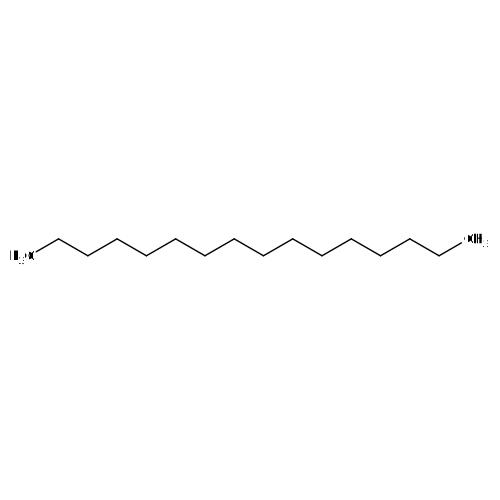
| Description | Hexadecane, also known as cetan or CH3-[CH2]14-CH3, belongs to the class of organic compounds known as alkanes. These are acyclic branched or unbranched hydrocarbons having the general formula CnH2n+2 , and therefore consisting entirely of hydrogen atoms and saturated carbon atoms. Thus, hexadecane is considered to be a hydrocarbon lipid molecule. A straight-chain alkane with 16 carbon atoms. Hexadecane is a very hydrophobic molecule, practically insoluble in water, and relatively neutral. Hexadecane is an alkane tasting compound. Hexadecane is found, on average, in the highest concentration within black walnuts. Hexadecane has also been detected, but not quantified, in several different foods, such as allspices, cucumbers, tea, orange bell peppers, and herbs and spices. This could make hexadecane a potential biomarker for the consumption of these foods. Hexadecane, with regard to humans, has been linked to the inborn metabolic disorder celiac disease. |
|---|
| Structure | InChI=1S/C16H34/c1-3-5-7-9-11-13-15-16-14-12-10-8-6-4-2/h3-16H2,1-2H3 |
|---|
| Synonyms | | Value | Source |
|---|
| Cetan | ChEBI | | Cetane | ChEBI | | CH3-[CH2]14-CH3 | ChEBI | | Hexadekan | ChEBI | | N-Cetane | ChEBI | | N-Hexadecane | ChEBI | | Zetan | ChEBI | | 1,2-Epoxyhexadecane | HMDB | | CNS | HMDB |
|
|---|
| Chemical Formula | C16H34 |
|---|
| Average Molecular Weight | 226.4412 |
|---|
| Monoisotopic Molecular Weight | 226.266051088 |
|---|
| IUPAC Name | hexadecane |
|---|
| Traditional Name | cetane |
|---|
| CAS Registry Number | 544-76-3 |
|---|
| SMILES | CCCCCCCCCCCCCCCC |
|---|
| InChI Identifier | InChI=1S/C16H34/c1-3-5-7-9-11-13-15-16-14-12-10-8-6-4-2/h3-16H2,1-2H3 |
|---|
| InChI Key | DCAYPVUWAIABOU-UHFFFAOYSA-N |
|---|
| Chemical Taxonomy |
|---|
| Description | Belongs to the class of organic compounds known as alkanes. These are acyclic branched or unbranched hydrocarbons having the general formula CnH2n+2 , and therefore consisting entirely of hydrogen atoms and saturated carbon atoms. |
|---|
| Kingdom | Organic compounds |
|---|
| Super Class | Hydrocarbons |
|---|
| Class | Saturated hydrocarbons |
|---|
| Sub Class | Alkanes |
|---|
| Direct Parent | Alkanes |
|---|
| Alternative Parents | Not Available |
|---|
| Substituents | - Acyclic alkane
- Alkane
- Aliphatic acyclic compound
|
|---|
| Molecular Framework | Aliphatic acyclic compounds |
|---|
| External Descriptors | |
|---|
| Ontology |
|---|
| Physiological effect | |
|---|
| Disposition | |
|---|
| Process | Not Available |
|---|
| Role | |
|---|
| Physical Properties |
|---|
| State | Liquid |
|---|
| Experimental Molecular Properties | |
|---|
| Experimental Chromatographic Properties | Not Available |
|---|
| Predicted Molecular Properties | |
|---|
| Predicted Chromatographic Properties | Predicted Collision Cross SectionsPredicted Retention Times Underivatized| Chromatographic Method | Retention Time | Reference |
|---|
| Measured using a Waters Acquity ultraperformance liquid chromatography (UPLC) ethylene-bridged hybrid (BEH) C18 column (100 mm × 2.1 mm; 1.7 μmparticle diameter). Predicted by Afia on May 17, 2022. Predicted by Afia on May 17, 2022. | 10.76 minutes | 32390414 | | Predicted by Siyang on May 30, 2022 | 28.6526 minutes | 33406817 | | Predicted by Siyang using ReTip algorithm on June 8, 2022 | 3.7 minutes | 32390414 | | Fem_Long = Waters ACQUITY UPLC HSS T3 C18 with Water:MeOH and 0.1% Formic Acid | 3274.0 seconds | 40023050 | | Fem_Lipids = Ascentis Express C18 with (60:40 water:ACN):(90:10 IPA:ACN) and 10mM NH4COOH + 0.1% Formic Acid | 1007.9 seconds | 40023050 | | Life_Old = Waters ACQUITY UPLC BEH C18 with Water:(20:80 acetone:ACN) and 0.1% Formic Acid | 366.9 seconds | 40023050 | | Life_New = RP Waters ACQUITY UPLC HSS T3 C18 with Water:(30:70 MeOH:ACN) and 0.1% Formic Acid | 639.5 seconds | 40023050 | | RIKEN = Waters ACQUITY UPLC BEH C18 with Water:ACN and 0.1% Formic Acid | 599.1 seconds | 40023050 | | Eawag_XBridgeC18 = XBridge C18 3.5u 2.1x50 mm with Water:MeOH and 0.1% Formic Acid | 1237.1 seconds | 40023050 | | BfG_NTS_RP1 =Agilent Zorbax Eclipse Plus C18 (2.1 mm x 150 mm, 3.5 um) with Water:ACN and 0.1% Formic Acid | 1241.6 seconds | 40023050 | | HILIC_BDD_2 = Merck SeQuant ZIC-HILIC with ACN(0.1% formic acid):water(16 mM ammonium formate) | 159.0 seconds | 40023050 | | UniToyama_Atlantis = RP Waters Atlantis T3 (2.1 x 150 mm, 5 um) with ACN:Water and 0.1% Formic Acid | 2596.7 seconds | 40023050 | | BDD_C18 = Hypersil Gold 1.9µm C18 with Water:ACN and 0.1% Formic Acid | 761.6 seconds | 40023050 | | UFZ_Phenomenex = Kinetex Core-Shell C18 2.6 um, 3.0 x 100 mm, Phenomenex with Water:MeOH and 0.1% Formic Acid | 2269.7 seconds | 40023050 | | SNU_RIKEN_POS = Waters ACQUITY UPLC BEH C18 with Water:ACN and 0.1% Formic Acid | 997.2 seconds | 40023050 | | RPMMFDA = Waters ACQUITY UPLC BEH C18 with Water:ACN and 0.1% Formic Acid | 719.0 seconds | 40023050 | | MTBLS87 = Merck SeQuant ZIC-pHILIC column with ACN:Water and :ammonium carbonate | 1011.0 seconds | 40023050 | | KI_GIAR_zic_HILIC_pH2_7 = Merck SeQuant ZIC-HILIC with ACN:Water and 0.1% FA | 784.4 seconds | 40023050 | | Meister zic-pHILIC pH9.3 = Merck SeQuant ZIC-pHILIC column with ACN:Water 5mM NH4Ac pH9.3 and 5mM ammonium acetate in water | 8.1 seconds | 40023050 |
Predicted Kovats Retention IndicesUnderivatized |
|---|
| Spectra |
|---|
| |
|---|
| Biological Properties |
|---|
| Cellular Locations | |
|---|
| Biospecimen Locations | |
|---|
| Tissue Locations | Not Available |
|---|
| Pathways | |
|---|
| Normal Concentrations |
|---|
| |
| Feces | Detected but not Quantified | Not Quantified | Adult (>18 years old) | Both | Normal | | details | | Feces | Detected and Quantified | 0-222647.940 nmol/g wet feces | Children (1-13 years old) | Not Specified | Normal | | details | | Saliva | Detected but not Quantified | Not Quantified | Adult (>18 years old) | Both | Normal | | details | | Saliva | Detected but not Quantified | Not Quantified | Adult (>18 years old) | Not Specified | Normal | | details | | Saliva | Detected but not Quantified | Not Quantified | Children (1-13 years old) | Both | Normal | | details |
|
|---|
| Abnormal Concentrations |
|---|
| |
| Feces | Detected and Quantified | 0-105884.736 nmol/g wet feces | Children (1-13 years old) | Not Specified | Treated celiac disease | | details | | Saliva | Detected but not Quantified | Not Quantified | Children (1-13 years old) | Both | Celiac disease | | details |
|
|---|
| Associated Disorders and Diseases |
|---|
| Disease References | | Celiac disease |
|---|
- Francavilla R, Ercolini D, Piccolo M, Vannini L, Siragusa S, De Filippis F, De Pasquale I, Di Cagno R, Di Toma M, Gozzi G, Serrazanetti DI, De Angelis M, Gobbetti M: Salivary microbiota and metabolome associated with celiac disease. Appl Environ Microbiol. 2014 Jun;80(11):3416-25. doi: 10.1128/AEM.00362-14. Epub 2014 Mar 21. [PubMed:24657864 ]
- Di Cagno R, De Angelis M, De Pasquale I, Ndagijimana M, Vernocchi P, Ricciuti P, Gagliardi F, Laghi L, Crecchio C, Guerzoni ME, Gobbetti M, Francavilla R: Duodenal and faecal microbiota of celiac children: molecular, phenotype and metabolome characterization. BMC Microbiol. 2011 Oct 4;11:219. doi: 10.1186/1471-2180-11-219. [PubMed:21970810 ]
|
|
|---|
| Associated OMIM IDs | |
|---|
| External Links |
|---|
| DrugBank ID | Not Available |
|---|
| Phenol Explorer Compound ID | Not Available |
|---|
| FooDB ID | FDB011952 |
|---|
| KNApSAcK ID | C00035639 |
|---|
| Chemspider ID | 10540 |
|---|
| KEGG Compound ID | C14499 |
|---|
| BioCyc ID | Not Available |
|---|
| BiGG ID | Not Available |
|---|
| Wikipedia Link | Hexadecane |
|---|
| METLIN ID | Not Available |
|---|
| PubChem Compound | 11006 |
|---|
| PDB ID | R16 |
|---|
| ChEBI ID | 45296 |
|---|
| Food Biomarker Ontology | Not Available |
|---|
| VMH ID | Not Available |
|---|
| MarkerDB ID | Not Available |
|---|
| Good Scents ID | rw1249651 |
|---|
| References |
|---|
| Synthesis Reference | Not Available |
|---|
| Material Safety Data Sheet (MSDS) | Download (PDF) |
|---|
| General References | - Peters RF, White AM: The relationship between cyclic adenosine 3', 5' - monophosphate and biochemical events in rat skin after the induction of epidermal hyperplasia using hexadecane. Br J Dermatol. 1978 Mar;98(3):301-14. [PubMed:205235 ]
- Callaghan AV, Tierney M, Phelps CD, Young LY: Anaerobic biodegradation of n-hexadecane by a nitrate-reducing consortium. Appl Environ Microbiol. 2009 Mar;75(5):1339-44. doi: 10.1128/AEM.02491-08. Epub 2008 Dec 29. [PubMed:19114507 ]
- Huguet J, Cartana J, Arola L, Alemany M: Alterations of energy metabolism induced by hexadecane in mice. Arch Int Physiol Biochim. 1989 Oct;97(5):333-40. [PubMed:2480087 ]
- (). Yannai, Shmuel. (2004) Dictionary of food compounds with CD-ROM: Additives, flavors, and ingredients. Boca Raton: Chapman & Hall/CRC.. .
|
|---|