| Record Information |
|---|
| Version | 5.0 |
|---|
| Status | Detected and Quantified |
|---|
| Creation Date | 2012-09-11 18:43:05 UTC |
|---|
| Update Date | 2023-02-21 17:23:47 UTC |
|---|
| HMDB ID | HMDB0033944 |
|---|
| Secondary Accession Numbers | |
|---|
| Metabolite Identification |
|---|
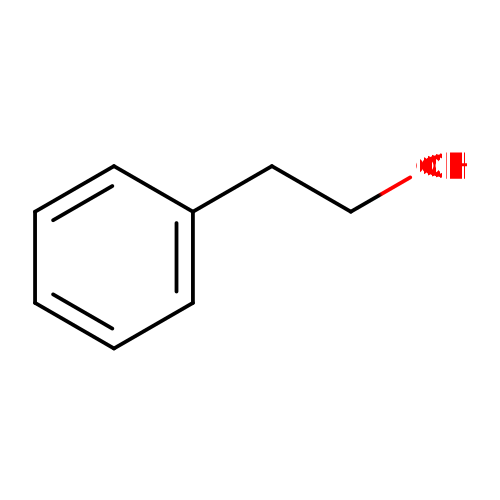
| Common Name | 2-Phenylethanol |
|---|
| Description | 2-Phenylethanol, also known as benzeneethanol or benzyl carbinol, belongs to the class of organic compounds known as benzene and substituted derivatives. These are aromatic compounds containing one monocyclic ring system consisting of benzene. 2-Phenylethanol exists in all living species, ranging from bacteria to humans. 2-Phenylethanol is a bitter, floral, and honey tasting compound. 2-Phenylethanol is found, on average, in the highest concentration within a few different foods, such as red wines, black walnuts, and white wines and in a lower concentration in grape wines, sweet basils, and peppermints. 2-Phenylethanol has also been detected, but not quantified, in several different foods, such as asparagus, allspices, fruits, horned melons, and lemons. 2-Phenylethanol, with regard to humans, has been found to be associated with several diseases such as ulcerative colitis, pervasive developmental disorder not otherwise specified, and autism. 2-phenylethanol has also been linked to the inborn metabolic disorder celiac disease. A primary alcohol that is ethanol substituted by a phenyl group at position 2. |
|---|
| Structure | InChI=1S/C8H10O/c9-7-6-8-4-2-1-3-5-8/h1-5,9H,6-7H2 |
|---|
| Synonyms | | Value | Source |
|---|
| 2-Hydroxyethylbenzene | ChEBI | | 2-PEA | ChEBI | | 2-PHENYL-ethanol | ChEBI | | Benzeneethanol | ChEBI | | Benzylmethanol | ChEBI | | beta-PEA | ChEBI | | beta-Phenethyl alcohol | ChEBI | | beta-Phenylethanol | ChEBI | | beta-Phenylethyl alcohol | ChEBI | | Phenethyl alcohol | ChEBI | | Phenylethyl alcohol | ChEBI | | b-PEA | Generator | | Β-pea | Generator | | b-Phenethyl alcohol | Generator | | Β-phenethyl alcohol | Generator | | b-Phenylethanol | Generator | | Β-phenylethanol | Generator | | b-Phenylethyl alcohol | Generator | | Β-phenylethyl alcohol | Generator | | 1-Phenyl-2-ethanol | HMDB | | 2-Phenethanol | HMDB | | 2-Phenethyl alcohol | HMDB | | 2-PhenyIethanol | HMDB | | 2-Phenylethyl alcohol | HMDB | | b-Hydroxyethylbenzene | HMDB | | Benzeneethanol, 9ci | HMDB | | Benzenethanol | HMDB | | Benzyl carbinol | HMDB, MeSH | | Benzyl ethyl alcohol | HMDB | | Benzyl-methanol | HMDB | | Benzylcarbinol | HMDB | | beta -Hydroxyethylbenzene | HMDB | | FEMA 2858 | HMDB | | Hydroxyethylbenzene | HMDB | | Phenethanol | HMDB | | Phenethyl alcohol, 8ci, ban | HMDB | | Phenyl ethyl alcohol | HMDB | | Phenyl-ethanol | HMDB | | Phenylethanol | HMDB, MeSH | | Phenylethyl alcohol, usan | HMDB | | Alcohol, phenylethyl | MeSH, HMDB | | Alcohol, phenethyl | MeSH, HMDB | | beta Phenylethanol | MeSH, HMDB | | 2 Phenylethanol | MeSH, HMDB | | Carbinol, benzyl | MeSH, HMDB |
|
|---|
| Chemical Formula | C8H10O |
|---|
| Average Molecular Weight | 122.1644 |
|---|
| Monoisotopic Molecular Weight | 122.073164942 |
|---|
| IUPAC Name | 2-phenylethan-1-ol |
|---|
| Traditional Name | phenylethanol |
|---|
| CAS Registry Number | 60-12-8 |
|---|
| SMILES | OCCC1=CC=CC=C1 |
|---|
| InChI Identifier | InChI=1S/C8H10O/c9-7-6-8-4-2-1-3-5-8/h1-5,9H,6-7H2 |
|---|
| InChI Key | WRMNZCZEMHIOCP-UHFFFAOYSA-N |
|---|
| Chemical Taxonomy |
|---|
| Description | Belongs to the class of organic compounds known as benzene and substituted derivatives. These are aromatic compounds containing one monocyclic ring system consisting of benzene. |
|---|
| Kingdom | Organic compounds |
|---|
| Super Class | Benzenoids |
|---|
| Class | Benzene and substituted derivatives |
|---|
| Sub Class | Not Available |
|---|
| Direct Parent | Benzene and substituted derivatives |
|---|
| Alternative Parents | |
|---|
| Substituents | - Monocyclic benzene moiety
- Organic oxygen compound
- Hydrocarbon derivative
- Primary alcohol
- Organooxygen compound
- Alcohol
- Aromatic homomonocyclic compound
|
|---|
| Molecular Framework | Aromatic homomonocyclic compounds |
|---|
| External Descriptors | |
|---|
| Ontology |
|---|
| Not Available | Not Available |
|---|
| Physical Properties |
|---|
| State | Liquid |
|---|
| Experimental Molecular Properties | | Property | Value | Reference |
|---|
| Melting Point | -25.8 °C | Not Available | | Boiling Point | 219.00 to 221.00 °C. @ 760.00 mm Hg | The Good Scents Company Information System | | Water Solubility | 22.2 mg/mL at 25 °C | Not Available | | LogP | 1.36 | Not Available |
|
|---|
| Experimental Chromatographic Properties | Experimental Collision Cross Sections |
|---|
| Predicted Molecular Properties | |
|---|
| Predicted Chromatographic Properties | Predicted Collision Cross SectionsPredicted Retention Times Underivatized| Chromatographic Method | Retention Time | Reference |
|---|
| Measured using a Waters Acquity ultraperformance liquid chromatography (UPLC) ethylene-bridged hybrid (BEH) C18 column (100 mm × 2.1 mm; 1.7 μmparticle diameter). Predicted by Afia on May 17, 2022. Predicted by Afia on May 17, 2022. | 4.14 minutes | 32390414 | | Predicted by Siyang on May 30, 2022 | 10.9536 minutes | 33406817 | | Predicted by Siyang using ReTip algorithm on June 8, 2022 | 6.2 minutes | 32390414 | | AjsUoB = Accucore 150 Amide HILIC with 10mM Ammonium Formate, 0.1% Formic Acid | 36.1 seconds | 40023050 | | Fem_Long = Waters ACQUITY UPLC HSS T3 C18 with Water:MeOH and 0.1% Formic Acid | 1512.0 seconds | 40023050 | | Fem_Lipids = Ascentis Express C18 with (60:40 water:ACN):(90:10 IPA:ACN) and 10mM NH4COOH + 0.1% Formic Acid | 389.8 seconds | 40023050 | | Life_Old = Waters ACQUITY UPLC BEH C18 with Water:(20:80 acetone:ACN) and 0.1% Formic Acid | 139.4 seconds | 40023050 | | Life_New = RP Waters ACQUITY UPLC HSS T3 C18 with Water:(30:70 MeOH:ACN) and 0.1% Formic Acid | 234.7 seconds | 40023050 | | RIKEN = Waters ACQUITY UPLC BEH C18 with Water:ACN and 0.1% Formic Acid | 173.7 seconds | 40023050 | | Eawag_XBridgeC18 = XBridge C18 3.5u 2.1x50 mm with Water:MeOH and 0.1% Formic Acid | 397.6 seconds | 40023050 | | BfG_NTS_RP1 =Agilent Zorbax Eclipse Plus C18 (2.1 mm x 150 mm, 3.5 um) with Water:ACN and 0.1% Formic Acid | 433.3 seconds | 40023050 | | HILIC_BDD_2 = Merck SeQuant ZIC-HILIC with ACN(0.1% formic acid):water(16 mM ammonium formate) | 103.6 seconds | 40023050 | | UniToyama_Atlantis = RP Waters Atlantis T3 (2.1 x 150 mm, 5 um) with ACN:Water and 0.1% Formic Acid | 942.9 seconds | 40023050 | | BDD_C18 = Hypersil Gold 1.9µm C18 with Water:ACN and 0.1% Formic Acid | 379.4 seconds | 40023050 | | UFZ_Phenomenex = Kinetex Core-Shell C18 2.6 um, 3.0 x 100 mm, Phenomenex with Water:MeOH and 0.1% Formic Acid | 1035.8 seconds | 40023050 | | SNU_RIKEN_POS = Waters ACQUITY UPLC BEH C18 with Water:ACN and 0.1% Formic Acid | 274.5 seconds | 40023050 | | RPMMFDA = Waters ACQUITY UPLC BEH C18 with Water:ACN and 0.1% Formic Acid | 339.2 seconds | 40023050 | | MTBLS87 = Merck SeQuant ZIC-pHILIC column with ACN:Water and :ammonium carbonate | 384.9 seconds | 40023050 | | KI_GIAR_zic_HILIC_pH2_7 = Merck SeQuant ZIC-HILIC with ACN:Water and 0.1% FA | 274.7 seconds | 40023050 | | Meister zic-pHILIC pH9.3 = Merck SeQuant ZIC-pHILIC column with ACN:Water 5mM NH4Ac pH9.3 and 5mM ammonium acetate in water | 53.6 seconds | 40023050 |
Predicted Kovats Retention IndicesUnderivatizedDerivatized |
|---|
| Disease References | | Ulcerative colitis |
|---|
- Garner CE, Smith S, de Lacy Costello B, White P, Spencer R, Probert CS, Ratcliffe NM: Volatile organic compounds from feces and their potential for diagnosis of gastrointestinal disease. FASEB J. 2007 Jun;21(8):1675-88. Epub 2007 Feb 21. [PubMed:17314143 ]
| | Celiac disease |
|---|
- Di Cagno R, De Angelis M, De Pasquale I, Ndagijimana M, Vernocchi P, Ricciuti P, Gagliardi F, Laghi L, Crecchio C, Guerzoni ME, Gobbetti M, Francavilla R: Duodenal and faecal microbiota of celiac children: molecular, phenotype and metabolome characterization. BMC Microbiol. 2011 Oct 4;11:219. doi: 10.1186/1471-2180-11-219. [PubMed:21970810 ]
| | Autism |
|---|
- De Angelis M, Piccolo M, Vannini L, Siragusa S, De Giacomo A, Serrazzanetti DI, Cristofori F, Guerzoni ME, Gobbetti M, Francavilla R: Fecal microbiota and metabolome of children with autism and pervasive developmental disorder not otherwise specified. PLoS One. 2013 Oct 9;8(10):e76993. doi: 10.1371/journal.pone.0076993. eCollection 2013. [PubMed:24130822 ]
| | Pervasive developmental disorder not otherwise specified |
|---|
- De Angelis M, Piccolo M, Vannini L, Siragusa S, De Giacomo A, Serrazzanetti DI, Cristofori F, Guerzoni ME, Gobbetti M, Francavilla R: Fecal microbiota and metabolome of children with autism and pervasive developmental disorder not otherwise specified. PLoS One. 2013 Oct 9;8(10):e76993. doi: 10.1371/journal.pone.0076993. eCollection 2013. [PubMed:24130822 ]
|
|
|---|