| Record Information |
|---|
| Version | 5.0 |
|---|
| Status | Detected and Quantified |
|---|
| Creation Date | 2012-09-11 19:02:38 UTC |
|---|
| Update Date | 2022-03-07 02:54:02 UTC |
|---|
| HMDB ID | HMDB0034240 |
|---|
| Secondary Accession Numbers | |
|---|
| Metabolite Identification |
|---|
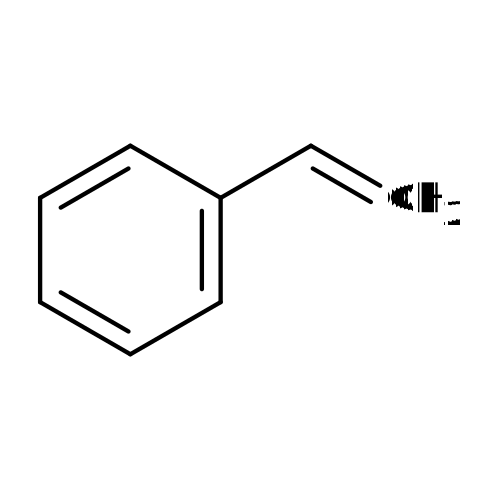
| Common Name | Styrene |
|---|
| Description | Styrene, also known as vinylbenzene or phenylethylene, belongs to the class of organic compounds known as styrenes. These are organic compounds containing an ethenylbenzene moiety. The metabolites of styrene are excreted mainly in the urine. Styrene is possibly neutral. Styrene is a sweet, balsamic, and floral tasting compound. Styrene has been detected, but not quantified, in several different foods, such as coffee and coffee products, fruits, cocoa and cocoa products, alcoholic beverages, and chinese cinnamons. This could make styrene a potential biomarker for the consumption of these foods. A minor pathway of styrene metabolism involves the formation of phenylacetaldehyde from styrene 7,8-oxide or cytochrome P450 conversion of styrene to pheylethanol and subsequent metabolism to phenylacetic acid. Styrene is formally rated as a possible carcinogen (by IARC 2B) and is also a potentially toxic compound. Styrene oxide is predominantly metabolized by epoxide hydrolase to form styrene glycol; the styrene glycol is subsequently converted to mandelic acid, phenylglyoxylic acid, and hippuric acid. Styrene, with regard to humans, has been found to be associated with several diseases such as nonalcoholic fatty liver disease and ulcerative colitis; styrene has also been linked to the inborn metabolic disorder celiac disease. Styrene may be absorbed following ingestion, inhalation, or dermal exposure. Breathing high levels of styrene may cause nervous system effects such as changes in color vision, tiredness, feeling drunk, slowed reaction time, concentration problems, or balance problems. Chest burning, wheezing, and dyspnea may also occur. Styrene causes nervous system depression and may be carcinogenic. |
|---|
| Structure | InChI=1S/C8H8/c1-2-8-6-4-3-5-7-8/h2-7H,1H2 |
|---|
| Synonyms | | Value | Source |
|---|
| Ethenylbenzene | ChEBI | | Phenylethene | ChEBI | | Phenylethylene | ChEBI | | Styren | ChEBI | | Styrol | ChEBI | | Vinylbenzene | ChEBI | | Monomer, styrene | MeSH | | Styrene monomer | MeSH | | Cinnamene | HMDB | | Cinnamenol | HMDB | | Cinnaminol | HMDB | | Cinnamol | HMDB | | Ethenyl-benzene | HMDB | | Ethenylbenzene, 9ci | HMDB | | Phenethylene | HMDB | | Phenyl-ethylene | HMDB | | Styrolene | HMDB | | Vinyl benzene | HMDB | | Vinyl-benzene | HMDB | | Vinylbenzol | HMDB |
|
|---|
| Chemical Formula | C8H8 |
|---|
| Average Molecular Weight | 104.1491 |
|---|
| Monoisotopic Molecular Weight | 104.062600256 |
|---|
| IUPAC Name | ethenylbenzene |
|---|
| Traditional Name | styrene |
|---|
| CAS Registry Number | 100-42-5 |
|---|
| SMILES | C=CC1=CC=CC=C1 |
|---|
| InChI Identifier | InChI=1S/C8H8/c1-2-8-6-4-3-5-7-8/h2-7H,1H2 |
|---|
| InChI Key | PPBRXRYQALVLMV-UHFFFAOYSA-N |
|---|
| Chemical Taxonomy |
|---|
| Description | Belongs to the class of organic compounds known as styrenes. These are organic compounds containing an ethenylbenzene moiety. |
|---|
| Kingdom | Organic compounds |
|---|
| Super Class | Benzenoids |
|---|
| Class | Benzene and substituted derivatives |
|---|
| Sub Class | Styrenes |
|---|
| Direct Parent | Styrenes |
|---|
| Alternative Parents | |
|---|
| Substituents | - Styrene
- Aromatic hydrocarbon
- Cyclic olefin
- Unsaturated hydrocarbon
- Olefin
- Hydrocarbon
- Aromatic homomonocyclic compound
|
|---|
| Molecular Framework | Aromatic homomonocyclic compounds |
|---|
| External Descriptors | |
|---|
| Ontology |
|---|
| Physiological effect | |
|---|
| Disposition | |
|---|
| Process | Not Available |
|---|
| Role | |
|---|
| Physical Properties |
|---|
| State | Liquid |
|---|
| Experimental Molecular Properties | | Property | Value | Reference |
|---|
| Melting Point | -33 °C | Not Available | | Boiling Point | 145.00 to 146.00 °C. @ 760.00 mm Hg | The Good Scents Company Information System | | Water Solubility | 0.31 mg/mL at 25 °C | Not Available | | LogP | 2.95 | Not Available |
|
|---|
| Experimental Chromatographic Properties | Not Available |
|---|
| Predicted Molecular Properties | |
|---|
| Predicted Chromatographic Properties | Predicted Collision Cross SectionsPredicted Retention Times Underivatized| Chromatographic Method | Retention Time | Reference |
|---|
| Measured using a Waters Acquity ultraperformance liquid chromatography (UPLC) ethylene-bridged hybrid (BEH) C18 column (100 mm × 2.1 mm; 1.7 μmparticle diameter). Predicted by Afia on May 17, 2022. Predicted by Afia on May 17, 2022. | 5.48 minutes | 32390414 | | Predicted by Siyang on May 30, 2022 | 15.3411 minutes | 33406817 | | Predicted by Siyang using ReTip algorithm on June 8, 2022 | 6.81 minutes | 32390414 | | Fem_Long = Waters ACQUITY UPLC HSS T3 C18 with Water:MeOH and 0.1% Formic Acid | 2121.1 seconds | 40023050 | | Fem_Lipids = Ascentis Express C18 with (60:40 water:ACN):(90:10 IPA:ACN) and 10mM NH4COOH + 0.1% Formic Acid | 614.8 seconds | 40023050 | | Life_Old = Waters ACQUITY UPLC BEH C18 with Water:(20:80 acetone:ACN) and 0.1% Formic Acid | 245.9 seconds | 40023050 | | Life_New = RP Waters ACQUITY UPLC HSS T3 C18 with Water:(30:70 MeOH:ACN) and 0.1% Formic Acid | 424.1 seconds | 40023050 | | RIKEN = Waters ACQUITY UPLC BEH C18 with Water:ACN and 0.1% Formic Acid | 318.6 seconds | 40023050 | | Eawag_XBridgeC18 = XBridge C18 3.5u 2.1x50 mm with Water:MeOH and 0.1% Formic Acid | 604.4 seconds | 40023050 | | BfG_NTS_RP1 =Agilent Zorbax Eclipse Plus C18 (2.1 mm x 150 mm, 3.5 um) with Water:ACN and 0.1% Formic Acid | 718.1 seconds | 40023050 | | HILIC_BDD_2 = Merck SeQuant ZIC-HILIC with ACN(0.1% formic acid):water(16 mM ammonium formate) | 366.4 seconds | 40023050 | | UniToyama_Atlantis = RP Waters Atlantis T3 (2.1 x 150 mm, 5 um) with ACN:Water and 0.1% Formic Acid | 1331.4 seconds | 40023050 | | BDD_C18 = Hypersil Gold 1.9µm C18 with Water:ACN and 0.1% Formic Acid | 499.9 seconds | 40023050 | | UFZ_Phenomenex = Kinetex Core-Shell C18 2.6 um, 3.0 x 100 mm, Phenomenex with Water:MeOH and 0.1% Formic Acid | 1324.8 seconds | 40023050 | | SNU_RIKEN_POS = Waters ACQUITY UPLC BEH C18 with Water:ACN and 0.1% Formic Acid | 445.7 seconds | 40023050 | | RPMMFDA = Waters ACQUITY UPLC BEH C18 with Water:ACN and 0.1% Formic Acid | 459.6 seconds | 40023050 | | MTBLS87 = Merck SeQuant ZIC-pHILIC column with ACN:Water and :ammonium carbonate | 603.6 seconds | 40023050 | | KI_GIAR_zic_HILIC_pH2_7 = Merck SeQuant ZIC-HILIC with ACN:Water and 0.1% FA | 422.3 seconds | 40023050 | | Meister zic-pHILIC pH9.3 = Merck SeQuant ZIC-pHILIC column with ACN:Water 5mM NH4Ac pH9.3 and 5mM ammonium acetate in water | 112.2 seconds | 40023050 |
Predicted Kovats Retention IndicesUnderivatized |
|---|
| Spectra |
|---|
| |
|---|
| Biological Properties |
|---|
| Cellular Locations | |
|---|
| Biospecimen Locations | - Blood
- Breath
- Feces
- Saliva
|
|---|
| Tissue Locations | Not Available |
|---|
| Pathways | |
|---|
| Normal Concentrations |
|---|
| |
| Blood | Detected and Quantified | 0.000490 (0.000422-0.00528) uM | Adult (>18 years old) | Not Specified | Normal | | details | | Blood | Detected and Quantified | 0.000374 (0.000298-0.00470) uM | Children (1-13 years old) | Not Specified | Normal | | details | | Breath | Detected but not Quantified | Not Quantified | Adult (>18 years old) | Both | Normal | | details | | Feces | Detected but not Quantified | Not Quantified | Adult (>18 years old) | Both | Normal | | details | | Feces | Detected but not Quantified | Not Quantified | Adult (>18 years old) | Both | Normal | | details | | Feces | Detected but not Quantified | Not Quantified | Adult (>18 years old) | Both | Normal | | details | | Feces | Detected but not Quantified | Not Quantified | Adult (>18 years old) | Both | Normal | | details | | Feces | Detected and Quantified | 0-10241.727 nmol/g wet feces | Children (1-13 years old) | Not Specified | Normal | | details | | Saliva | Detected but not Quantified | Not Quantified | Adult (>18 years old) | Not Specified | Normal | | details |
|
|---|
| Abnormal Concentrations |
|---|
| |
| Feces | Detected but not Quantified | Not Quantified | Adult (>18 years old) | Both | Campylobacter jejuni infection | | details | | Feces | Detected but not Quantified | Not Quantified | Adult (>18 years old) | Both | Clostridium difficile infection | | details | | Feces | Detected but not Quantified | Not Quantified | Adult (>18 years old) | Both | Ulcerative Colitis | | details | | Feces | Detected but not Quantified | Not Quantified | Adult (>18 years old) | Both | Nonalcoholic fatty liver disease (NAFLD) | | details | | Feces | Detected and Quantified | 0-315189.153 nmol/g wet feces | Children (1-13 years old) | Not Specified | Treated celiac disease | | details |
|
|---|
| Associated Disorders and Diseases |
|---|
| Disease References | | Ulcerative colitis |
|---|
- Garner CE, Smith S, de Lacy Costello B, White P, Spencer R, Probert CS, Ratcliffe NM: Volatile organic compounds from feces and their potential for diagnosis of gastrointestinal disease. FASEB J. 2007 Jun;21(8):1675-88. Epub 2007 Feb 21. [PubMed:17314143 ]
| | Nonalcoholic fatty liver disease |
|---|
- Raman M, Ahmed I, Gillevet PM, Probert CS, Ratcliffe NM, Smith S, Greenwood R, Sikaroodi M, Lam V, Crotty P, Bailey J, Myers RP, Rioux KP: Fecal microbiome and volatile organic compound metabolome in obese humans with nonalcoholic fatty liver disease. Clin Gastroenterol Hepatol. 2013 Jul;11(7):868-75.e1-3. doi: 10.1016/j.cgh.2013.02.015. Epub 2013 Feb 27. [PubMed:23454028 ]
| | Celiac disease |
|---|
- Di Cagno R, De Angelis M, De Pasquale I, Ndagijimana M, Vernocchi P, Ricciuti P, Gagliardi F, Laghi L, Crecchio C, Guerzoni ME, Gobbetti M, Francavilla R: Duodenal and faecal microbiota of celiac children: molecular, phenotype and metabolome characterization. BMC Microbiol. 2011 Oct 4;11:219. doi: 10.1186/1471-2180-11-219. [PubMed:21970810 ]
|
|
|---|
| Associated OMIM IDs | |
|---|
| External Links |
|---|
| DrugBank ID | Not Available |
|---|
| Phenol Explorer Compound ID | Not Available |
|---|
| FooDB ID | FDB012552 |
|---|
| KNApSAcK ID | C00037855 |
|---|
| Chemspider ID | 7220 |
|---|
| KEGG Compound ID | C19506 |
|---|
| BioCyc ID | CPD-1092 |
|---|
| BiGG ID | Not Available |
|---|
| Wikipedia Link | Styrene |
|---|
| METLIN ID | Not Available |
|---|
| PubChem Compound | 7501 |
|---|
| PDB ID | Not Available |
|---|
| ChEBI ID | 27452 |
|---|
| Food Biomarker Ontology | Not Available |
|---|
| VMH ID | Not Available |
|---|
| MarkerDB ID | MDB00029824 |
|---|
| Good Scents ID | rw1009281 |
|---|
| References |
|---|
| Synthesis Reference | Not Available |
|---|
| Material Safety Data Sheet (MSDS) | Not Available |
|---|
| General References | - Roder-Stolinski C, Fischader G, Oostingh GJ, Feltens R, Kohse F, von Bergen M, Morbt N, Eder K, Duschl A, Lehmann I: Styrene induces an inflammatory response in human lung epithelial cells via oxidative stress and NF-kappaB activation. Toxicol Appl Pharmacol. 2008 Sep 1;231(2):241-7. doi: 10.1016/j.taap.2008.04.010. Epub 2008 Apr 29. [PubMed:18554678 ]
- Alonso S, Bartolome-Martin D, del Alamo M, Diaz E, Garcia JL, Perera J: Genetic characterization of the styrene lower catabolic pathway of Pseudomonas sp. strain Y2. Gene. 2003 Nov 13;319:71-83. [PubMed:14597173 ]
- (). Yannai, Shmuel. (2004) Dictionary of food compounds with CD-ROM: Additives, flavors, and ingredients. Boca Raton: Chapman & Hall/CRC.. .
|
|---|