| Record Information |
|---|
| Version | 5.0 |
|---|
| Status | Detected but not Quantified |
|---|
| Creation Date | 2005-11-16 15:48:42 UTC |
|---|
| Update Date | 2023-02-21 17:14:54 UTC |
|---|
| HMDB ID | HMDB0000528 |
|---|
| Secondary Accession Numbers | - HMDB0011746
- HMDB00528
- HMDB11746
|
|---|
| Metabolite Identification |
|---|
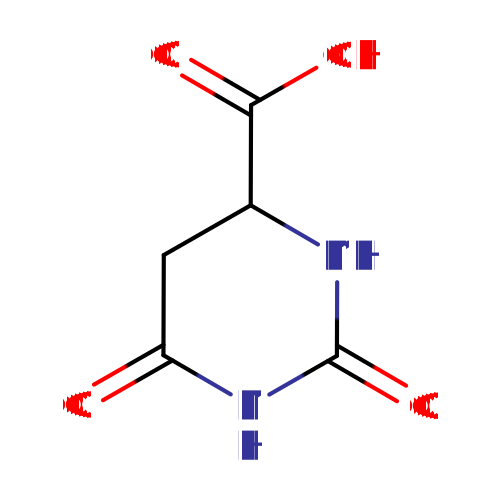
| Common Name | 4,5-Dihydroorotic acid |
|---|
| Description | 4,5-Dihydroorotic acid, also known as dihydroorotate or hydroorotate is a pyrimidinemonocarboxylic acid that results from the base-catalysed cyclisation of N-alpha-carbethoxyasparagine. It is classified as a secondary amide, a monocarboxylic acid, a pyrimidinemonocarboxylic acid and a N-acylurea. 4,5-Dihydroorotic acid is a derivative of orotic acid which serves as an intermediate in pyrimidine biosynthesis. 4,5-Dihydroorotic acid exists in all living species, ranging from bacteria to plants to humans. 4,5-Dihydroorotic acid is synthesized by the enzyme known as Dihydroorotase (EC 3.5.2.3) which converts carbamoyl aspartic acid into 4,5-dihydroorotic acid as part of the de novo pyrimidine biosynthesis pathway (PMID: 13163076 ). 4,5-Dihydroorotic acid is also a substrate for the enzyme known as dihydroorotate dehydrogenase (DHODH). In mammalian species, DHODH catalyzes the fourth step in the de novo pyrimidine biosynthesis pathway, which involves the ubiquinone-mediated oxidation of dihydroorotate to orotate and the reduction of flavin mononucleotide (FMN) to dihydroflavin mononucleotide (FMNH2). Inhibition of DHODH activity with teriflunomide (an immunomodulatory drug) or expression with RNA interference results in reduced ROS generation and consequent apoptosis of transformed skin and prostate epithelial cells. Mutations in the DHOD gene have been shown to cause Miller syndrome, also known as Genee-Wiedemann syndrome, Wildervanck-Smith syndrome or post-axial acrofacial dystosis (PMID: 19915526 ). |
|---|
| Structure | InChI=1S/C5H6N2O4/c8-3-1-2(4(9)10)6-5(11)7-3/h2H,1H2,(H,9,10)(H2,6,7,8,11) |
|---|
| Synonyms | | Value | Source |
|---|
| 5,6-Dihydro-orotic acid | ChEBI | | DL-Dihydroortotic acid | ChEBI | | Hydroorotic acid | ChEBI | | 5,6-Dihydro-orotate | Generator | | DL-Dihydroortotate | Generator | | Hydroorotate | Generator | | 4,5-Dihydroorotate | Generator | | 4,5-Dihydroorotic acid, (D)-isomer | MeSH | | 4,5-Dihydroorotic acid, (DL)-isomer | MeSH | | 4,5-Dihydroorotic acid, (L)-isomer | MeSH | | 5,6-Dihydroorotate | MeSH | | L-Dihydroorotate | MeSH | | Dihydroorotate | MeSH | | (+)-2,6-dioxo-hexahydro-Pyrimidine-4-carboxylate | HMDB | | (+)-2,6-dioxo-hexahydro-Pyrimidine-4-carboxylic acid | HMDB | | (R)-2,6-dioxo-hexahydro-Pyrimidine-4-carboxylate | HMDB | | (R)-2,6-dioxo-hexahydro-Pyrimidine-4-carboxylic acid | HMDB | | (S)-2,6-dioxo-hexahydro-Pyrimidine-4-carboxylate | HMDB | | (S)-2,6-dioxo-hexahydro-Pyrimidine-4-carboxylic acid | HMDB | | 2,6-dioxo-hexahydro-Pyrimidine-4-carboxylate | HMDB | | 2,6-dioxo-hexahydro-Pyrimidine-4-carboxylic acid | HMDB | | L-Hydroorotate | HMDB | | L-Hydroorotic acid | HMDB | | R,S-Hydroorotate | HMDB |
|
|---|
| Chemical Formula | C5H6N2O4 |
|---|
| Average Molecular Weight | 158.1121 |
|---|
| Monoisotopic Molecular Weight | 158.03275669 |
|---|
| IUPAC Name | 2,6-dioxo-1,3-diazinane-4-carboxylic acid |
|---|
| Traditional Name | dihydroorotic acid |
|---|
| CAS Registry Number | 155-54-4 |
|---|
| SMILES | OC(=O)C1CC(=O)NC(=O)N1 |
|---|
| InChI Identifier | InChI=1S/C5H6N2O4/c8-3-1-2(4(9)10)6-5(11)7-3/h2H,1H2,(H,9,10)(H2,6,7,8,11) |
|---|
| InChI Key | UFIVEPVSAGBUSI-UHFFFAOYSA-N |
|---|
| Chemical Taxonomy |
|---|
| Description | Belongs to the class of organic compounds known as alpha amino acids and derivatives. These are amino acids in which the amino group is attached to the carbon atom immediately adjacent to the carboxylate group (alpha carbon), or a derivative thereof. |
|---|
| Kingdom | Organic compounds |
|---|
| Super Class | Organic acids and derivatives |
|---|
| Class | Carboxylic acids and derivatives |
|---|
| Sub Class | Amino acids, peptides, and analogues |
|---|
| Direct Parent | Alpha amino acids and derivatives |
|---|
| Alternative Parents | |
|---|
| Substituents | - Alpha-amino acid or derivatives
- N-acyl urea
- Pyrimidone
- Ureide
- 1,3-diazinane
- Pyrimidine
- Dicarboximide
- Urea
- Carbonic acid derivative
- Azacycle
- Monocarboxylic acid or derivatives
- Carboxylic acid
- Organoheterocyclic compound
- Hydrocarbon derivative
- Organic oxide
- Organooxygen compound
- Organonitrogen compound
- Organopnictogen compound
- Organic oxygen compound
- Carbonyl group
- Organic nitrogen compound
- Aliphatic heteromonocyclic compound
|
|---|
| Molecular Framework | Aliphatic heteromonocyclic compounds |
|---|
| External Descriptors | |
|---|
| Ontology |
|---|
| Physiological effect | Not Available |
|---|
| Disposition | |
|---|
| Process | |
|---|
| Role | Not Available |
|---|
| Physical Properties |
|---|
| State | Solid |
|---|
| Experimental Molecular Properties | | Property | Value | Reference |
|---|
| Melting Point | Not Available | Not Available | | Boiling Point | Not Available | Not Available | | Water Solubility | Not Available | Not Available | | LogP | Not Available | Not Available |
|
|---|
| Experimental Chromatographic Properties | Not Available |
|---|
| Predicted Molecular Properties | |
|---|
| Predicted Chromatographic Properties | Predicted Collision Cross SectionsPredicted Retention Times Underivatized| Chromatographic Method | Retention Time | Reference |
|---|
| Measured using a Waters Acquity ultraperformance liquid chromatography (UPLC) ethylene-bridged hybrid (BEH) C18 column (100 mm × 2.1 mm; 1.7 μmparticle diameter). Predicted by Afia on May 17, 2022. | 1.35 minutes | 32390414 | | Predicted by Siyang on May 30, 2022 | 9.796 minutes | 33406817 | | Predicted by Siyang using ReTip algorithm on June 8, 2022 | 5.72 minutes | 32390414 | | AjsUoB = Accucore 150 Amide HILIC with 10mM Ammonium Formate, 0.1% Formic Acid | 238.9 seconds | 40023050 | | Fem_Long = Waters ACQUITY UPLC HSS T3 C18 with Water:MeOH and 0.1% Formic Acid | 821.1 seconds | 40023050 | | Fem_Lipids = Ascentis Express C18 with (60:40 water:ACN):(90:10 IPA:ACN) and 10mM NH4COOH + 0.1% Formic Acid | 343.9 seconds | 40023050 | | Life_Old = Waters ACQUITY UPLC BEH C18 with Water:(20:80 acetone:ACN) and 0.1% Formic Acid | 56.8 seconds | 40023050 | | Life_New = RP Waters ACQUITY UPLC HSS T3 C18 with Water:(30:70 MeOH:ACN) and 0.1% Formic Acid | 202.4 seconds | 40023050 | | RIKEN = Waters ACQUITY UPLC BEH C18 with Water:ACN and 0.1% Formic Acid | 73.5 seconds | 40023050 | | Eawag_XBridgeC18 = XBridge C18 3.5u 2.1x50 mm with Water:MeOH and 0.1% Formic Acid | 270.9 seconds | 40023050 | | BfG_NTS_RP1 =Agilent Zorbax Eclipse Plus C18 (2.1 mm x 150 mm, 3.5 um) with Water:ACN and 0.1% Formic Acid | 277.9 seconds | 40023050 | | HILIC_BDD_2 = Merck SeQuant ZIC-HILIC with ACN(0.1% formic acid):water(16 mM ammonium formate) | 656.2 seconds | 40023050 | | UniToyama_Atlantis = RP Waters Atlantis T3 (2.1 x 150 mm, 5 um) with ACN:Water and 0.1% Formic Acid | 626.4 seconds | 40023050 | | BDD_C18 = Hypersil Gold 1.9µm C18 with Water:ACN and 0.1% Formic Acid | 70.2 seconds | 40023050 | | UFZ_Phenomenex = Kinetex Core-Shell C18 2.6 um, 3.0 x 100 mm, Phenomenex with Water:MeOH and 0.1% Formic Acid | 895.6 seconds | 40023050 | | SNU_RIKEN_POS = Waters ACQUITY UPLC BEH C18 with Water:ACN and 0.1% Formic Acid | 211.3 seconds | 40023050 | | RPMMFDA = Waters ACQUITY UPLC BEH C18 with Water:ACN and 0.1% Formic Acid | 261.8 seconds | 40023050 | | MTBLS87 = Merck SeQuant ZIC-pHILIC column with ACN:Water and :ammonium carbonate | 703.7 seconds | 40023050 | | KI_GIAR_zic_HILIC_pH2_7 = Merck SeQuant ZIC-HILIC with ACN:Water and 0.1% FA | 290.0 seconds | 40023050 | | Meister zic-pHILIC pH9.3 = Merck SeQuant ZIC-pHILIC column with ACN:Water 5mM NH4Ac pH9.3 and 5mM ammonium acetate in water | 339.0 seconds | 40023050 |
Predicted Kovats Retention IndicesUnderivatizedDerivatized| Derivative Name / Structure | SMILES | Kovats RI Value | Column Type | Reference |
|---|
| 4,5-Dihydroorotic acid,1TMS,isomer #1 | C[Si](C)(C)OC(=O)C1CC(=O)NC(=O)N1 | 1660.6 | Semi standard non polar | 33892256 | | 4,5-Dihydroorotic acid,1TMS,isomer #2 | C[Si](C)(C)N1C(=O)CC(C(=O)O)NC1=O | 1676.6 | Semi standard non polar | 33892256 | | 4,5-Dihydroorotic acid,1TMS,isomer #3 | C[Si](C)(C)N1C(=O)NC(=O)CC1C(=O)O | 1672.5 | Semi standard non polar | 33892256 | | 4,5-Dihydroorotic acid,2TMS,isomer #1 | C[Si](C)(C)OC(=O)C1CC(=O)N([Si](C)(C)C)C(=O)N1 | 1708.7 | Semi standard non polar | 33892256 | | 4,5-Dihydroorotic acid,2TMS,isomer #1 | C[Si](C)(C)OC(=O)C1CC(=O)N([Si](C)(C)C)C(=O)N1 | 1803.2 | Standard non polar | 33892256 | | 4,5-Dihydroorotic acid,2TMS,isomer #1 | C[Si](C)(C)OC(=O)C1CC(=O)N([Si](C)(C)C)C(=O)N1 | 2846.9 | Standard polar | 33892256 | | 4,5-Dihydroorotic acid,2TMS,isomer #2 | C[Si](C)(C)OC(=O)C1CC(=O)NC(=O)N1[Si](C)(C)C | 1682.0 | Semi standard non polar | 33892256 | | 4,5-Dihydroorotic acid,2TMS,isomer #2 | C[Si](C)(C)OC(=O)C1CC(=O)NC(=O)N1[Si](C)(C)C | 1807.4 | Standard non polar | 33892256 | | 4,5-Dihydroorotic acid,2TMS,isomer #2 | C[Si](C)(C)OC(=O)C1CC(=O)NC(=O)N1[Si](C)(C)C | 2875.1 | Standard polar | 33892256 | | 4,5-Dihydroorotic acid,2TMS,isomer #3 | C[Si](C)(C)N1C(=O)CC(C(=O)O)N([Si](C)(C)C)C1=O | 1671.8 | Semi standard non polar | 33892256 | | 4,5-Dihydroorotic acid,2TMS,isomer #3 | C[Si](C)(C)N1C(=O)CC(C(=O)O)N([Si](C)(C)C)C1=O | 1748.6 | Standard non polar | 33892256 | | 4,5-Dihydroorotic acid,2TMS,isomer #3 | C[Si](C)(C)N1C(=O)CC(C(=O)O)N([Si](C)(C)C)C1=O | 2485.0 | Standard polar | 33892256 | | 4,5-Dihydroorotic acid,3TMS,isomer #1 | C[Si](C)(C)OC(=O)C1CC(=O)N([Si](C)(C)C)C(=O)N1[Si](C)(C)C | 1699.5 | Semi standard non polar | 33892256 | | 4,5-Dihydroorotic acid,3TMS,isomer #1 | C[Si](C)(C)OC(=O)C1CC(=O)N([Si](C)(C)C)C(=O)N1[Si](C)(C)C | 1812.4 | Standard non polar | 33892256 | | 4,5-Dihydroorotic acid,3TMS,isomer #1 | C[Si](C)(C)OC(=O)C1CC(=O)N([Si](C)(C)C)C(=O)N1[Si](C)(C)C | 2209.8 | Standard polar | 33892256 | | 4,5-Dihydroorotic acid,1TBDMS,isomer #1 | CC(C)(C)[Si](C)(C)OC(=O)C1CC(=O)NC(=O)N1 | 1942.6 | Semi standard non polar | 33892256 | | 4,5-Dihydroorotic acid,1TBDMS,isomer #2 | CC(C)(C)[Si](C)(C)N1C(=O)CC(C(=O)O)NC1=O | 1964.9 | Semi standard non polar | 33892256 | | 4,5-Dihydroorotic acid,1TBDMS,isomer #3 | CC(C)(C)[Si](C)(C)N1C(=O)NC(=O)CC1C(=O)O | 1969.8 | Semi standard non polar | 33892256 | | 4,5-Dihydroorotic acid,2TBDMS,isomer #1 | CC(C)(C)[Si](C)(C)OC(=O)C1CC(=O)N([Si](C)(C)C(C)(C)C)C(=O)N1 | 2157.1 | Semi standard non polar | 33892256 | | 4,5-Dihydroorotic acid,2TBDMS,isomer #1 | CC(C)(C)[Si](C)(C)OC(=O)C1CC(=O)N([Si](C)(C)C(C)(C)C)C(=O)N1 | 2239.9 | Standard non polar | 33892256 | | 4,5-Dihydroorotic acid,2TBDMS,isomer #1 | CC(C)(C)[Si](C)(C)OC(=O)C1CC(=O)N([Si](C)(C)C(C)(C)C)C(=O)N1 | 2802.5 | Standard polar | 33892256 | | 4,5-Dihydroorotic acid,2TBDMS,isomer #2 | CC(C)(C)[Si](C)(C)OC(=O)C1CC(=O)NC(=O)N1[Si](C)(C)C(C)(C)C | 2180.9 | Semi standard non polar | 33892256 | | 4,5-Dihydroorotic acid,2TBDMS,isomer #2 | CC(C)(C)[Si](C)(C)OC(=O)C1CC(=O)NC(=O)N1[Si](C)(C)C(C)(C)C | 2254.4 | Standard non polar | 33892256 | | 4,5-Dihydroorotic acid,2TBDMS,isomer #2 | CC(C)(C)[Si](C)(C)OC(=O)C1CC(=O)NC(=O)N1[Si](C)(C)C(C)(C)C | 2908.0 | Standard polar | 33892256 | | 4,5-Dihydroorotic acid,2TBDMS,isomer #3 | CC(C)(C)[Si](C)(C)N1C(=O)CC(C(=O)O)N([Si](C)(C)C(C)(C)C)C1=O | 2183.1 | Semi standard non polar | 33892256 | | 4,5-Dihydroorotic acid,2TBDMS,isomer #3 | CC(C)(C)[Si](C)(C)N1C(=O)CC(C(=O)O)N([Si](C)(C)C(C)(C)C)C1=O | 2208.1 | Standard non polar | 33892256 | | 4,5-Dihydroorotic acid,2TBDMS,isomer #3 | CC(C)(C)[Si](C)(C)N1C(=O)CC(C(=O)O)N([Si](C)(C)C(C)(C)C)C1=O | 2559.5 | Standard polar | 33892256 | | 4,5-Dihydroorotic acid,3TBDMS,isomer #1 | CC(C)(C)[Si](C)(C)OC(=O)C1CC(=O)N([Si](C)(C)C(C)(C)C)C(=O)N1[Si](C)(C)C(C)(C)C | 2385.0 | Semi standard non polar | 33892256 | | 4,5-Dihydroorotic acid,3TBDMS,isomer #1 | CC(C)(C)[Si](C)(C)OC(=O)C1CC(=O)N([Si](C)(C)C(C)(C)C)C(=O)N1[Si](C)(C)C(C)(C)C | 2467.5 | Standard non polar | 33892256 | | 4,5-Dihydroorotic acid,3TBDMS,isomer #1 | CC(C)(C)[Si](C)(C)OC(=O)C1CC(=O)N([Si](C)(C)C(C)(C)C)C(=O)N1[Si](C)(C)C(C)(C)C | 2480.7 | Standard polar | 33892256 |
|
|---|
| GC-MS Spectra| Spectrum Type | Description | Splash Key | Deposition Date | Source | View |
|---|
| Predicted GC-MS | Predicted GC-MS Spectrum - 4,5-Dihydroorotic acid GC-MS (Non-derivatized) - 70eV, Positive | splash10-000f-9400000000-248b8d6d703ba73c2058 | 2016-09-22 | Wishart Lab | View Spectrum | | Predicted GC-MS | Predicted GC-MS Spectrum - 4,5-Dihydroorotic acid GC-MS (1 TMS) - 70eV, Positive | splash10-03di-3900000000-b0776f22820e6e570a09 | 2017-10-06 | Wishart Lab | View Spectrum | | Predicted GC-MS | Predicted GC-MS Spectrum - 4,5-Dihydroorotic acid GC-MS (Non-derivatized) - 70eV, Positive | Not Available | 2021-10-12 | Wishart Lab | View Spectrum | | Predicted GC-MS | Predicted GC-MS Spectrum - 4,5-Dihydroorotic acid GC-MS (TMS_1_2) - 70eV, Positive | Not Available | 2021-11-05 | Wishart Lab | View Spectrum | | Predicted GC-MS | Predicted GC-MS Spectrum - 4,5-Dihydroorotic acid GC-MS (TMS_1_3) - 70eV, Positive | Not Available | 2021-11-05 | Wishart Lab | View Spectrum | | Predicted GC-MS | Predicted GC-MS Spectrum - 4,5-Dihydroorotic acid GC-MS (TBDMS_1_1) - 70eV, Positive | Not Available | 2021-11-05 | Wishart Lab | View Spectrum | | Predicted GC-MS | Predicted GC-MS Spectrum - 4,5-Dihydroorotic acid GC-MS (TBDMS_1_2) - 70eV, Positive | Not Available | 2021-11-05 | Wishart Lab | View Spectrum | | Predicted GC-MS | Predicted GC-MS Spectrum - 4,5-Dihydroorotic acid GC-MS (TBDMS_1_3) - 70eV, Positive | Not Available | 2021-11-05 | Wishart Lab | View Spectrum |
MS/MS Spectra| Spectrum Type | Description | Splash Key | Deposition Date | Source | View |
|---|
| Experimental LC-MS/MS | LC-MS/MS Spectrum - 4,5-Dihydroorotic acid Quattro_QQQ 10V, Positive-QTOF (Annotated) | splash10-059i-9700000000-c8ce0433c02db41880b9 | 2012-07-24 | HMDB team, MONA | View Spectrum | | Experimental LC-MS/MS | LC-MS/MS Spectrum - 4,5-Dihydroorotic acid Quattro_QQQ 25V, Positive-QTOF (Annotated) | splash10-00di-9000000000-56601203ef19b09212fe | 2012-07-24 | HMDB team, MONA | View Spectrum | | Experimental LC-MS/MS | LC-MS/MS Spectrum - 4,5-Dihydroorotic acid Quattro_QQQ 40V, Positive-QTOF (Annotated) | splash10-006x-9000000000-b6342346ce51dd871eaa | 2012-07-24 | HMDB team, MONA | View Spectrum | | Predicted LC-MS/MS | Predicted LC-MS/MS Spectrum - 4,5-Dihydroorotic acid 10V, Positive-QTOF | splash10-0a4i-0900000000-2ddb498acc970a567f6b | 2016-09-14 | Wishart Lab | View Spectrum | | Predicted LC-MS/MS | Predicted LC-MS/MS Spectrum - 4,5-Dihydroorotic acid 20V, Positive-QTOF | splash10-03dl-5900000000-4b73ae512e57466dd4e6 | 2016-09-14 | Wishart Lab | View Spectrum | | Predicted LC-MS/MS | Predicted LC-MS/MS Spectrum - 4,5-Dihydroorotic acid 40V, Positive-QTOF | splash10-0006-9100000000-d6c31a36d6fe5c68d9e1 | 2016-09-14 | Wishart Lab | View Spectrum | | Predicted LC-MS/MS | Predicted LC-MS/MS Spectrum - 4,5-Dihydroorotic acid 10V, Negative-QTOF | splash10-0a4i-1900000000-c84801951eaa1da750f7 | 2016-09-14 | Wishart Lab | View Spectrum | | Predicted LC-MS/MS | Predicted LC-MS/MS Spectrum - 4,5-Dihydroorotic acid 20V, Negative-QTOF | splash10-0006-9000000000-4ae1d11ab20f903606c3 | 2016-09-14 | Wishart Lab | View Spectrum | | Predicted LC-MS/MS | Predicted LC-MS/MS Spectrum - 4,5-Dihydroorotic acid 40V, Negative-QTOF | splash10-0006-9000000000-aec3a40befb20e60f21b | 2016-09-14 | Wishart Lab | View Spectrum | | Predicted LC-MS/MS | Predicted LC-MS/MS Spectrum - 4,5-Dihydroorotic acid 10V, Positive-QTOF | splash10-06r6-0900000000-86736ae769db7bc83c23 | 2021-09-24 | Wishart Lab | View Spectrum | | Predicted LC-MS/MS | Predicted LC-MS/MS Spectrum - 4,5-Dihydroorotic acid 20V, Positive-QTOF | splash10-03di-5900000000-f6e9e0cbdc2adf67aa89 | 2021-09-24 | Wishart Lab | View Spectrum | | Predicted LC-MS/MS | Predicted LC-MS/MS Spectrum - 4,5-Dihydroorotic acid 40V, Positive-QTOF | splash10-00dl-9000000000-aac58a007ab745825d74 | 2021-09-24 | Wishart Lab | View Spectrum | | Predicted LC-MS/MS | Predicted LC-MS/MS Spectrum - 4,5-Dihydroorotic acid 10V, Negative-QTOF | splash10-0a4i-0900000000-b0c5e687f246809cdae9 | 2021-09-24 | Wishart Lab | View Spectrum | | Predicted LC-MS/MS | Predicted LC-MS/MS Spectrum - 4,5-Dihydroorotic acid 20V, Negative-QTOF | splash10-01ox-6900000000-cb60b796898e6ca4336d | 2021-09-24 | Wishart Lab | View Spectrum | | Predicted LC-MS/MS | Predicted LC-MS/MS Spectrum - 4,5-Dihydroorotic acid 40V, Negative-QTOF | splash10-0006-9000000000-fccf5d7216b23cffed7a | 2021-09-24 | Wishart Lab | View Spectrum |
NMR Spectra| Spectrum Type | Description | Deposition Date | Source | View |
|---|
| Experimental 1D NMR | 1H NMR Spectrum (1D, 500 MHz, H2O, experimental) | 2012-12-04 | Wishart Lab | View Spectrum | | Predicted 1D NMR | 13C NMR Spectrum (1D, 100 MHz, D2O, predicted) | 2021-09-29 | Wishart Lab | View Spectrum | | Predicted 1D NMR | 1H NMR Spectrum (1D, 100 MHz, D2O, predicted) | 2021-09-29 | Wishart Lab | View Spectrum | | Predicted 1D NMR | 13C NMR Spectrum (1D, 1000 MHz, D2O, predicted) | 2021-09-29 | Wishart Lab | View Spectrum | | Predicted 1D NMR | 1H NMR Spectrum (1D, 1000 MHz, D2O, predicted) | 2021-09-29 | Wishart Lab | View Spectrum | | Predicted 1D NMR | 13C NMR Spectrum (1D, 200 MHz, D2O, predicted) | 2021-09-29 | Wishart Lab | View Spectrum | | Predicted 1D NMR | 1H NMR Spectrum (1D, 200 MHz, D2O, predicted) | 2021-09-29 | Wishart Lab | View Spectrum | | Predicted 1D NMR | 13C NMR Spectrum (1D, 300 MHz, D2O, predicted) | 2021-09-29 | Wishart Lab | View Spectrum | | Predicted 1D NMR | 1H NMR Spectrum (1D, 300 MHz, D2O, predicted) | 2021-09-29 | Wishart Lab | View Spectrum | | Predicted 1D NMR | 13C NMR Spectrum (1D, 400 MHz, D2O, predicted) | 2021-09-29 | Wishart Lab | View Spectrum | | Predicted 1D NMR | 1H NMR Spectrum (1D, 400 MHz, D2O, predicted) | 2021-09-29 | Wishart Lab | View Spectrum | | Predicted 1D NMR | 13C NMR Spectrum (1D, 500 MHz, D2O, predicted) | 2021-09-29 | Wishart Lab | View Spectrum | | Predicted 1D NMR | 1H NMR Spectrum (1D, 500 MHz, D2O, predicted) | 2021-09-29 | Wishart Lab | View Spectrum | | Predicted 1D NMR | 13C NMR Spectrum (1D, 600 MHz, D2O, predicted) | 2021-09-29 | Wishart Lab | View Spectrum | | Predicted 1D NMR | 1H NMR Spectrum (1D, 600 MHz, D2O, predicted) | 2021-09-29 | Wishart Lab | View Spectrum | | Predicted 1D NMR | 13C NMR Spectrum (1D, 700 MHz, D2O, predicted) | 2021-09-29 | Wishart Lab | View Spectrum | | Predicted 1D NMR | 1H NMR Spectrum (1D, 700 MHz, D2O, predicted) | 2021-09-29 | Wishart Lab | View Spectrum | | Predicted 1D NMR | 13C NMR Spectrum (1D, 800 MHz, D2O, predicted) | 2021-09-29 | Wishart Lab | View Spectrum | | Predicted 1D NMR | 1H NMR Spectrum (1D, 800 MHz, D2O, predicted) | 2021-09-29 | Wishart Lab | View Spectrum | | Predicted 1D NMR | 13C NMR Spectrum (1D, 900 MHz, D2O, predicted) | 2021-09-29 | Wishart Lab | View Spectrum | | Predicted 1D NMR | 1H NMR Spectrum (1D, 900 MHz, D2O, predicted) | 2021-09-29 | Wishart Lab | View Spectrum | | Experimental 2D NMR | [1H, 13C]-HSQC NMR Spectrum (2D, 600 MHz, H2O, experimental) | 2012-12-05 | Wishart Lab | View Spectrum |
IR Spectra| Spectrum Type | Description | Deposition Date | Source | View |
|---|
| Predicted IR Spectrum | IR Ion Spectrum (Predicted IRIS Spectrum, Adduct: [M-H]-) | 2023-02-03 | FELIX lab | View Spectrum | | Predicted IR Spectrum | IR Ion Spectrum (Predicted IRIS Spectrum, Adduct: [M+H]+) | 2023-02-03 | FELIX lab | View Spectrum | | Predicted IR Spectrum | IR Ion Spectrum (Predicted IRIS Spectrum, Adduct: [M+Na]+) | 2023-02-03 | FELIX lab | View Spectrum |
|
|---|
| General References | - Ng SB, Buckingham KJ, Lee C, Bigham AW, Tabor HK, Dent KM, Huff CD, Shannon PT, Jabs EW, Nickerson DA, Shendure J, Bamshad MJ: Exome sequencing identifies the cause of a mendelian disorder. Nat Genet. 2010 Jan;42(1):30-5. doi: 10.1038/ng.499. Epub 2009 Nov 13. [PubMed:19915526 ]
- Sreekumar A, Poisson LM, Rajendiran TM, Khan AP, Cao Q, Yu J, Laxman B, Mehra R, Lonigro RJ, Li Y, Nyati MK, Ahsan A, Kalyana-Sundaram S, Han B, Cao X, Byun J, Omenn GS, Ghosh D, Pennathur S, Alexander DC, Berger A, Shuster JR, Wei JT, Varambally S, Beecher C, Chinnaiyan AM: Metabolomic profiles delineate potential role for sarcosine in prostate cancer progression. Nature. 2009 Feb 12;457(7231):910-4. doi: 10.1038/nature07762. [PubMed:19212411 ]
- LIEBERMAN I, KORNBERG A: Enzymatic synthesis and breakdown of a pyrimidine, orotic acid. I. Dihydroortic acid, ureidosuccinic acid, and 5-carboxymethylhydantoin. J Biol Chem. 1954 Apr;207(2):911-24. [PubMed:13163076 ]
|
|---|