| Record Information |
|---|
| Version | 5.0 |
|---|
| Status | Detected and Quantified |
|---|
| Creation Date | 2006-08-15 22:23:21 UTC |
|---|
| Update Date | 2022-03-07 02:49:04 UTC |
|---|
| HMDB ID | HMDB0000598 |
|---|
| Secondary Accession Numbers | - HMDB0031433
- HMDB00598
- HMDB31433
|
|---|
| Metabolite Identification |
|---|
| Common Name | Sulfide |
|---|
| Description | A sulfide or sulphide (UK) is an anion of sulfur in its lowest oxidation state of 2-. Sulfide is also a slightly archaic term for thioethers, a common type oforganosulfur compound that are well known for their bad odors. Sulfides are moderately strong reducing agents. They react with oxygen in the air in elevated temperatures to form higher-valence sulfur salts, such as sulfates and sulfur dioxide. (Wikipedia ). Sulfur (Greek is theion) is the chemical element in the periodic table that has the symbol S and atomic number 16. It is an abundant, tasteless, odorless, multivalent non-metal. Sulfur, in its native form, is a yellow crystalline solid. In nature, it can be found as the pure element or as sulfide and sulfate minerals. It is an essential element for life, and is widely used in biochemical processes. Sulfur is an important part of many enzymes and also in antioxidant molecules like glutathione and thioredoxin. The amino acids cysteine and methionine contain sulfur, as do all polypeptides, proteins, and enzymes which contain these amino acids. This makes sulfur a necessary component of all living cells. Disulfide bonds between polypeptides are very important in protein assembly and structure. They are largely responsible for the mechanical strength and insolubility of the protein keratin, found in outer skin, hair, and feathers, and the element contributes to their pungent odor when burned. (Wikipedia ). Homocysteine and taurine are also sulfur containing amino acids but are not coded for by DNA nor are they part of the primary structure of proteins. Some forms of bacteria use hydrogen sulfide (H2S) in the place of water as the electron donor in a primitive photosynthesis-like process. Sulfur is absorbed by plants via the roots from soil as the sulfate ion and reduced to sulfide before it is incorporated into cysteine and other organic sulfur compounds (sulfur assimilation). Inorganic sulfur forms a part of iron-sulfur clusters, and sulfur is the bridging ligand in the CuA site of cytochrome c oxidase. Sulfur is an important component of coenzyme A. At room temperature, sulfur is a soft bright yellow solid. Although sulfur is blamed for the smell of rotten eggs elemental sulfur has only the faintest odor (the odor associated with rotten eggs is actually due to hydrogen sulfide and organic sulfur compounds). It burns with a blue flame that emits sulfur dioxide, notable for its peculiar suffocating odor. Sulfur is insoluble in water but soluble in carbon disulfide and to a lesser extent in other organic solvents such as benzene. Through its major derivative, sulfuric acid (H2SO4), sulfur ranks as one of the more important industrial raw materials. It is of prime importance to every sector of the world's economies. The Latin name of the element is sulfur with an F. Since it is an original Latin name and not a Classical Greek loan, the fricative phoneme is indeed denoted with f rather than ph. Its commercial uses are primarily in fertilizers, but it is also widely used in gunpowder, matches, insecticides and fungicides; A flammable, poisonous gas with a characteristic odor of rotten eggs. It is used in the manufacture of chemicals, in metallurgy, and as an analytical reagent. (From Merck Index, 11th ed.) The burning of coal and petroleum by industry and power plants liberates huge amounts of sulfur dioxide (SO2) which reacts with atmospheric water and oxygen to produce sulfuric acid. This sulfuric acid is a component of acid rain, which lowers the pH of soil and freshwater bodies, resulting in substantial damage to the natural environment and chemical weathering of statues and architecture. |
|---|
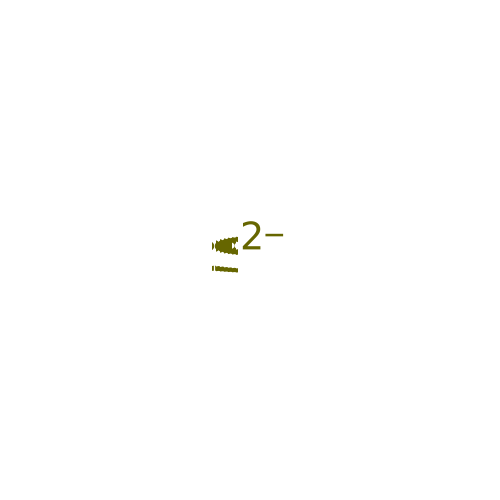
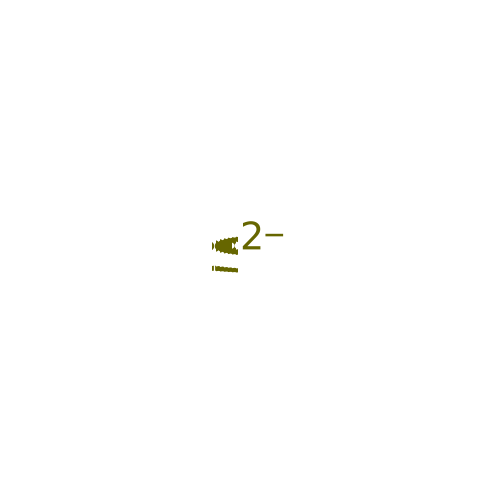
| Structure | |
|---|
| Synonyms | | Value | Source |
|---|
| S(2-) | ChEBI | | Sulphide | ChEBI | | Sulfanediide | HMDB | | Sulfur | HMDB | | Sulphide(2-) | HMDB | | Sulfide | ChEBI |
|
|---|
| Chemical Formula | S |
|---|
| Average Molecular Weight | 32.065 |
|---|
| Monoisotopic Molecular Weight | 31.97207069 |
|---|
| IUPAC Name | sulfanediide |
|---|
| Traditional Name | sulfanediide |
|---|
| CAS Registry Number | 18496-25-8 |
|---|
| SMILES | [S--] |
|---|
| InChI Identifier | InChI=1S/S/q-2 |
|---|
| InChI Key | UCKMPCXJQFINFW-UHFFFAOYSA-N |
|---|
| Chemical Taxonomy |
|---|
| Description | Belongs to the class of inorganic compounds known as other non-metal sulfides. These are inorganic compounds containing a sulfur atom of an oxidation state of -2, in which the heaviest atom bonded to the oxygen belongs to the class of other non-metals. |
|---|
| Kingdom | Inorganic compounds |
|---|
| Super Class | Homogeneous non-metal compounds |
|---|
| Class | Other non-metal organides |
|---|
| Sub Class | Other non-metal sulfides |
|---|
| Direct Parent | Other non-metal sulfides |
|---|
| Alternative Parents | Not Available |
|---|
| Substituents | |
|---|
| Molecular Framework | Not Available |
|---|
| External Descriptors | |
|---|
| Ontology |
|---|
| Physiological effect | Not Available |
|---|
| Disposition | |
|---|
| Process | Not Available |
|---|
| Role | Not Available |
|---|
| Physical Properties |
|---|
| State | Solid |
|---|
| Experimental Molecular Properties | | Property | Value | Reference |
|---|
| Melting Point | 112 °C | Not Available | | Boiling Point | Not Available | Not Available | | Water Solubility | Not Available | Not Available | | LogP | Not Available | Not Available |
|
|---|
| Experimental Chromatographic Properties | Not Available |
|---|
| Predicted Molecular Properties | |
|---|
| Predicted Chromatographic Properties | Predicted Collision Cross Sections| Predictor | Adduct Type | CCS Value (Å2) | Reference |
|---|
| DeepCCS | [M+H]+ | 111.431 | 30932474 | | DeepCCS | [M-H]- | 109.708 | 30932474 | | DeepCCS | [M-2H]- | 144.996 | 30932474 | | DeepCCS | [M+Na]+ | 118.342 | 30932474 |
Predicted Retention Times Underivatized| Chromatographic Method | Retention Time | Reference |
|---|
| Predicted by Siyang on May 30, 2022 | 8.8529 minutes | 33406817 | | AjsUoB = Accucore 150 Amide HILIC with 10mM Ammonium Formate, 0.1% Formic Acid | 290.0 seconds | 40023050 | | Fem_Long = Waters ACQUITY UPLC HSS T3 C18 with Water:MeOH and 0.1% Formic Acid | 953.6 seconds | 40023050 | | Fem_Lipids = Ascentis Express C18 with (60:40 water:ACN):(90:10 IPA:ACN) and 10mM NH4COOH + 0.1% Formic Acid | 444.2 seconds | 40023050 | | Life_Old = Waters ACQUITY UPLC BEH C18 with Water:(20:80 acetone:ACN) and 0.1% Formic Acid | 199.0 seconds | 40023050 | | Life_New = RP Waters ACQUITY UPLC HSS T3 C18 with Water:(30:70 MeOH:ACN) and 0.1% Formic Acid | 367.0 seconds | 40023050 | | RIKEN = Waters ACQUITY UPLC BEH C18 with Water:ACN and 0.1% Formic Acid | 223.8 seconds | 40023050 | | Eawag_XBridgeC18 = XBridge C18 3.5u 2.1x50 mm with Water:MeOH and 0.1% Formic Acid | 336.8 seconds | 40023050 | | BfG_NTS_RP1 =Agilent Zorbax Eclipse Plus C18 (2.1 mm x 150 mm, 3.5 um) with Water:ACN and 0.1% Formic Acid | 435.2 seconds | 40023050 | | HILIC_BDD_2 = Merck SeQuant ZIC-HILIC with ACN(0.1% formic acid):water(16 mM ammonium formate) | 662.8 seconds | 40023050 | | UniToyama_Atlantis = RP Waters Atlantis T3 (2.1 x 150 mm, 5 um) with ACN:Water and 0.1% Formic Acid | 683.8 seconds | 40023050 | | BDD_C18 = Hypersil Gold 1.9µm C18 with Water:ACN and 0.1% Formic Acid | 194.8 seconds | 40023050 | | UFZ_Phenomenex = Kinetex Core-Shell C18 2.6 um, 3.0 x 100 mm, Phenomenex with Water:MeOH and 0.1% Formic Acid | 783.6 seconds | 40023050 | | SNU_RIKEN_POS = Waters ACQUITY UPLC BEH C18 with Water:ACN and 0.1% Formic Acid | 301.3 seconds | 40023050 | | RPMMFDA = Waters ACQUITY UPLC BEH C18 with Water:ACN and 0.1% Formic Acid | 387.0 seconds | 40023050 | | MTBLS87 = Merck SeQuant ZIC-pHILIC column with ACN:Water and :ammonium carbonate | 719.7 seconds | 40023050 | | KI_GIAR_zic_HILIC_pH2_7 = Merck SeQuant ZIC-HILIC with ACN:Water and 0.1% FA | 374.0 seconds | 40023050 | | Meister zic-pHILIC pH9.3 = Merck SeQuant ZIC-pHILIC column with ACN:Water 5mM NH4Ac pH9.3 and 5mM ammonium acetate in water | 324.4 seconds | 40023050 |
Predicted Kovats Retention IndicesUnderivatized |
|---|
| Spectra |
|---|
| |
|---|
| Biological Properties |
|---|
| Cellular Locations | Not Available |
|---|
| Biospecimen Locations | |
|---|
| Tissue Locations | - Brain
- Cartilage
- Epidermis
- Hair
- Liver
- Platelet
|
|---|
| Pathways | |
|---|
| Normal Concentrations |
|---|
| |
| Blood | Detected and Quantified | < 0.003 uM | Not Specified | Not Specified | Normal | | details |
|
|---|
| Abnormal Concentrations |
|---|
| |
| Blood | Detected and Quantified | 102.14 (9.98-291.91) uM | Adult (>18 years old) | Male | Fatal hydrogen sulfide poisoning | | details | | Blood | Detected and Quantified | 7000-95000 uM | Adult (>18 years old) | Male | Fatal hydrogen sulfide poisoning | | details | | Blood | Detected and Quantified | 30 uM | Adult (>18 years old) | Male | Fatal hydrogen sulfide poisoning | | details | | Blood | Detected and Quantified | 21.21 uM | Adult (>18 years old) | Male | Fatal hydrogen sulfide poisoning | | details |
|
|---|
| Associated Disorders and Diseases |
|---|
| Disease References | | Hydrogen sulfide poisoning |
|---|
- Kage S, Ikeda H, Ikeda N, Tsujita A, Kudo K: Fatal hydrogen sulfide poisoning at a dye works. Leg Med (Tokyo). 2004 Jul;6(3):182-6. [PubMed:15231289 ]
- Kage S, Takekawa K, Kurosaki K, Imamura T, Kudo K: The usefulness of thiosulfate as an indicator of hydrogen sulfide poisoning: three cases. Int J Legal Med. 1997;110(4):220-2. [PubMed:9274948 ]
- Daldal H, Beder B, Serin S, Sungurtekin H: Hydrogen sulfide toxicity in a thermal spring: a fatal outcome. Clin Toxicol (Phila). 2010 Aug;48(7):755-6. doi: 10.3109/15563650.2010.508044. [PubMed:20704456 ]
|
|
|---|
| Associated OMIM IDs | None |
|---|
| External Links |
|---|
| DrugBank ID | Not Available |
|---|
| Phenol Explorer Compound ID | Not Available |
|---|
| FooDB ID | FDB022136 |
|---|
| KNApSAcK ID | Not Available |
|---|
| Chemspider ID | 27079 |
|---|
| KEGG Compound ID | C00087 |
|---|
| BioCyc ID | Not Available |
|---|
| BiGG ID | Not Available |
|---|
| Wikipedia Link | Sulfide |
|---|
| METLIN ID | Not Available |
|---|
| PubChem Compound | 29109 |
|---|
| PDB ID | Not Available |
|---|
| ChEBI ID | 15138 |
|---|
| Food Biomarker Ontology | Not Available |
|---|
| VMH ID | S |
|---|
| MarkerDB ID | Not Available |
|---|
| Good Scents ID | Not Available |
|---|
| References |
|---|
| Synthesis Reference | Green, Martina; Verkoczy, Bela; Lown, Elizabeth M.; Strausz, Otto P. The reactions of sulfur atoms with propadiene and 1,2-butadiene. Canadian Journal of Chemistry (1985), 63(3), 667-75. |
|---|
| Material Safety Data Sheet (MSDS) | Not Available |
|---|
| General References | - Codipilly DP, Kaufman HW, Kleinberg I: Use of a novel group of oral malodor measurements to evaluate an anti-oral malodor mouthrinse (TriOralTM) in humans. J Clin Dent. 2004;15(4):98-104. [PubMed:15794454 ]
- Yoshida K, Kuroda K, Zhou X, Inoue Y, Date Y, Wanibuchi H, Fukushima S, Endo G: Urinary sulfur-containing metabolite produced by intestinal bacteria following oral administration of dimethylarsinic acid to rats. Chem Res Toxicol. 2003 Sep;16(9):1124-9. [PubMed:12971800 ]
- Vargas HI, Vargas MP, Gonzalez KD, Burla M, Venegas R, Diggles L, Mishkin F, Klein SR, Khalkhali I: Immediate preoperative injection of 99m-Tc sulfur colloid is effective in the detection of breast sentinel lymph nodes. Am Surg. 2002 Dec;68(12):1083-7. [PubMed:12516814 ]
- Yonezawa H, Takasaki K, Teraoka K, Asaka T, Sato C, Tsuchiya K: Effects of tongue and oral mucosa cleaning on oral Candida species and production of volatile sulfur compounds in the elderly in a nursing home. J Med Dent Sci. 2003 Mar;50(1):1-8. [PubMed:12715913 ]
- Pandit-Taskar N, Dauer LT, Montgomery L, St Germain J, Zanzonico PB, Divgi CR: Organ and fetal absorbed dose estimates from 99mTc-sulfur colloid lymphoscintigraphy and sentinel node localization in breast cancer patients. J Nucl Med. 2006 Jul;47(7):1202-8. [PubMed:16818956 ]
- Dauphine CE, Khalkhali I, Vargas MP, Isaac NM, Haukoos J, Vargas HI: Intraoperative injection of technetium-99m sulfur colloid is effective in the detection of sentinel lymph nodes in breast cancer. Am J Surg. 2006 Oct;192(4):423-6. [PubMed:16978942 ]
- Koshimune S, Awano S, Gohara K, Kurihara E, Ansai T, Takehara T: Low salivary flow and volatile sulfur compounds in mouth air. Oral Surg Oral Med Oral Pathol Oral Radiol Endod. 2003 Jul;96(1):38-41. [PubMed:12847442 ]
- Walash MI, Metwally ME, El-Brashy AM, Abdelal AA: Kinetic spectrophotometric determination of some sulfur containing compounds in pharmaceutical preparations and human serum. Farmaco. 2003 Dec;58(12):1325-32. [PubMed:14630247 ]
- Macone A, Matarese RM, Gentili V, Antonucci A, Dupre S, Nardini M: Effect of aminoethylcysteine ketimine decarboxylated dimer, a natural sulfur compound present in human plasma, on tert-butyl hydroperoxide-induced oxidative stress in human monocytic U937 cells. Free Radic Res. 2004 Jul;38(7):705-14. [PubMed:15453636 ]
- Lee CH, Kho HS, Chung SC, Lee SW, Kim YK: The relationship between volatile sulfur compounds and major halitosis-inducing factors. J Periodontol. 2003 Jan;74(1):32-7. [PubMed:12593593 ]
- de la Flor St Remy RR, Montes-Bayon M, Sanz-Medel A: Determination of total homocysteine in human serum by capillary gas chromatography with sulfur-specific detection by double focusing ICP-MS. Anal Bioanal Chem. 2003 Sep;377(2):299-305. Epub 2003 Jul 3. [PubMed:12844208 ]
- Joseph UA, Barron BJ, Lamki LM: Rim sign in Tc-99m sulfur colloid hepatic scintigraphy. Clin Nucl Med. 2005 Apr;30(4):284-5. [PubMed:15764894 ]
- Fasl H, Stana J, Stropnik D, Strnad S, Stana-Kleinschek K, Ribitsch V: Improvement of the hemocompatibility of PET surfaces using different sulphated polysaccharides as coating materials. Biomacromolecules. 2010 Feb 8;11(2):377-81. doi: 10.1021/bm9010084. [PubMed:20050671 ]
- Li L, Moore PK: An overview of the biological significance of endogenous gases: new roles for old molecules. Biochem Soc Trans. 2007 Nov;35(Pt 5):1138-41. [PubMed:17956296 ]
- Melino S, Sabelli R, Paci M: Allyl sulfur compounds and cellular detoxification system: effects and perspectives in cancer therapy. Amino Acids. 2011 Jun;41(1):103-12. doi: 10.1007/s00726-010-0522-6. Epub 2010 Mar 6. [PubMed:20213447 ]
- Knowles LM, Milner JA: Allyl sulfides modify cell growth. Drug Metabol Drug Interact. 2000;17(1-4):81-107. [PubMed:11201305 ]
- Santhosh-Kumar CR, Hassell KL, Deutsch JC, Kolhouse JF: Are neuropsychiatric manifestations of folate, cobalamin and pyridoxine deficiency mediated through imbalances in excitatory sulfur amino acids? Med Hypotheses. 1994 Oct;43(4):239-44. [PubMed:7838008 ]
- (). Duke, James A. (1992) Handbook of phytochemical constituents of GRAS herbs and other economic plants. Boca Raton, FL. CRC Press.. .
|
|---|