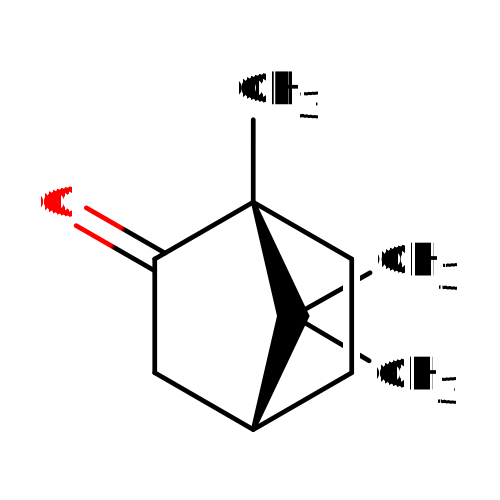
| Record Information |
|---|
| Version | 5.0 |
|---|
| Status | Expected but not Quantified |
|---|
| Creation Date | 2013-03-07 21:32:17 UTC |
|---|
| Update Date | 2023-02-21 17:29:28 UTC |
|---|
| HMDB ID | HMDB0059838 |
|---|
| Secondary Accession Numbers | |
|---|
| Metabolite Identification |
|---|
| Common Name | Camphor |
|---|
| Description | Camphor, also known as (+)-camphor or (+)-bornan-2-one, is a member of the class of compounds known as bicyclic monoterpenoids. Bicyclic monoterpenoids are monoterpenoids containing exactly 2 rings, which are fused to each other. Camphor is practically insoluble (in water) and an extremely weak basic (essentially neutral) compound (based on its pKa). Within the cell, camphor is primarily located in the membrane (predicted from logP). Camphor is a waxy, flammable, white or transparent solid with a strong aroma. It is a terpenoid with the chemical formula C10H16O. It is found in many plants, such as in the wood of the camphor laurel (Cinnamomum camphora), a large evergreen tree found in Asia (particularly in Sumatra and Borneo islands, Indonesia) and also of the unrelated Kapur tree, a tall timber tree from the same region. It also occurs in some other related trees in the laurel family, notably Ocotea usambarensis and in the oil in rosemary leaves (Rosmarinus officinalis). The mint family contains 10 to 20% camphor, while camphorweed (Heterotheca) only contains some 5%. Camphor can also be synthetically produced from oil of turpentine. It is used for its scent, as an ingredient in cooking (mainly in India), as an embalming fluid, for medicinal purposes, and in religious ceremonies. A major source of camphor in Asia is camphor basil (the parent of African blue basil) (Wikipedia ). |
|---|
| Structure | CC1(C)[C@@H]2CC[C@@]1(C)C(=O)C2 InChI=1S/C10H16O/c1-9(2)7-4-5-10(9,3)8(11)6-7/h7H,4-6H2,1-3H3/t7-,10+/m1/s1 |
|---|
| Synonyms | | Value | Source |
|---|
| (+)-Bornan-2-one | ChEBI | | (+)-Camphor | ChEBI | | (1R)-(+)-Camphor | ChEBI | | (1R,4R)-Camphor | ChEBI | | (R)-(+)-Camphor | ChEBI | | Camphor(D) | ChEBI | | D-Camphor | ChEBI | | Camphora | HMDB | | CAMPHOR | ChEBI | | (1R,4R)-1,7,7-Trimethylbicyclo[2.2.1]heptan-2-one | PhytoBank | | (1R)-1,7,7-Trimethylbicyclo[2.2.1]heptan-2-one | PhytoBank | | (+)-(1R,4R)-Camphor | PhytoBank | | (1R)-Camphor | PhytoBank | | (1R,4R)-(+)-Camphor | PhytoBank | | (R)-Camphor | PhytoBank | | D-(+)-Camphor | PhytoBank | | Alcanfor | PhytoBank | | (+)-2-Bornanone | PhytoBank | | (±)-Camphor | PhytoBank | | 1,7,7-Trimethylbicyclo[2.2.1]heptan-2-one | PhytoBank | | 1,7,7-Trimethylbicyclo[2.2.1]-2-heptanone | PhytoBank | | 1,7,7-Trimethylnorcamphor | PhytoBank | | 2-Bornanone | PhytoBank | | 2-Camphanone | PhytoBank | | Alphanon | PhytoBank | | Borneo camphor | PhytoBank | | dl-Camphor | PhytoBank |
|
|---|
| Chemical Formula | C10H16O |
|---|
| Average Molecular Weight | 152.2334 |
|---|
| Monoisotopic Molecular Weight | 152.120115134 |
|---|
| IUPAC Name | (1R,4R)-1,7,7-trimethylbicyclo[2.2.1]heptan-2-one |
|---|
| Traditional Name | (+)-camphor |
|---|
| CAS Registry Number | 464-49-3 |
|---|
| SMILES | CC1(C)[C@@H]2CC[C@@]1(C)C(=O)C2 |
|---|
| InChI Identifier | InChI=1S/C10H16O/c1-9(2)7-4-5-10(9,3)8(11)6-7/h7H,4-6H2,1-3H3/t7-,10+/m1/s1 |
|---|
| InChI Key | DSSYKIVIOFKYAU-XCBNKYQSSA-N |
|---|
| Chemical Taxonomy |
|---|
| Description | Belongs to the class of organic compounds known as bicyclic monoterpenoids. These are monoterpenoids containing exactly 2 rings, which are fused to each other. |
|---|
| Kingdom | Organic compounds |
|---|
| Super Class | Lipids and lipid-like molecules |
|---|
| Class | Prenol lipids |
|---|
| Sub Class | Monoterpenoids |
|---|
| Direct Parent | Bicyclic monoterpenoids |
|---|
| Alternative Parents | |
|---|
| Substituents | - Bicyclic monoterpenoid
- Bornane monoterpenoid
- Ketone
- Organic oxygen compound
- Organic oxide
- Hydrocarbon derivative
- Organooxygen compound
- Carbonyl group
- Aliphatic homopolycyclic compound
|
|---|
| Molecular Framework | Aliphatic homopolycyclic compounds |
|---|
| External Descriptors | |
|---|
| Ontology |
|---|
| Physiological effect | Not Available |
|---|
| Disposition | |
|---|
| Process | Not Available |
|---|
| Role | Not Available |
|---|
| Physical Properties |
|---|
| State | Not Available |
|---|
| Experimental Molecular Properties | |
|---|
| Experimental Chromatographic Properties | Experimental Collision Cross Sections| Adduct Type | Data Source | CCS Value (Å2) | Reference |
|---|
| [M+H]+ | Baker | 142.797 | 30932474 |
|
|---|
| Predicted Molecular Properties | |
|---|
| Predicted Chromatographic Properties | Predicted Collision Cross SectionsPredicted Retention Times Underivatized| Chromatographic Method | Retention Time | Reference |
|---|
| Measured using a Waters Acquity ultraperformance liquid chromatography (UPLC) ethylene-bridged hybrid (BEH) C18 column (100 mm × 2.1 mm; 1.7 μmparticle diameter). Predicted by Afia on May 17, 2022. Predicted by Afia on May 17, 2022. | 4.52 minutes | 32390414 | | Predicted by Siyang on May 30, 2022 | 15.0094 minutes | 33406817 | | Predicted by Siyang using ReTip algorithm on June 8, 2022 | 2.23 minutes | 32390414 |
Predicted Kovats Retention IndicesUnderivatizedDerivatized| Derivative Name / Structure | SMILES | Kovats RI Value | Column Type | Reference |
|---|
| Camphor,1TMS,isomer #1 | CC1(C)[C@H]2C=C(O[Si](C)(C)C)[C@]1(C)CC2 | 1258.0 | Semi standard non polar | 33892256 | | Camphor,1TMS,isomer #1 | CC1(C)[C@H]2C=C(O[Si](C)(C)C)[C@]1(C)CC2 | 1252.2 | Standard non polar | 33892256 | | Camphor,1TMS,isomer #1 | CC1(C)[C@H]2C=C(O[Si](C)(C)C)[C@]1(C)CC2 | 1348.8 | Standard polar | 33892256 | | Camphor,1TBDMS,isomer #1 | CC1(C)[C@H]2C=C(O[Si](C)(C)C(C)(C)C)[C@]1(C)CC2 | 1500.9 | Semi standard non polar | 33892256 | | Camphor,1TBDMS,isomer #1 | CC1(C)[C@H]2C=C(O[Si](C)(C)C(C)(C)C)[C@]1(C)CC2 | 1380.1 | Standard non polar | 33892256 | | Camphor,1TBDMS,isomer #1 | CC1(C)[C@H]2C=C(O[Si](C)(C)C(C)(C)C)[C@]1(C)CC2 | 1503.6 | Standard polar | 33892256 |
|
|---|