Hmdb loader
Record Information
Version5.0
StatusDetected and Quantified
Creation Date2005-11-16 15:48:42 UTC
Update Date2023-02-21 17:14:28 UTC
HMDB IDHMDB0000026
Secondary Accession Numbers
  • HMDB00026
  • HMDB0062812
  • HMDB62812
Metabolite Identification
Common NameUreidopropionic acid
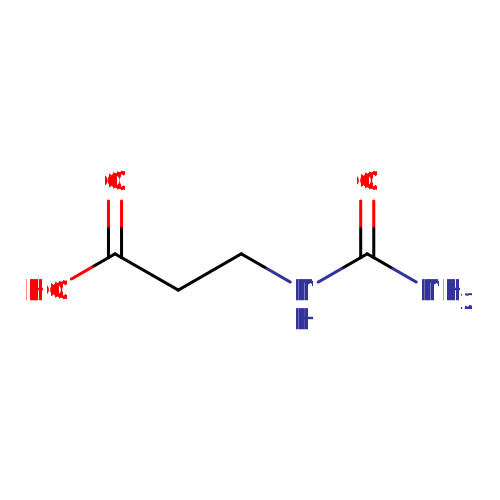
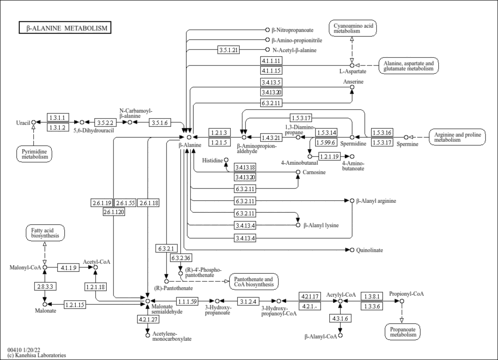
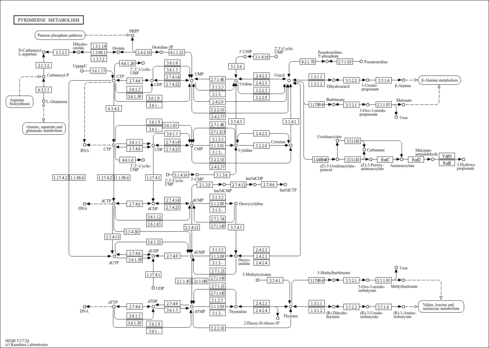
DescriptionUreidopropionic acid, also known as 3-ureidopropanoate or N-carbamoyl-beta-alanine, belongs to the class of organic compounds known as ureas. Ureas are compounds containing two amine groups joined by a carbonyl (C=O) functional group. Ureidopropionic acid is an intermediate in the metabolism of uracil. More specifically, it is a breakdown product of dihydrouracil and is produced by the enzyme dihydropyrimidase. It is further decomposed into beta-alanine via the enzyme beta-ureidopropionase. Ureidopropionic acid is essentially a urea derivative of beta-alanine. High levels of ureidopropionic acid are found in individuals with beta-ureidopropionase (UP) deficiency (PMID: 11675655 ). Enzyme deficiencies in pyrimidine metabolism are associated with a risk for severe toxicity against the antineoplastic agent 5-fluorouracil. Ureidopropionic acid has been detected, but not quantified in, several different foods, such as gram beans, broccoli, climbing beans, oriental wheat, and mandarin orange (clementine, tangerine). This could make ureidopropionic acid a potential biomarker for the consumption of these foods.
Structure
Data?1676999668
Synonyms
ValueSource
3-[(Aminocarbonyl)amino]propanoic acidChEBI
3-UreidopropanoateChEBI
3-Ureidopropanoic acidChEBI
3-UreidopropionateChEBI
3-Ureidopropionic acidChEBI
beta-Ureidopropionic acidChEBI
N-(AMINOCARBONYL)-BETA-alanineChEBI
Ureidopropanoic acidChEBI
N-Carbamoyl-beta-alanineKegg
3-[(Aminocarbonyl)amino]propanoateGenerator
b-UreidopropionateGenerator
b-Ureidopropionic acidGenerator
beta-UreidopropionateGenerator
Β-ureidopropionateGenerator
Β-ureidopropionic acidGenerator
N-(AMINOCARBONYL)-b-alanineGenerator
N-(AMINOCARBONYL)-β-alanineGenerator
UreidopropanoateGenerator
N-Carbamoyl-b-alanineGenerator
N-Carbamoyl-β-alanineGenerator
UreidopropionateGenerator
3-(carbamoylamino)PropanoateHMDB
3-(carbamoylamino)Propanoic acidHMDB
3-ureido-PropionateHMDB
Carbamoyl-b-ala-OHHMDB
Carbamoyl-beta-ala-OHHMDB
N-(Aminocarbonyl)-'b-alanineHMDB
N-Carbamyl-b-alanineHMDB
N-Carbamyl-beta-alanineHMDB
Ion(-1) OF N-carbamoyl-beta-alanineMeSH, HMDB
Carbamoyl-beta-alanineHMDB
Carbamoyl-β-alanineHMDB
Carbamyl beta-alanineHMDB
Carbamyl β-alanineHMDB
beta-Ureidopropanoic acidHMDB
β-Ureidopropanoic acidHMDB
Chemical FormulaC4H8N2O3
Average Molecular Weight132.1179
Monoisotopic Molecular Weight132.053492132
IUPAC Name3-(carbamoylamino)propanoic acid
Traditional Nameureidopropionic acid
CAS Registry Number462-88-4
SMILES
NC(=O)NCCC(O)=O
InChI Identifier
InChI=1S/C4H8N2O3/c5-4(9)6-2-1-3(7)8/h1-2H2,(H,7,8)(H3,5,6,9)
InChI KeyJSJWCHRYRHKBBW-UHFFFAOYSA-N
Chemical Taxonomy
Description Belongs to the class of organic compounds known as ureas. Ureas are compounds containing two amine groups joined by a carbonyl (C=O) functional group.
KingdomOrganic compounds
Super ClassOrganic acids and derivatives
ClassOrganic carbonic acids and derivatives
Sub ClassUreas
Direct ParentUreas
Alternative Parents
Substituents
  • Urea
  • Monocarboxylic acid or derivatives
  • Carboxylic acid
  • Carboxylic acid derivative
  • Organic nitrogen compound
  • Organic oxygen compound
  • Organopnictogen compound
  • Organic oxide
  • Hydrocarbon derivative
  • Organooxygen compound
  • Organonitrogen compound
  • Carbonyl group
  • Aliphatic acyclic compound
Molecular FrameworkAliphatic acyclic compounds
External Descriptors
Ontology
Not AvailableNot Available
Physical Properties
StateSolid
Experimental Molecular Properties
PropertyValueReference
Melting Point170 °CNot Available
Boiling PointNot AvailableNot Available
Water Solubility20.9 mg/mLNot Available
LogPNot AvailableNot Available
Experimental Chromatographic PropertiesNot Available
Predicted Molecular Properties
PropertyValueSource
Water Solubility52.7 g/LALOGPS
logP-0.98ALOGPS
logP-1.4ChemAxon
logS-0.4ALOGPS
pKa (Strongest Acidic)4.23ChemAxon
pKa (Strongest Basic)-2ChemAxon
Physiological Charge-1ChemAxon
Hydrogen Acceptor Count3ChemAxon
Hydrogen Donor Count3ChemAxon
Polar Surface Area92.42 ŲChemAxon
Rotatable Bond Count3ChemAxon
Refractivity28.82 m³·mol⁻¹ChemAxon
Polarizability12.07 ųChemAxon
Number of Rings0ChemAxon
BioavailabilityYesChemAxon
Rule of FiveYesChemAxon
Ghose FilterNoChemAxon
Veber's RuleNoChemAxon
MDDR-like RuleNoChemAxon
Predicted Chromatographic Properties

Predicted Collision Cross Sections

PredictorAdduct TypeCCS Value (Å2)Reference
DarkChem[M+H]+128.11431661259
DarkChem[M-H]-122.32631661259
AllCCS[M+H]+130.8232859911
AllCCS[M-H]-126.42132859911
DeepCCS[M+H]+128.63630932474
DeepCCS[M-H]-125.71730932474
DeepCCS[M-2H]-162.13630932474
DeepCCS[M+Na]+137.230932474
AllCCS[M+H]+130.832859911
AllCCS[M+H-H2O]+126.732859911
AllCCS[M+NH4]+134.632859911
AllCCS[M+Na]+135.732859911
AllCCS[M-H]-126.432859911
AllCCS[M+Na-2H]-129.232859911
AllCCS[M+HCOO]-132.232859911

Predicted Retention Times

Underivatized

Chromatographic MethodRetention TimeReference
Measured using a Waters Acquity ultraperformance liquid chromatography (UPLC) ethylene-bridged hybrid (BEH) C18 column (100 mm × 2.1 mm; 1.7 μmparticle diameter). Predicted by Afia on May 17, 2022. Predicted by Afia on May 17, 2022.1.5 minutes32390414
Predicted by Siyang on May 30, 20228.6447 minutes33406817
Predicted by Siyang using ReTip algorithm on June 8, 20226.16 minutes32390414
AjsUoB = Accucore 150 Amide HILIC with 10mM Ammonium Formate, 0.1% Formic Acid371.8 seconds40023050
Fem_Long = Waters ACQUITY UPLC HSS T3 C18 with Water:MeOH and 0.1% Formic Acid400.9 seconds40023050
Fem_Lipids = Ascentis Express C18 with (60:40 water:ACN):(90:10 IPA:ACN) and 10mM NH4COOH + 0.1% Formic Acid320.5 seconds40023050
Life_Old = Waters ACQUITY UPLC BEH C18 with Water:(20:80 acetone:ACN) and 0.1% Formic Acid43.5 seconds40023050
Life_New = RP Waters ACQUITY UPLC HSS T3 C18 with Water:(30:70 MeOH:ACN) and 0.1% Formic Acid205.8 seconds40023050
RIKEN = Waters ACQUITY UPLC BEH C18 with Water:ACN and 0.1% Formic Acid78.1 seconds40023050
Eawag_XBridgeC18 = XBridge C18 3.5u 2.1x50 mm with Water:MeOH and 0.1% Formic Acid273.1 seconds40023050
BfG_NTS_RP1 =Agilent Zorbax Eclipse Plus C18 (2.1 mm x 150 mm, 3.5 um) with Water:ACN and 0.1% Formic Acid221.7 seconds40023050
HILIC_BDD_2 = Merck SeQuant ZIC-HILIC with ACN(0.1% formic acid):water(16 mM ammonium formate)860.3 seconds40023050
UniToyama_Atlantis = RP Waters Atlantis T3 (2.1 x 150 mm, 5 um) with ACN:Water and 0.1% Formic Acid555.1 seconds40023050
BDD_C18 = Hypersil Gold 1.9µm C18 with Water:ACN and 0.1% Formic Acid37.3 seconds40023050
UFZ_Phenomenex = Kinetex Core-Shell C18 2.6 um, 3.0 x 100 mm, Phenomenex with Water:MeOH and 0.1% Formic Acid649.0 seconds40023050
SNU_RIKEN_POS = Waters ACQUITY UPLC BEH C18 with Water:ACN and 0.1% Formic Acid207.9 seconds40023050
RPMMFDA = Waters ACQUITY UPLC BEH C18 with Water:ACN and 0.1% Formic Acid312.5 seconds40023050
MTBLS87 = Merck SeQuant ZIC-pHILIC column with ACN:Water and :ammonium carbonate757.6 seconds40023050
KI_GIAR_zic_HILIC_pH2_7 = Merck SeQuant ZIC-HILIC with ACN:Water and 0.1% FA529.7 seconds40023050
Meister zic-pHILIC pH9.3 = Merck SeQuant ZIC-pHILIC column with ACN:Water 5mM NH4Ac pH9.3 and 5mM ammonium acetate in water370.3 seconds40023050

Predicted Kovats Retention Indices

Underivatized

MetaboliteSMILESKovats RI ValueColumn TypeReference
Ureidopropionic acidNC(=O)NCCC(O)=O2311.6Standard polar33892256
Ureidopropionic acidNC(=O)NCCC(O)=O1450.7Standard non polar33892256
Ureidopropionic acidNC(=O)NCCC(O)=O1734.9Semi standard non polar33892256

Derivatized

Derivative Name / StructureSMILESKovats RI ValueColumn TypeReference
Ureidopropionic acid,1TMS,isomer #1C[Si](C)(C)OC(=O)CCNC(N)=O1590.3Semi standard non polar33892256
Ureidopropionic acid,1TMS,isomer #2C[Si](C)(C)NC(=O)NCCC(=O)O1614.3Semi standard non polar33892256
Ureidopropionic acid,1TMS,isomer #3C[Si](C)(C)N(CCC(=O)O)C(N)=O1609.2Semi standard non polar33892256
Ureidopropionic acid,2TMS,isomer #1C[Si](C)(C)NC(=O)NCCC(=O)O[Si](C)(C)C1675.0Semi standard non polar33892256
Ureidopropionic acid,2TMS,isomer #1C[Si](C)(C)NC(=O)NCCC(=O)O[Si](C)(C)C1475.1Standard non polar33892256
Ureidopropionic acid,2TMS,isomer #1C[Si](C)(C)NC(=O)NCCC(=O)O[Si](C)(C)C2282.5Standard polar33892256
Ureidopropionic acid,2TMS,isomer #2C[Si](C)(C)OC(=O)CCN(C(N)=O)[Si](C)(C)C1585.2Semi standard non polar33892256
Ureidopropionic acid,2TMS,isomer #2C[Si](C)(C)OC(=O)CCN(C(N)=O)[Si](C)(C)C1559.0Standard non polar33892256
Ureidopropionic acid,2TMS,isomer #2C[Si](C)(C)OC(=O)CCN(C(N)=O)[Si](C)(C)C2393.3Standard polar33892256
Ureidopropionic acid,2TMS,isomer #3C[Si](C)(C)N(C(=O)NCCC(=O)O)[Si](C)(C)C1727.3Semi standard non polar33892256
Ureidopropionic acid,2TMS,isomer #3C[Si](C)(C)N(C(=O)NCCC(=O)O)[Si](C)(C)C1609.8Standard non polar33892256
Ureidopropionic acid,2TMS,isomer #3C[Si](C)(C)N(C(=O)NCCC(=O)O)[Si](C)(C)C2317.0Standard polar33892256
Ureidopropionic acid,2TMS,isomer #4C[Si](C)(C)NC(=O)N(CCC(=O)O)[Si](C)(C)C1701.1Semi standard non polar33892256
Ureidopropionic acid,2TMS,isomer #4C[Si](C)(C)NC(=O)N(CCC(=O)O)[Si](C)(C)C1661.7Standard non polar33892256
Ureidopropionic acid,2TMS,isomer #4C[Si](C)(C)NC(=O)N(CCC(=O)O)[Si](C)(C)C2219.5Standard polar33892256
Ureidopropionic acid,3TMS,isomer #1C[Si](C)(C)OC(=O)CCNC(=O)N([Si](C)(C)C)[Si](C)(C)C1719.3Semi standard non polar33892256
Ureidopropionic acid,3TMS,isomer #1C[Si](C)(C)OC(=O)CCNC(=O)N([Si](C)(C)C)[Si](C)(C)C1597.6Standard non polar33892256
Ureidopropionic acid,3TMS,isomer #1C[Si](C)(C)OC(=O)CCNC(=O)N([Si](C)(C)C)[Si](C)(C)C1982.7Standard polar33892256
Ureidopropionic acid,3TMS,isomer #2C[Si](C)(C)NC(=O)N(CCC(=O)O[Si](C)(C)C)[Si](C)(C)C1671.7Semi standard non polar33892256
Ureidopropionic acid,3TMS,isomer #2C[Si](C)(C)NC(=O)N(CCC(=O)O[Si](C)(C)C)[Si](C)(C)C1619.3Standard non polar33892256
Ureidopropionic acid,3TMS,isomer #2C[Si](C)(C)NC(=O)N(CCC(=O)O[Si](C)(C)C)[Si](C)(C)C1935.4Standard polar33892256
Ureidopropionic acid,3TMS,isomer #3C[Si](C)(C)N(CCC(=O)O)C(=O)N([Si](C)(C)C)[Si](C)(C)C1745.9Semi standard non polar33892256
Ureidopropionic acid,3TMS,isomer #3C[Si](C)(C)N(CCC(=O)O)C(=O)N([Si](C)(C)C)[Si](C)(C)C1787.0Standard non polar33892256
Ureidopropionic acid,3TMS,isomer #3C[Si](C)(C)N(CCC(=O)O)C(=O)N([Si](C)(C)C)[Si](C)(C)C1926.1Standard polar33892256
Ureidopropionic acid,4TMS,isomer #1C[Si](C)(C)OC(=O)CCN(C(=O)N([Si](C)(C)C)[Si](C)(C)C)[Si](C)(C)C1756.3Semi standard non polar33892256
Ureidopropionic acid,4TMS,isomer #1C[Si](C)(C)OC(=O)CCN(C(=O)N([Si](C)(C)C)[Si](C)(C)C)[Si](C)(C)C1769.4Standard non polar33892256
Ureidopropionic acid,4TMS,isomer #1C[Si](C)(C)OC(=O)CCN(C(=O)N([Si](C)(C)C)[Si](C)(C)C)[Si](C)(C)C1725.3Standard polar33892256
Ureidopropionic acid,1TBDMS,isomer #1CC(C)(C)[Si](C)(C)OC(=O)CCNC(N)=O1832.7Semi standard non polar33892256
Ureidopropionic acid,1TBDMS,isomer #2CC(C)(C)[Si](C)(C)NC(=O)NCCC(=O)O1867.0Semi standard non polar33892256
Ureidopropionic acid,1TBDMS,isomer #3CC(C)(C)[Si](C)(C)N(CCC(=O)O)C(N)=O1813.5Semi standard non polar33892256
Ureidopropionic acid,2TBDMS,isomer #1CC(C)(C)[Si](C)(C)NC(=O)NCCC(=O)O[Si](C)(C)C(C)(C)C2114.6Semi standard non polar33892256
Ureidopropionic acid,2TBDMS,isomer #1CC(C)(C)[Si](C)(C)NC(=O)NCCC(=O)O[Si](C)(C)C(C)(C)C1865.0Standard non polar33892256
Ureidopropionic acid,2TBDMS,isomer #1CC(C)(C)[Si](C)(C)NC(=O)NCCC(=O)O[Si](C)(C)C(C)(C)C2284.7Standard polar33892256
Ureidopropionic acid,2TBDMS,isomer #2CC(C)(C)[Si](C)(C)OC(=O)CCN(C(N)=O)[Si](C)(C)C(C)(C)C2029.9Semi standard non polar33892256
Ureidopropionic acid,2TBDMS,isomer #2CC(C)(C)[Si](C)(C)OC(=O)CCN(C(N)=O)[Si](C)(C)C(C)(C)C1970.3Standard non polar33892256
Ureidopropionic acid,2TBDMS,isomer #2CC(C)(C)[Si](C)(C)OC(=O)CCN(C(N)=O)[Si](C)(C)C(C)(C)C2477.1Standard polar33892256
Ureidopropionic acid,2TBDMS,isomer #3CC(C)(C)[Si](C)(C)N(C(=O)NCCC(=O)O)[Si](C)(C)C(C)(C)C2156.4Semi standard non polar33892256
Ureidopropionic acid,2TBDMS,isomer #3CC(C)(C)[Si](C)(C)N(C(=O)NCCC(=O)O)[Si](C)(C)C(C)(C)C1999.9Standard non polar33892256
Ureidopropionic acid,2TBDMS,isomer #3CC(C)(C)[Si](C)(C)N(C(=O)NCCC(=O)O)[Si](C)(C)C(C)(C)C2282.3Standard polar33892256
Ureidopropionic acid,2TBDMS,isomer #4CC(C)(C)[Si](C)(C)NC(=O)N(CCC(=O)O)[Si](C)(C)C(C)(C)C2138.6Semi standard non polar33892256
Ureidopropionic acid,2TBDMS,isomer #4CC(C)(C)[Si](C)(C)NC(=O)N(CCC(=O)O)[Si](C)(C)C(C)(C)C2002.2Standard non polar33892256
Ureidopropionic acid,2TBDMS,isomer #4CC(C)(C)[Si](C)(C)NC(=O)N(CCC(=O)O)[Si](C)(C)C(C)(C)C2263.9Standard polar33892256
Ureidopropionic acid,3TBDMS,isomer #1CC(C)(C)[Si](C)(C)OC(=O)CCNC(=O)N([Si](C)(C)C(C)(C)C)[Si](C)(C)C(C)(C)C2368.8Semi standard non polar33892256
Ureidopropionic acid,3TBDMS,isomer #1CC(C)(C)[Si](C)(C)OC(=O)CCNC(=O)N([Si](C)(C)C(C)(C)C)[Si](C)(C)C(C)(C)C2207.1Standard non polar33892256
Ureidopropionic acid,3TBDMS,isomer #1CC(C)(C)[Si](C)(C)OC(=O)CCNC(=O)N([Si](C)(C)C(C)(C)C)[Si](C)(C)C(C)(C)C2227.0Standard polar33892256
Ureidopropionic acid,3TBDMS,isomer #2CC(C)(C)[Si](C)(C)NC(=O)N(CCC(=O)O[Si](C)(C)C(C)(C)C)[Si](C)(C)C(C)(C)C2333.2Semi standard non polar33892256
Ureidopropionic acid,3TBDMS,isomer #2CC(C)(C)[Si](C)(C)NC(=O)N(CCC(=O)O[Si](C)(C)C(C)(C)C)[Si](C)(C)C(C)(C)C2193.4Standard non polar33892256
Ureidopropionic acid,3TBDMS,isomer #2CC(C)(C)[Si](C)(C)NC(=O)N(CCC(=O)O[Si](C)(C)C(C)(C)C)[Si](C)(C)C(C)(C)C2242.2Standard polar33892256
Ureidopropionic acid,3TBDMS,isomer #3CC(C)(C)[Si](C)(C)N(CCC(=O)O)C(=O)N([Si](C)(C)C(C)(C)C)[Si](C)(C)C(C)(C)C2387.9Semi standard non polar33892256
Ureidopropionic acid,3TBDMS,isomer #3CC(C)(C)[Si](C)(C)N(CCC(=O)O)C(=O)N([Si](C)(C)C(C)(C)C)[Si](C)(C)C(C)(C)C2311.4Standard non polar33892256
Ureidopropionic acid,3TBDMS,isomer #3CC(C)(C)[Si](C)(C)N(CCC(=O)O)C(=O)N([Si](C)(C)C(C)(C)C)[Si](C)(C)C(C)(C)C2223.3Standard polar33892256
Ureidopropionic acid,4TBDMS,isomer #1CC(C)(C)[Si](C)(C)OC(=O)CCN(C(=O)N([Si](C)(C)C(C)(C)C)[Si](C)(C)C(C)(C)C)[Si](C)(C)C(C)(C)C2615.6Semi standard non polar33892256
Ureidopropionic acid,4TBDMS,isomer #1CC(C)(C)[Si](C)(C)OC(=O)CCN(C(=O)N([Si](C)(C)C(C)(C)C)[Si](C)(C)C(C)(C)C)[Si](C)(C)C(C)(C)C2520.6Standard non polar33892256
Ureidopropionic acid,4TBDMS,isomer #1CC(C)(C)[Si](C)(C)OC(=O)CCN(C(=O)N([Si](C)(C)C(C)(C)C)[Si](C)(C)C(C)(C)C)[Si](C)(C)C(C)(C)C2209.5Standard polar33892256
Spectra
Biological Properties
Cellular Locations
  • Cytoplasm
Biospecimen Locations
  • Blood
  • Cerebrospinal Fluid (CSF)
  • Feces
  • Urine
Tissue Locations
  • Placenta
Pathways
Normal Concentrations
BiospecimenStatusValueAgeSexConditionReferenceDetails
BloodExpected but not QuantifiedNot QuantifiedNot AvailableNot Available
Normal
      Not Available
details
Cerebrospinal Fluid (CSF)Detected and Quantified0.0 - 0.5 uMChildren (1-13 years old)Not SpecifiedNormal details
FecesDetected but not QuantifiedNot QuantifiedAdult (>18 years old)Both
Normal
details
FecesDetected but not QuantifiedNot QuantifiedAdult (>18 years old)Both
Normal
details
FecesDetected but not QuantifiedNot QuantifiedAdult (>18 years old)Both
Normal
details
UrineDetected and Quantified2.23 (1.48 - 2.81) umol/mmol creatinineAdult (>18 years old)BothNormal details
UrineDetected and Quantified2.09 (1.23–4.80) umol/mmol creatinineAdult (>18 years old)BothNormal details
UrineDetected and Quantified0.88 umol/mmol creatinineAdult (>18 years old)BothNormal details
UrineDetected and Quantified<3.2 umol/mmol creatinineInfant (0-1 year old)Both
Normal
details
Abnormal Concentrations
BiospecimenStatusValueAgeSexConditionReferenceDetails
Cerebrospinal Fluid (CSF)Detected and Quantified0.5 (0.0-1.0) uMChildren (1-13 years old)BothDihydropyrimidinase deficiency details
FecesDetected but not QuantifiedNot QuantifiedAdult (>18 years old)BothColorectal Cancer details
FecesDetected but not QuantifiedNot QuantifiedAdult (>18 years old)Both
Colorectal cancer
details
Associated Disorders and Diseases
Disease References
Dihydropyrimidinase deficiency
  1. van Kuilenburg AB, Meijer J, Dobritzsch D, Meinsma R, Duran M, Lohkamp B, Zoetekouw L, Abeling NG, van Tinteren HL, Bosch AM: Clinical, biochemical and genetic findings in two siblings with a dihydropyrimidinase deficiency. Mol Genet Metab. 2007 Jun;91(2):157-64. Epub 2007 Mar 26. [PubMed:17383919 ]
Colorectal cancer
  1. Brown DG, Rao S, Weir TL, O'Malia J, Bazan M, Brown RJ, Ryan EP: Metabolomics and metabolic pathway networks from human colorectal cancers, adjacent mucosa, and stool. Cancer Metab. 2016 Jun 6;4:11. doi: 10.1186/s40170-016-0151-y. eCollection 2016. [PubMed:27275383 ]
  2. Goedert JJ, Sampson JN, Moore SC, Xiao Q, Xiong X, Hayes RB, Ahn J, Shi J, Sinha R: Fecal metabolomics: assay performance and association with colorectal cancer. Carcinogenesis. 2014 Sep;35(9):2089-96. doi: 10.1093/carcin/bgu131. Epub 2014 Jul 18. [PubMed:25037050 ]
Associated OMIM IDs
DrugBank IDNot Available
Phenol Explorer Compound IDNot Available
FooDB IDFDB021879
KNApSAcK IDNot Available
Chemspider ID109
KEGG Compound IDC02642
BioCyc ID3-UREIDO-PROPIONATE
BiGG IDNot Available
Wikipedia Link3-Ureidopropionic_acid
METLIN IDNot Available
PubChem CompoundNot Available
PDB IDNot Available
ChEBI ID18261
Food Biomarker OntologyNot Available
VMH IDNot Available
MarkerDB IDNot Available
Good Scents IDNot Available
References
Synthesis Referencew-Ureido carboxylic acids. (1962), 3 pp. GB 913713 19621228 CAN 58:72975 AN 1963:72975
Material Safety Data Sheet (MSDS)Download (PDF)
General References
  1. Moolenaar SH, Gohlich-Ratmann G, Engelke UF, Spraul M, Humpfer E, Dvortsak P, Voit T, Hoffmann GF, Brautigam C, van Kuilenburg AB, van Gennip A, Vreken P, Wevers RA: beta-Ureidopropionase deficiency: a novel inborn error of metabolism discovered using NMR spectroscopy on urine. Magn Reson Med. 2001 Nov;46(5):1014-7. [PubMed:11675655 ]
  2. Sparidans RW, Bosch TM, Jorger M, Schellens JH, Beijnen JH: Liquid chromatography-tandem mass spectrometric assay for the analysis of uracil, 5,6-dihydrouracil and beta-ureidopropionic acid in urine for the measurement of the activities of the pyrimidine catabolic enzymes. J Chromatogr B Analyt Technol Biomed Life Sci. 2006 Jul 24;839(1-2):45-53. Epub 2006 Feb 28. [PubMed:16513432 ]
  3. Ito S, Kawamura T, Inada M, Inoue Y, Hirao Y, Koga T, Kunizaki J, Shimizu T, Sato H: Physiologically based pharmacokinetic modelling of the three-step metabolism of pyrimidine using C-uracil as an in vivo probe. Br J Clin Pharmacol. 2005 Dec;60(6):584-93. [PubMed:16305582 ]
  4. Hofmann U, Schwab M, Seefried S, Marx C, Zanger UM, Eichelbaum M, Murdter TE: Sensitive method for the quantification of urinary pyrimidine metabolites in healthy adults by gas chromatography-tandem mass spectrometry. J Chromatogr B Analyt Technol Biomed Life Sci. 2003 Jul 5;791(1-2):371-80. [PubMed:12798197 ]
  5. Malet-Martino MC, Armand JP, Lopez A, Bernadou J, Beteille JP, Bon M, Martino R: Evidence for the importance of 5'-deoxy-5-fluorouridine catabolism in humans from 19F nuclear magnetic resonance spectrometry. Cancer Res. 1986 Apr;46(4 Pt 2):2105-12. [PubMed:2936452 ]
  6. Desmoulin F, Gilard V, Malet-Martino M, Martino R: Metabolism of capecitabine, an oral fluorouracil prodrug: (19)F NMR studies in animal models and human urine. Drug Metab Dispos. 2002 Nov;30(11):1221-9. [PubMed:12386128 ]
  7. Elshenawy S, Pinney SE, Stuart T, Doulias PT, Zura G, Parry S, Elovitz MA, Bennett MJ, Bansal A, Strauss JF 3rd, Ischiropoulos H, Simmons RA: The Metabolomic Signature of the Placenta in Spontaneous Preterm Birth. Int J Mol Sci. 2020 Feb 4;21(3). pii: ijms21031043. doi: 10.3390/ijms21031043. [PubMed:32033212 ]

Enzymes

General function:
Involved in hydrolase activity
Specific function:
Catalyzes the second step of the reductive pyrimidine degradation, the reversible hydrolytic ring opening of dihydropyrimidines. Can catalyze the ring opening of 5,6-dihydrouracil to N-carbamyl-alanine and of 5,6-dihydrothymine to N-carbamyl-amino isobutyrate.
Gene Name:
DPYS
Uniprot ID:
Q14117
Molecular weight:
56629.36
Reactions
Dihydrouracil + Water → Ureidopropionic aciddetails
General function:
Involved in hydrolase activity, acting on carbon-nitrogen (but not peptide) bonds
Specific function:
Converts N-carbamyl-beta-aminoisobutyric acid and N-carbamyl-beta-alanine to, respectively, beta-aminoisobutyric acid and beta-alanine, ammonia and carbon dioxide.
Gene Name:
UPB1
Uniprot ID:
Q9UBR1
Molecular weight:
43165.705
Reactions
Ureidopropionic acid + Water → beta-Alanine + CO(2) + Ammoniadetails
Ureidopropionic acid + Water → beta-Alanine + Carbon dioxide + Ammoniadetails
References
  1. Moolenaar SH, Gohlich-Ratmann G, Engelke UF, Spraul M, Humpfer E, Dvortsak P, Voit T, Hoffmann GF, Brautigam C, van Kuilenburg AB, van Gennip A, Vreken P, Wevers RA: beta-Ureidopropionase deficiency: a novel inborn error of metabolism discovered using NMR spectroscopy on urine. Magn Reson Med. 2001 Nov;46(5):1014-7. [PubMed:11675655 ]
General function:
Involved in hydrolase activity
Specific function:
Necessary for signaling by class 3 semaphorins and subsequent remodeling of the cytoskeleton. Plays a role in axon guidance, neuronal growth cone collapse and cell migration
Gene Name:
DPYSL3
Uniprot ID:
Q14195
Molecular weight:
61962.8
General function:
Nucleotide transport and metabolism
Specific function:
Necessary for signaling by class 3 semaphorins and subsequent remodeling of the cytoskeleton. Plays a role in axon guidance, neuronal growth cone collapse and cell migration
Gene Name:
DPYSL2
Uniprot ID:
Q16555
Molecular weight:
62293.1