| Record Information |
|---|
| Version | 5.0 |
|---|
| Status | Detected and Quantified |
|---|
| Creation Date | 2006-05-22 14:17:29 UTC |
|---|
| Update Date | 2020-02-26 21:23:40 UTC |
|---|
| HMDB ID | HMDB0001966 |
|---|
| Secondary Accession Numbers | |
|---|
| Metabolite Identification |
|---|
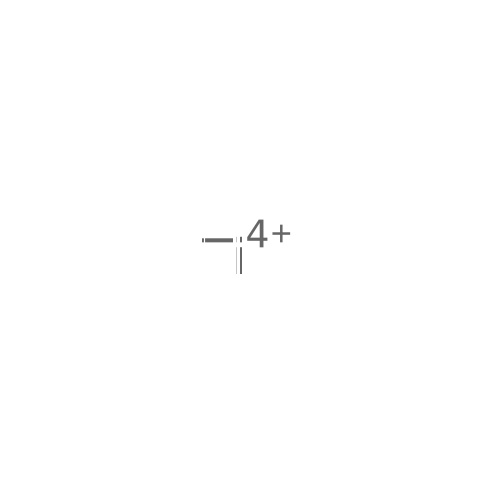
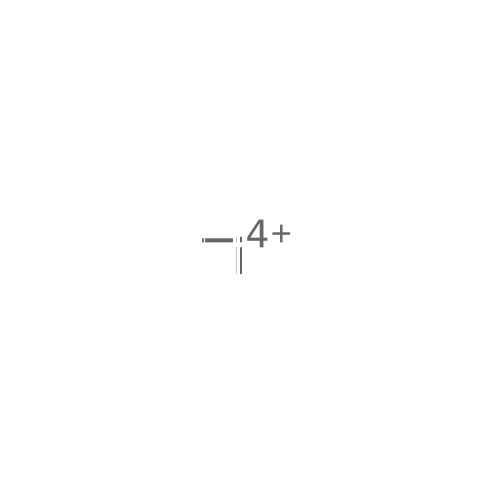
| Common Name | Titanium |
|---|
| Description | Titanium is a light, strong, lustrous, corrosion-resistant (including resistance to sea water and chlorine) transition metal with a white-silvery-metallic color; in the periodic table it has the symbol Ti and atomic number 22. Titanium and its alloys are used for medical purpose like osteosynthesis, arthroplasty, pacemaker encasing, orthodontical wires, or in daily-use articles like spectacle frames. At a composition of 50% nickel and 50% titanium, the material nitinol can be folded but returns at given temperatures to its original form without damage. This shape memory effect is used for spectacle frames, flexible tubes, intravascular stents, or orthodontic wires. When exposing the latter to an acidic environment, a substantial nickel and titanium release can be observed. However, even 'pure' titanium materials used for implant alloys may contain nickel as result of the production process. Standard titanium alloys (TiAl6Nb7, TiAl6V4) and pure titanium discs supplied by five different titanium manufactures were shown to contain up to 0.034 wt % nickel, with iodide-titanium having the lowest percentage (0.002 wt %). Here, the nickel atoms are reported to be in solid solution in the titanium lattice. Suspected delayed-type hypersensitivity reactions to titanium were first reported as pacemaker dermatitis, but their existence is still put in question due to not always complete allergological work up and insufficient patch test preparations. In 1984, Peters et al. described a patient who had repeatedly cardiac pacemakers implanted and removed because pruritus, redness, and swelling of the skin overlying the pacemaker had developed within several weeks after insertion. These reactions were interpreted as contact sensitivity to the pure titanium encasing of the pacemaker, as there was a ++ patch test reaction to a thin square of metallic titanium applied with artificial sweat. Physiologically, it exists as an ion in the body. Humans exposed to titanium can develop pulmonary alveolar proteinosis (PAP, a disease of obscure cause that is characterized by the accumulation of a granular material that contains abundant lipid within the alveoli of lung.) with severe respiratory failure; analysis of particles found in lung tissues obtained by open lung biopsies demonstrated the presence of titanium. Salts of titanium are often considered to be relatively harmless but its chlorine compounds, such as TiCl2, TiCl3 and TiCl4, have unusual hazards. The dichloride takes the form of pyrophoric black crystals, and the tetrachloride is a volatile fuming liquid. All of titanium's chlorides are corrosive. (PMID: 7606971 , 14756054 , 16958916 ). |
|---|
| Structure | |
|---|
| Synonyms | | Value | Source |
|---|
| Titanium alloy | HMDB | | Alpaste rta 030 | HMDB | | ATI 24 | HMDB | | C.P. titanium | HMDB | | Contimet 30 | HMDB | | CP Titanium | HMDB | | DAT 1 | HMDB | | DAT 5E | HMDB | | Dentcraft titan ingot | HMDB | | EBT | HMDB | | EBT (metal) | HMDB | | Oremet | HMDB | | PTKH 2 | HMDB | | Smelloff-cutter titanium | HMDB | | Titan | HMDB | | Titan VT 1-1 | HMDB | | Titanate | HMDB | | Titanium element | HMDB | | Titanium fulleride (tic20) | HMDB | | Titanium hydride | HMDB | | Titanium VT1 | HMDB | | Titanium(II) hydride | HMDB | | Titanium-125 | HMDB | | Tiunite | HMDB |
|
|---|
| Chemical Formula | Ti |
|---|
| Average Molecular Weight | 47.867 |
|---|
| Monoisotopic Molecular Weight | 47.947947053 |
|---|
| IUPAC Name | titanium(4+) ion |
|---|
| Traditional Name | titanium(4+) ion |
|---|
| CAS Registry Number | 7440-32-6 |
|---|
| SMILES | [Ti+4] |
|---|
| InChI Identifier | InChI=1S/Ti/q+4 |
|---|
| InChI Key | LCKIEQZJEYYRIY-UHFFFAOYSA-N |
|---|
| Chemical Taxonomy |
|---|
| Description | Belongs to the class of inorganic compounds known as homogeneous transition metal compounds. These are inorganic compounds containing only metal atoms,with the largest atom being a transition metal atom. |
|---|
| Kingdom | Inorganic compounds |
|---|
| Super Class | Homogeneous metal compounds |
|---|
| Class | Homogeneous transition metal compounds |
|---|
| Sub Class | Not Available |
|---|
| Direct Parent | Homogeneous transition metal compounds |
|---|
| Alternative Parents | Not Available |
|---|
| Substituents | - Homogeneous transition metal
|
|---|
| Molecular Framework | Not Available |
|---|
| External Descriptors | Not Available |
|---|
| Ontology |
|---|
| Physiological effect | Not Available |
|---|
| Disposition | Biological locationSourceExogenous- Exogenous (HMDB: HMDB0001966)
FoodNutFruitVegetablePulseSoyCereal and cereal productGourdHerb and spiceMilk and milk productUnfermented milk- Milk (Cow) (FooDB: FOOD00618)
- Cow milk, pasteurized, vitamin A + D added, 0% fat (FooDB: FOOD00889)
- Cow milk, pasteurized, vitamin A + D added, 1% fat (FooDB: FOOD00890)
- Cow milk, pasteurized, vitamin A + D added, 2% fat (FooDB: FOOD00891)
- Cow milk, pasteurized, vitamin D added, 3.25% fat (FooDB: FOOD00892)
|
|---|
| Process | Not Available |
|---|
| Role | Not Available |
|---|
| Physical Properties |
|---|
| State | Solid |
|---|
| Experimental Molecular Properties | | Property | Value | Reference |
|---|
| Melting Point | 1668 °C | Not Available | | Boiling Point | Not Available | Not Available | | Water Solubility | Not Available | Not Available | | LogP | Not Available | Not Available |
|
|---|
| Experimental Chromatographic Properties | Not Available |
|---|
| Predicted Molecular Properties | |
|---|
| Predicted Chromatographic Properties | Predicted Retention Times Underivatized| Chromatographic Method | Retention Time | Reference |
|---|
| AjsUoB = Accucore 150 Amide HILIC with 10mM Ammonium Formate, 0.1% Formic Acid | 311.6 seconds | 40023050 | | Fem_Long = Waters ACQUITY UPLC HSS T3 C18 with Water:MeOH and 0.1% Formic Acid | 1071.1 seconds | 40023050 | | Fem_Lipids = Ascentis Express C18 with (60:40 water:ACN):(90:10 IPA:ACN) and 10mM NH4COOH + 0.1% Formic Acid | 500.7 seconds | 40023050 | | Life_Old = Waters ACQUITY UPLC BEH C18 with Water:(20:80 acetone:ACN) and 0.1% Formic Acid | 222.5 seconds | 40023050 | | Life_New = RP Waters ACQUITY UPLC HSS T3 C18 with Water:(30:70 MeOH:ACN) and 0.1% Formic Acid | 415.5 seconds | 40023050 | | RIKEN = Waters ACQUITY UPLC BEH C18 with Water:ACN and 0.1% Formic Acid | 271.8 seconds | 40023050 | | Eawag_XBridgeC18 = XBridge C18 3.5u 2.1x50 mm with Water:MeOH and 0.1% Formic Acid | 386.1 seconds | 40023050 | | BfG_NTS_RP1 =Agilent Zorbax Eclipse Plus C18 (2.1 mm x 150 mm, 3.5 um) with Water:ACN and 0.1% Formic Acid | 501.9 seconds | 40023050 | | HILIC_BDD_2 = Merck SeQuant ZIC-HILIC with ACN(0.1% formic acid):water(16 mM ammonium formate) | 700.5 seconds | 40023050 | | UniToyama_Atlantis = RP Waters Atlantis T3 (2.1 x 150 mm, 5 um) with ACN:Water and 0.1% Formic Acid | 787.9 seconds | 40023050 | | BDD_C18 = Hypersil Gold 1.9µm C18 with Water:ACN and 0.1% Formic Acid | 263.9 seconds | 40023050 | | UFZ_Phenomenex = Kinetex Core-Shell C18 2.6 um, 3.0 x 100 mm, Phenomenex with Water:MeOH and 0.1% Formic Acid | 861.2 seconds | 40023050 | | SNU_RIKEN_POS = Waters ACQUITY UPLC BEH C18 with Water:ACN and 0.1% Formic Acid | 348.4 seconds | 40023050 | | RPMMFDA = Waters ACQUITY UPLC BEH C18 with Water:ACN and 0.1% Formic Acid | 431.6 seconds | 40023050 | | MTBLS87 = Merck SeQuant ZIC-pHILIC column with ACN:Water and :ammonium carbonate | 748.0 seconds | 40023050 | | KI_GIAR_zic_HILIC_pH2_7 = Merck SeQuant ZIC-HILIC with ACN:Water and 0.1% FA | 401.4 seconds | 40023050 | | Meister zic-pHILIC pH9.3 = Merck SeQuant ZIC-pHILIC column with ACN:Water 5mM NH4Ac pH9.3 and 5mM ammonium acetate in water | 321.1 seconds | 40023050 |
Predicted Kovats Retention IndicesUnderivatized |
|---|
| MS/MS Spectra| Spectrum Type | Description | Splash Key | Deposition Date | Source | View |
|---|
| Predicted LC-MS/MS | Predicted LC-MS/MS Spectrum - Titanium 10V, Positive-QTOF | splash10-0002-9000000000-47e5da0937d003fd9f3f | 2016-08-03 | Wishart Lab | View Spectrum | | Predicted LC-MS/MS | Predicted LC-MS/MS Spectrum - Titanium 20V, Positive-QTOF | splash10-0002-9000000000-47e5da0937d003fd9f3f | 2016-08-03 | Wishart Lab | View Spectrum | | Predicted LC-MS/MS | Predicted LC-MS/MS Spectrum - Titanium 40V, Positive-QTOF | splash10-0002-9000000000-47e5da0937d003fd9f3f | 2016-08-03 | Wishart Lab | View Spectrum | | Predicted LC-MS/MS | Predicted LC-MS/MS Spectrum - Titanium 10V, Negative-QTOF | splash10-0002-9000000000-7ac118264f854b5c0359 | 2016-08-03 | Wishart Lab | View Spectrum | | Predicted LC-MS/MS | Predicted LC-MS/MS Spectrum - Titanium 20V, Negative-QTOF | splash10-0002-9000000000-7ac118264f854b5c0359 | 2016-08-03 | Wishart Lab | View Spectrum | | Predicted LC-MS/MS | Predicted LC-MS/MS Spectrum - Titanium 40V, Negative-QTOF | splash10-0002-9000000000-7ac118264f854b5c0359 | 2016-08-03 | Wishart Lab | View Spectrum |
|
|---|
| General References | - Keller CA, Frost A, Cagle PT, Abraham JL: Pulmonary alveolar proteinosis in a painter with elevated pulmonary concentrations of titanium. Chest. 1995 Jul;108(1):277-80. [PubMed:7606971 ]
- Floarea-Strat A, Stanciu A, Creteanu M: [Pulmonary alveolar proteinosis]. Rev Med Chir Soc Med Nat Iasi. 2003 Jul-Sep;107(3):518-23. [PubMed:14756054 ]
- Thomas P, Bandl WD, Maier S, Summer B, Przybilla B: Hypersensitivity to titanium osteosynthesis with impaired fracture healing, eczema, and T-cell hyperresponsiveness in vitro: case report and review of the literature. Contact Dermatitis. 2006 Oct;55(4):199-202. [PubMed:16958916 ]
|
|---|