| Record Information |
|---|
| Version | 5.0 |
|---|
| Status | Detected and Quantified |
|---|
| Creation Date | 2006-05-22 14:17:35 UTC |
|---|
| Update Date | 2022-03-07 02:49:12 UTC |
|---|
| HMDB ID | HMDB0002068 |
|---|
| Secondary Accession Numbers | |
|---|
| Metabolite Identification |
|---|
| Common Name | Erucic acid |
|---|
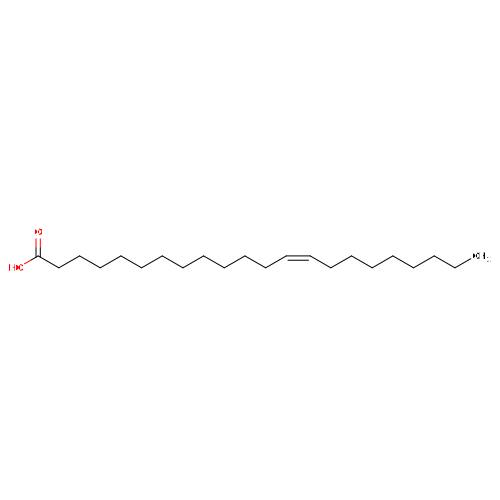
| Description | Erucic acid is a 22-carbon, monounsaturated omega-9 fatty acid found mainly in the Brassica family of plants such as canola, rapeseed, wallflower seed, mustard seed as well as Brussels spouts and broccoli. Some Brassica cultivars can have up to 40 to 50 percent of their oil recovered as erucic acid. Erucic acid is also known as cis-13-docosenoic acid. The trans isomer is known as brassidic acid. Erucic acid occurs in nature only along with bitter-tasting compounds. Erucic acid has many of the same uses as mineral oils but with the advantage that it is more readily bio-degradable. Its high tolerance to temperature makes it suitable for transmission oil. Erucic acid’s ability to polymerize and dry means it can be - and is - used as a binder for oil paints. Increased levels of eicosenoic acid (20:Ln9) and erucic acid (22:1N9) have been found in the red blood cell membranes of autistic subjects with developmental regression (PMID: 16581239 ). Erucic acid is broken down long-chain acyl-coenzyme A (CoA) dehydrogenase, which is produced in the liver. This enzyme breaks this long chain fatty acid into shorter-chain fatty acids. Human infants have relatively low amounts of this enzyme and because of this, babies should not be given foods high in erucic acid. Food-grade rapeseed oil (also known as canola oil) is regulated to a maximum of 2% erucic acid by weight in the US and 5% in the EU, with special regulations for infant food. Canola was bred from rapeseed cultivars of B. napus and B. rapa at the University of Manitoba, Canada. Canola oil is derived from a variety of rapeseed that is low in erucic acid. |
|---|
| Structure | CCCCCCCC\C=C/CCCCCCCCCCCC(O)=O InChI=1S/C22H42O2/c1-2-3-4-5-6-7-8-9-10-11-12-13-14-15-16-17-18-19-20-21-22(23)24/h9-10H,2-8,11-21H2,1H3,(H,23,24)/b10-9- |
|---|
| Synonyms | | Value | Source |
|---|
| (13Z)-13-Docosenoic acid | ChEBI | | (13Z)-Docosenoic acid | ChEBI | | (Z)-13-Docosenoic acid | ChEBI | | (Z)-Docos-13-enoic acid | ChEBI | | 13-cis-Docosenoic acid | ChEBI | | 22:1Omega9 | ChEBI | | C22:1N-9 | ChEBI | | cis-13-Docosenoic acid | ChEBI | | cis-Delta(13)-Docosenoic acid | ChEBI | | cis-Eruic acid | ChEBI | | Docos-13C-enoic acid | ChEBI | | Erucasaeure | ChEBI | | (13Z)-13-Docosenoate | Generator | | (13Z)-Docosenoate | Generator | | (Z)-13-Docosenoate | Generator | | (Z)-Docos-13-enoate | Generator | | 13-cis-Docosenoate | Generator | | cis-13-Docosenoate | Generator | | cis-delta(13)-Docosenoate | Generator | | cis-Δ(13)-docosenoate | Generator | | cis-Δ(13)-docosenoic acid | Generator | | cis-Eruate | Generator | | Docos-13C-enoate | Generator | | Erucate | Generator | | 13-Docosenoic acid | HMDB | | Erucic acid, (Z)-isomer | HMDB | | 13-Docosenoate | HMDB | | 13-Docosenoic acid (acd/name 4.0) | HMDB | | cis-Erucic acid | HMDB | | delta 13-cis-Docosenoate | HMDB | | delta 13-cis-Docosenoic acid | HMDB | | Delta.13-cis-docosenoate | HMDB | | Delta.13-cis-docosenoic acid | HMDB | | Prifrac 2990 | HMDB | | (Z)-Erucic acid | HMDB | | 13(Z)-Docosenoic acid | HMDB | | FA(22:1(13Z)) | HMDB | | FA(22:1n9) | HMDB | | cis-13-Erucic acid | HMDB | | delta13-cis-Docosenoic acid | HMDB | | Δ13-cis-docosenoic acid | HMDB | | Erucic acid | HMDB |
|
|---|
| Chemical Formula | C22H42O2 |
|---|
| Average Molecular Weight | 338.5677 |
|---|
| Monoisotopic Molecular Weight | 338.318480588 |
|---|
| IUPAC Name | (13Z)-docos-13-enoic acid |
|---|
| Traditional Name | erucic acid |
|---|
| CAS Registry Number | 112-86-7 |
|---|
| SMILES | CCCCCCCC\C=C/CCCCCCCCCCCC(O)=O |
|---|
| InChI Identifier | InChI=1S/C22H42O2/c1-2-3-4-5-6-7-8-9-10-11-12-13-14-15-16-17-18-19-20-21-22(23)24/h9-10H,2-8,11-21H2,1H3,(H,23,24)/b10-9- |
|---|
| InChI Key | DPUOLQHDNGRHBS-KTKRTIGZSA-N |
|---|
| Chemical Taxonomy |
|---|
| Description | Belongs to the class of organic compounds known as very long-chain fatty acids. These are fatty acids with an aliphatic tail that contains at least 22 carbon atoms. |
|---|
| Kingdom | Organic compounds |
|---|
| Super Class | Lipids and lipid-like molecules |
|---|
| Class | Fatty Acyls |
|---|
| Sub Class | Fatty acids and conjugates |
|---|
| Direct Parent | Very long-chain fatty acids |
|---|
| Alternative Parents | |
|---|
| Substituents | - Very long-chain fatty acid
- Unsaturated fatty acid
- Straight chain fatty acid
- Monocarboxylic acid or derivatives
- Carboxylic acid
- Carboxylic acid derivative
- Organic oxygen compound
- Organic oxide
- Hydrocarbon derivative
- Organooxygen compound
- Carbonyl group
- Aliphatic acyclic compound
|
|---|
| Molecular Framework | Aliphatic acyclic compounds |
|---|
| External Descriptors | |
|---|
| Ontology |
|---|
| Not Available | Not Available |
|---|
| Physical Properties |
|---|
| State | Liquid |
|---|
| Experimental Molecular Properties | |
|---|
| Experimental Chromatographic Properties | Experimental Collision Cross Sections |
|---|
| Predicted Molecular Properties | |
|---|
| Predicted Chromatographic Properties | Predicted Collision Cross SectionsPredicted Retention Times Underivatized| Chromatographic Method | Retention Time | Reference |
|---|
| Measured using a Waters Acquity ultraperformance liquid chromatography (UPLC) ethylene-bridged hybrid (BEH) C18 column (100 mm × 2.1 mm; 1.7 μmparticle diameter). Predicted by Afia on May 17, 2022. Predicted by Afia on May 17, 2022. | 11.12 minutes | 32390414 | | Predicted by Siyang on May 30, 2022 | 29.2752 minutes | 33406817 | | Predicted by Siyang using ReTip algorithm on June 8, 2022 | 1.76 minutes | 32390414 | | AjsUoB = Accucore 150 Amide HILIC with 10mM Ammonium Formate, 0.1% Formic Acid | 44.1 seconds | 40023050 | | Fem_Long = Waters ACQUITY UPLC HSS T3 C18 with Water:MeOH and 0.1% Formic Acid | 3653.4 seconds | 40023050 | | Fem_Lipids = Ascentis Express C18 with (60:40 water:ACN):(90:10 IPA:ACN) and 10mM NH4COOH + 0.1% Formic Acid | 814.0 seconds | 40023050 | | Life_Old = Waters ACQUITY UPLC BEH C18 with Water:(20:80 acetone:ACN) and 0.1% Formic Acid | 314.8 seconds | 40023050 | | Life_New = RP Waters ACQUITY UPLC HSS T3 C18 with Water:(30:70 MeOH:ACN) and 0.1% Formic Acid | 457.7 seconds | 40023050 | | RIKEN = Waters ACQUITY UPLC BEH C18 with Water:ACN and 0.1% Formic Acid | 717.6 seconds | 40023050 | | Eawag_XBridgeC18 = XBridge C18 3.5u 2.1x50 mm with Water:MeOH and 0.1% Formic Acid | 1271.5 seconds | 40023050 | | BfG_NTS_RP1 =Agilent Zorbax Eclipse Plus C18 (2.1 mm x 150 mm, 3.5 um) with Water:ACN and 0.1% Formic Acid | 1048.7 seconds | 40023050 | | HILIC_BDD_2 = Merck SeQuant ZIC-HILIC with ACN(0.1% formic acid):water(16 mM ammonium formate) | 104.0 seconds | 40023050 | | UniToyama_Atlantis = RP Waters Atlantis T3 (2.1 x 150 mm, 5 um) with ACN:Water and 0.1% Formic Acid | 2743.3 seconds | 40023050 | | BDD_C18 = Hypersil Gold 1.9µm C18 with Water:ACN and 0.1% Formic Acid | 764.4 seconds | 40023050 | | UFZ_Phenomenex = Kinetex Core-Shell C18 2.6 um, 3.0 x 100 mm, Phenomenex with Water:MeOH and 0.1% Formic Acid | 2265.8 seconds | 40023050 | | SNU_RIKEN_POS = Waters ACQUITY UPLC BEH C18 with Water:ACN and 0.1% Formic Acid | 1026.2 seconds | 40023050 | | RPMMFDA = Waters ACQUITY UPLC BEH C18 with Water:ACN and 0.1% Formic Acid | 608.7 seconds | 40023050 | | MTBLS87 = Merck SeQuant ZIC-pHILIC column with ACN:Water and :ammonium carbonate | 834.8 seconds | 40023050 | | KI_GIAR_zic_HILIC_pH2_7 = Merck SeQuant ZIC-HILIC with ACN:Water and 0.1% FA | 734.7 seconds | 40023050 | | Meister zic-pHILIC pH9.3 = Merck SeQuant ZIC-pHILIC column with ACN:Water 5mM NH4Ac pH9.3 and 5mM ammonium acetate in water | 8.4 seconds | 40023050 |
Predicted Kovats Retention IndicesUnderivatizedDerivatized |
|---|
| Spectra |
|---|
| |
|---|
| Biological Properties |
|---|
| Cellular Locations | - Extracellular
- Membrane (predicted from logP)
|
|---|
| Biospecimen Locations | |
|---|
| Tissue Locations | |
|---|
| Pathways | |
|---|
| Normal Concentrations |
|---|
| |
| Blood | Detected and Quantified | 1.264 +/- 1.590 uM | Adult (>18 years old) | Both | Normal | | details | | Blood | Detected and Quantified | 0.028 +/- 0.002 uM | Adult (>18 years old) | Both | Normal | | details | | Blood | Detected and Quantified | 20.2 +/- 6.8 uM | Adult (>18 years old) | Not Specified | Normal | | details | | Feces | Detected but not Quantified | Not Quantified | Adult (>18 years old) | Both | Normal | | details |
|
|---|
| Abnormal Concentrations |
|---|
| |
| Blood | Detected and Quantified | 150.0 (125.0-160.0) uM | Adult (>18 years old) | Both | Adrenomyeloneuropathy | | details | | Blood | Detected and Quantified | 3.4 +/- 2.2 uM | Adult (>18 years old) | Not Specified | Isovaleric acidemia | | details | | Feces | Detected but not Quantified | Not Quantified | Adult (>18 years old) | Both | Colorectal Cancer | | details |
|
|---|
| Associated Disorders and Diseases |
|---|
| Disease References | | Adrenomyeloneuropathy |
|---|
- Aubourg P, Adamsbaum C, Lavallard-Rousseau MC, Rocchiccioli F, Cartier N, Jambaque I, Jakobezak C, Lemaitre A, Boureau F, Wolf C, et al.: A two-year trial of oleic and erucic acids ("Lorenzo's oil") as treatment for adrenomyeloneuropathy. N Engl J Med. 1993 Sep 9;329(11):745-52. [PubMed:8350883 ]
| | Isovaleric acidemia |
|---|
- Dercksen M, Kulik W, Mienie LJ, Reinecke CJ, Wanders RJ, Duran M: Polyunsaturated fatty acid status in treated isovaleric acidemia patients. Eur J Clin Nutr. 2016 Oct;70(10):1123-1126. doi: 10.1038/ejcn.2016.100. Epub 2016 Jun 22. [PubMed:27329611 ]
| | Colorectal cancer |
|---|
- Brown DG, Rao S, Weir TL, O'Malia J, Bazan M, Brown RJ, Ryan EP: Metabolomics and metabolic pathway networks from human colorectal cancers, adjacent mucosa, and stool. Cancer Metab. 2016 Jun 6;4:11. doi: 10.1186/s40170-016-0151-y. eCollection 2016. [PubMed:27275383 ]
|
|
|---|
| Associated OMIM IDs | |
|---|
| External Links |
|---|
| DrugBank ID | Not Available |
|---|
| Phenol Explorer Compound ID | Not Available |
|---|
| FooDB ID | FDB004287 |
|---|
| KNApSAcK ID | C00001217 |
|---|
| Chemspider ID | 4444561 |
|---|
| KEGG Compound ID | C08316 |
|---|
| BioCyc ID | CPD-14292 |
|---|
| BiGG ID | Not Available |
|---|
| Wikipedia Link | Erucic_acid |
|---|
| METLIN ID | 6470 |
|---|
| PubChem Compound | 5281116 |
|---|
| PDB ID | Not Available |
|---|
| ChEBI ID | 28792 |
|---|
| Food Biomarker Ontology | Not Available |
|---|
| VMH ID | DOCO13AC |
|---|
| MarkerDB ID | MDB00000374 |
|---|
| Good Scents ID | rw1242821 |
|---|
| References |
|---|
| Synthesis Reference | Not Available |
|---|
| Material Safety Data Sheet (MSDS) | Download (PDF) |
|---|
| General References | - Rizzo WB, Leshner RT, Odone A, Dammann AL, Craft DA, Jensen ME, Jennings SS, Davis S, Jaitly R, Sgro JA: Dietary erucic acid therapy for X-linked adrenoleukodystrophy. Neurology. 1989 Nov;39(11):1415-22. [PubMed:2682348 ]
- Bu B, Ashwood P, Harvey D, King IB, Water JV, Jin LW: Fatty acid compositions of red blood cell phospholipids in children with autism. Prostaglandins Leukot Essent Fatty Acids. 2006 Apr;74(4):215-21. [PubMed:16581239 ]
- Elshenawy S, Pinney SE, Stuart T, Doulias PT, Zura G, Parry S, Elovitz MA, Bennett MJ, Bansal A, Strauss JF 3rd, Ischiropoulos H, Simmons RA: The Metabolomic Signature of the Placenta in Spontaneous Preterm Birth. Int J Mol Sci. 2020 Feb 4;21(3). pii: ijms21031043. doi: 10.3390/ijms21031043. [PubMed:32033212 ]
|
|---|