| Record Information |
|---|
| Version | 5.0 |
|---|
| Status | Detected and Quantified |
|---|
| Creation Date | 2006-05-22 15:12:01 UTC |
|---|
| Update Date | 2022-03-07 02:49:16 UTC |
|---|
| HMDB ID | HMDB0002655 |
|---|
| Secondary Accession Numbers | |
|---|
| Metabolite Identification |
|---|
| Common Name | Isorhamnetin |
|---|
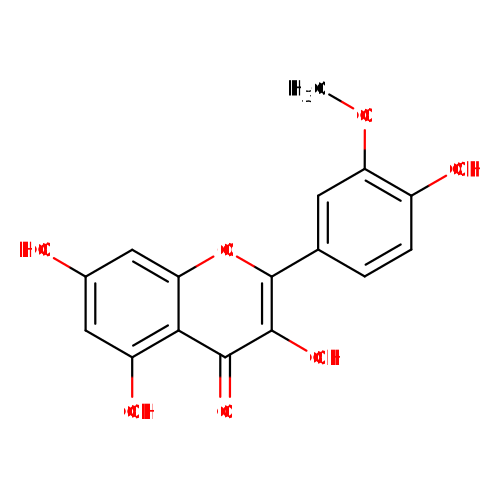
| Description | Isorhamnetin is the methylated metabolite of quercetin. Quercetin is an important dietary flavonoid with in vitro antioxidant activity. However, it is found in human plasma as conjugates with glucuronic acid, sulfate or methyl groups, with no significant amounts of free quercetin present. Isorhamnetin prevents endothelial cell injuries from oxidized LDL via inhibition of lectin-like ox-LDL receptor-1 upregulation, interference of ox-LDL-mediated intracellular signaling pathway (p38MAPK activation, NF-kappaB nuclear translocation, eNOS expression) and the antioxidant activity of isorhamnetin. Isorhamnetin prevents endothelial dysfunction, superoxide production, and overexpression of p47phox induced by angiotensin II. Isorhamnetin appears to be a potent drug against esophageal cancer due to its in vitro potential to not only inhibit proliferation but also induce apoptosis of Eca-109 cells. (PMID: 15493462 , 17368593 , 17374653 , 16963021 ). |
|---|
| Structure | COC1=C(O)C=CC(=C1)C1=C(O)C(=O)C2=C(O)C=C(O)C=C2O1 InChI=1S/C16H12O7/c1-22-11-4-7(2-3-9(11)18)16-15(21)14(20)13-10(19)5-8(17)6-12(13)23-16/h2-6,17-19,21H,1H3 |
|---|
| Synonyms | | Value | Source |
|---|
| 3,5,7,4'-Tetrahydroxy-3'-methoxyflavone | ChEBI | | 3,5,7-Trihydroxy-2-(4-hydroxy-3-methoxyphenyl)-4H-benzopyran-4-one | ChEBI | | 3-Methylquercetin | ChEBI | | Isorhamnetol | ChEBI | | Quercetin 3'-methyl ether | ChEBI | | 3'-Methoxy-3,4',5,7-tetrahydroxyflavone | HMDB | | 3'-Methoxyquercetin | HMDB | | 3'-Methylquercetin | HMDB | | 3'-O-Methylquercetin | HMDB | | 3,4',5,7-Tetrahydroxy-3'-methoxy-flavone | HMDB, MeSH | | 3,4',5,7-Tetrahydroxy-3'-methoxyflavone | HMDB, MeSH | | 3-Methylquercetine | HMDB | | 4'-Methoxyquercetin | HMDB | | 4'-Methylquercetin | HMDB | | 4'-O-Methylquercetin | HMDB | | 3-O-Methylquercetin | MeSH, HMDB | | iso-Rhamnetin | MeSH, HMDB | | Isorhamnetine | MeSH, HMDB | | 3-Methyl-quercetin | MeSH, HMDB | | 3,5,7-Trihydroxy-2-(4-hydroxy-3-methoxyphenyl)-4H-1-benzopyran-4-one | PhytoBank | | 3,4’,5,7-Tetrahydroxy-3’-methoxyflavone | PhytoBank | | 3’-Methoxyquercetin | PhytoBank | | 3’-Methylquercetin | PhytoBank | | 3’-O-Methylquercetin | PhytoBank | | Quercetin 3’-methyl ether | PhytoBank |
|
|---|
| Chemical Formula | C16H12O7 |
|---|
| Average Molecular Weight | 316.2623 |
|---|
| Monoisotopic Molecular Weight | 316.058302738 |
|---|
| IUPAC Name | 3,5,7-trihydroxy-2-(4-hydroxy-3-methoxyphenyl)-4H-chromen-4-one |
|---|
| Traditional Name | isorhamnetin |
|---|
| CAS Registry Number | 480-19-3 |
|---|
| SMILES | COC1=C(O)C=CC(=C1)C1=C(O)C(=O)C2=C(O)C=C(O)C=C2O1 |
|---|
| InChI Identifier | InChI=1S/C16H12O7/c1-22-11-4-7(2-3-9(11)18)16-15(21)14(20)13-10(19)5-8(17)6-12(13)23-16/h2-6,17-19,21H,1H3 |
|---|
| InChI Key | IZQSVPBOUDKVDZ-UHFFFAOYSA-N |
|---|
| Chemical Taxonomy |
|---|
| Description | Belongs to the class of organic compounds known as flavonols. Flavonols are compounds that contain a flavone (2-phenyl-1-benzopyran-4-one) backbone carrying a hydroxyl group at the 3-position. |
|---|
| Kingdom | Organic compounds |
|---|
| Super Class | Phenylpropanoids and polyketides |
|---|
| Class | Flavonoids |
|---|
| Sub Class | Flavones |
|---|
| Direct Parent | Flavonols |
|---|
| Alternative Parents | |
|---|
| Substituents | - 3p-methoxyflavonoid-skeleton
- 3-hydroxyflavone
- 3-hydroxyflavonoid
- 4'-hydroxyflavonoid
- 5-hydroxyflavonoid
- 7-hydroxyflavonoid
- Hydroxyflavonoid
- Chromone
- Benzopyran
- 1-benzopyran
- Methoxyphenol
- Phenoxy compound
- Anisole
- Methoxybenzene
- Phenol ether
- 1-hydroxy-4-unsubstituted benzenoid
- 1-hydroxy-2-unsubstituted benzenoid
- Alkyl aryl ether
- Pyranone
- Phenol
- Benzenoid
- Monocyclic benzene moiety
- Pyran
- Vinylogous acid
- Heteroaromatic compound
- Ether
- Organoheterocyclic compound
- Oxacycle
- Polyol
- Organic oxygen compound
- Organooxygen compound
- Organic oxide
- Hydrocarbon derivative
- Aromatic heteropolycyclic compound
|
|---|
| Molecular Framework | Aromatic heteropolycyclic compounds |
|---|
| External Descriptors | |
|---|
| Ontology |
|---|
| Physiological effect | |
|---|
| Disposition | |
|---|
| Process | |
|---|
| Role | |
|---|
| Physical Properties |
|---|
| State | Solid |
|---|
| Experimental Molecular Properties | |
|---|
| Experimental Chromatographic Properties | Experimental Collision Cross Sections |
|---|
| Predicted Molecular Properties | |
|---|
| Predicted Chromatographic Properties | Predicted Collision Cross SectionsPredicted Retention Times Underivatized| Chromatographic Method | Retention Time | Reference |
|---|
| Measured using a Waters Acquity ultraperformance liquid chromatography (UPLC) ethylene-bridged hybrid (BEH) C18 column (100 mm × 2.1 mm; 1.7 μmparticle diameter). Predicted by Afia on May 17, 2022. Predicted by Afia on May 17, 2022. | 6.32 minutes | 32390414 | | Predicted by Siyang on May 30, 2022 | 12.1393 minutes | 33406817 | | Predicted by Siyang using ReTip algorithm on June 8, 2022 | 1.69 minutes | 32390414 | | Fem_Long = Waters ACQUITY UPLC HSS T3 C18 with Water:MeOH and 0.1% Formic Acid | 2284.8 seconds | 40023050 | | Fem_Lipids = Ascentis Express C18 with (60:40 water:ACN):(90:10 IPA:ACN) and 10mM NH4COOH + 0.1% Formic Acid | 261.8 seconds | 40023050 | | Life_Old = Waters ACQUITY UPLC BEH C18 with Water:(20:80 acetone:ACN) and 0.1% Formic Acid | 129.2 seconds | 40023050 | | Life_New = RP Waters ACQUITY UPLC HSS T3 C18 with Water:(30:70 MeOH:ACN) and 0.1% Formic Acid | 159.9 seconds | 40023050 | | RIKEN = Waters ACQUITY UPLC BEH C18 with Water:ACN and 0.1% Formic Acid | 351.6 seconds | 40023050 | | Eawag_XBridgeC18 = XBridge C18 3.5u 2.1x50 mm with Water:MeOH and 0.1% Formic Acid | 617.3 seconds | 40023050 | | BfG_NTS_RP1 =Agilent Zorbax Eclipse Plus C18 (2.1 mm x 150 mm, 3.5 um) with Water:ACN and 0.1% Formic Acid | 547.8 seconds | 40023050 | | HILIC_BDD_2 = Merck SeQuant ZIC-HILIC with ACN(0.1% formic acid):water(16 mM ammonium formate) | 128.0 seconds | 40023050 | | UniToyama_Atlantis = RP Waters Atlantis T3 (2.1 x 150 mm, 5 um) with ACN:Water and 0.1% Formic Acid | 927.4 seconds | 40023050 | | BDD_C18 = Hypersil Gold 1.9µm C18 with Water:ACN and 0.1% Formic Acid | 424.5 seconds | 40023050 | | UFZ_Phenomenex = Kinetex Core-Shell C18 2.6 um, 3.0 x 100 mm, Phenomenex with Water:MeOH and 0.1% Formic Acid | 1481.8 seconds | 40023050 | | SNU_RIKEN_POS = Waters ACQUITY UPLC BEH C18 with Water:ACN and 0.1% Formic Acid | 325.4 seconds | 40023050 | | RPMMFDA = Waters ACQUITY UPLC BEH C18 with Water:ACN and 0.1% Formic Acid | 435.2 seconds | 40023050 | | MTBLS87 = Merck SeQuant ZIC-pHILIC column with ACN:Water and :ammonium carbonate | 470.4 seconds | 40023050 | | KI_GIAR_zic_HILIC_pH2_7 = Merck SeQuant ZIC-HILIC with ACN:Water and 0.1% FA | 213.4 seconds | 40023050 | | Meister zic-pHILIC pH9.3 = Merck SeQuant ZIC-pHILIC column with ACN:Water 5mM NH4Ac pH9.3 and 5mM ammonium acetate in water | 182.9 seconds | 40023050 |
Predicted Kovats Retention IndicesUnderivatizedDerivatized| Derivative Name / Structure | SMILES | Kovats RI Value | Column Type | Reference |
|---|
| Isorhamnetin,1TMS,isomer #1 | COC1=CC(C2=C(O)C(=O)C3=C(O)C=C(O)C=C3O2)=CC=C1O[Si](C)(C)C | 3248.4 | Semi standard non polar | 33892256 | | Isorhamnetin,1TMS,isomer #2 | COC1=CC(C2=C(O[Si](C)(C)C)C(=O)C3=C(O)C=C(O)C=C3O2)=CC=C1O | 3225.5 | Semi standard non polar | 33892256 | | Isorhamnetin,1TMS,isomer #3 | COC1=CC(C2=C(O)C(=O)C3=C(O[Si](C)(C)C)C=C(O)C=C3O2)=CC=C1O | 3259.6 | Semi standard non polar | 33892256 | | Isorhamnetin,1TMS,isomer #4 | COC1=CC(C2=C(O)C(=O)C3=C(O)C=C(O[Si](C)(C)C)C=C3O2)=CC=C1O | 3311.4 | Semi standard non polar | 33892256 | | Isorhamnetin,2TMS,isomer #1 | COC1=CC(C2=C(O)C(=O)C3=C(O)C=C(O[Si](C)(C)C)C=C3O2)=CC=C1O[Si](C)(C)C | 3185.4 | Semi standard non polar | 33892256 | | Isorhamnetin,2TMS,isomer #2 | COC1=CC(C2=C(O)C(=O)C3=C(O[Si](C)(C)C)C=C(O)C=C3O2)=CC=C1O[Si](C)(C)C | 3138.4 | Semi standard non polar | 33892256 | | Isorhamnetin,2TMS,isomer #3 | COC1=CC(C2=C(O[Si](C)(C)C)C(=O)C3=C(O)C=C(O)C=C3O2)=CC=C1O[Si](C)(C)C | 3116.3 | Semi standard non polar | 33892256 | | Isorhamnetin,2TMS,isomer #4 | COC1=CC(C2=C(O[Si](C)(C)C)C(=O)C3=C(O)C=C(O[Si](C)(C)C)C=C3O2)=CC=C1O | 3146.7 | Semi standard non polar | 33892256 | | Isorhamnetin,2TMS,isomer #5 | COC1=CC(C2=C(O[Si](C)(C)C)C(=O)C3=C(O[Si](C)(C)C)C=C(O)C=C3O2)=CC=C1O | 3117.3 | Semi standard non polar | 33892256 | | Isorhamnetin,2TMS,isomer #6 | COC1=CC(C2=C(O)C(=O)C3=C(O[Si](C)(C)C)C=C(O[Si](C)(C)C)C=C3O2)=CC=C1O | 3248.7 | Semi standard non polar | 33892256 | | Isorhamnetin,3TMS,isomer #1 | COC1=CC(C2=C(O)C(=O)C3=C(O[Si](C)(C)C)C=C(O[Si](C)(C)C)C=C3O2)=CC=C1O[Si](C)(C)C | 3136.9 | Semi standard non polar | 33892256 | | Isorhamnetin,3TMS,isomer #2 | COC1=CC(C2=C(O[Si](C)(C)C)C(=O)C3=C(O)C=C(O[Si](C)(C)C)C=C3O2)=CC=C1O[Si](C)(C)C | 3059.1 | Semi standard non polar | 33892256 | | Isorhamnetin,3TMS,isomer #3 | COC1=CC(C2=C(O[Si](C)(C)C)C(=O)C3=C(O[Si](C)(C)C)C=C(O)C=C3O2)=CC=C1O[Si](C)(C)C | 3033.4 | Semi standard non polar | 33892256 | | Isorhamnetin,3TMS,isomer #4 | COC1=CC(C2=C(O[Si](C)(C)C)C(=O)C3=C(O[Si](C)(C)C)C=C(O[Si](C)(C)C)C=C3O2)=CC=C1O | 3139.4 | Semi standard non polar | 33892256 | | Isorhamnetin,4TMS,isomer #1 | COC1=CC(C2=C(O[Si](C)(C)C)C(=O)C3=C(O[Si](C)(C)C)C=C(O[Si](C)(C)C)C=C3O2)=CC=C1O[Si](C)(C)C | 3129.8 | Semi standard non polar | 33892256 | | Isorhamnetin,1TBDMS,isomer #1 | COC1=CC(C2=C(O)C(=O)C3=C(O)C=C(O)C=C3O2)=CC=C1O[Si](C)(C)C(C)(C)C | 3524.5 | Semi standard non polar | 33892256 | | Isorhamnetin,1TBDMS,isomer #2 | COC1=CC(C2=C(O[Si](C)(C)C(C)(C)C)C(=O)C3=C(O)C=C(O)C=C3O2)=CC=C1O | 3527.1 | Semi standard non polar | 33892256 | | Isorhamnetin,1TBDMS,isomer #3 | COC1=CC(C2=C(O)C(=O)C3=C(O[Si](C)(C)C(C)(C)C)C=C(O)C=C3O2)=CC=C1O | 3534.1 | Semi standard non polar | 33892256 | | Isorhamnetin,1TBDMS,isomer #4 | COC1=CC(C2=C(O)C(=O)C3=C(O)C=C(O[Si](C)(C)C(C)(C)C)C=C3O2)=CC=C1O | 3580.7 | Semi standard non polar | 33892256 | | Isorhamnetin,2TBDMS,isomer #1 | COC1=CC(C2=C(O)C(=O)C3=C(O)C=C(O[Si](C)(C)C(C)(C)C)C=C3O2)=CC=C1O[Si](C)(C)C(C)(C)C | 3724.7 | Semi standard non polar | 33892256 | | Isorhamnetin,2TBDMS,isomer #2 | COC1=CC(C2=C(O)C(=O)C3=C(O[Si](C)(C)C(C)(C)C)C=C(O)C=C3O2)=CC=C1O[Si](C)(C)C(C)(C)C | 3678.6 | Semi standard non polar | 33892256 | | Isorhamnetin,2TBDMS,isomer #3 | COC1=CC(C2=C(O[Si](C)(C)C(C)(C)C)C(=O)C3=C(O)C=C(O)C=C3O2)=CC=C1O[Si](C)(C)C(C)(C)C | 3658.8 | Semi standard non polar | 33892256 | | Isorhamnetin,2TBDMS,isomer #4 | COC1=CC(C2=C(O[Si](C)(C)C(C)(C)C)C(=O)C3=C(O)C=C(O[Si](C)(C)C(C)(C)C)C=C3O2)=CC=C1O | 3696.5 | Semi standard non polar | 33892256 | | Isorhamnetin,2TBDMS,isomer #5 | COC1=CC(C2=C(O[Si](C)(C)C(C)(C)C)C(=O)C3=C(O[Si](C)(C)C(C)(C)C)C=C(O)C=C3O2)=CC=C1O | 3661.8 | Semi standard non polar | 33892256 | | Isorhamnetin,2TBDMS,isomer #6 | COC1=CC(C2=C(O)C(=O)C3=C(O[Si](C)(C)C(C)(C)C)C=C(O[Si](C)(C)C(C)(C)C)C=C3O2)=CC=C1O | 3766.6 | Semi standard non polar | 33892256 | | Isorhamnetin,3TBDMS,isomer #1 | COC1=CC(C2=C(O)C(=O)C3=C(O[Si](C)(C)C(C)(C)C)C=C(O[Si](C)(C)C(C)(C)C)C=C3O2)=CC=C1O[Si](C)(C)C(C)(C)C | 3917.0 | Semi standard non polar | 33892256 | | Isorhamnetin,3TBDMS,isomer #2 | COC1=CC(C2=C(O[Si](C)(C)C(C)(C)C)C(=O)C3=C(O)C=C(O[Si](C)(C)C(C)(C)C)C=C3O2)=CC=C1O[Si](C)(C)C(C)(C)C | 3820.8 | Semi standard non polar | 33892256 | | Isorhamnetin,3TBDMS,isomer #3 | COC1=CC(C2=C(O[Si](C)(C)C(C)(C)C)C(=O)C3=C(O[Si](C)(C)C(C)(C)C)C=C(O)C=C3O2)=CC=C1O[Si](C)(C)C(C)(C)C | 3791.0 | Semi standard non polar | 33892256 | | Isorhamnetin,3TBDMS,isomer #4 | COC1=CC(C2=C(O[Si](C)(C)C(C)(C)C)C(=O)C3=C(O[Si](C)(C)C(C)(C)C)C=C(O[Si](C)(C)C(C)(C)C)C=C3O2)=CC=C1O | 3893.1 | Semi standard non polar | 33892256 | | Isorhamnetin,4TBDMS,isomer #1 | COC1=CC(C2=C(O[Si](C)(C)C(C)(C)C)C(=O)C3=C(O[Si](C)(C)C(C)(C)C)C=C(O[Si](C)(C)C(C)(C)C)C=C3O2)=CC=C1O[Si](C)(C)C(C)(C)C | 4022.4 | Semi standard non polar | 33892256 |
|
|---|
| GC-MS Spectra| Spectrum Type | Description | Splash Key | Deposition Date | Source | View |
|---|
| Experimental GC-MS | GC-MS Spectrum - Isorhamnetin EI-B (Non-derivatized) | splash10-014i-2219000000-20feeef38553ee7cdd29 | 2017-09-12 | HMDB team, MONA, MassBank | View Spectrum | | Experimental GC-MS | GC-MS Spectrum - Isorhamnetin EI-B (Non-derivatized) | splash10-014i-2219000000-20feeef38553ee7cdd29 | 2018-05-18 | HMDB team, MONA, MassBank | View Spectrum | | Predicted GC-MS | Predicted GC-MS Spectrum - Isorhamnetin GC-MS (Non-derivatized) - 70eV, Positive | splash10-000i-0591000000-2e1f6e28bf0d47d5e240 | 2017-09-01 | Wishart Lab | View Spectrum | | Predicted GC-MS | Predicted GC-MS Spectrum - Isorhamnetin GC-MS (4 TMS) - 70eV, Positive | splash10-001u-0041090000-7e13d91dc4b2bd93fc17 | 2017-10-06 | Wishart Lab | View Spectrum | | Predicted GC-MS | Predicted GC-MS Spectrum - Isorhamnetin GC-MS (Non-derivatized) - 70eV, Positive | Not Available | 2021-10-12 | Wishart Lab | View Spectrum |
MS/MS Spectra| Spectrum Type | Description | Splash Key | Deposition Date | Source | View |
|---|
| Experimental LC-MS/MS | LC-MS/MS Spectrum - Isorhamnetin DI-ESI-qTof , Positive-QTOF | splash10-0udi-0394000000-f903b8df9b79e6a94f44 | 2017-09-14 | HMDB team, MONA | View Spectrum | | Experimental LC-MS/MS | LC-MS/MS Spectrum - Isorhamnetin DI-ESI-qTof , Negative-QTOF | splash10-0udi-0956000000-6286c6784746c9eba0e8 | 2017-09-14 | HMDB team, MONA | View Spectrum | | Experimental LC-MS/MS | LC-MS/MS Spectrum - Isorhamnetin LC-ESI-QTOF , negative-QTOF | splash10-0gb9-0219000000-c620190cc3878a4242f9 | 2017-09-14 | HMDB team, MONA | View Spectrum | | Experimental LC-MS/MS | LC-MS/MS Spectrum - Isorhamnetin LC-ESI-QTOF , negative-QTOF | splash10-0zfr-1941000000-10313269e61a0584f37f | 2017-09-14 | HMDB team, MONA | View Spectrum | | Experimental LC-MS/MS | LC-MS/MS Spectrum - Isorhamnetin LC-ESI-QTOF , negative-QTOF | splash10-0gb9-0109000000-082620470bd7fd8a6897 | 2017-09-14 | HMDB team, MONA | View Spectrum | | Experimental LC-MS/MS | LC-MS/MS Spectrum - Isorhamnetin LC-ESI-QTOF , positive-QTOF | splash10-0ufr-0491000000-da6ec11ed89cc64a7972 | 2017-09-14 | HMDB team, MONA | View Spectrum | | Experimental LC-MS/MS | LC-MS/MS Spectrum - Isorhamnetin LC-ESI-QTOF , positive-QTOF | splash10-014i-0139000000-141b68c1e564685b35ce | 2017-09-14 | HMDB team, MONA | View Spectrum | | Experimental LC-MS/MS | LC-MS/MS Spectrum - Isorhamnetin LC-ESI-QTOF , positive-QTOF | splash10-014i-0139000000-8fa57905e16cdfcc4e9e | 2017-09-14 | HMDB team, MONA | View Spectrum | | Experimental LC-MS/MS | LC-MS/MS Spectrum - Isorhamnetin 30V, Positive-QTOF | splash10-0udi-0493000000-2b88769e97319b5f076c | 2021-09-20 | HMDB team, MONA | View Spectrum | | Experimental LC-MS/MS | LC-MS/MS Spectrum - Isorhamnetin 50V, Positive-QTOF | splash10-0udi-1940000000-51e0d426523f81faa98b | 2021-09-20 | HMDB team, MONA | View Spectrum | | Experimental LC-MS/MS | LC-MS/MS Spectrum - Isorhamnetin 35V, Negative-QTOF | splash10-0gb9-0009000000-caca1c7784ed9828dfb4 | 2021-09-20 | HMDB team, MONA | View Spectrum | | Experimental LC-MS/MS | LC-MS/MS Spectrum - Isorhamnetin 10V, Negative-QTOF | splash10-014i-0009000000-0233e63233dadf52ffc5 | 2021-09-20 | HMDB team, MONA | View Spectrum | | Experimental LC-MS/MS | LC-MS/MS Spectrum - Isorhamnetin 30V, Negative-QTOF | splash10-0zfr-0952000000-13e1d438b3f800cfc18a | 2021-09-20 | HMDB team, MONA | View Spectrum | | Experimental LC-MS/MS | LC-MS/MS Spectrum - Isorhamnetin 10V, Negative-QTOF | splash10-0gb9-0209000000-89d7fc697d82018c1228 | 2021-09-20 | HMDB team, MONA | View Spectrum | | Experimental LC-MS/MS | LC-MS/MS Spectrum - Isorhamnetin 6V, Positive-QTOF | splash10-0gb9-0209000000-405d086d8e4de2b975b1 | 2021-09-20 | HMDB team, MONA | View Spectrum | | Experimental LC-MS/MS | LC-MS/MS Spectrum - Isorhamnetin 50V, Negative-QTOF | splash10-0a4i-1910000000-170b80b866f2075e44e9 | 2021-09-20 | HMDB team, MONA | View Spectrum | | Experimental LC-MS/MS | LC-MS/MS Spectrum - Isorhamnetin 6V, Positive-QTOF | splash10-014i-0029000000-a9da21c499e339f09ac6 | 2021-09-20 | HMDB team, MONA | View Spectrum | | Experimental LC-MS/MS | LC-MS/MS Spectrum - Isorhamnetin 6V, Positive-QTOF | splash10-0udi-0493000000-14bbb49d59d91543a76e | 2021-09-20 | HMDB team, MONA | View Spectrum | | Experimental LC-MS/MS | LC-MS/MS Spectrum - Isorhamnetin 10V, Positive-QTOF | splash10-014i-0029000000-3458ddb4f7ba64eb81c8 | 2021-09-20 | HMDB team, MONA | View Spectrum | | Predicted LC-MS/MS | Predicted LC-MS/MS Spectrum - Isorhamnetin 10V, Positive-QTOF | splash10-014i-0019000000-bb7cbcffdd9f296b6b9b | 2016-08-03 | Wishart Lab | View Spectrum | | Predicted LC-MS/MS | Predicted LC-MS/MS Spectrum - Isorhamnetin 20V, Positive-QTOF | splash10-014i-0079000000-c73663231834b1b1b79a | 2016-08-03 | Wishart Lab | View Spectrum | | Predicted LC-MS/MS | Predicted LC-MS/MS Spectrum - Isorhamnetin 40V, Positive-QTOF | splash10-0uds-3790000000-3b8ca78684ffcba51bf1 | 2016-08-03 | Wishart Lab | View Spectrum | | Predicted LC-MS/MS | Predicted LC-MS/MS Spectrum - Isorhamnetin 10V, Negative-QTOF | splash10-014i-0009000000-57dd2505d869c8f411dc | 2016-08-03 | Wishart Lab | View Spectrum | | Predicted LC-MS/MS | Predicted LC-MS/MS Spectrum - Isorhamnetin 20V, Negative-QTOF | splash10-014i-0169000000-38b50b4081dff638023b | 2016-08-03 | Wishart Lab | View Spectrum | | Predicted LC-MS/MS | Predicted LC-MS/MS Spectrum - Isorhamnetin 40V, Negative-QTOF | splash10-0frb-3890000000-3525a3f4676b6a964b71 | 2016-08-03 | Wishart Lab | View Spectrum |
NMR Spectra| Spectrum Type | Description | Deposition Date | Source | View |
|---|
| Predicted 1D NMR | 13C NMR Spectrum (1D, 100 MHz, H2O, predicted) | 2022-08-21 | Wishart Lab | View Spectrum | | Predicted 1D NMR | 1H NMR Spectrum (1D, 100 MHz, H2O, predicted) | 2022-08-21 | Wishart Lab | View Spectrum | | Predicted 1D NMR | 13C NMR Spectrum (1D, 1000 MHz, H2O, predicted) | 2022-08-21 | Wishart Lab | View Spectrum | | Predicted 1D NMR | 1H NMR Spectrum (1D, 1000 MHz, H2O, predicted) | 2022-08-21 | Wishart Lab | View Spectrum | | Predicted 1D NMR | 13C NMR Spectrum (1D, 200 MHz, H2O, predicted) | 2022-08-21 | Wishart Lab | View Spectrum | | Predicted 1D NMR | 1H NMR Spectrum (1D, 200 MHz, H2O, predicted) | 2022-08-21 | Wishart Lab | View Spectrum | | Predicted 1D NMR | 13C NMR Spectrum (1D, 300 MHz, H2O, predicted) | 2022-08-21 | Wishart Lab | View Spectrum | | Predicted 1D NMR | 1H NMR Spectrum (1D, 300 MHz, H2O, predicted) | 2022-08-21 | Wishart Lab | View Spectrum | | Predicted 1D NMR | 13C NMR Spectrum (1D, 400 MHz, H2O, predicted) | 2022-08-21 | Wishart Lab | View Spectrum | | Predicted 1D NMR | 1H NMR Spectrum (1D, 400 MHz, H2O, predicted) | 2022-08-21 | Wishart Lab | View Spectrum | | Predicted 1D NMR | 13C NMR Spectrum (1D, 500 MHz, H2O, predicted) | 2022-08-21 | Wishart Lab | View Spectrum | | Predicted 1D NMR | 1H NMR Spectrum (1D, 500 MHz, H2O, predicted) | 2022-08-21 | Wishart Lab | View Spectrum | | Predicted 1D NMR | 13C NMR Spectrum (1D, 600 MHz, H2O, predicted) | 2022-08-21 | Wishart Lab | View Spectrum | | Predicted 1D NMR | 1H NMR Spectrum (1D, 600 MHz, H2O, predicted) | 2022-08-21 | Wishart Lab | View Spectrum | | Predicted 1D NMR | 13C NMR Spectrum (1D, 700 MHz, H2O, predicted) | 2022-08-21 | Wishart Lab | View Spectrum | | Predicted 1D NMR | 1H NMR Spectrum (1D, 700 MHz, H2O, predicted) | 2022-08-21 | Wishart Lab | View Spectrum | | Predicted 1D NMR | 13C NMR Spectrum (1D, 800 MHz, H2O, predicted) | 2022-08-21 | Wishart Lab | View Spectrum | | Predicted 1D NMR | 1H NMR Spectrum (1D, 800 MHz, H2O, predicted) | 2022-08-21 | Wishart Lab | View Spectrum | | Predicted 1D NMR | 13C NMR Spectrum (1D, 900 MHz, H2O, predicted) | 2022-08-21 | Wishart Lab | View Spectrum | | Predicted 1D NMR | 1H NMR Spectrum (1D, 900 MHz, H2O, predicted) | 2022-08-21 | Wishart Lab | View Spectrum |
|
|---|
| General References | - Spencer JP, Schroeter H, Crossthwaithe AJ, Kuhnle G, Williams RJ, Rice-Evans C: Contrasting influences of glucuronidation and O-methylation of epicatechin on hydrogen peroxide-induced cell death in neurons and fibroblasts. Free Radic Biol Med. 2001 Nov 1;31(9):1139-46. [PubMed:11677047 ]
- Sheu JR, Hsiao G, Chou PH, Shen MY, Chou DS: Mechanisms involved in the antiplatelet activity of rutin, a glycoside of the flavonol quercetin, in human platelets. J Agric Food Chem. 2004 Jul 14;52(14):4414-8. [PubMed:15237945 ]
- Chanoine JP, Braverman LE: The role of transthyretin in the transport of thyroid hormone to cerebrospinal fluid and brain. Acta Med Austriaca. 1992;19 Suppl 1:25-8. [PubMed:1519447 ]
- Ritter J, Kahl R, Hildebrandt AG: Effect of the antioxidant (+)-cyanidanol-3 on H2O2 formation and lipid peroxidation in liver microsomes. Res Commun Chem Pathol Pharmacol. 1985 Jan;47(1):48-58. [PubMed:3983470 ]
- Kandaswami C, Lee LT, Lee PP, Hwang JJ, Ke FC, Huang YT, Lee MT: The antitumor activities of flavonoids. In Vivo. 2005 Sep-Oct;19(5):895-909. [PubMed:16097445 ]
- Lee HJ, Noh YH, Lee DY, Kim YS, Kim KY, Chung YH, Lee WB, Kim SS: Baicalein attenuates 6-hydroxydopamine-induced neurotoxicity in SH-SY5Y cells. Eur J Cell Biol. 2005 Nov;84(11):897-905. [PubMed:16323286 ]
- Chen CY, Milbury PE, Lapsley K, Blumberg JB: Flavonoids from almond skins are bioavailable and act synergistically with vitamins C and E to enhance hamster and human LDL resistance to oxidation. J Nutr. 2005 Jun;135(6):1366-73. [PubMed:15930439 ]
- Lindahl M, Tagesson C: Flavonoids as phospholipase A2 inhibitors: importance of their structure for selective inhibition of group II phospholipase A2. Inflammation. 1997 Jun;21(3):347-56. [PubMed:9246576 ]
- Wenisch C, Biffignandi PM: Effect of bioflavonoids (trihydroxyethylrutin and disodium flavodate) in vitro on neutrophil reactive oxygen production and phagocytic ability assessed by flow cytometry. Curr Med Res Opin. 2001;17(2):123-7. [PubMed:11759181 ]
- Hubbard GP, Wolffram S, Lovegrove JA, Gibbins JM: Ingestion of quercetin inhibits platelet aggregation and essential components of the collagen-stimulated platelet activation pathway in humans. J Thromb Haemost. 2004 Dec;2(12):2138-45. [PubMed:15613018 ]
- Shoab SS, Porter JB, Scurr JH, Coleridge-Smith PD: Effect of oral micronized purified flavonoid fraction treatment on leukocyte adhesion molecule expression in patients with chronic venous disease: a pilot study. J Vasc Surg. 2000 Mar;31(3):456-61. [PubMed:10709057 ]
- Lu J, Feng X, Sun Q, Lu H, Manabe M, Sugahara K, Ma D, Sagara Y, Kodama H: Effect of six flavonoid compounds from Ixeris sonchifolia on stimulus-induced superoxide generation and tyrosyl phosphorylation in human neutrophils. Clin Chim Acta. 2002 Feb;316(1-2):95-9. [PubMed:11750278 ]
- Miniscalco A, Lundahl J, Regardh CG, Edgar B, Eriksson UG: Inhibition of dihydropyridine metabolism in rat and human liver microsomes by flavonoids found in grapefruit juice. J Pharmacol Exp Ther. 1992 Jun;261(3):1195-9. [PubMed:1602384 ]
- Engler MB, Engler MM, Chen CY, Malloy MJ, Browne A, Chiu EY, Kwak HK, Milbury P, Paul SM, Blumberg J, Mietus-Snyder ML: Flavonoid-rich dark chocolate improves endothelial function and increases plasma epicatechin concentrations in healthy adults. J Am Coll Nutr. 2004 Jun;23(3):197-204. [PubMed:15190043 ]
- Brusselmans K, Vrolix R, Verhoeven G, Swinnen JV: Induction of cancer cell apoptosis by flavonoids is associated with their ability to inhibit fatty acid synthase activity. J Biol Chem. 2005 Feb 18;280(7):5636-45. Epub 2004 Nov 8. [PubMed:15533929 ]
- Chen G, Lu H, Wang C, Yamashita K, Manabe M, Meng Z, Xu S, Kodama H: Effect of five flavonoid compounds isolated from leaves of Diospyros kaki on stimulus-induced superoxide generation and tyrosyl phosphorylation of proteins in human neutrophils. Clin Chim Acta. 2002 Dec;326(1-2):169-75. [PubMed:12417109 ]
- Young JM, Shand BI, McGregor PM, Scott RS, Frampton CM: Comparative effects of enzogenol and vitamin C supplementation versus vitamin C alone on endothelial function and biochemical markers of oxidative stress and inflammation in chronic smokers. Free Radic Res. 2006 Jan;40(1):85-94. [PubMed:16298763 ]
- Meng Z, Zhou Y, Lu J, Sugahara K, Xu S, Kodama H: Effect of five flavonoid compounds isolated from Quercus dentata Thunb on superoxide generation in human neutrophils and phosphorylation of neutrophil proteins. Clin Chim Acta. 2001 Apr;306(1-2):97-102. [PubMed:11282099 ]
- Ito H, Gonthier MP, Manach C, Morand C, Mennen L, Remesy C, Scalbert A: Polyphenol levels in human urine after intake of six different polyphenol-rich beverages. Br J Nutr. 2005 Oct;94(4):500-9. [PubMed:16197573 ]
- Lin N, Sato T, Takayama Y, Mimaki Y, Sashida Y, Yano M, Ito A: Novel anti-inflammatory actions of nobiletin, a citrus polymethoxy flavonoid, on human synovial fibroblasts and mouse macrophages. Biochem Pharmacol. 2003 Jun 15;65(12):2065-71. [PubMed:12787887 ]
- Janisch KM, Williamson G, Needs P, Plumb GW: Properties of quercetin conjugates: modulation of LDL oxidation and binding to human serum albumin. Free Radic Res. 2004 Aug;38(8):877-84. [PubMed:15493462 ]
- Ma G, Yang C, Qu Y, Wei H, Zhang T, Zhang N: The flavonoid component isorhamnetin in vitro inhibits proliferation and induces apoptosis in Eca-109 cells. Chem Biol Interact. 2007 Apr 25;167(2):153-60. Epub 2007 Feb 20. [PubMed:17368593 ]
- Sanchez M, Lodi F, Vera R, Villar IC, Cogolludo A, Jimenez R, Moreno L, Romero M, Tamargo J, Perez-Vizcaino F, Duarte J: Quercetin and isorhamnetin prevent endothelial dysfunction, superoxide production, and overexpression of p47phox induced by angiotensin II in rat aorta. J Nutr. 2007 Apr;137(4):910-5. [PubMed:17374653 ]
- Bao M, Lou Y: Isorhamnetin prevent endothelial cell injuries from oxidized LDL via activation of p38MAPK. Eur J Pharmacol. 2006 Oct 10;547(1-3):22-30. Epub 2006 Jul 22. [PubMed:16963021 ]
|
|---|