| Record Information |
|---|
| Version | 5.0 |
|---|
| Status | Expected but not Quantified |
|---|
| Creation Date | 2006-10-17 11:44:46 UTC |
|---|
| Update Date | 2022-03-07 02:49:25 UTC |
|---|
| HMDB ID | HMDB0005041 |
|---|
| Secondary Accession Numbers | |
|---|
| Metabolite Identification |
|---|
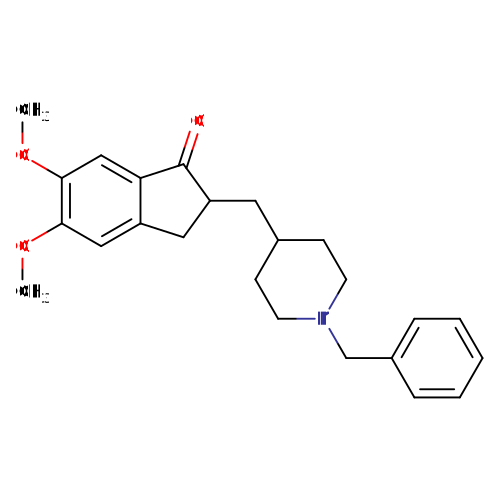
| Common Name | Donepezil |
|---|
| Description | Donepezil, marketed under the trade name Aricept (Eisai), is a centrally acting reversible acetyl cholinesterase inhibitor. Its main therapeutic use is in the treatment of Alzheimer's disease where it is used to increase cortical acetylcholine. It has an oral bioavailability of 100% and easily crosses the blood-brain barrier. Because it has a half life of about 70 hours, it can be taken once a day. Initial dose is 5 mg per day, which can be increased to 10 mg per day after an adjustment period of at least 4 weeks. Donepezil is a centrally acting reversible acetyl cholinesterase inhibitor. Its main therapeutic use is in the treatment of Alzheimer's disease where it is used to increase cortical acetylcholine. It is well absorbed in the gut with an oral bioavailability of 100% and easily crosses the blood-brain barrier. Because it has a half life of about 70 hours, it can be taken once a day. Currently, there is no definitive proof that use of donepezil or other similar agents alters the course or progression of Alzheimer's disease. However, 6-12 month controlled studies have shown modest benefits in cognition and/or behavior. Pilot studies have reported that donepezil therapy may potentially have effects on markers of disease progression, such as hippocampal volume. Therefore, many neurologists, psychiatrists, and primary care physicians use donepezil in patients with Alzheimer's disease. In 2005, the UK National Institute for Clinical Excellence (NICE) withdrew its recommendation for use of the drug for mild-to-moderate AD, on the basis that there is no significant improvement in functional outcome; Currently, there is no definitive proof that use of donepezil or other similar agents alters the course or progression of Alzheimer's disease. However, 6-12 month controlled studies have shown modest benefits in cognition and/or behavior. Pilot studies have reported that donepezil therapy may potentially have effects on markers of disease progression, such as hippocampal volume. Therefore, many neurologists, psychiatrists, and primary care physicians use donepezil in patients with Alzheimer's disease. In 2005, the UK National Institute for Clinical Excellence (NICE) withdrew its recommendation for use of the drug for mild-to-moderate AD, on the basis that there is no significant improvement in functional outcome; of quality of life or of behavioral symptoms. However, NICE revised its guidelines to suggest that donepezil be used in moderate stage patients for whom the evidence is strongest. While the drug is currently indicated for mild to moderate Alzheimer's, there is also evidence from 2 trials that it may be effective for moderate to severe disease. An example of this is a Karolinska Institute paper published in The Lancet in early 2006, which states that donepezil improves cognitive function even in patients with severe Alzheimer's disease symptoms. of quality of life or of behavioral symptoms. However, NICE revised its guidelines to suggest that donepezil be used in moderate stage patients for whom the evidence is strongest. While the drug is currently indicated for mild to moderate Alzheimer's, there is also evidence from 2 trials that it may be effective for moderate to severe disease. An example of this is a Karolinska Institute paper published in The Lancet in early 2006, which states that donepezil improves cognitive function even in patients with severe Alzheimer's disease symptoms. |
|---|
| Structure | COC1=C(OC)C=C2C(=O)C(CC3CCN(CC4=CC=CC=C4)CC3)CC2=C1 InChI=1S/C24H29NO3/c1-27-22-14-19-13-20(24(26)21(19)15-23(22)28-2)12-17-8-10-25(11-9-17)16-18-6-4-3-5-7-18/h3-7,14-15,17,20H,8-13,16H2,1-2H3 |
|---|
| Synonyms | | Value | Source |
|---|
| Donepezilo | ChEBI | | Donepezilum | ChEBI | | Donaz | Kegg | | Aricept | HMDB, MeSH | | Aricept odt | HMDB | | Donepezil hydrochloride | HMDB, MeSH | | 1-Benzyl-4-((5,6-dimethoxy-1-indanon)-2-yl)methylpiperidine hydrochloride | MeSH, HMDB | | Donepezilium oxalate trihydrate | MeSH, HMDB | | Eranz | MeSH, HMDB |
|
|---|
| Chemical Formula | C24H29NO3 |
|---|
| Average Molecular Weight | 379.492 |
|---|
| Monoisotopic Molecular Weight | 379.214743799 |
|---|
| IUPAC Name | 2-[(1-benzylpiperidin-4-yl)methyl]-5,6-dimethoxy-2,3-dihydro-1H-inden-1-one |
|---|
| Traditional Name | donepezil |
|---|
| CAS Registry Number | 120014-06-4 |
|---|
| SMILES | COC1=C(OC)C=C2C(=O)C(CC3CCN(CC4=CC=CC=C4)CC3)CC2=C1 |
|---|
| InChI Identifier | InChI=1S/C24H29NO3/c1-27-22-14-19-13-20(24(26)21(19)15-23(22)28-2)12-17-8-10-25(11-9-17)16-18-6-4-3-5-7-18/h3-7,14-15,17,20H,8-13,16H2,1-2H3 |
|---|
| InChI Key | ADEBPBSSDYVVLD-UHFFFAOYSA-N |
|---|
| Chemical Taxonomy |
|---|
| Description | Belongs to the class of organic compounds known as n-benzylpiperidines. These are heterocyclic Compounds containing a piperidine ring conjugated to a benzyl group through one nitrogen ring atom. |
|---|
| Kingdom | Organic compounds |
|---|
| Super Class | Organoheterocyclic compounds |
|---|
| Class | Piperidines |
|---|
| Sub Class | Benzylpiperidines |
|---|
| Direct Parent | N-benzylpiperidines |
|---|
| Alternative Parents | |
|---|
| Substituents | - N-benzylpiperidine
- Indanone
- Indane
- Aryl alkyl ketone
- Aryl ketone
- Phenylmethylamine
- Benzylamine
- Anisole
- Aralkylamine
- Alkyl aryl ether
- Benzenoid
- Monocyclic benzene moiety
- Tertiary aliphatic amine
- Tertiary amine
- Ketone
- Azacycle
- Ether
- Organic nitrogen compound
- Organic oxygen compound
- Organopnictogen compound
- Organic oxide
- Hydrocarbon derivative
- Organooxygen compound
- Organonitrogen compound
- Amine
- Aromatic heteropolycyclic compound
|
|---|
| Molecular Framework | Aromatic heteropolycyclic compounds |
|---|
| External Descriptors | |
|---|
| Ontology |
|---|
| Physiological effect | Not Available |
|---|
| Disposition | |
|---|
| Process | Not Available |
|---|
| Role | Not Available |
|---|
| Physical Properties |
|---|
| State | Solid |
|---|
| Experimental Molecular Properties | | Property | Value | Reference |
|---|
| Melting Point | Not Available | Not Available | | Boiling Point | Not Available | Not Available | | Water Solubility | Not Available | Not Available | | LogP | Not Available | Not Available |
|
|---|
| Experimental Chromatographic Properties | Experimental Collision Cross Sections| Adduct Type | Data Source | CCS Value (Å2) | Reference |
|---|
| [M+H]+ | CBM | 198.1 | 30932474 |
|
|---|
| Predicted Molecular Properties | |
|---|
| Predicted Chromatographic Properties | Predicted Collision Cross SectionsPredicted Retention Times Underivatized| Chromatographic Method | Retention Time | Reference |
|---|
| Measured using a Waters Acquity ultraperformance liquid chromatography (UPLC) ethylene-bridged hybrid (BEH) C18 column (100 mm × 2.1 mm; 1.7 μmparticle diameter). Predicted by Afia on May 17, 2022. Predicted by Afia on May 17, 2022. | 6.19 minutes | 32390414 | | Predicted by Siyang on May 30, 2022 | 11.1875 minutes | 33406817 | | Predicted by Siyang using ReTip algorithm on June 8, 2022 | 2.01 minutes | 32390414 | | AjsUoB = Accucore 150 Amide HILIC with 10mM Ammonium Formate, 0.1% Formic Acid | 42.2 seconds | 40023050 |
Predicted Kovats Retention IndicesUnderivatized |
|---|
| GC-MS Spectra| Spectrum Type | Description | Splash Key | Deposition Date | Source | View |
|---|
| Predicted GC-MS | Predicted GC-MS Spectrum - Donepezil GC-MS (Non-derivatized) - 70eV, Positive | splash10-0fdo-6948000000-6c7dc19cab1af35fbb59 | 2017-09-01 | Wishart Lab | View Spectrum | | Predicted GC-MS | Predicted GC-MS Spectrum - Donepezil GC-MS (Non-derivatized) - 70eV, Positive | Not Available | 2021-10-12 | Wishart Lab | View Spectrum | | Predicted GC-MS | Predicted GC-MS Spectrum - Donepezil GC-MS (Non-derivatized) - 70eV, Positive | Not Available | 2021-10-12 | Wishart Lab | View Spectrum |
MS/MS Spectra| Spectrum Type | Description | Splash Key | Deposition Date | Source | View |
|---|
| Experimental LC-MS/MS | LC-MS/MS Spectrum - Donepezil 35V, Negative-QTOF | splash10-004i-0079000000-97441986dda64eeb2ed0 | 2021-09-20 | HMDB team, MONA | View Spectrum | | Experimental LC-MS/MS | LC-MS/MS Spectrum - Donepezil 35V, Positive-QTOF | splash10-000x-4279000000-8057308579d31f5bbb76 | 2021-09-20 | HMDB team, MONA | View Spectrum | | Predicted LC-MS/MS | Predicted LC-MS/MS Spectrum - Donepezil 10V, Positive-QTOF | splash10-001l-3109000000-7610503c88b3d172ef5d | 2016-08-03 | Wishart Lab | View Spectrum | | Predicted LC-MS/MS | Predicted LC-MS/MS Spectrum - Donepezil 20V, Positive-QTOF | splash10-0006-9322000000-f0d3e8edeecc7f261b94 | 2016-08-03 | Wishart Lab | View Spectrum | | Predicted LC-MS/MS | Predicted LC-MS/MS Spectrum - Donepezil 40V, Positive-QTOF | splash10-0006-9000000000-9934c235983cbddb269c | 2016-08-03 | Wishart Lab | View Spectrum | | Predicted LC-MS/MS | Predicted LC-MS/MS Spectrum - Donepezil 10V, Negative-QTOF | splash10-004i-0019000000-efb0e051a3400937c1e3 | 2016-08-03 | Wishart Lab | View Spectrum | | Predicted LC-MS/MS | Predicted LC-MS/MS Spectrum - Donepezil 20V, Negative-QTOF | splash10-004i-0239000000-f766ac8eda8a1a30facc | 2016-08-03 | Wishart Lab | View Spectrum | | Predicted LC-MS/MS | Predicted LC-MS/MS Spectrum - Donepezil 40V, Negative-QTOF | splash10-00ai-4693000000-8d87007bbd84d8b72159 | 2016-08-03 | Wishart Lab | View Spectrum | | Predicted LC-MS/MS | Predicted LC-MS/MS Spectrum - Donepezil 10V, Negative-QTOF | splash10-004i-0009000000-4b6aa6423da10b561e2e | 2021-09-22 | Wishart Lab | View Spectrum | | Predicted LC-MS/MS | Predicted LC-MS/MS Spectrum - Donepezil 20V, Negative-QTOF | splash10-004i-1009000000-4727eca26ceeec565366 | 2021-09-22 | Wishart Lab | View Spectrum | | Predicted LC-MS/MS | Predicted LC-MS/MS Spectrum - Donepezil 40V, Negative-QTOF | splash10-01di-0059000000-3fb1cd564ce0fcc93f62 | 2021-09-22 | Wishart Lab | View Spectrum | | Predicted LC-MS/MS | Predicted LC-MS/MS Spectrum - Donepezil 10V, Positive-QTOF | splash10-001i-0009000000-bcd66f7c41688cf26726 | 2021-09-23 | Wishart Lab | View Spectrum | | Predicted LC-MS/MS | Predicted LC-MS/MS Spectrum - Donepezil 20V, Positive-QTOF | splash10-001i-1009000000-7b9769e47f72dc71726a | 2021-09-23 | Wishart Lab | View Spectrum | | Predicted LC-MS/MS | Predicted LC-MS/MS Spectrum - Donepezil 40V, Positive-QTOF | splash10-0006-9123000000-bace768387e44aecb5ba | 2021-09-23 | Wishart Lab | View Spectrum |
|
|---|
| Synthesis Reference | Sugimoto, Hachiro; Tsuchiya, Yutaka; Higurashi, Kunizou; Karibe, Norio; Iimura, Yuoichi; Sasaki, Atsushi; Yamanashi, Yoshiharu; Ogura, Hiroo; Araki, Shin; et al. Preparation of 1-benzyl-4-(substituted alkyl)piperidines and analogs as acetylcholinesterase inhibitors. Eur. Pat. Appl. (1988), 103 pp. CODEN: EPXXDW EP 296560 A2 19881228 CAN 110:173102 AN 1989:173102 |
|---|
| General References | - Hayslett RL, Tizabi Y: Effects of donepezil, nicotine and haloperidol on the central serotonergic system in mice: implications for Tourette's syndrome. Pharmacol Biochem Behav. 2005 Aug;81(4):879-86. [PubMed:16045972 ]
- Wang LN, Wang W, Zhang XH, Ma L, Yin H, Li DJ: [An interventional study on amnestic mild cognitive impairment with small dose donepezil]. Zhonghua Nei Ke Za Zhi. 2004 Oct;43(10):760-3. [PubMed:15631830 ]
- Emre M: Switching cholinesterase inhibitors in patients with Alzheimer's disease. Int J Clin Pract Suppl. 2002 Jun;(127):64-72. [PubMed:12139369 ]
- Nakano S, Asada T, Matsuda H, Uno M, Takasaki M: Donepezil hydrochloride preserves regional cerebral blood flow in patients with Alzheimer's disease. J Nucl Med. 2001 Oct;42(10):1441-5. [PubMed:11585854 ]
- Wilkinson DG, Francis PT, Schwam E, Payne-Parrish J: Cholinesterase inhibitors used in the treatment of Alzheimer's disease: the relationship between pharmacological effects and clinical efficacy. Drugs Aging. 2004;21(7):453-78. [PubMed:15132713 ]
|
|---|